Winter Travel

Middle East Adventure

Oman’s Natural Beauty

An antidote

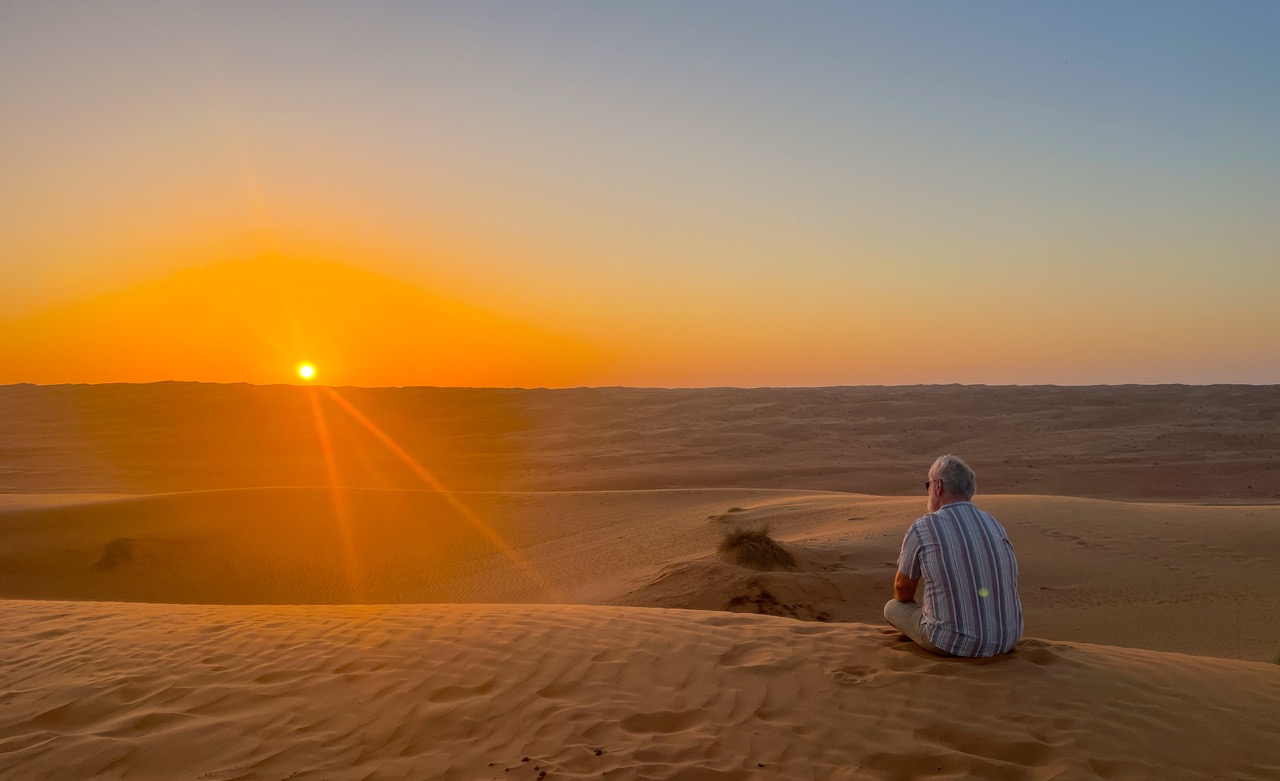
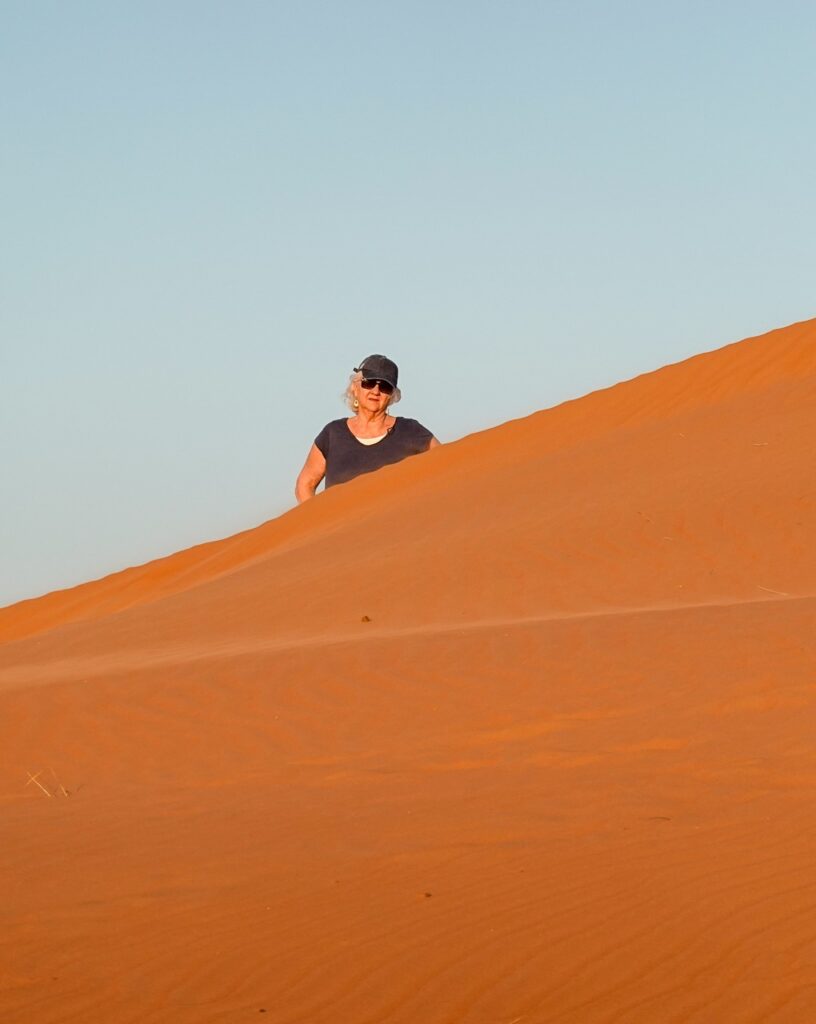
A gentle breeze softly stirred the fine, dry sand and swirled it across the slight ridge of the dune where I sat soaking up the last of the day. The colors around me were gradually warming and the silence seemed to deepen as the sun continued its inexorable, slow descent toward the endless sea of desert stretched out before me. Here was a moment to be fully present, engaged with the beauty of nature. Here is why I had come to the Arabian Peninsula.

It’s hard to put into words the depths of our grieving in the weeks leading up to this moment. Like many of you, Bonnie and I have watched the beginning of a systematic and deliberate destruction of all that we have cherished and believed to be right about our country. It is utterly heartbreaking. The stress, anxiety, and uncertainty about our own future nearly led us to abandon this trip. Thankfully, we did not.

The natural world extends us an invitation: be fully present – savor my beauty – feel your place in the vastness – find perspective – soothe your despair. Oman gave us a chance to accept this invitation. It is a land of stunningly diverse landscapes that seem to speak of origins and eternity. Our immersion was far too brief.
The planning for this visit began with a mandate to find a warm escape from winters’ frost. This is an annual event in our household but took on added urgency this year with the approach of one of those round number birthdays. Oman sprang to mind – warm, unknown, exotic maybe. Bonnie had never been to the Middle East, and it had been more than forty years for me. It was an impulsive . .  sure, why not . . kind of decision. Once again, as has so often happened in our travels, the experience was richer and more compelling than anticipated. We are learning to be open to new experiences and embrace the surprises that come along as we travel. This trip certainly included a few:

  • The emotional impact of watching a 300-pound greenback turtle trudge through the sand, laboring to dig an enormous hole to bury her precious cargo of fertile eggs.
  • The cleanliness of a desert landscape almost entire made up of sand.
  • Spectacularly jagged mountains and great yawning canyons with a geological character unique on the planet.
  • The crystalline, aqua waters of the Arabian Sea, teaming with life in quantities I haven’t seen since the good-ol’-days in Baja.
  • Our own preconceptions and prejudices needing a major update.
Long Before Us . . . there were Turtles

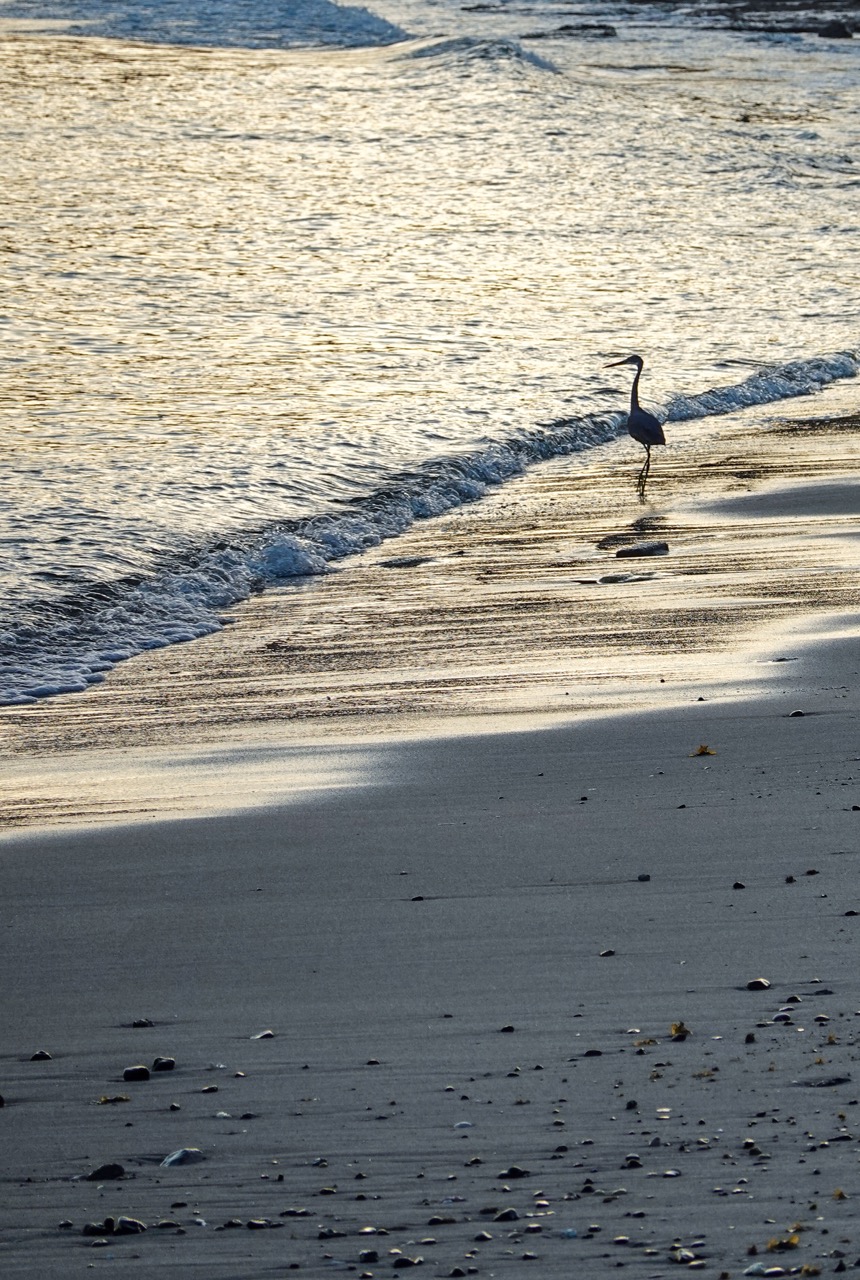
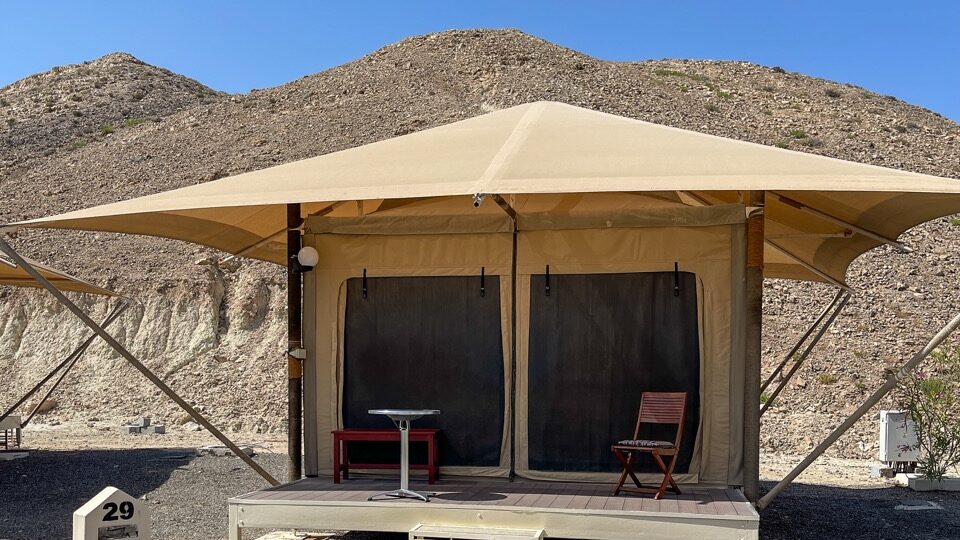
After unpacking and settling into one of the twelve “Eco-Tents” at Ras al-Jinz Turtle Reserve, we eagerly awaited the 8:30 PM gathering time for the short trek to the beach in the hopes of seeing sea turtles lay their eggs. Oman is home to some of the most important turtle nesting grounds in the world and Ras al-Jinz is famous for its endangered green turtles. The turtles return, after 20 to 30 years of growth, to the very beach where they were hatched. It was not peak season, and we heard that the previous night did not produce any turtles. Sea turtles come ashore under the cover of darkness and typically avoid the beach at full moon and, yep, the moon was nearly full that night.
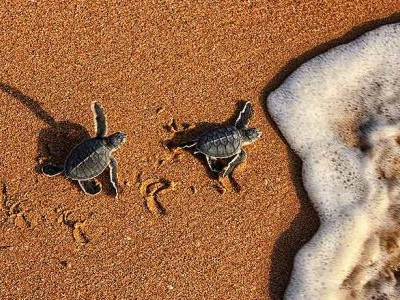
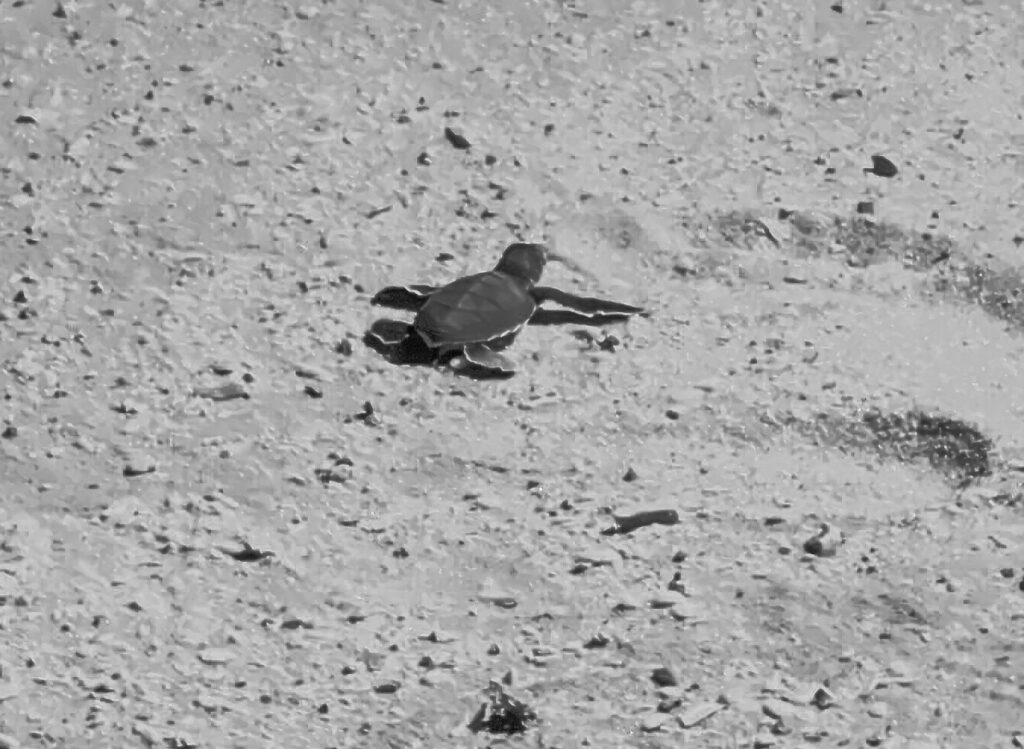
We gathered with other hopeful souls at the designated time, only to be told to wait. The staff was combing the 4-kilometer beach but could not report good news yet. Finally, at about 10PM we were hurried into a van which deposited us on the protected beach. The sea sparkled under a bright moon that led us a hundred yards up the beach where we were stunned to encounter a hatchling just a few hours old. We had hoped to see a mother attempting to lay eggs, but a hatchling was completely unexpected! At about 2 inches long, she struggled over the sand, straining with the all-consuming need to reach the ocean. As we stood in awestruck silence, I became aware of the tears streaming down Bonnie’s face and gently wrapped my arms around her while we shared this miracle of nature.
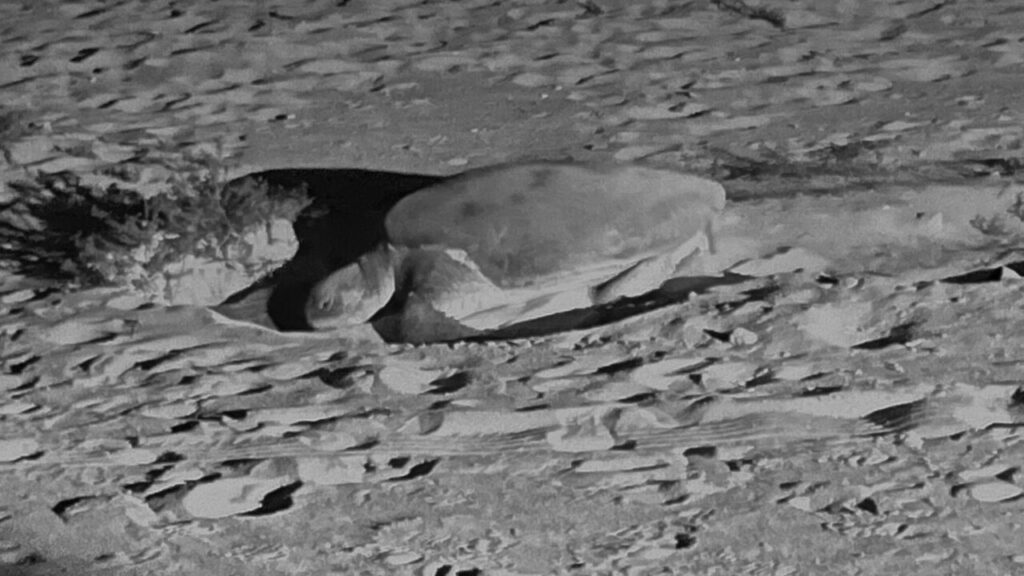
We silently left that drama to make our way in the moonlight further along the shore to where a guide had located an adult mother (no relation to the hatchling) attempting to find an appropriate spot to lay her eggs. She was digging. And digging. Front flippers flinging sand in great heaves that required her to rest occasionally before continuing. She started fresh at five different locations while we watched, struggling to find just the right sand – not too dry, not too wet, but damp enough to have some structure – where she could deposit her fertilized eggs in safety. No success. Later that night, she would return to the ocean and rest a bit before trying again the next night.

Oceans of Sand

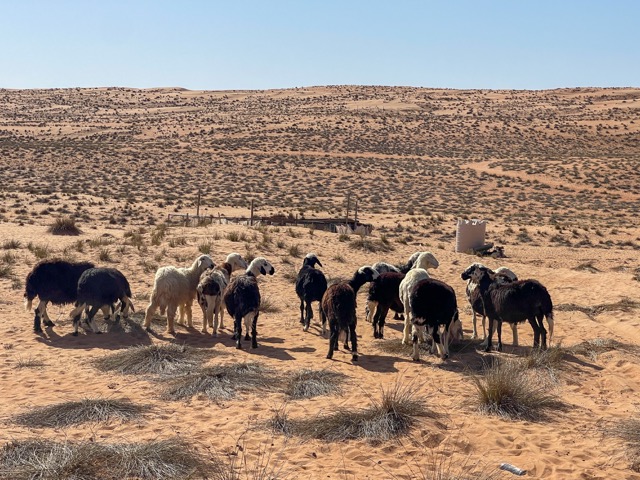
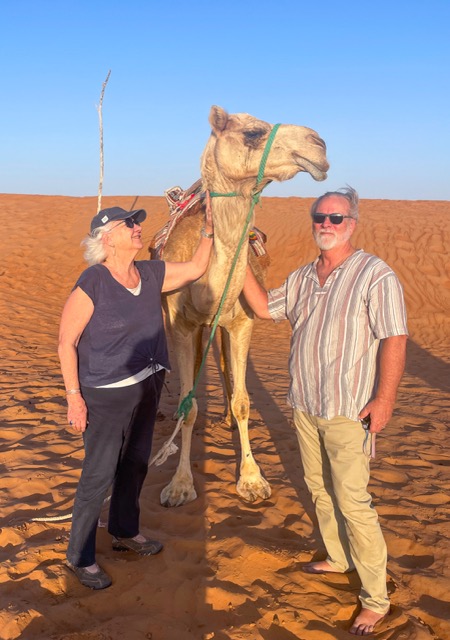
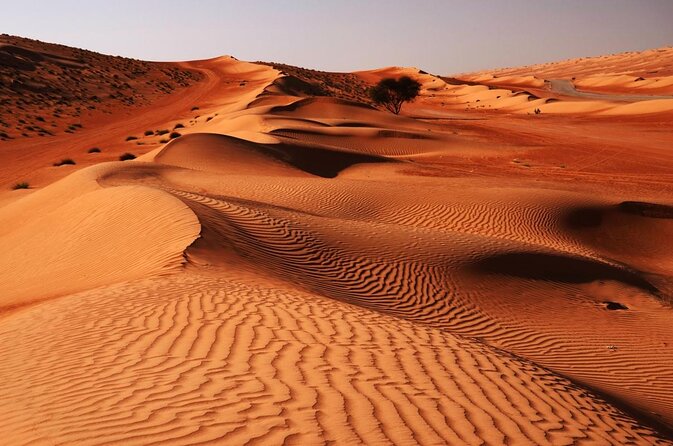
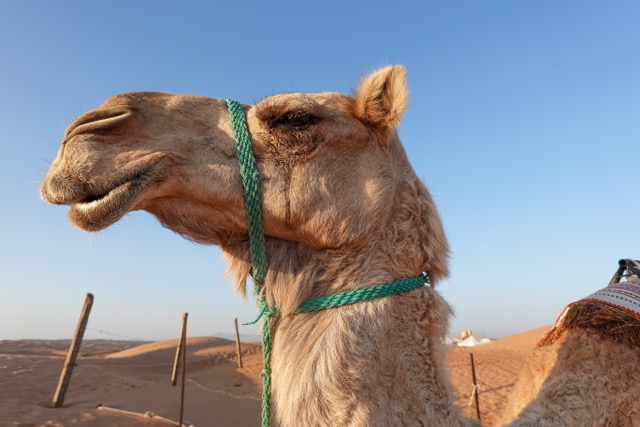
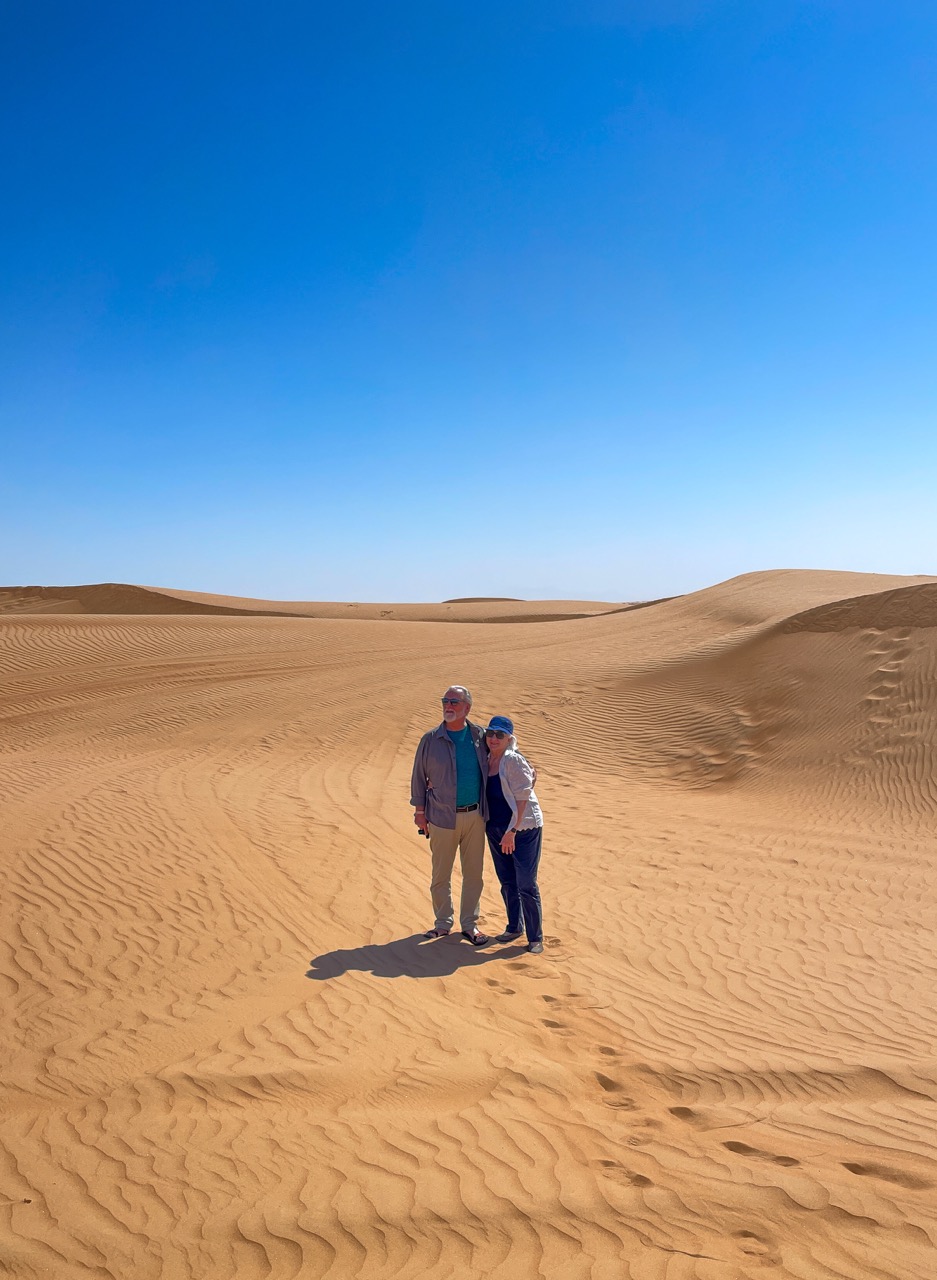
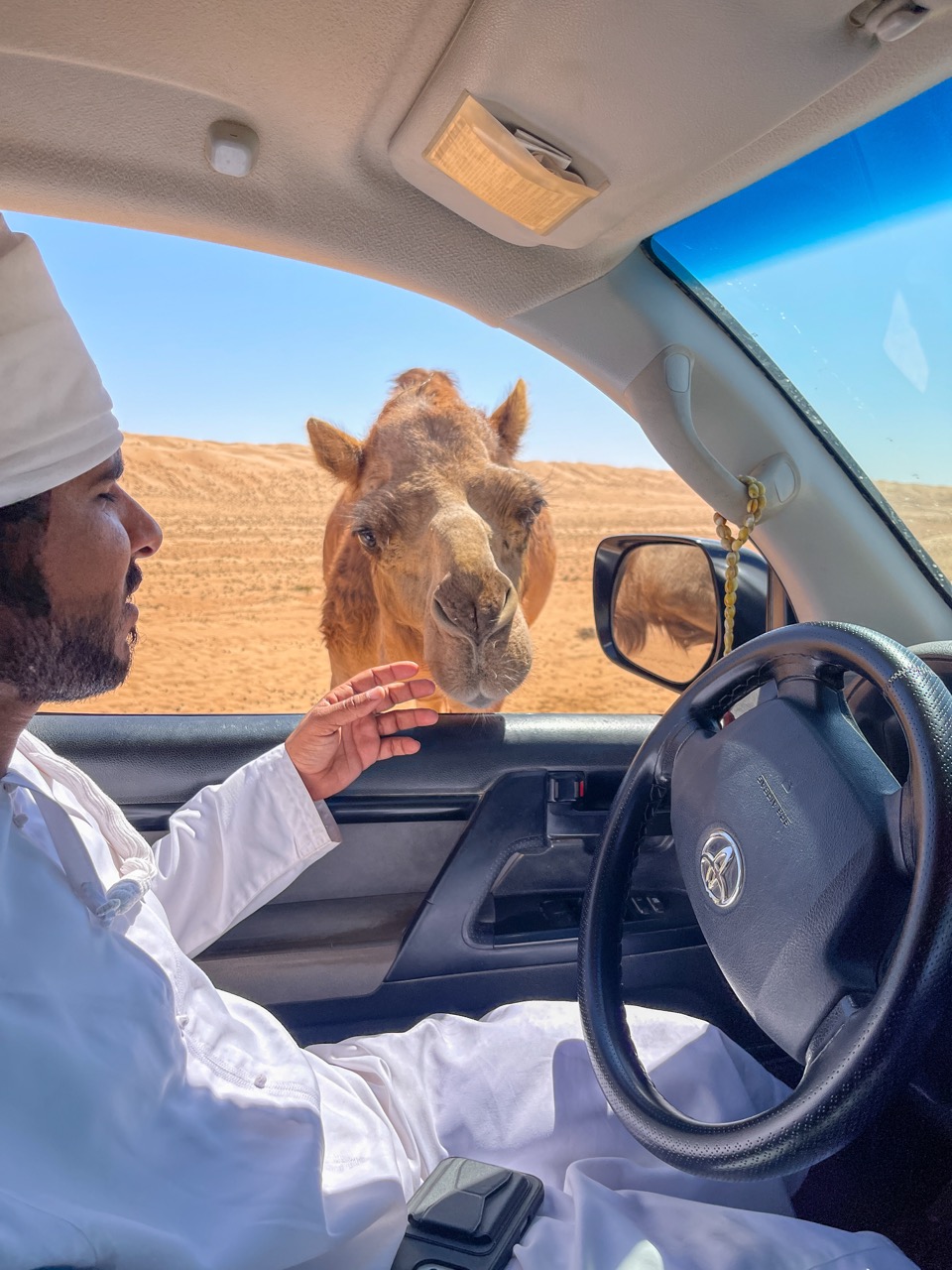
Leaving the Ras Al Jinz, we headed to the desert – specifically, to the Wahiba (Sharqiya) Sands – an area of Oman renowned for spectacular sand dunes. We were immediately captivated by the stillness of this arid land. There’s a mystical charm in the pristine beauty of this landscape. While it seems barren at first glance, this desert is home to a surprising variety of flora and fauna, and we were treated to up close encounters with camels, goats and Arabian gazelles. 
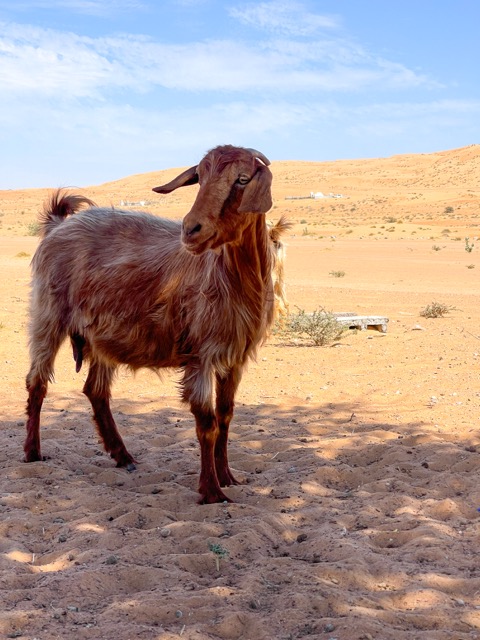
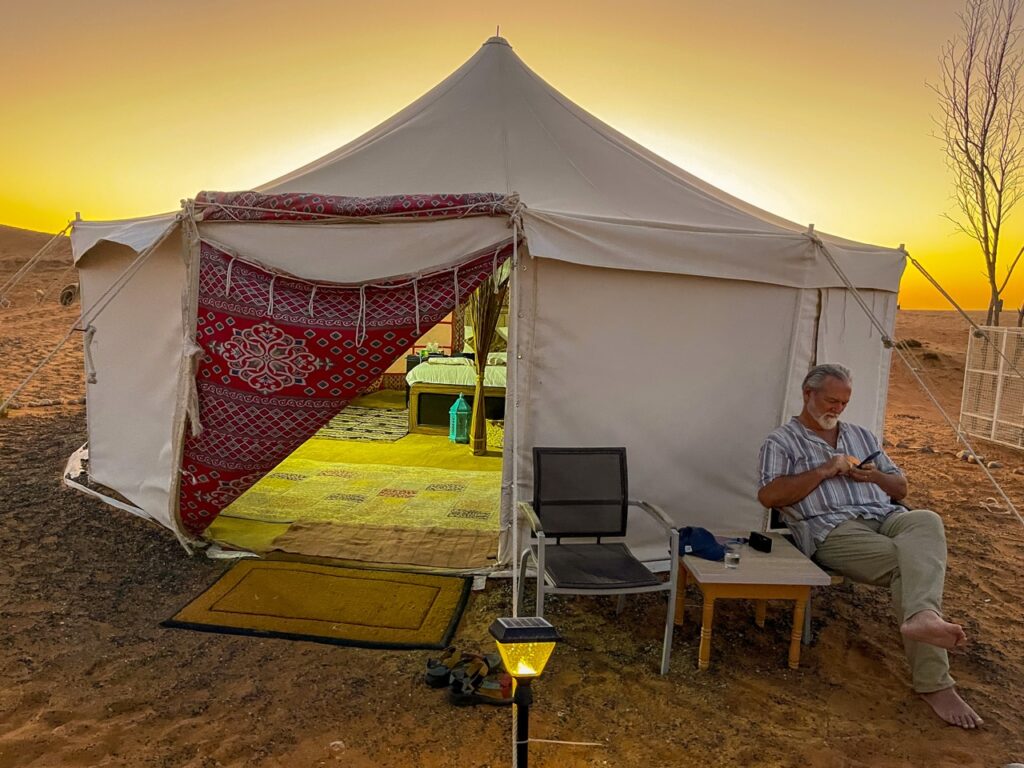
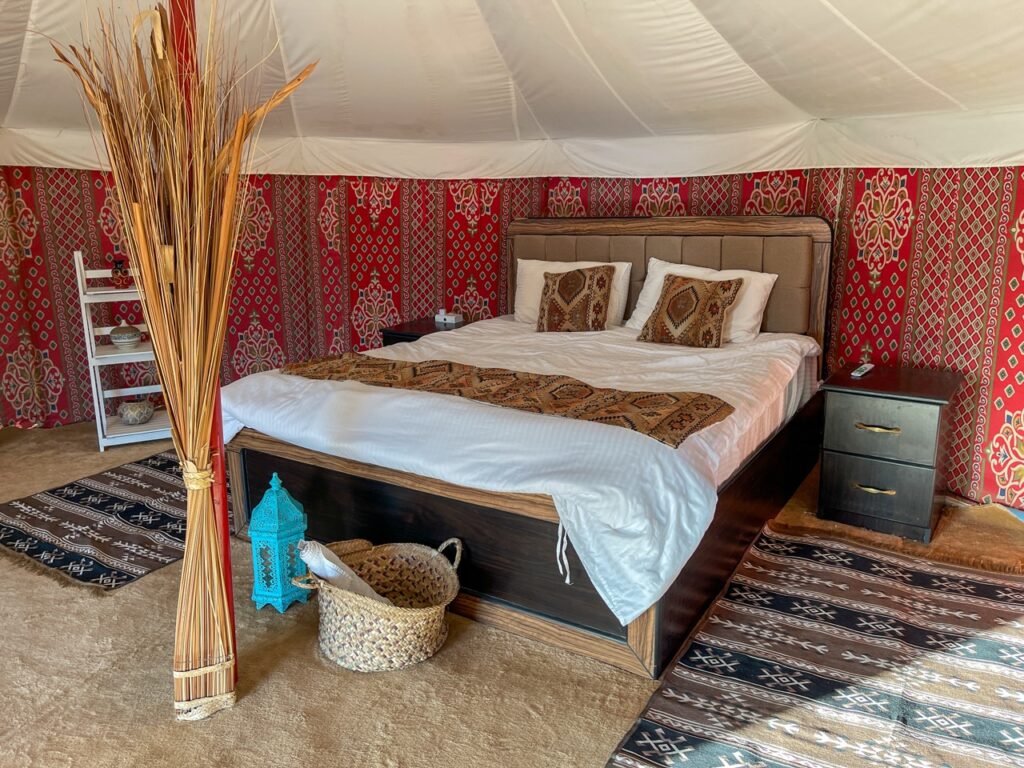
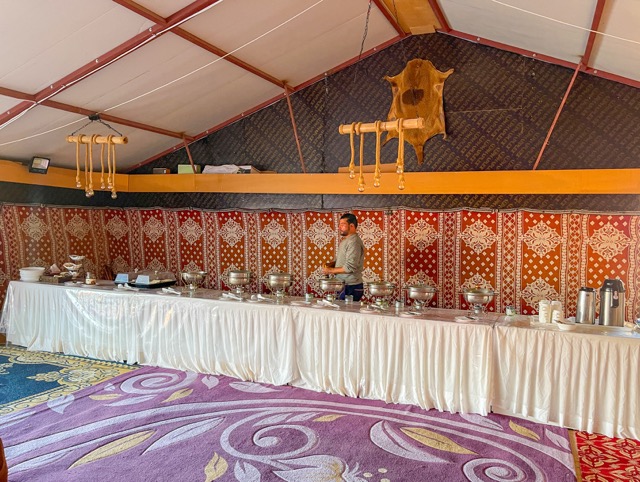
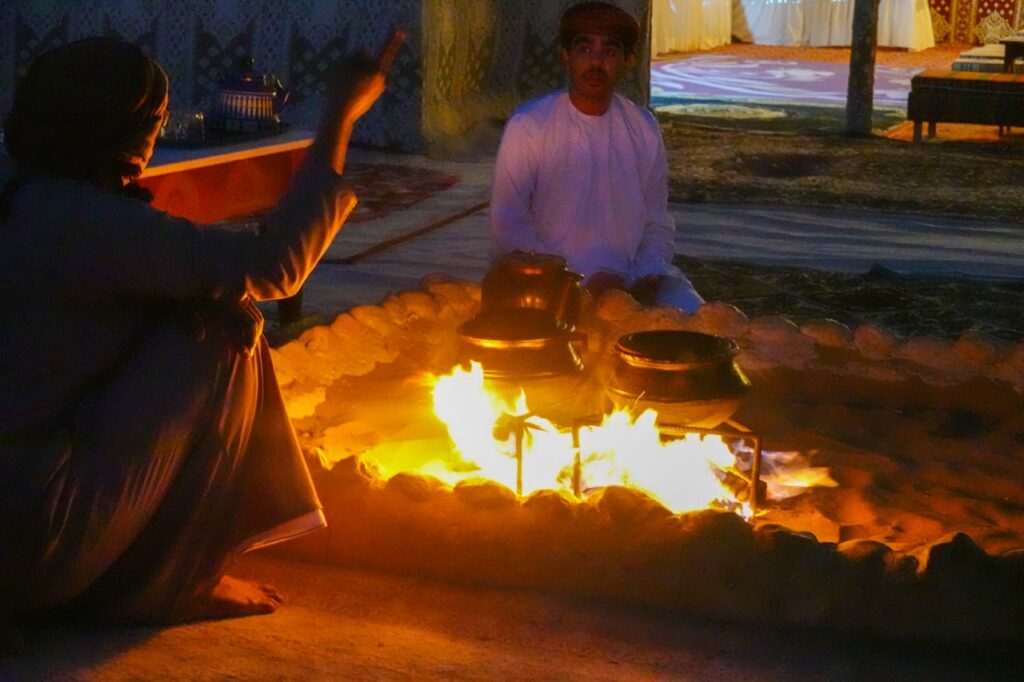
Pale gold at noon, the towering piles of sand shift between rich yellow and coppery orange when the sun is at lower angles. Experiencing the primal power of the desert from the comfort of a luxurious tent was surreal. After climbing to the top of a dune to watch the sun set, we sat by an open fire and then dined on local cuisine including the traditional Omani lamb shuwa and a delicious camel meat stew.
Oceans of Life

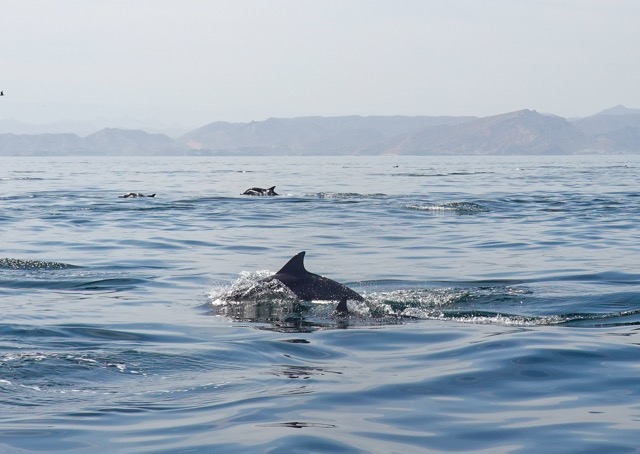
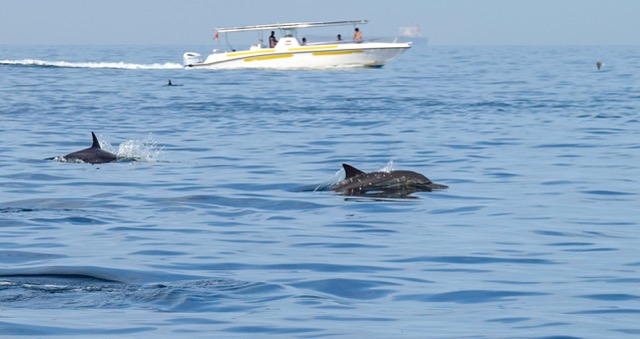
Reluctantly, we left the serenity of the desert and headed back to the hustle and bustle of Muscat where we had booked a dolphin tour from a local marina. As with turtles, there are no guarantees about dolphin sightings. While we were ferried to the marina to board a boat, we prepared ourselves to enjoy being on the water, but we boarded with expectations in check. Off we sped to a point perhaps a mile off the coast where we began to spot the Spinner and Bottlenose dolphins that are typical along the coast of Muscat. Delight, rather than disappointment, ensued as we enjoyed the dolphins feeding and cavorting in their natural habitat. Hundreds of dolphins jumped and frolicked around our boat for more than an hour. It was a wonderful and relaxing.

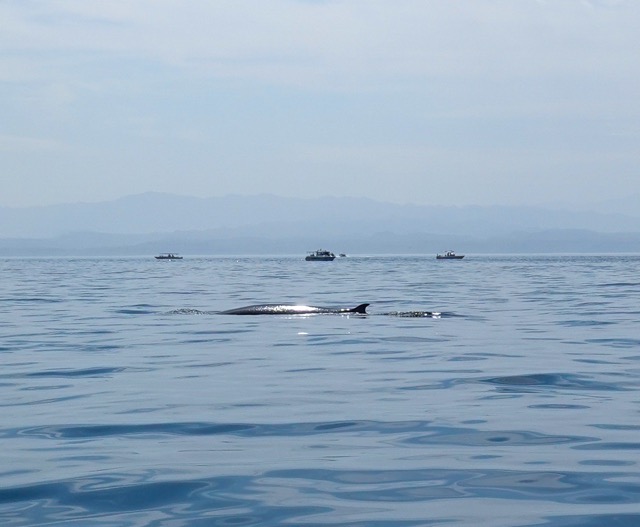
A little-known fact: Oman’s waters are home to about 25% of the world’s population of whales and dolphins. As we were cruising about watching dolphins, someone on the boat announced they had seen a whale. Then, as I was turned to my left to watch a pod of dolphins, I heard the unmistakable sound of a whale spout to my right. I turned quickly, and said, “Oh, Hello!” as the magnificent creature surfaced just a few yards from our boat.
The Boundry

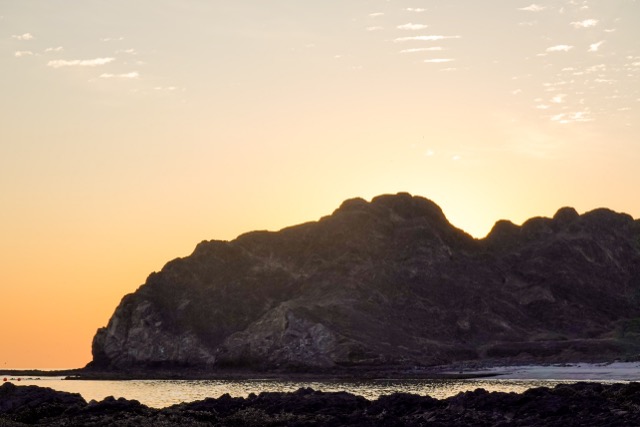
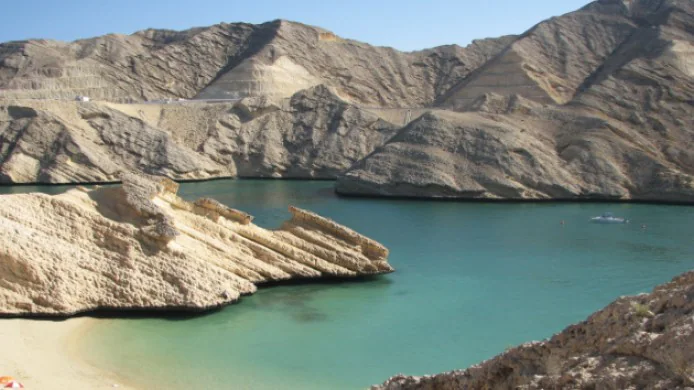
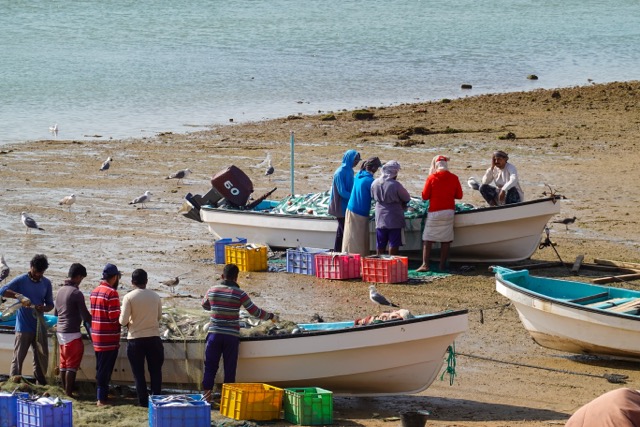
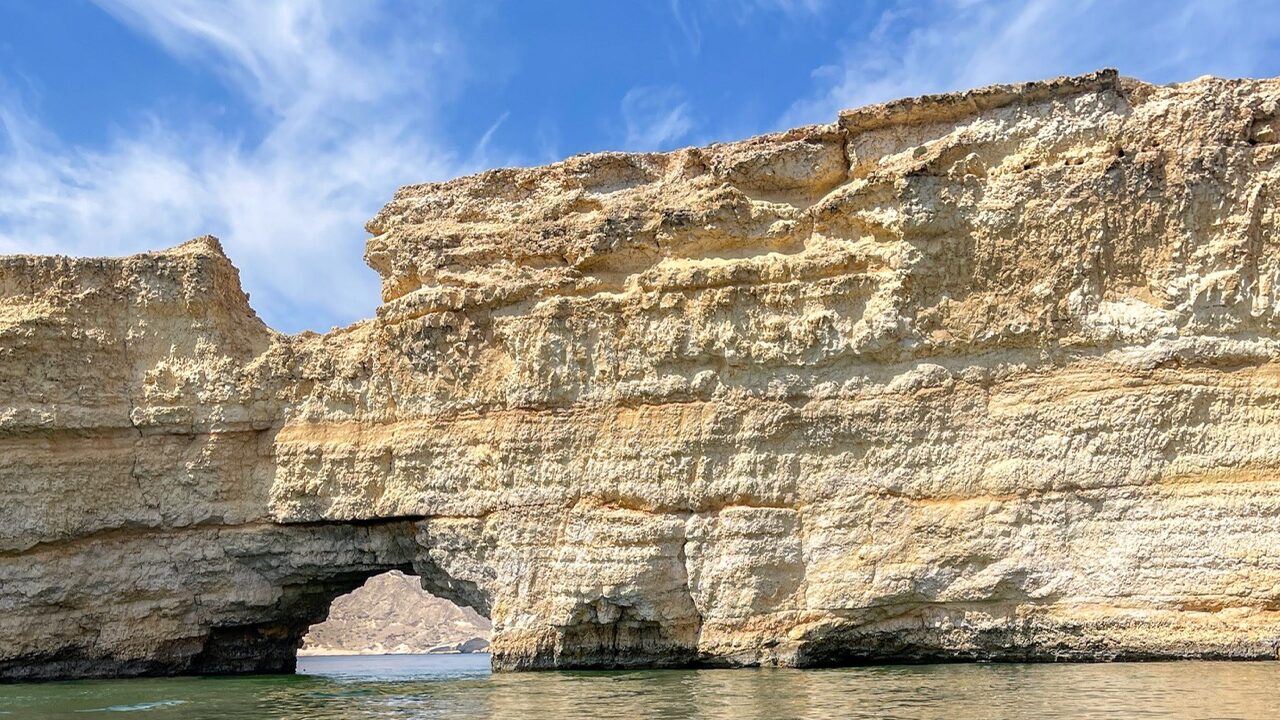
Our road trip from Muscat to the Ras al-Jinz Turtle Camp offered a spectacular view of Oman’s corniche – a road built along a coast along the face of a cliff (which we have some familiarity with having driven along the Mendocino Coast countless times). The trip back to the marina after dolphin and whale sightings provided another perspective of the amazing Omani coastline.
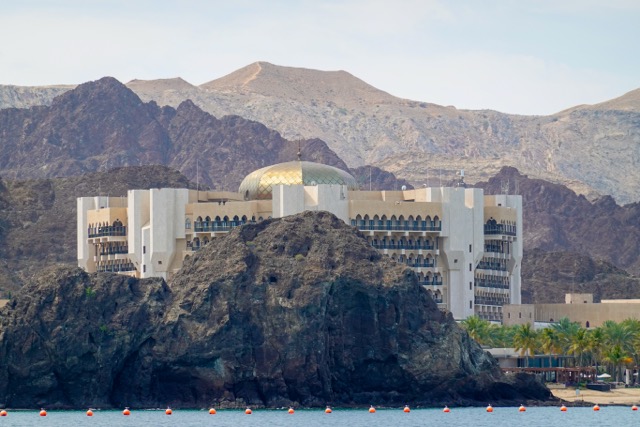
In our reading we’ve seen Oman referred to as a geologist’s paradise. Apparently, Oman is the only place in the world where we can see the “Moho” – the boundary between Earth’s crust and the mantle (an underlying layer of denser rocks in Earth’s interior). Okay, geology is not our strong suit, and this revelation left us feeling distressingly unprepared to appreciate the alien landscape we found ourselves traversing. We resolved to correct this deficiency before any new adventures, and immediately began a lecture series from the “Great Courses” on Geology 101 when we got home to Valencia. Look out. There are rocks in our future!
Awakening to Omani Culture

We began this trip with a number of well-worn preconceived notions about “the middle-east” – conservative, repressive, nouveau riche bling, etc. Forty years ago, I was involved in a major construction project in Riyadh, Saudi Arabia. It was, in fact, an extremely repressive, ultra-conservative culture just beginning to reach for the bling. Now, I will readily admit that one week in Oman as a tourist does not begin to qualify as cultural immersion. It was, however, enough exposure to recognize that it is well past time for a serious revision to our prejudices and judgements. Almost nothing we thought we knew is true.

I’m going to skip over any discussion of Doha from a cultural perspective because we were only there for two nights. And, because millions of words were written on the subject in the run-up to the 2022 World Cup by people with far more knowledge. I would caution, however, that we live in an age of “information” overload where it is very challenging to parse out the nefarious agendas and biases contained in almost every source to which we are exposed. It turns out, you just can’t believe most of what you read (or hear, or see, for that matter).

Diversity

Over the centuries, Oman’s capital, Muscat, has played a crucial role in a flourishing trade between Arabia, Africa, and Asia. Merchants from around the world passed through the city, exchanging a variety of goods, from spices and textiles to precious metals and gemstones. This rich trading history left an indelible mark on Muscat’s culture that must, in some respect, account for the enormous diversity in the country today. In just one week, we met and talked with people from Bangladesh, India, Zanzibar, Indonesia, Pakistan, the Philippines, Sri Lanka, Sudan, Switzerland, France, Denmark, Qatar, the UAE, Iran, and of course, many Omanis. Not once did we run into another American.

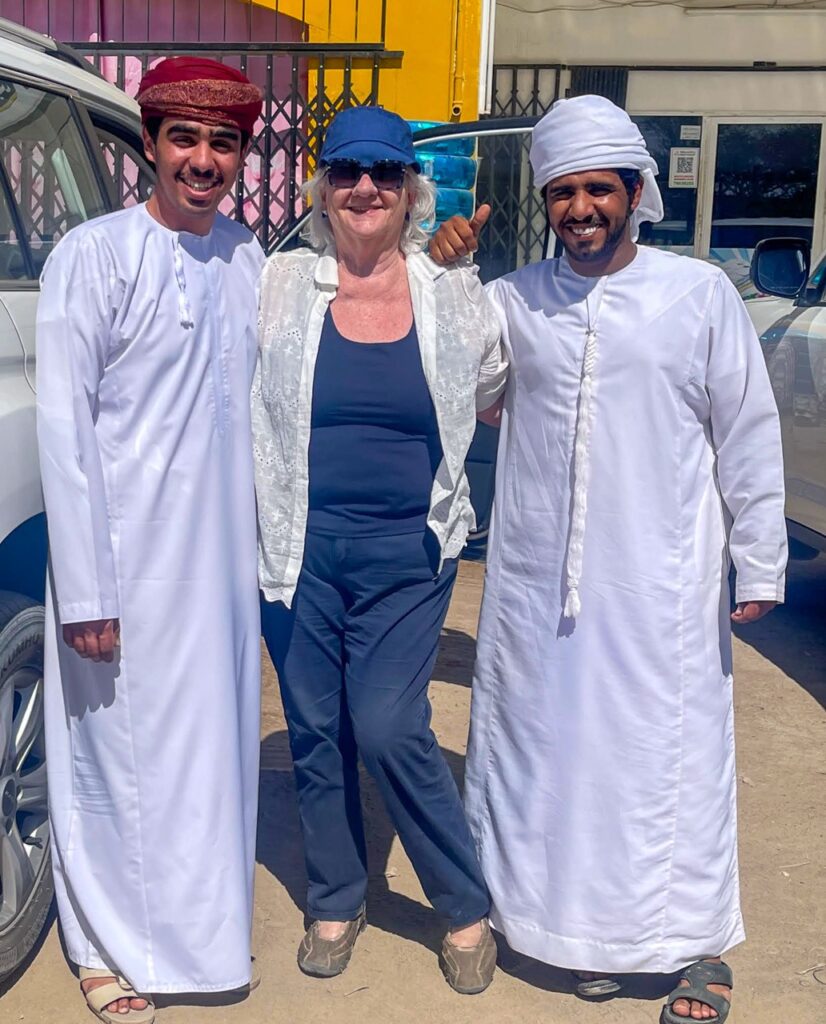
There are hundreds of thousands of Indians who have been living in Oman for centuries due, primarily, to their trading relationship throughout history. The main observable difference is that the Indian kids play cricket, while Omani kids play football – usually wearing Barcelona shirts. Many Omanis have East African ancestry: they colonized places like Zanzibar hundreds of years ago. As we traveled and interacted with this amazing array of people from various cultures, we slowly came to the realization that all of them, without exception, were happy and loved living in Oman. And friendly. Of all the places we have traveled (a list far short of our aspirations) the people of Oman are the most welcoming and friendly we have experienced, and it’s not close. They are quick to laugh or make a joke, go out of their way to assist total strangers, and overwhelm you with their hospitality. Of course, with all these diverse cultures and traditions coming together in one place there must be a lot of conflict and tension along religious and ethnic lines, right? Nope. None. This is a peace-loving culture which just might be the closest to the proverbial melting pot that we have experienced.
Unlike just about everyone else, Oman has stayed out of the geopolitical conflicts in the region. Although a member of the Gulf Cooperation Council (GCC), Oman is a neutral and non-interventionist State with regard to the war in Yemen, keeping communication channels open for different actors in the wider Middle East. Home to hundreds of refugees from Iraq, Syria and Pakistan, they have adopted a humanitarian stance, sending cash and aid to Yemen, and allowing Yemeni citizens to cross the border for care in Omani hospitals. No wonder we, like most U.S. citizens, know so little of this peaceful little nation: good news rarely makes into our data streams.

An Example of Leadership

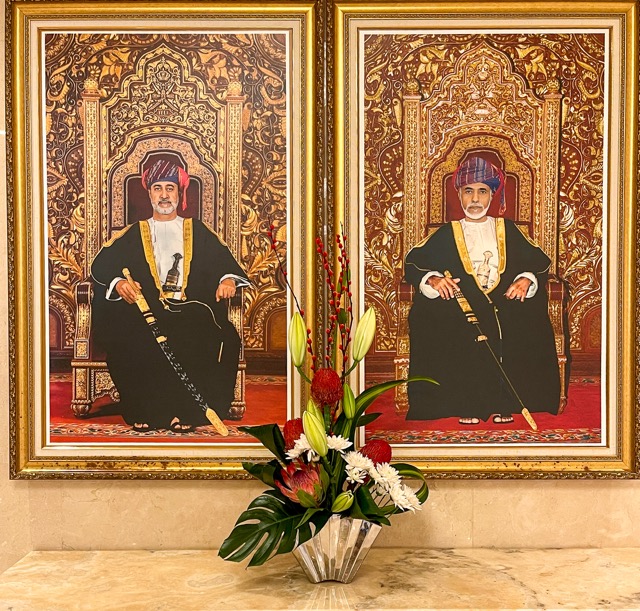
A significant amount of credit for the remarkably peaceful, safe, and joyful state-of-affairs in Oman must go to the work of His Majesty, the late Sultan Qaboos, who overthrew his father in a peaceful coup around 1970. (Daddy was sent into exile at the Ritz Hotel in London!) Until then, Oman had been impoverished and riven by tribal conflicts with only a couple of hospitals and schools in the whole country. Sultan Qaboos set about methodically improving his country, concentrating on education, health, gender equality, and the construction of civil infrastructure. He didn’t squander the wealth that came from his country’s natural resources (mainly natural gas) on grandiose schemes, nor was he a kleptocrat who looted the country’s wealth for himself, in contrast to rulers of other gulf states. Modern Oman’s society and economy resembles Denmark more than Dubai.
The Clothes We Wear

Yes, but what about the oppression of women? What about the burqa? These questions are a big issue for Bonnie and I. And, like many in the west, we see these black, head to toe garments as symbols of oppression and worse. They represent something vaguely frightening and sinister. Once again, however, maybe we need to check what we think we know.

First, let’s deal with the religious elements of this tradition. No where does the Qur’an require that women cover themselves from head to toe. In fact, this style of dress was in place long before Muhammad’s visions in the desert. Protection from the desert environment and protection from tribal raiding parties was the primary motive for this mode of dress. For the Bedouins who originated it, in other words, it was cultural. And, like many cultural artifacts and practices, it was appropriated by religion once Islam was up and running as a political power. And, as religions are run almost entirely by men, for their own benefit, they found that the imposition of requirements such as the burqa served their interest. (If you want to see Bonnie get really wound up, ask her sometime about the restrictions men impose on the Amish women in our area of Pennsylvania.) So, our initial revulsion is not without some grounding. Except, once again, its cultural, and maybe more complicated than we would like to admit.

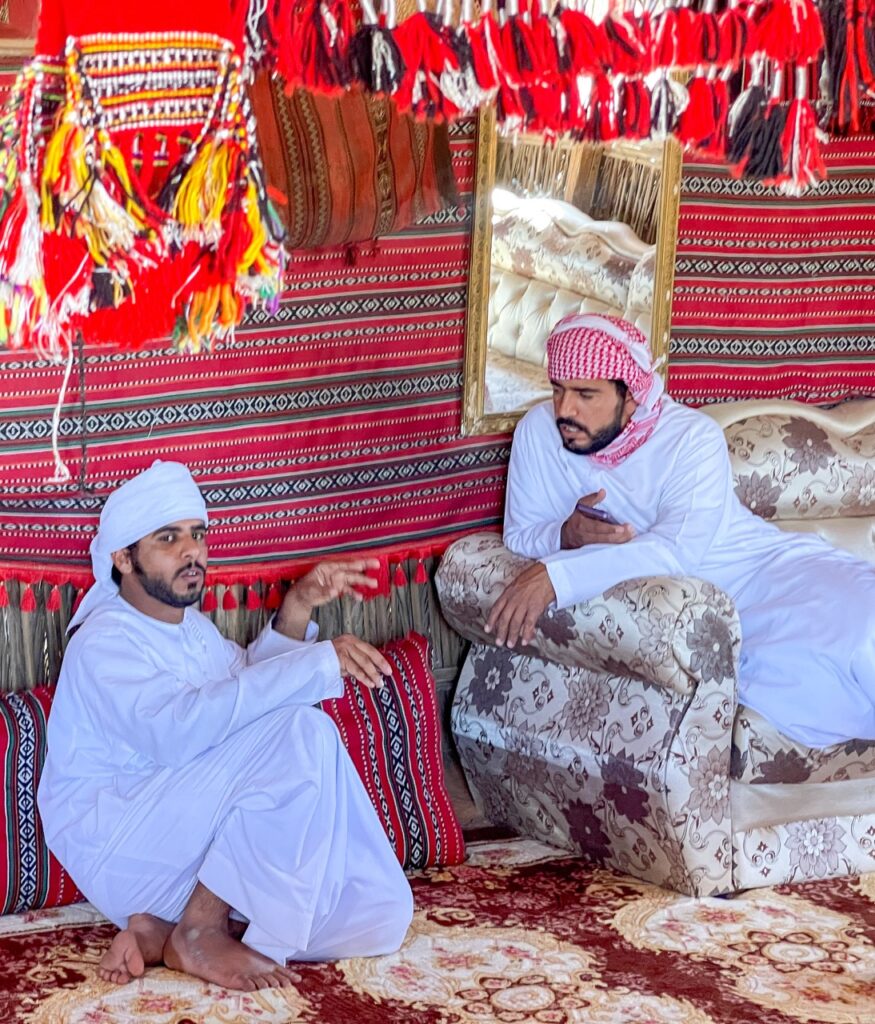
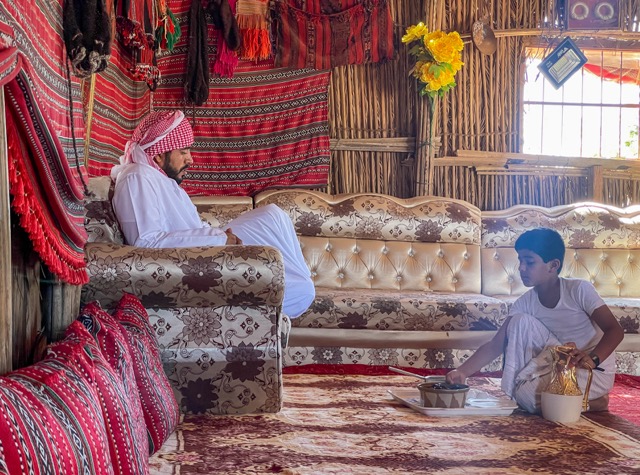
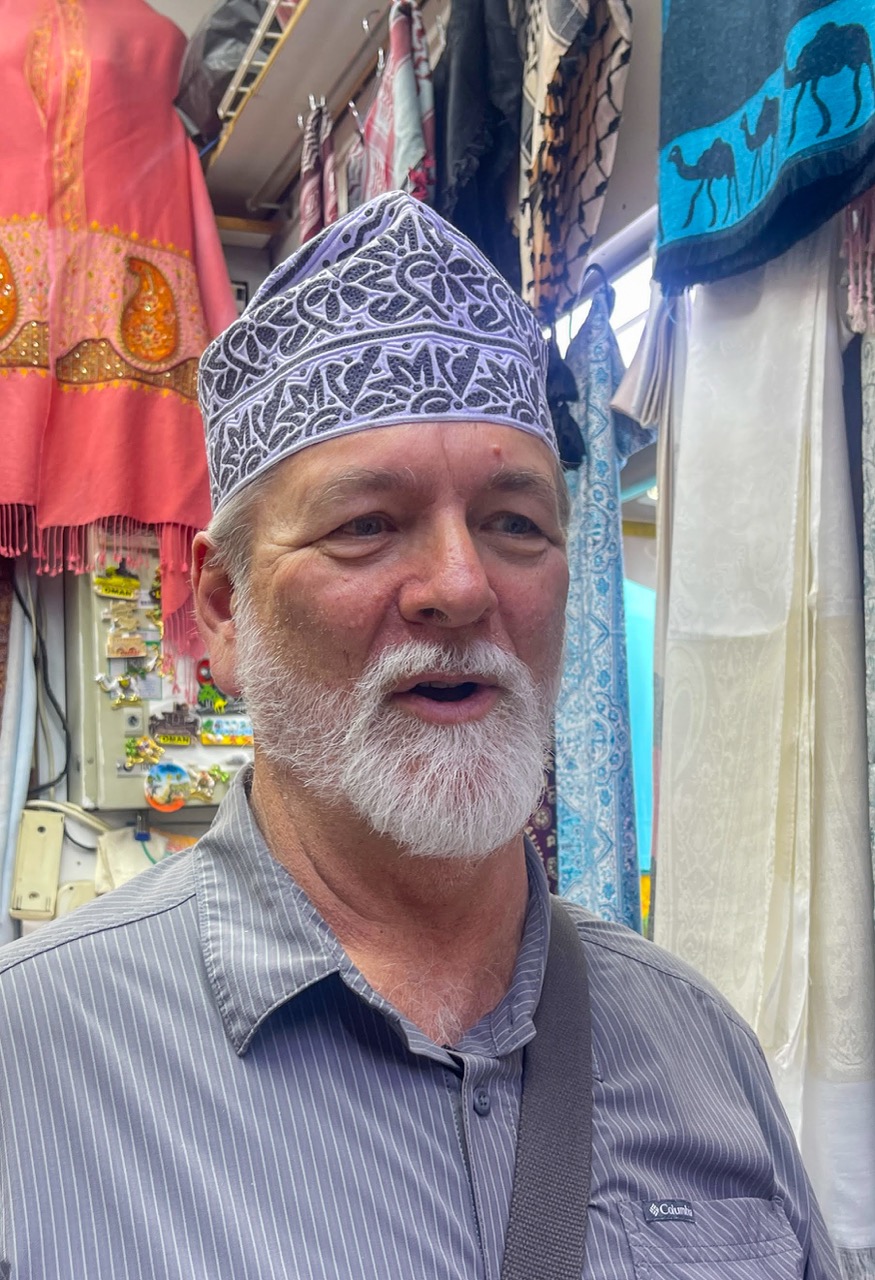
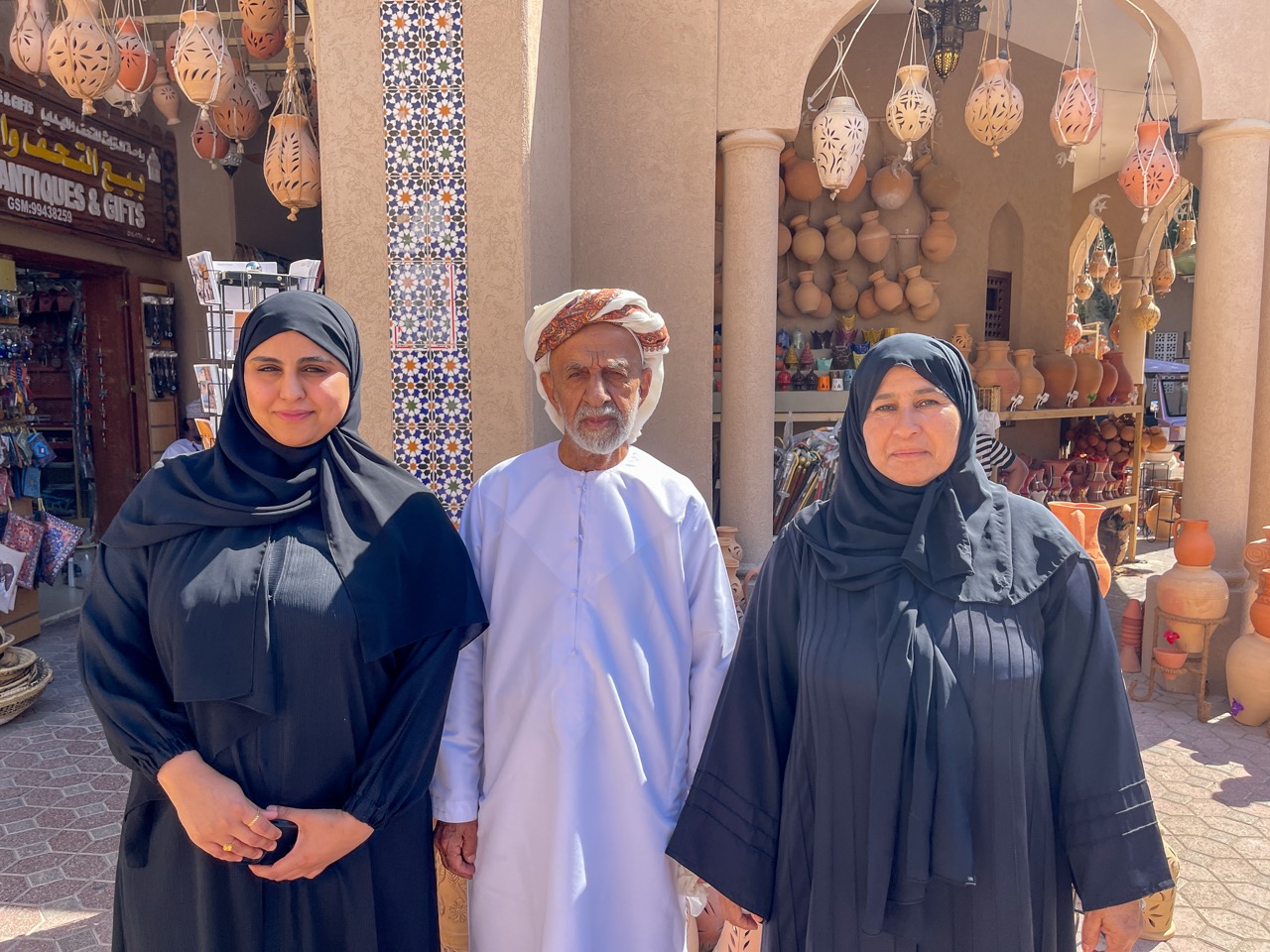
Oman is a predominantly Ibadi Muslim culture (as opposed to Shiite or Sunni) where local women wear a full-length abaya and a hijab covering their heads. It is uncommon to see women in Oman in a niqab (full face and body coverings). Afghanistan is currently the only country where the full burqa is legally required. Whenever we had the opportunity to have an extended conversation with an Omani, we brought up the subject as respectfully as possible. They challenged our assumptions. Without exception, everyone stated that their style of dress is a choice. This seemed to be especially true for the newest generation. Grandmothers almost universally wear the traditional abaya and hijab. Mothers and their daughters, however, are increasingly choosing a more European style. One thing that is almost universal in Oman is a head covering for both men and women. Men all wear a muzzar (a round, fabric cap), with or without an additional square scarf known as a keffiyeh, worn either Bedouin style, or as a turban wrap. Women wear a variety of shawls and scarves, folded and tied in creative forms, but all serving the same purpose – to cover the head – and make a fashion statement. These are the trappings of culture: dressing to fit in.
Trying to put all of this into context, I began to think about the oddities and silliness of cultural imperatives in the U.S. just in my own lifetime. There was a time when men were considered undressed without a hat. There was a time when it was scandalous for a woman to wear pants in public (something to ponder in the age of the ubiquitous yoga pant). It’s still considered a bit risqué in the U.S. for women to go braless in public (not so much in Europe). And, like the desert inspired hajib and keffiyeh, there are many examples of fashions born of practical solutions to environmental circumstances. Blue jeans, for example, which have become the universal symbol of western dress, were created as a rugged, inexpensive garment capable of holding up to the rigor of the California gold fields in the mid 19th century.

Open Minds and Hearts

To summarize: once again, travel has challenged us to open our minds and make room for the vast variety of cultures and practices that are often simple, beautiful expressions of our humanity. It is a conundrum of profound significance that in this era of instant global communication, where the opportunity for cross-cultural sharing and understanding has never been greater, we are becoming more intolerant and polarized. I think I need another evening on my sand dune.

I must share one more anecdote. Our first evening in Muscat, we were eager to see a bit of the traditional shops in the Muttrah Souqs and find a bite to eat, so we hired a taxi for the evening. Jamal proved to be gregarious, talkative, and eager to share his homeland with us. He offered a non-stop stream of opinions, suggestions, and pointers while we drove around seeing the sights. We were particularly grateful to him for guiding us to a traditional Omani restaurant, which he proclaimed made the best Shuwa (spiced lamb buried with hot coals to braise overnight). This was so good we began looking for it on every menu.

 On the way back to the hotel, with our energy and the conversation waning, Jamal wanted to play us some music. We asked for something traditional from Oman. “No, no,” he said. “What is your favorite classic?” Classic? What is he talking about? After some back and forth, he became impatient with us and said, “Ok, I’ll play my favorite.” After a moment the first bars of an instantly recognizable Eagles tune began to fill the car: welcome to the Hotel California. Jamal sang along as though greeting an intimate friend and near the end turned to declare, “this is my favorite line!” Mirrors on the ceiling, the pink champagne on ice. And she said, “We are all just prisoners here.”

Art & Architecture

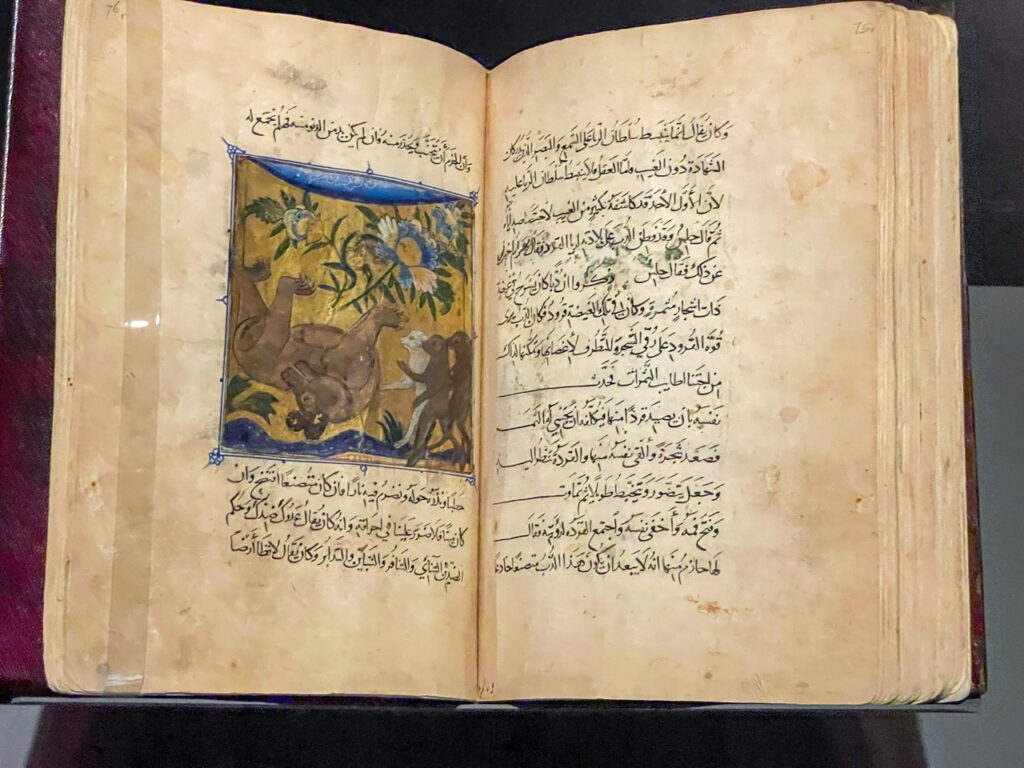
Our adventures in Oman began with a stopover in the capitol of Qatar. The descent into the Doha airport produced a bit of apprehension. One feature of the Arabian Peninsula that has not changed from my first exposure 40 years ago is the dust. As we descend, the air thickens with the stuff, dimming visibility and reminding me the of my lurking vulnerability to asthmatic symptoms in such environments. These concerns started to fall away, however, as we began to glimpse the jaw-dropping architectural creations that have bloomed in this port city. Since our time here was brief, we focused our attention on two major museums – The Museum of Islamic Art, and the Qatar National Museum. Both proved to be extraordinary and well worth prioritizing.

The Building Itself is Art

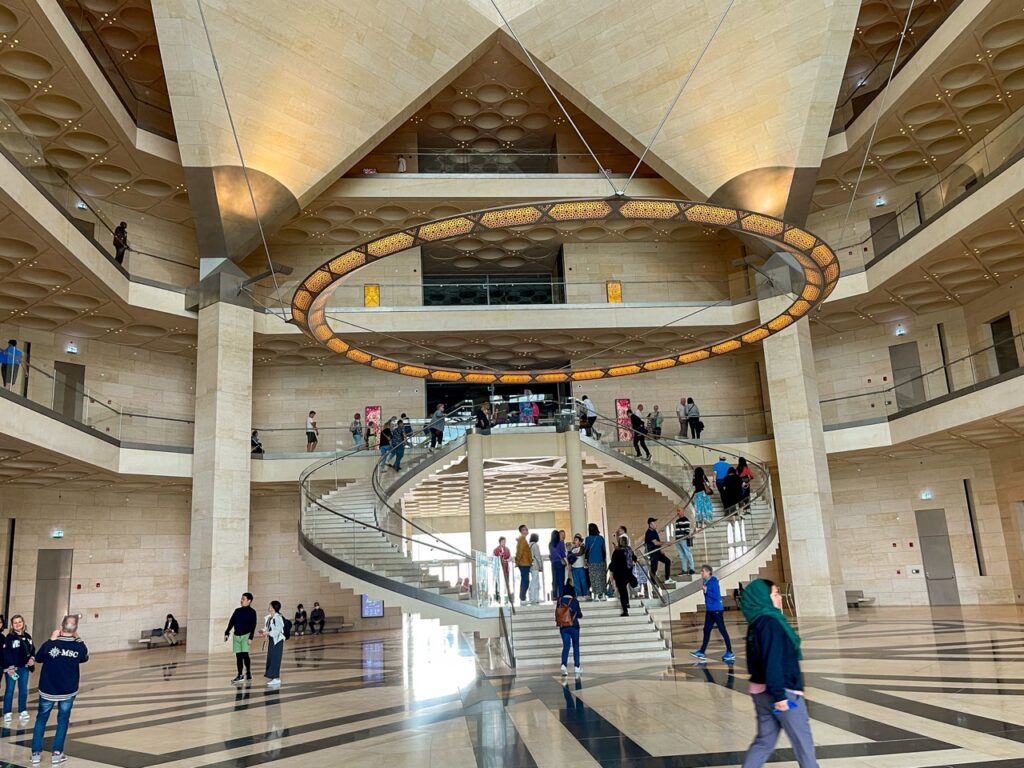
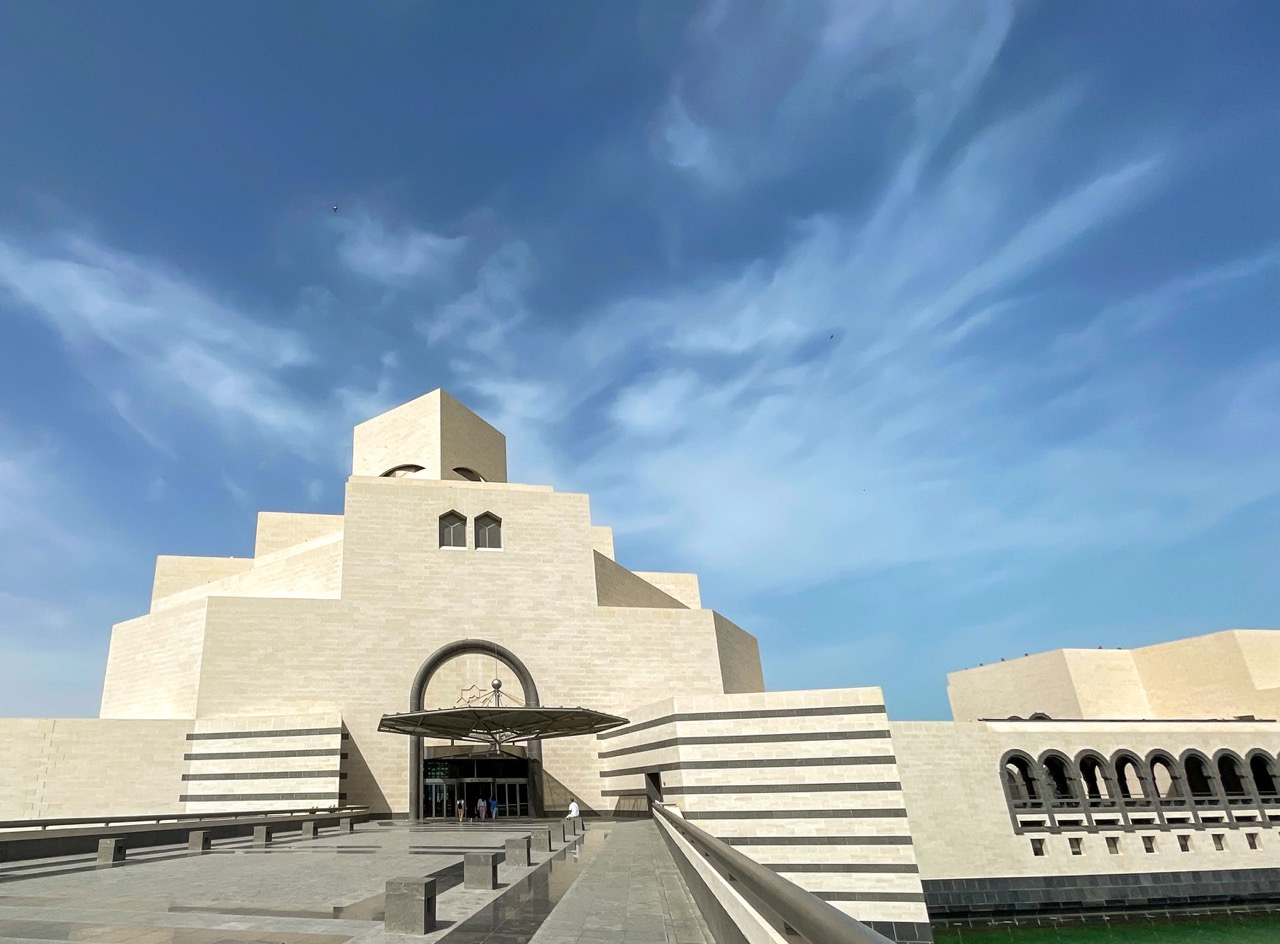
The Islamic Art Museum sits on its own little peninsula adjacent to a waterfront promenade with the bay and downtown skyline serving as a stunning backdrop. It is an I.M. Pei design, with an understated grandeur that projects a subtle, modern interpretation of traditional Arabic motifs. Pei was actually retired when the commission came up and he had to be talked into becoming involved. Once on board, however, he demanded full control and insisted on the creation of the little peninsula for the site to ensure that no future development could encroach on the building in the future.

I’m pretty familiar with Pei’s design approach (he was the design architect for the UCLA Medical Center that consumed a chunk of my career). So, it was particularly interesting to see a building where every detail was scrupulously executed to his standard without concern for cost. This, in fact, is a feature throughout Arabia where, over the past 50 years, the world’s greatest architects have been given carte blanche to produce whatever their imaginations might conjure without budget limitations. It is a unique moment in the history of design.
Intricate and Beautiful Designs

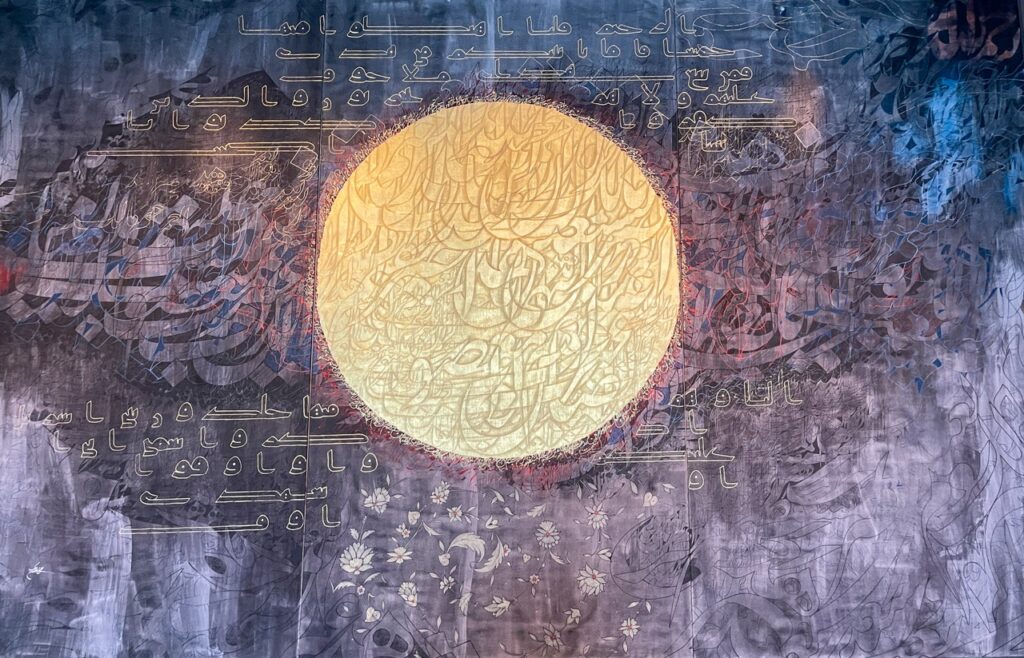
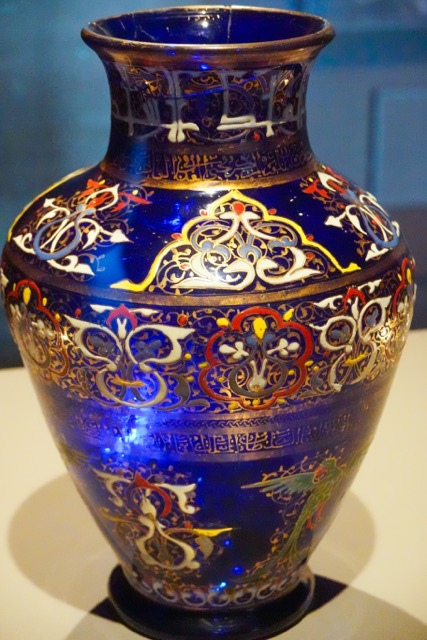
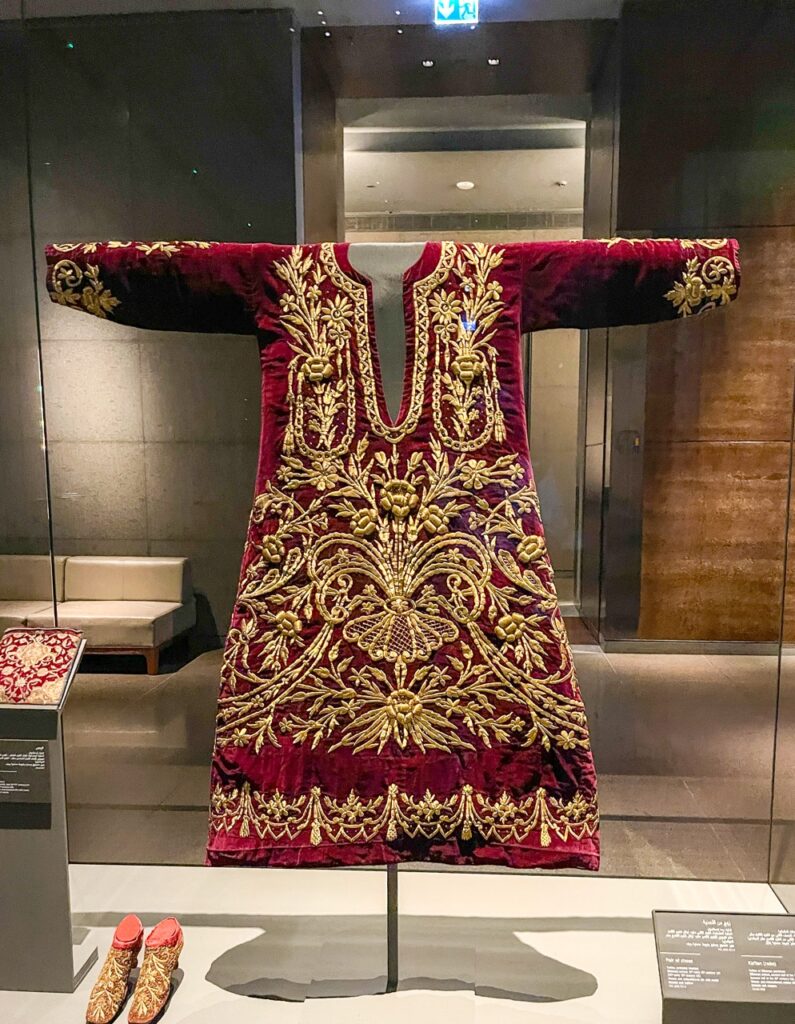
The collection held and displayed here more than lives up to the pedigree of the architecture. It is a magnificent survey of Islamic art across fourteen centuries, since the religion’s founding, from all corners of the Muslim world. There’s no filler here. Every item in the collection, exquisitely displayed with subtle lighting, represents a masterpiece of its genre.
A Building in Harmony with it’s Location

Having failed to score a reservation at the museum’s Alain Ducassse restaurant, IDMA, we made our way to the Qatar National Museum a few minutes away to dine at their Michelin recommendation, Jiwan. Another world class architect, Jean Nouvel, has produced a creation uniquely suited to its location. Unlike Pei, whose work features a consistent palette of carefully worked elements that mark his designs like a signature, Nouvel is intent on something entirely new for each project. His focus is not on any particular style. Rather, he is intent on the harmony of the building with its location. To produce that harmony in Doha, Nouvel created a building that imitates the desert rose, a unique crystalline rock formation found in the desert sands of Qatar, and other similar landscapes. To be honest, we found this building nearly impossible to photograph, so I’m going to encourage you to visit this link: https://archello.com/project/qatar-national-museum if you want to see one of the most unique buildings ever constructed. So challenging was the execution of this design that the team responsible for the 3D modeling won awards for their work.
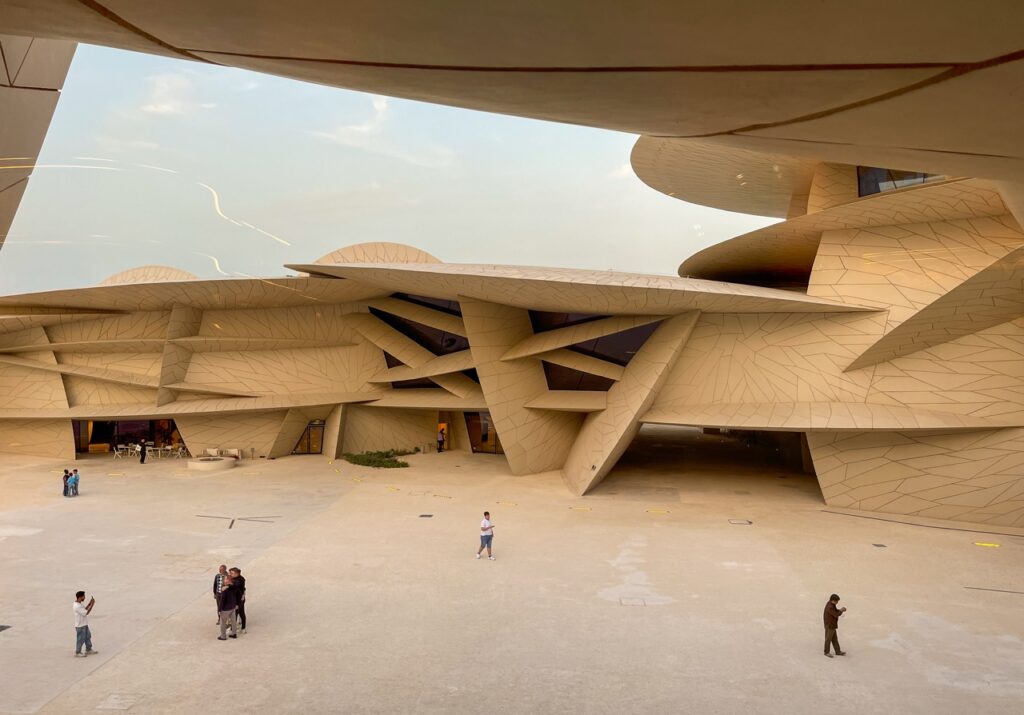
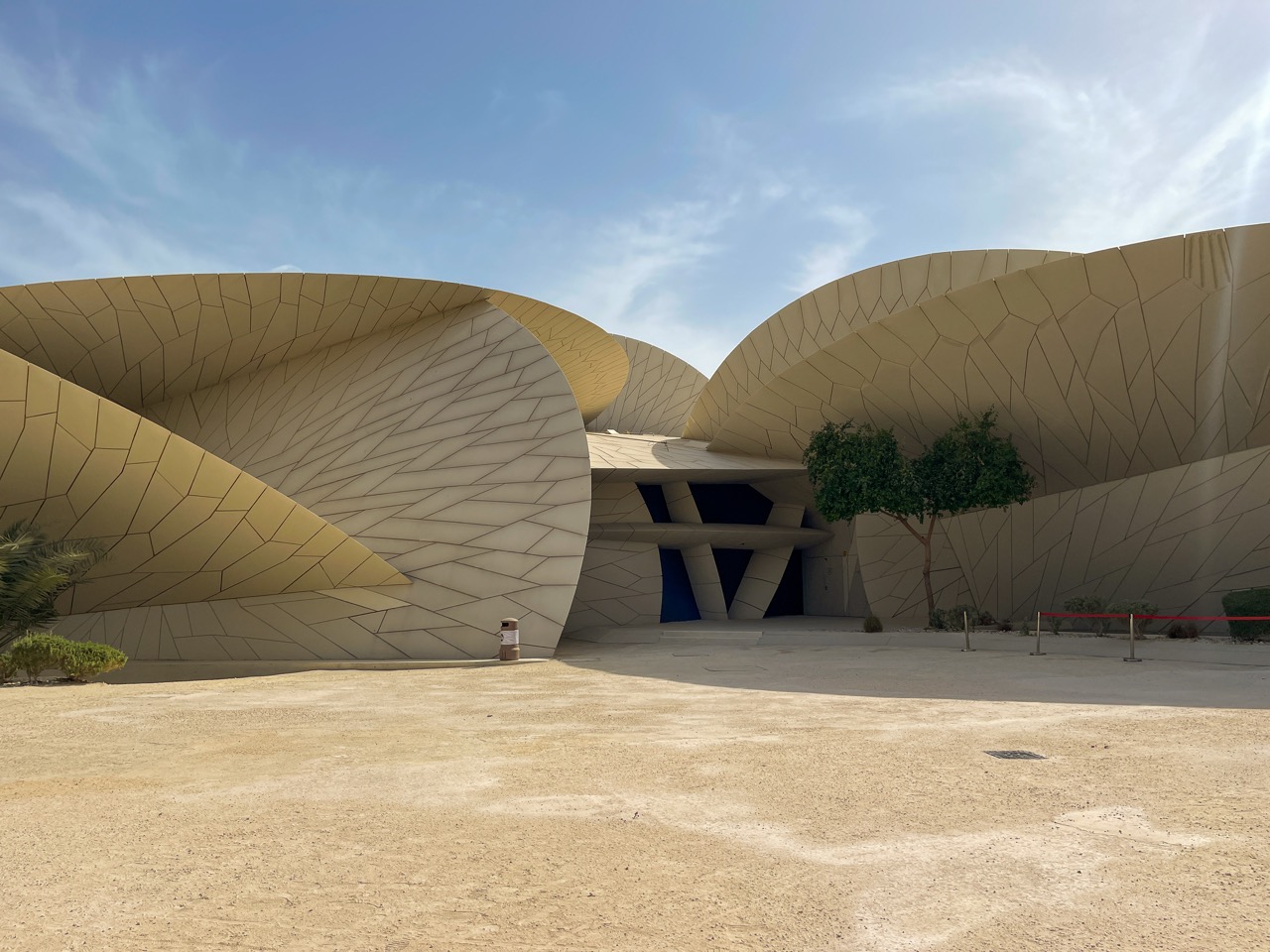
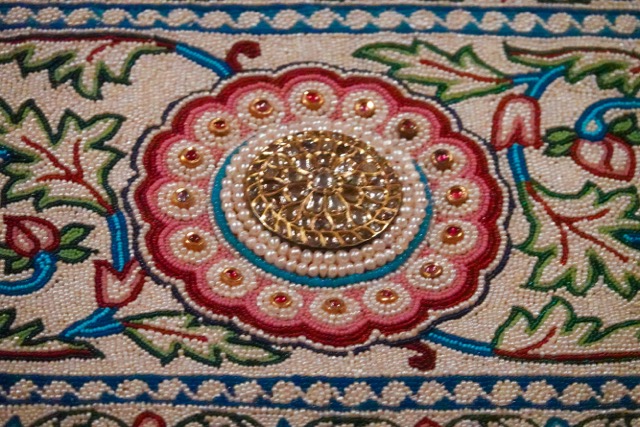
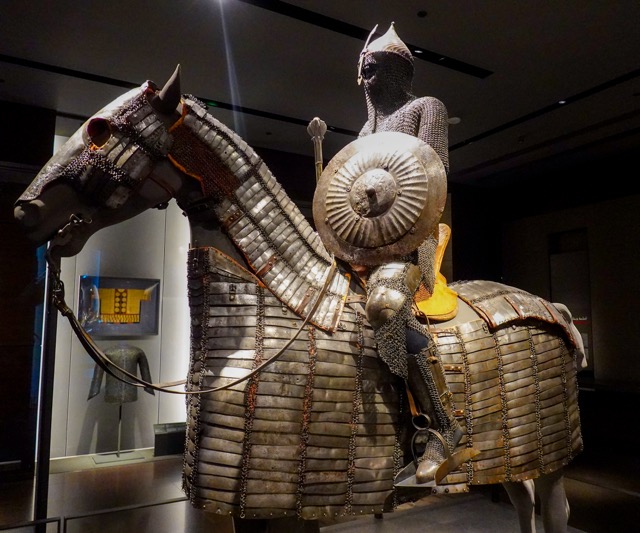
Inside, the exhibits trace the geology, history, and ethnography of Qatar from the beginning of time to the present day utilizing a dazzling array of artifacts combined with state-of-the-art technology. But what I was most striking for me was the relegation of the desert Bedouin lifestyle, which was prevalent just a generation or two ago, to an artifact of history. It is one more example of the speed at which our world is evolving and changing.
Having had our museum appetite well and truly satiated, we grabbed a taxi and headed to what remains of Doha’s old city to wander the souks. Our driver was not a fan of the old city. Why would you visit there with all the gleaming new city to explore? He did grudgingly recommend a traditional fish restaurant, however, where I picked a 2-kilo red snapper out of the ice to be grilled over an open fire. It was fantastic! Although, I must confess, I longed for a glass of crisp Alberiño to go with it.

Oman & Qatar – Technology Saturation

Traveling around the Arabian Peninsula can be a very disorienting experience for an American. Afterall, we’re the greatest nation on earth, leading the world in technology and innovation, right? I’m afraid once again, we’re going to need an update on our viewpoint.

Consider for a moment the pace of change that has been transforming Arabia. The massive energy industry that has funded the transformation began producing cash in earnest around 50 years ago. In my lifetime, Doha, Dubai, Bahrain and others have gone from small port towns on the Persian Gulf to world class cities of gleaming skyscrapers and sparkling luxury. Across the region, this scenario has played out over and over. The Arabia of 50 years ago has been relegated to museums, literally. And what to do you get when you build a new society with an unlimited budget? The best of everything, including the latest and greatest technology money can buy.

A Picnic with Muhammed

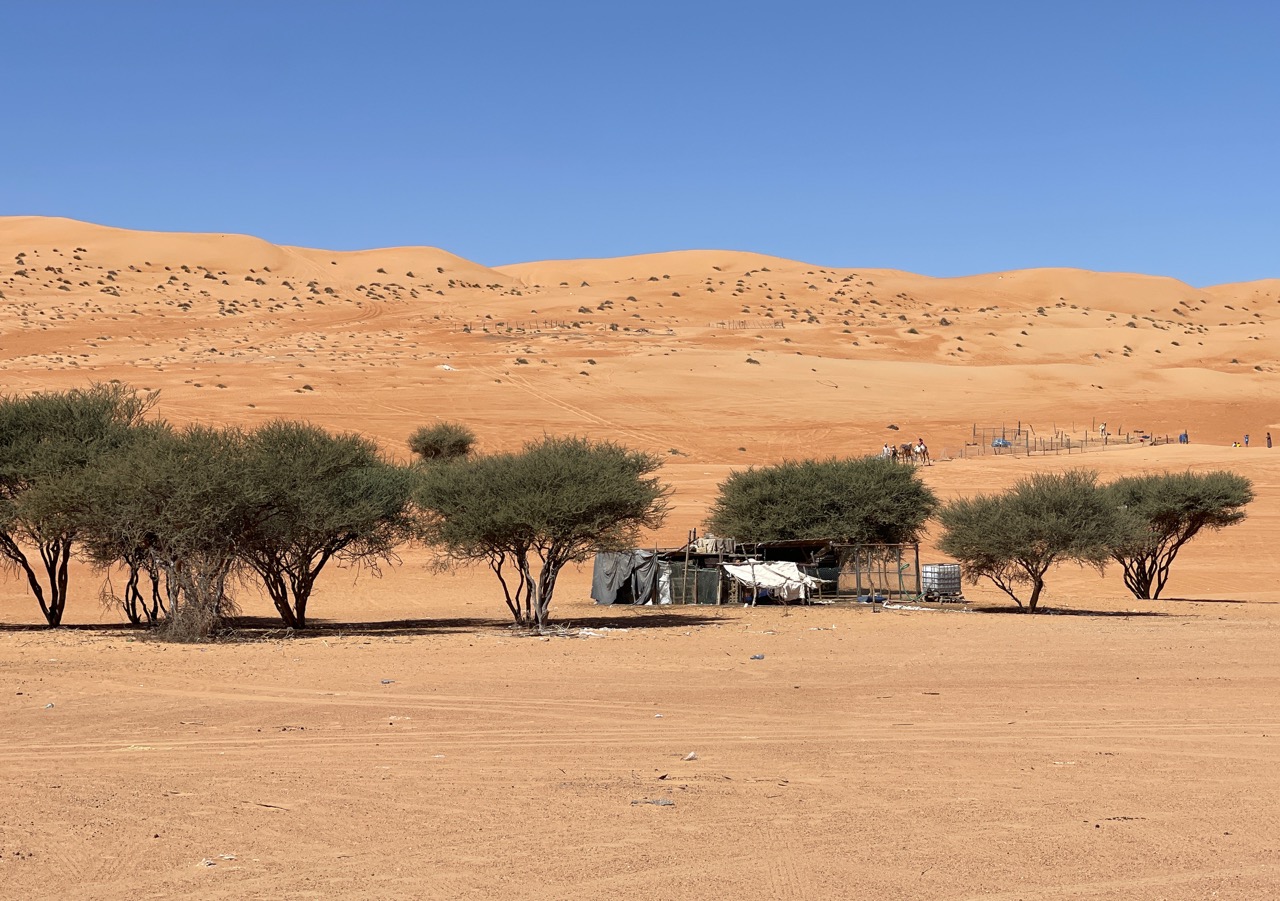
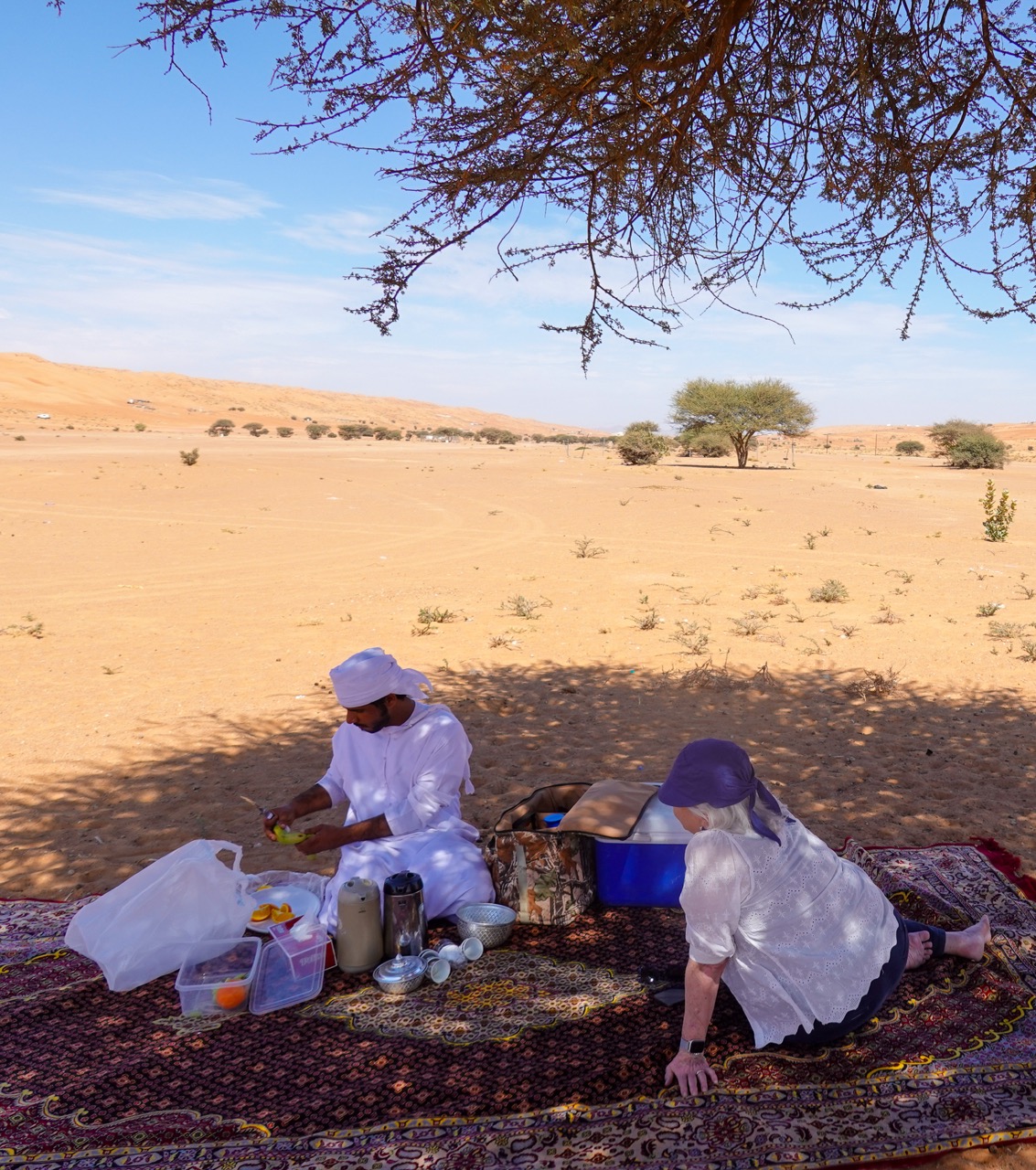
It was a small moment, but it beautifully illustrated the paradigm shift we were challenged to make. We’d just finished two hours of a riotous little adventure with a young Omani named Muhammad in the great desert known as the Sharqiya Sands. Muhammad introduced us to the apparently common practice of “dune bashing.” This is an excursion that involves pushing the capacity of a four-wheel drive SUV to the limits of the vehicle’s capacity to climb, slide, slip and dip over mountainous sand dunes for the purpose of terrifying foreign tourists. It is effective. Having satisfactorily elicited cries, whimpers, and the occasional hushed prayer from his passengers, Muhammad guided his modern beast to a stop under one of the few trees within sight and unpacked a beautiful carpet on which to spread a small feast.
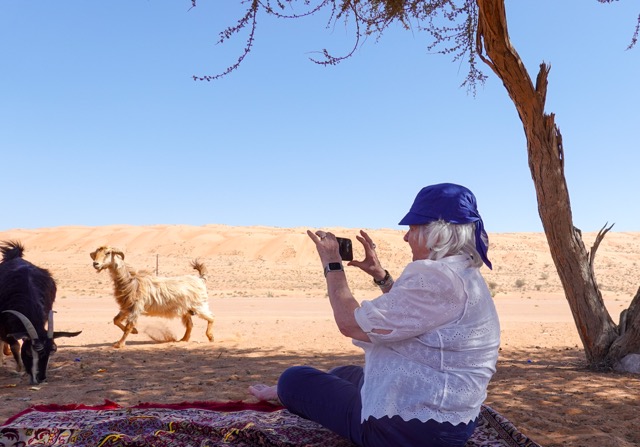
As we savored the luscious dates and sampled Muhammad’s falafel, he began telling us about his passion for camel racing. It seems that Muhammad’s family own a total of ten camels that serve a variety of functions in sustaining their lives in the desert: milk, meat, breeding, work, and the occasional special camel suitable for racing. Lest you get the wrong idea about the sophistication of this camel rearing family, Muhammad whipped out his phone to begin sharing his favorite videos of his favorite camels. The first thing that we noticed as we lounged on our carpet in the desert was that the racing camels were riderless. “Well of course,” explained Muhammad. “They are controlled remotely.” Wait, what? Remote control camels? It turns out that racing camels with riders was resulting in some pretty ugly camel mash-ups and people were getting seriously injured or killed. Solution: strap on a widget that feels like a rider to the camel but is activated with a handheld controller safely out of harms way. Seriously.
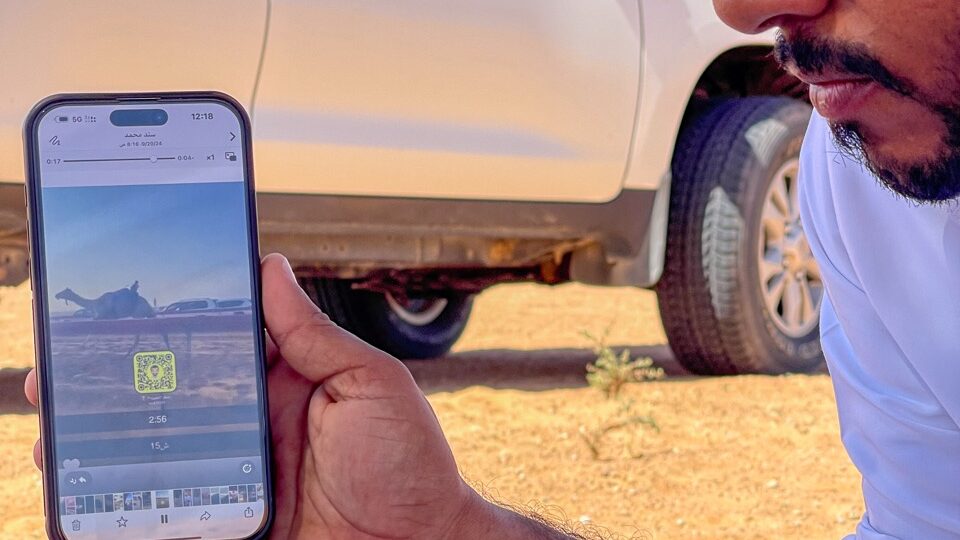
While I was beginning to ponder the wonders of accessing 5G cellular out here under our tree in the Sharqiya, Bonnie pipes up with “Muhammad? What model iPhone are you using?” “It’s a 16 Pro with a terabyte,” he replied without looking up. “What? she gasped. “I’m still carrying an iPhone 12 that runs out of battery regularly!”

And so it went at every turn. This is what a brand spanking new country looks like if you just started building it about the time the internet was invented. Qatar claims 99.7% 5G coverage of the entire country for the highest online penetration on the globe. When Bonnie got over being out teched by a desert camel racer she asked Muhammad if he might send her a few of the pictures. “No problem,” he said. “I’ll air drop them to you.” The digital world is integrated into life in Qatar and Oman at every turn. In airports, hotels, and around town, use of the highest quality technology was evident in the way everything just worked.

Not content to rest on these achievements, Qatar has created partnerships with Microsoft and Google worth billions of dollars to invest in the future development of the technology ecosystem. Quite simply, they are competing with their Arab neighbors to become the new hub of digital innovation for the future

Fit for a Sultan

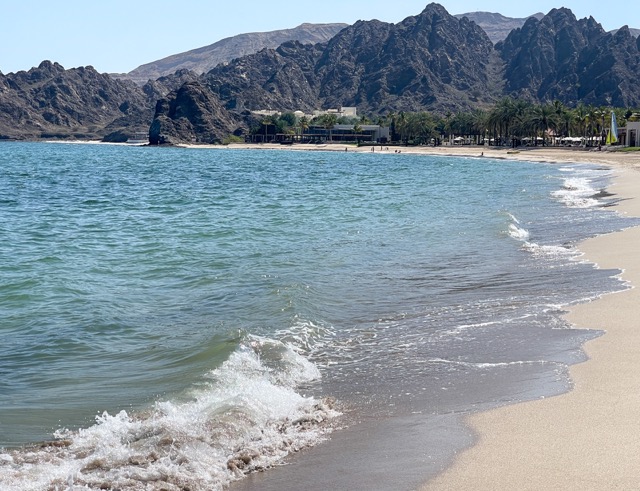
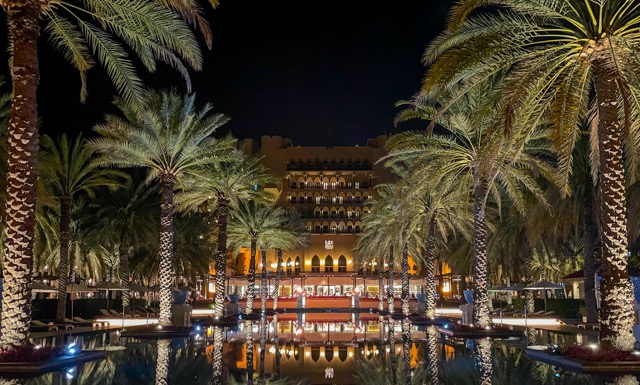
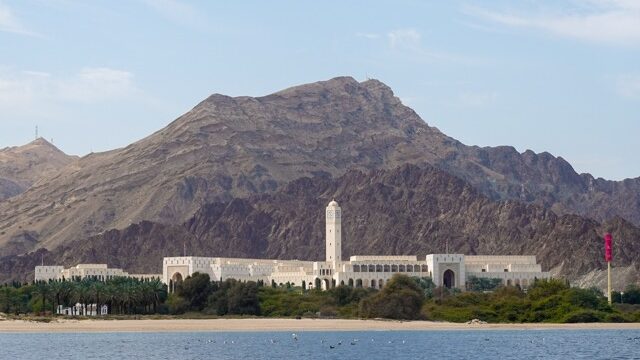
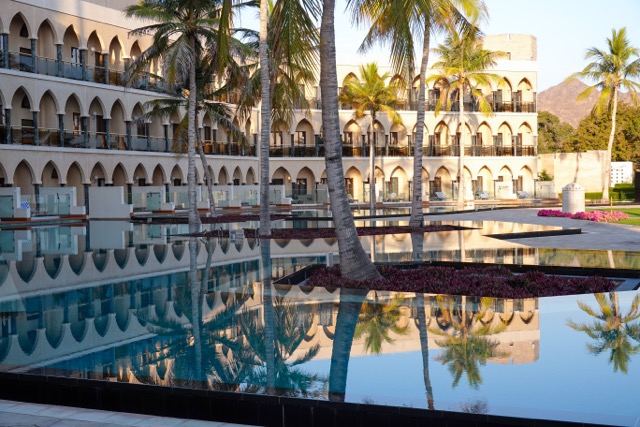
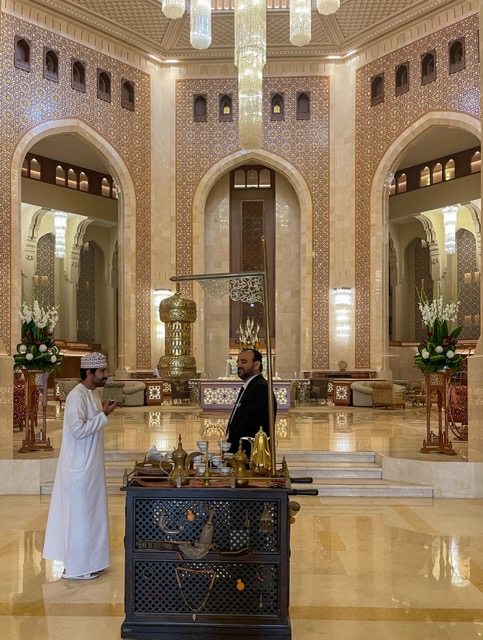
Muscat sprawls along a stunningly beautiful strip of coast line, surrounded by mountains. No where is it more beautiful than at the Al Bustan Palace Hotel where we spent our last three nights in Oman. From the moment of arrival, when dates and coffee are presented in a gesture of welcome and the smell of frankincense wafts through the lobby, there is a profound sense of peace and calm. This is the world of tradition, expressed in customs and cuisine, combined with the modern world of convenience and comfort. This junction of two worlds is expressed in the famous 125 ft high lobby that glimmers with gold, polished marble, and a huge chandelier. Six glittering pools, meticulously manicured grounds, and a private beach were just the perfect way to recover from our charming tent experiences and the trauma of dune bashing.
As we made our way back to the West, I couldn’t help the thought that perhaps we had been given a glimpse the future, or at least its potential.

Middle East Adventure Read More »
A Big One Coming Up….

I’ll be 70 in January. One study I’ve seen classifies older adults as the young old (60-69), the middle old (70-79), and the very old (80+). So, I’m entering middle old age. Yikes!

I figure I’ve got about two months to reflect on my accomplishments, failures, and lessons learned. Apparently, the wisdom gained at this stage of life can lead to a greater sense of gratitude and contentment. I’ll let you know how that goes.

Aging is an extraordinary process where you become the person you always should have been.

David Bowie

I’m thrilled and honored that our boys have decided to trek to Spain with their families! The whole gang (12 of us, in all) will spend time together in Valencia during the first week or so of January.

Then, on January 13, Ed and I will be off for a big adventure. We’re going to Oman…yep, that country on the Arabian Sea next to Saudi Arabia. This might sound crazy to some of you but hear me out. I ‘ve been thinking about how to celebrate. I’d love to have a big party and spend the day with all of you. Of course, that’s challenging given my habit of moving about quite a bit. So, I’m leaning into the move about thing and will be traveling for my big day. (I know, not much of a surprise.) But where does one go in January, especially one who is seeking warmth? Here’s the plan…

Think 4-day road trip with glamping on the beach to (hopefully) see sea turtles laying their eggs, staying in a luxury tent on the edge of massive sand dunes and visiting a Bedouin village, and then splurging on three nights at a Ritz-Carlton. Our flight itinerary takes us through Doha, so we’ll spend a couple of nights in Qatar also.

I’m giving you all a heads up about this big adventure in the hopes that some of you will decide to meet me in Oman! Seriously…say the word and I’ll forward the itinerary and links for booking.

A Big One Coming Up…. Read More »
Marrakesh – A look Back

We’ve been considering a brief trip back to Morocco this winter and that got me thinking about past travels we’ve enjoyed. Back in the day (before we got all hoity-toity with our own blog site) we would often keep our family and friends informed of our adventures with emails. So, it occurred to me that a few of you might enjoy accounts of our past adventures. Here’s a series of emails from November of 2015 – our first trip to Morocco. I’ve edited a bit and added photos. I hope you’ll enjoy it.

Email #1 November 24, 2015 – Day One

I write to you as we journey on the night train to Casablanca.

I had to say that . . . it just sounds so cool.

First, I hope that you are all well. As the weekend has turned to Thanksgiving week, our thoughts of family and friends have become more insistent. Our adventure through Morocco is becoming a mix of intriguing new stimulations accompanied by the occasional sting of absence from our loved ones. In other words, having a great time, wish you were here!

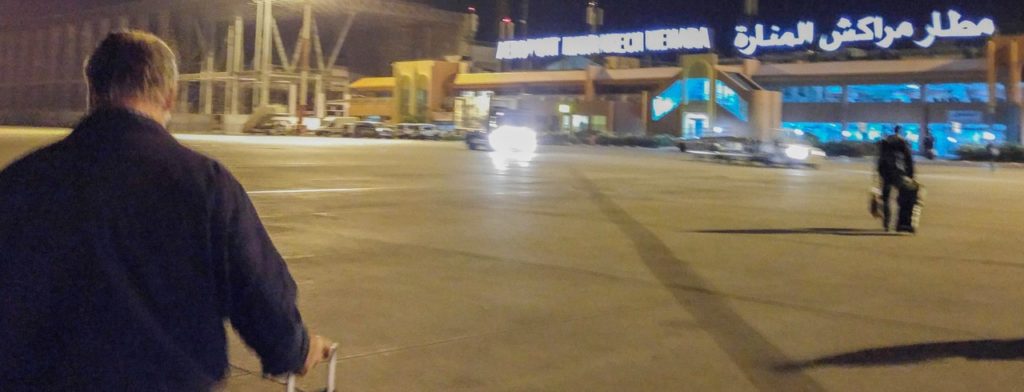
It’s hard to know where to start telling you about this trip. When we set out from SFO Thursday evening, we did not have much of an itinerary. We had some vague notion that our phones would be connected to Google, we’d talk it over on the plane, and things would work out. I know that doesn’t sound like our usual approach, but our activity level in the past several months really caught us off guard and we simply never got around to planning very much. We even forgot to bring along the guidebooks we had purchased many months ago, but never read. As we boarded the British Air flight to London for the first leg, we had a place reserved to sleep most nights in three different Moroccan cities. That’s pretty much it. In keeping with this haphazard approach, our British Airways flight was an hour late leaving SFO, causing us to miss our connection in London, and prompting Iberia (our booking airline) to reroute us on Royal Air through Casablanca to our final destination, Marrakesh. Unsurprisingly, our baggage lacked the necessary travel acumen to make this adjustment, and our first stop, after making our way through customs (disappointingly modest passport stamp), was the Royal Air “lost and found”.

No,” we were told, “we have no idea where your bags might be. Perhaps Madrid. Maybe London. There is another flight arriving in the morning. Perhaps they will show up then. Bon soire.” Fortunately, Bonnie and I have advanced to the level of modestly seasoned travelers. Having come to expect exactly this result, we had both packed enough essentials for the first two days in our carryon bags. So, we emerged from the airport at 1:30 in the morning Friday relatively unconcerned. Our host in Marrakesh had been informed of the delay, and would have a bed waiting, we would call the airport in the morning. The luggage thing would work out . . . or not. (Notice how carefree we are becoming in our dotage.)

The Medina

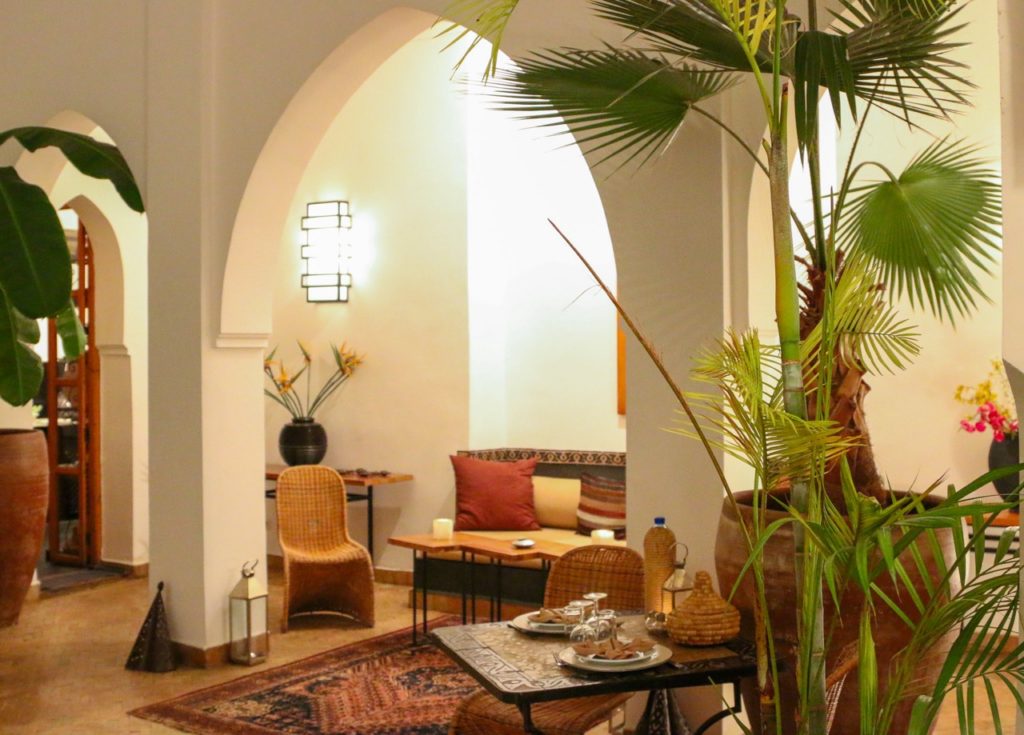
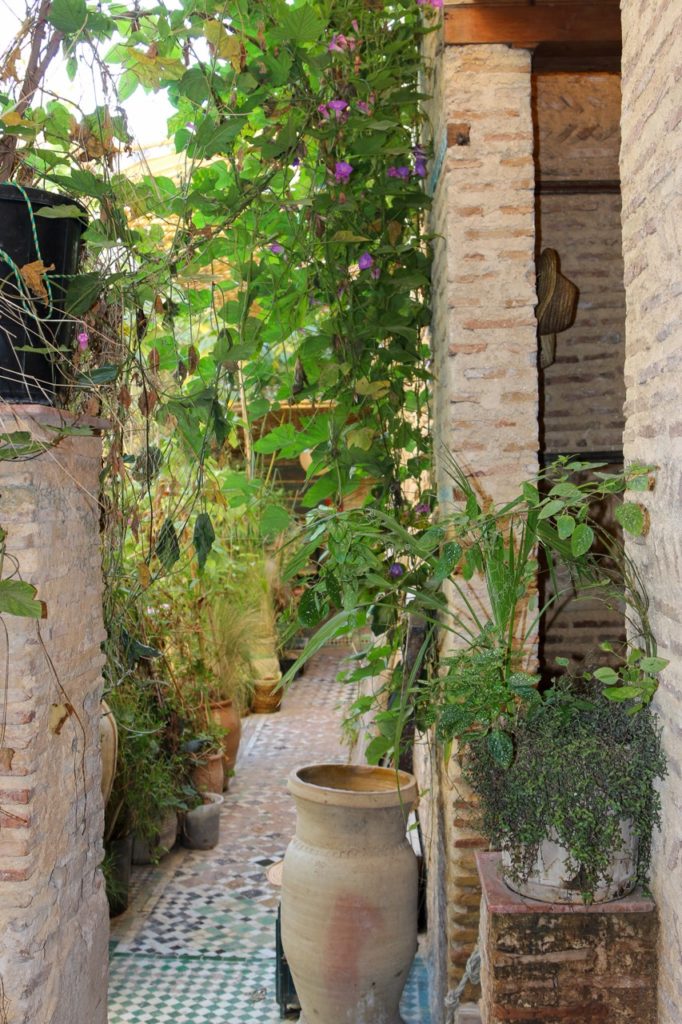
And so, we found a taxi and made our way through the silent, deserted streets, toward the ancient walled medina that contained our riad, a massive arched gate looming ahead. We passed through into twisting, trash strewn alleys of crumbling pavers, lined with seemingly abandoned buildings. My western sensibilities began kicking in about now. And, just as my imagination was conjuring the image of mujahedeen surrounding the cab, scimitars gleaming, our driver came to a stop in one of the darkest streets yet, and a figure, swathed from head to toe in a rich blue drapery, complete with turban, emerged from the dark. I fought the impulse to cry out a warning, and instead heard my name quietly spoken in a richly accented rumble. Apparently, we had arrived. The blue ghost led us down a narrow dark passage between buildings, unlocked a door and allowed us to step through into a candlelit oasis of beauty and grace unimaginable from the exterior.

We were awakened the next morning by the sound of children’s laughter, followed shortly by the second call to prayer, and we turned to each other bemused by the strange Saturday that lay before us. Riad is the name given to a certain class of traditional home found in the heart of these ancient walled cities. Generally, they are gracious three-story homes created around an open, central courtyard. Trees and vines reach upward to the second and third levels, light streaming through the building’s open, columned architecture. Many of these centuries old structures have been repurposed from their initial use as the estates of successful merchant families into boutique hotels or guest homes. The other, inevitable feature of a riad is the rooftop patio and garden. It is to this area of Riad Miski that we were directed to our breakfast, overlooking the surrounding roof tops, with the High Atlas Mountains visible through the distant haze.

We lounged like cats for a while, soaking up the sun, working on developing full consciousness, recovering from the previous 36 hours. Emmanuel, our host came by around mid-morning and sat down with us to begin our education on the nuances, pleasures, and dangers of the medina. The Marrakesh medina, like others in the ancient world, is a fortified city defined by massively thick walls, where the traditional life and culture of its inhabitants has continued largely unchanged for centuries. By this, I don’t mean to imply that the modern world has not had an impact. The rooftops sprout satellite dishes like mushrooms in December around our beloved Villa Ondina, and cell phones are ubiquitous. The citizens of the medina, however, make their way through life subsisting on the basis of their craft or trade, utilizing almost nothing in the way of modern equipment or methods. Every conceivable nook and hovel are filled by an artisan or merchant engaged in the single-minded business of producing his livelihood.

Instant Immersion

As we stepped from the tiny alleyway that connected Riad Miski to the rest of the medina, we entered a whorl of activity, color, smells, sounds, and stimulation that I despair of ever conveying to you. After walking only a few hundred meters, we turned to each other in amazement, both expressing the same thought. How are we ever going to tell them about this back home? By Saturday evening, when seemingly every resident of the city was in the streets, it became clear that photography would be useless. No photo, or book of photos, was capable of conveying this experience. Perhaps a video, handled skillfully could begin to hint at it, but nothing more than a hint. How to explain the cacophony of sensory inputs? Let me try this:

Imagine a New York sidewalk on Fifth Avenue at the height of the holiday season early on a Friday evening. Now, to the pedestrian traffic, add a continuous stream of bicycles sharing the same space, dodging and weaving. Are you with me, so far? Next, add to this imagined scene an equal number of motor-scooters, operated at the highest possible speed for the conditions of the moment, swerving and jostling with the bicycles, accelerating and braking with heart stopping agility, all in the midst of that Fifth Avenue pedestrian traffic. Now, if you’re still with me, (I am not making this up) toss in the occasional donkey pulling a cart laden with who knows what, the regular appearance of two wheeled hand carts, wheel barrows, and every other possible wheeled conveyance that might possibly be squeezed down a ten-foot-wide street lined on both sides with shops and stalls spilling out of the walls that form the tight lane. And, with this, I have only attempted to describe the movement, and clearly the danger, of merely being on the street. I cannot think how to explain the smells, sounds, colors, languages, costumes, curses, prayers, and the faces. Who knew human beings came in such variety? The act of simply walking the ½ mile to the central square involved a sensory overload unlike anything I have experienced . . . until the street opened onto the Jemaa-el-Fna Square.

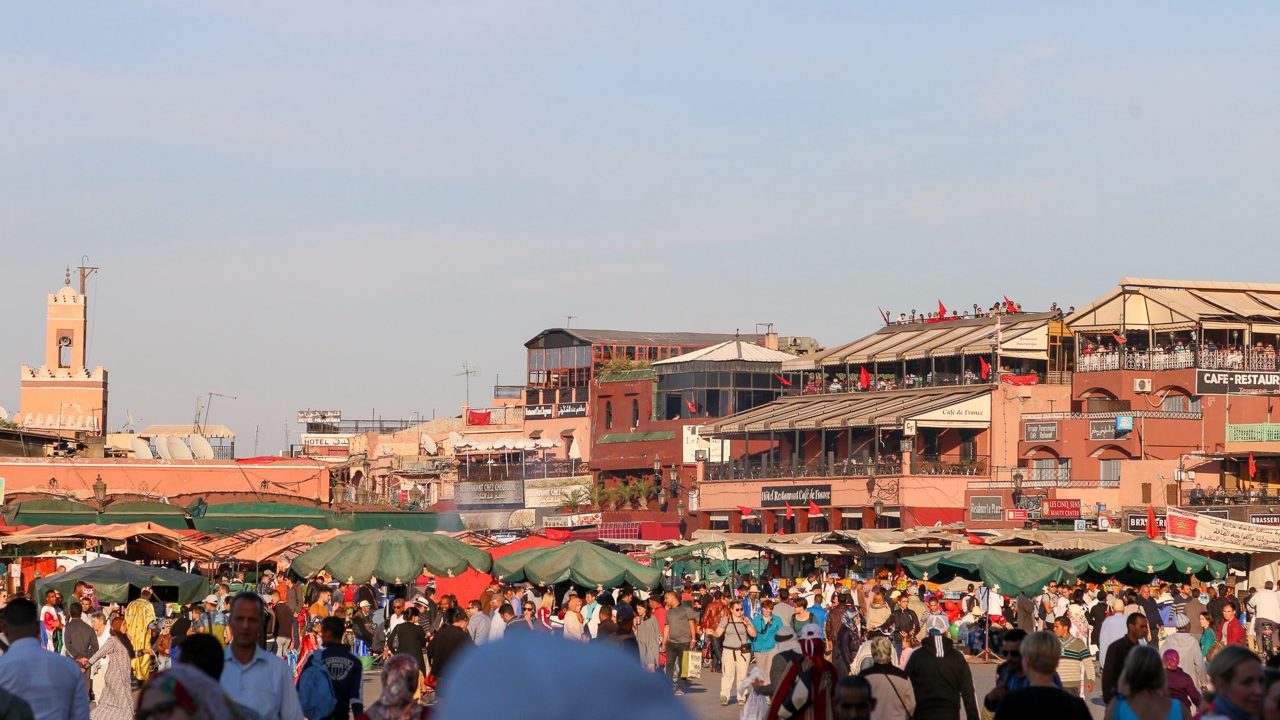
The square is symbolically and truly the center of life in the medina. Part community center, part tourist trap, throngs of natives and visitors cover this vast square, and as the day began drifting toward evening, an enormous carnival of food vendors and pop-up restaurants began to take shape amid the snake charmers, henna artists, monkey trainers, acrobats, and jugglers. The incessant honk of the snake charmer’s horn, the rhythmic pounding of drums, the cries of vendors hawking every conceivable manner of food and drink (alcohol and pork not in evidence), groups of musicians, and every other person shouting into their cell phone all combined to produce a non-stop din until the evening call to prayer provided a brief respite.

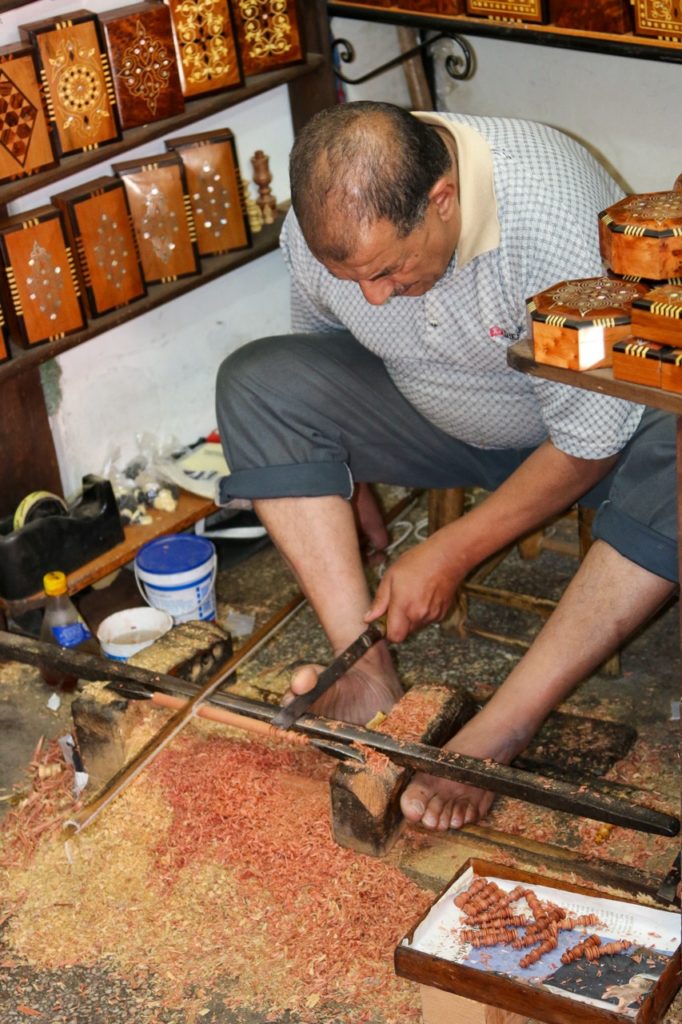
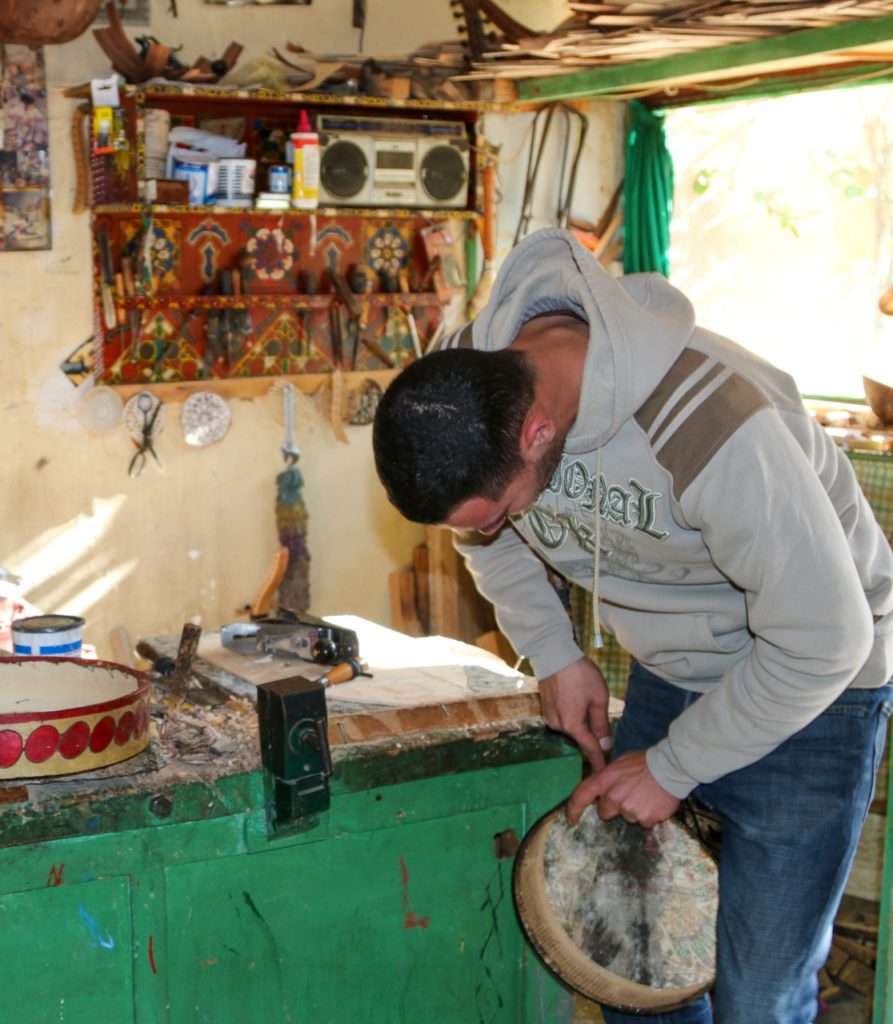
This first day, having braved the adventure of merely walking through the medina and enjoying a light lunch on the rooftop of a café on the square, we made our way to the Berber handcraft center where some of the finest craftsmen in the region are allowed to set up shop. Here, off the beaten path and away from the square we were able to quietly stroll through each craftsman’s shop without being harangued. Bonnie had to have a hand-drum and we selected a number of other possible purchases. Finally, we made the long trek back through the teeming streets to the riad, collapsing into the silent, tranquil, secure embrace of our temporary home and feeling for a moment, how precious these interiors must have been to their original owners. After a rest and a call to the airport, “no I am afraid we still have no idea where your luggage is, but there is a flight arriving at 10:00 am . . . ,” we screwed up our courage and headed back out to make our way to a restaurant reservation.

A teachable Moment . . .

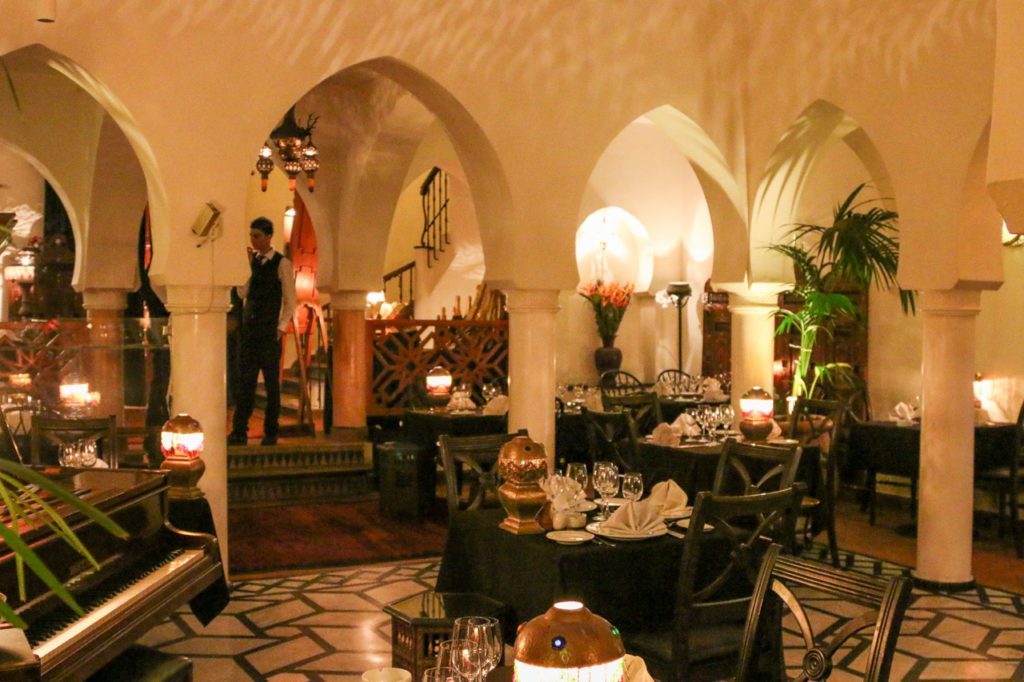
Now, we experienced the full medina. At times the pedestrian traffic became congested to the point of forcing the motor bikes to walk with everyone else. It’s the first time in my life I have been grateful for a traffic jam! We promptly got lost. Posing as a helpful guide to the unsuspecting visitors is one of the principal games played by the touts in these streets. Having led the tourist on a wild goose chase through the twisting alleyways, the guide then demands a generous tip for having brought them safely to their destination, which they may have reached by simply continuing their original path. It was with some trepidation, then, that we accepted the guidance of an eager young man to guide us into the warren of souks toward Restaurant Nomad. After a long, winding route, we began to make a turn that would clearly begin taking us back in the direction we had started. Bonnie declared, and I had to agree, that we’d been had. We were strategizing how to extract ourselves from this situation when I spotted the restaurant’s sign not 50 feet from us! We gratefully provided our thanks, and a generous tip, and made our way to the patio bar on top of the restaurant. A bright moon, wonderfully interesting food, a gently cooling evening, and a slow stroll through the now abandoned streets to our waiting bed completed day one of our Moroccan adventure.

Email #2 – November 25, 2015 – Day 2

Note: Rereading the following account of day 2 was especially poignant for me in light of the magnitude 6.9 earthquake that struck the region in September of 2023, killing 3,000 and injuring many thousands more. The epicenter was in the Atlas Mountains where the Berber’s were particularly devastated.

The Atlas Mountains

After my narrative regarding Day One, I’m sure you are opening this message with some trepidation. “Surely, he’s not going to go on and on about every day of their trip?” No. Alas, everyday cannot be so stimulating. I do, however, feel an obligation to recount our Day Two adventure. After all, every good story needs a sequel, and sequels always come with lower expectations, which suits me in this instance.
Before leaving for dinner that first evening, I had asked our host if he might be able to arrange an excursion into the mountains for us on the following day. Jose, our Berber guide met us at Riad Miski around 9:00 AM, directed us to a late model mini-van, and introduced our driver, Mohammed. The day had dawned overcast and drizzly, forcing our breakfast off the roof terrace, but as we headed out of the city, the sky began to lighten, and our attitude could not be dampened. We were headed into the High Atlas Mountains that rise to the South and East of Marrakesh, forming a great barrier between the broad, fertile valley the city occupies, and the dunes of the Sahara Desert.

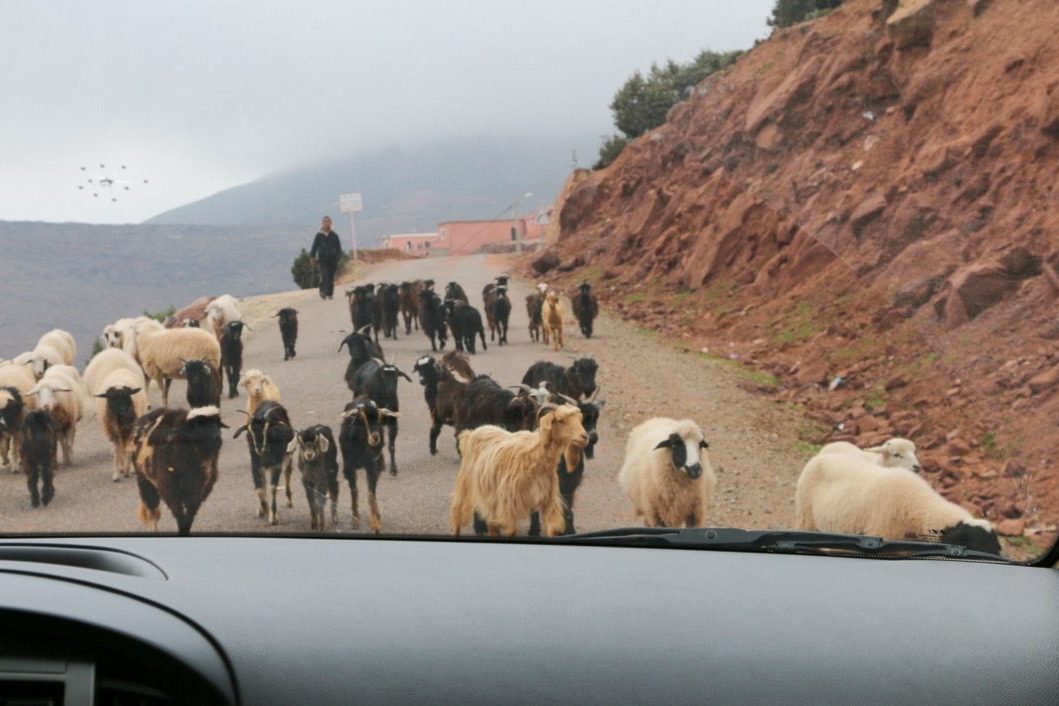
As we began our journey, Jose explained in very excited terms that we were incredibly fortunate to have him as our guide on this Sunday because it was Berber market day! We would be stopping to tour this excellent example of his people’s culture on our way to the mountains. This announcement had very little impact on us. After all, hadn’t we just spent a day in the Marrakesh market? As the scenery around us became more distinctly rural, our highway became a two-lane country road populated by motor scooters, bicycles and the occasional car. I was struck by the almost complete absence of trucks, vans, tractors, or any of the equipment we associate with agriculture in the West. Nonetheless, it was clear that we were traversing a rich farming area, with fruit and olive orchards stretching as far as we could see on both sides of the road.

Berber Pride and Angst

As we drove, Jose delivered a lecture on the recent changes in Morocco. As I am sure you recall, some four years-ago now, the Arab Spring erupted across North Africa, beginning in Tunisia with the toppling of the dictatorship, spreading into Egypt and Libya, and unsettling Algeria. Morocco was similarly affected, despite the general feeling that their King was a benevolent and generous ruler. As the unrest spread, the King moved to get ahead of history by convening the parliament, and offering to create a new constitution, shifting a substantial amount of power from the monarchy to the people. There is some debate over just how much authority the King actually relinquished, but there were other, very dramatic changes affecting Moroccan society that Jose was eager to recount for us.

“Morocco,” he announced with some pride, “created a new constitution three years ago. This has changed many things for us.” He went on to explain that among the key provisions of the new constitution was the absolute equality of all people under the law.

“Until now, the Arabs treated Berber people like slaves,” Jose stated flatly. “Now,” he explained, “we have all the same rights. Berber and Arabs, we live in parallel, now.”

Bonnie and I were aware that the Berbers were indigenous to Morocco and had lived under Arab rule for centuries. What we had not understood is that they represent more than 60% of Morocco’s population, and their language bears no relationship to Arabic. For the first time, the new constitution officially recognized the Berber language in both government and education settings.

Jose’s more startling pronouncement, however, involved equality for women. According to our guide, the new constitution provides full equality for women and mandates that all children, both boys and girls, attend public school to a minimum age of 14. The tradition among the Arabs of taking multiple wives is now conditioned on the written permission of all existing wives and includes strict financial obligations. If a man wants a divorce, he now faces the same prospects as a westerner – alimony, joint custody, etc. For a traditional Islamic country to adopt these positions constitutionally would seem to presage a cataclysmic culture shift which Bonnie and I see as essential for the future of our world. From our experience so far, however, it seems that it will take several generations for the reality to match the promise. As for Jose, he was very clear about what it meant.

“For us men, it is over,” he declared. “We are finished! The women work harder than the men and will now be educated like men. We are done. In a few years, women will run everything.”

We joked and teased about this the rest of the day. But, in the end I was never clear where his true feelings lay. I could not help feeling some empathy for his plight – on the one hand, he was thrilled by his new equal standing with Arabs, while at the same time apprehensive about the scope of the changes that were coming. We were so absorbed in our conversation with Jose that I failed to notice that we had entered a village until we slowed and stopped along the side of the road at a place that looked initially like the saddest flea market on the planet. We disembarked, and Jose, grinning broadly, led us into a Berber Sunday market.

Market Day

Our first stop, after picking our way through the mud, debris, stray cats, and general chaos was the abattoir. For the uninitiated, that is the meat market, or more correctly, the butcher shops. As we approached, Jose stopped abruptly with a slightly mischievous look in his eye, as if a thought had just come to him.

“You are okay?” he asked tentatively, “with seeing the meat, where is comes from?”

“I’m a nurse,” Bonnie retorted, a little miffed.

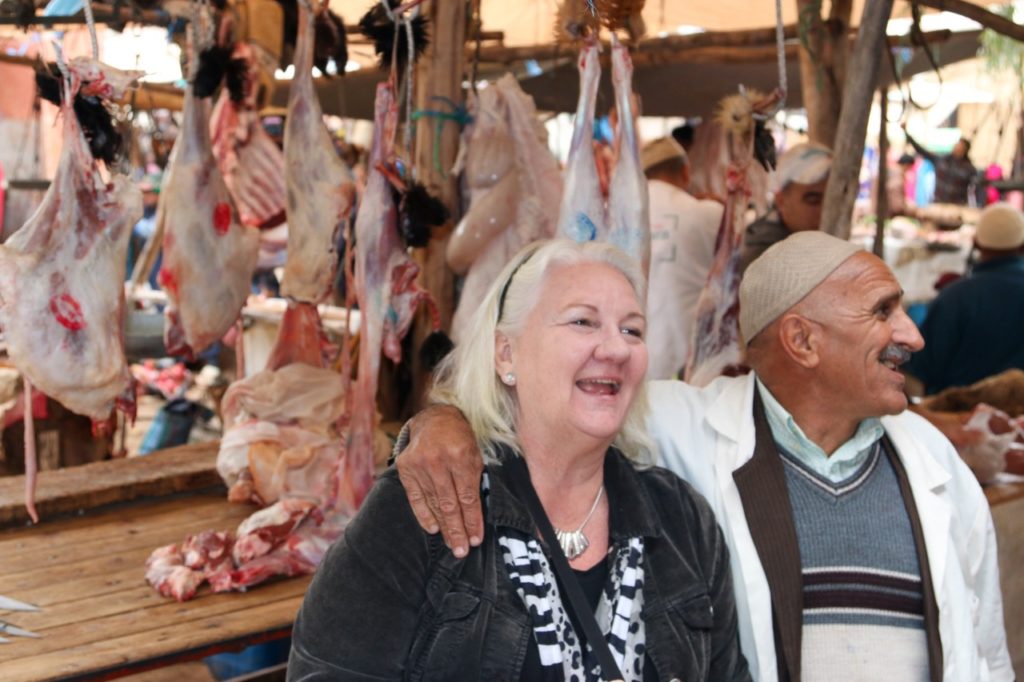
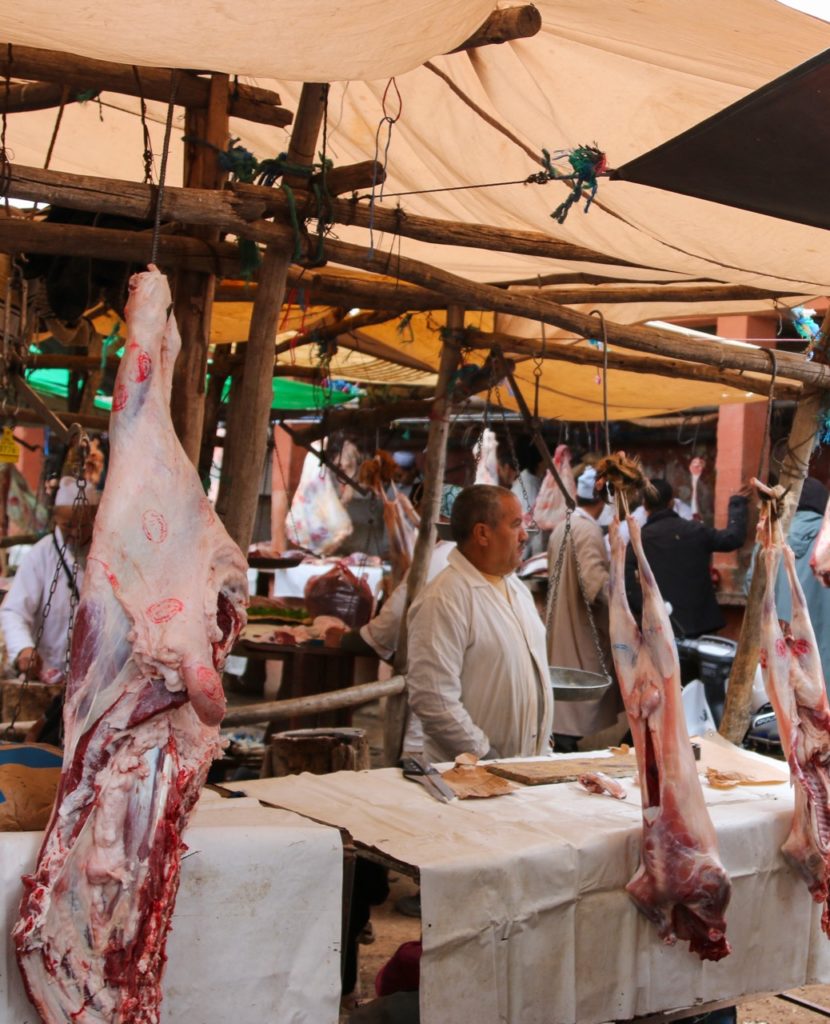
It seems we had missed the earlier events of the day, in which the animals are bartered, selected, sold, and slaughtered. By the time we arrived, the area was a forest of hanging carcasses in all shapes and sizes. With delight, Jose pointed out that today they had camel, apparently one of his true favorite sheesh kabob meats. The butcher featuring camel meat this day was quite easy to distinguish from the others. His was the stall proudly displaying the softly furred camel head hanging on a hook through its lower lip. The proprietors were delighted with the appearance of the Americans, competing to have pictures taken, eagerly offering their specialty – young lamb, organ meat, beef, goat, and fowl of various descriptions, including peacock.

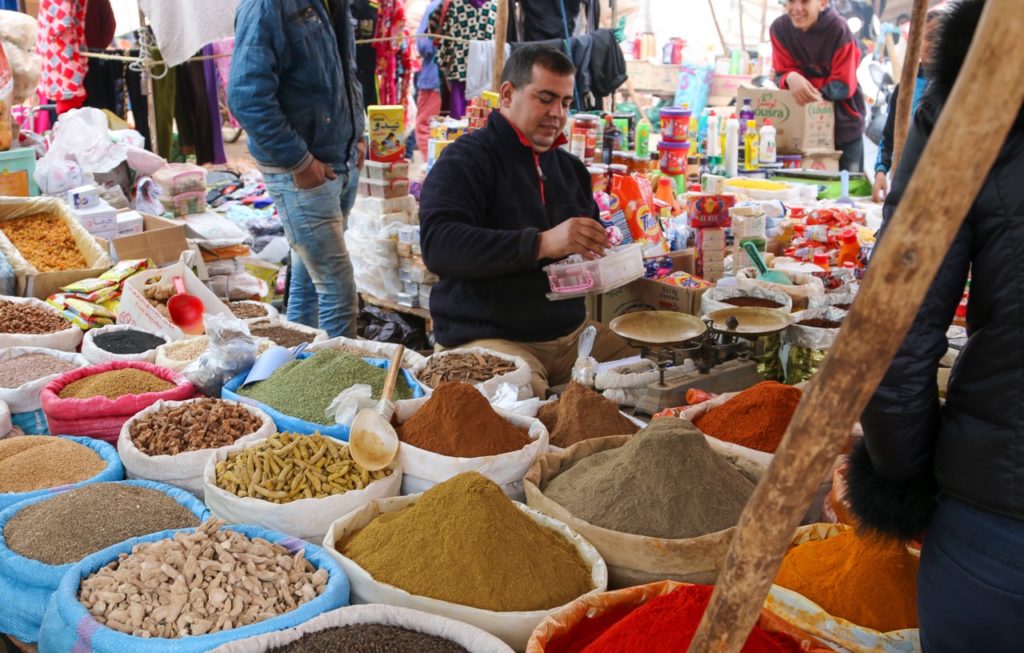
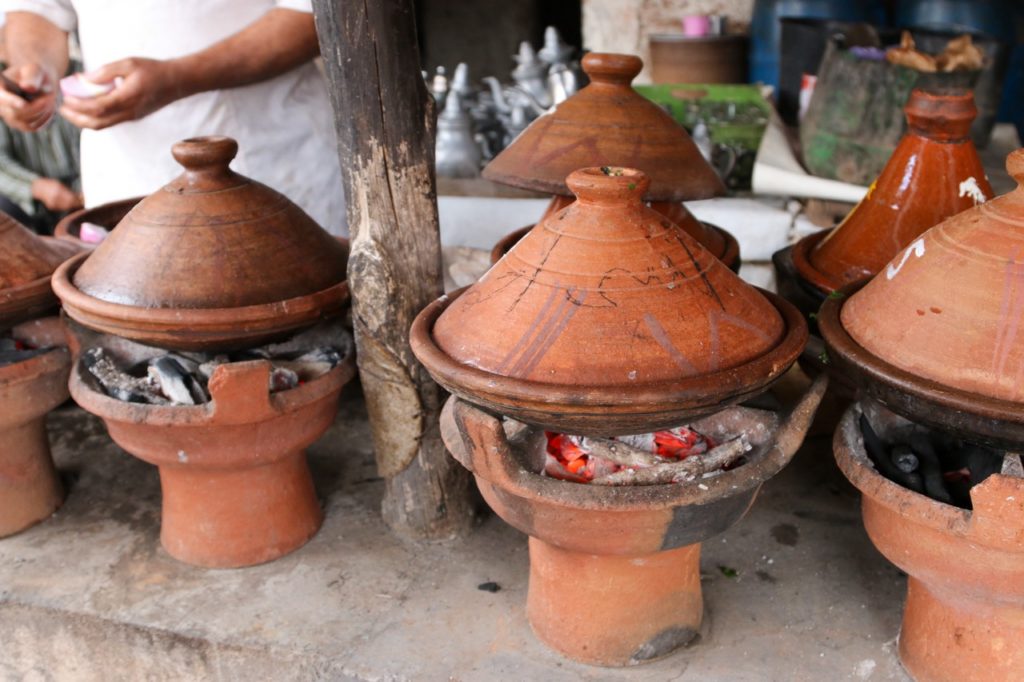
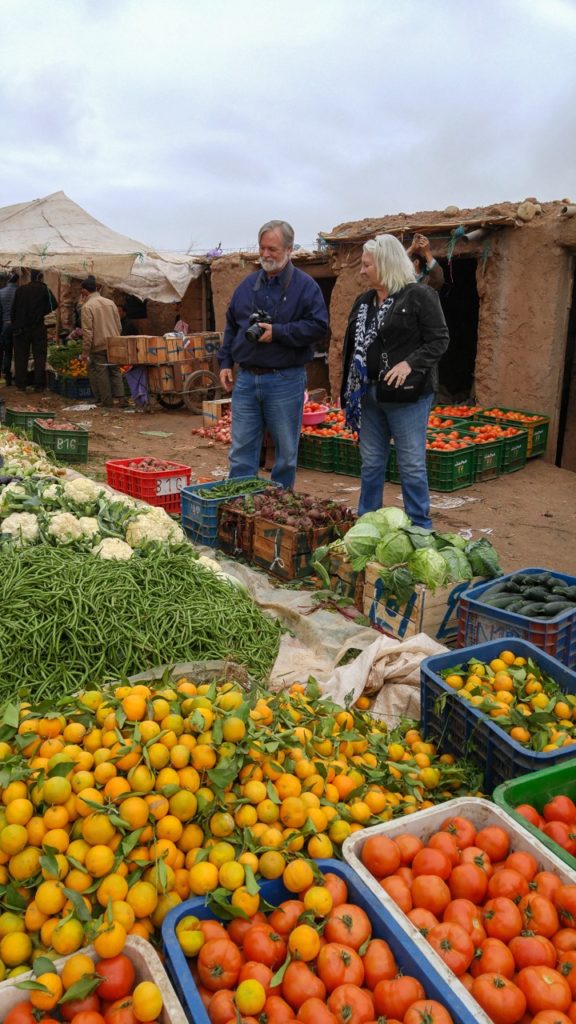
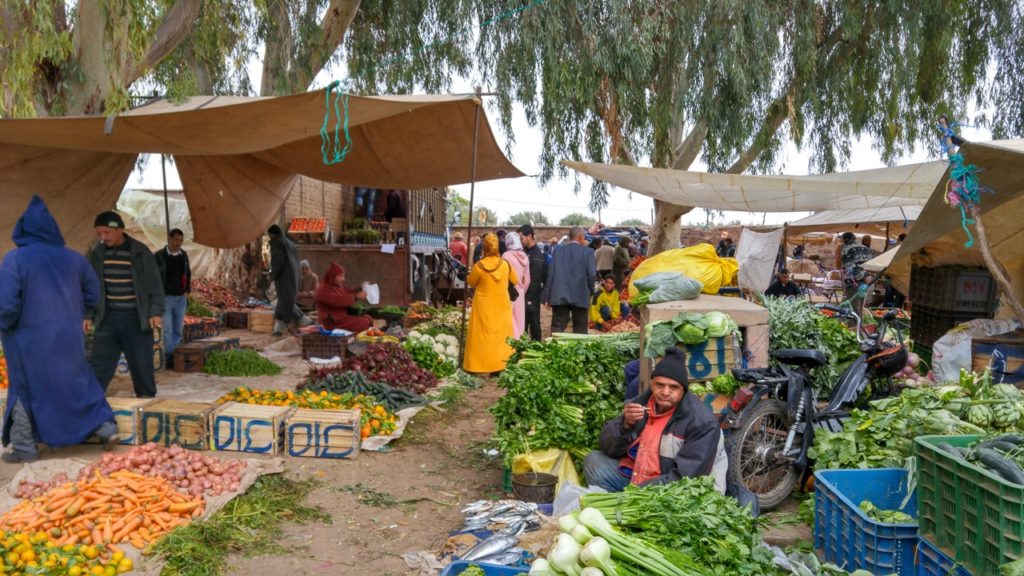
We proceeded through the rest of the market which represented the collective abundance of the region’s produce and livestock. We strolled past huge piles of gorgeous vegetables the equal of anything we might have found at the San Francisco Ferry Building on a Saturday morning, tables loaded with dried fruits glistening with sugar, the deep color saturation of sculpted spice mounds, alongside the vessels, tagines, and tools to convert this bounty into the richly spiced food we would be enjoying throughout the trip.

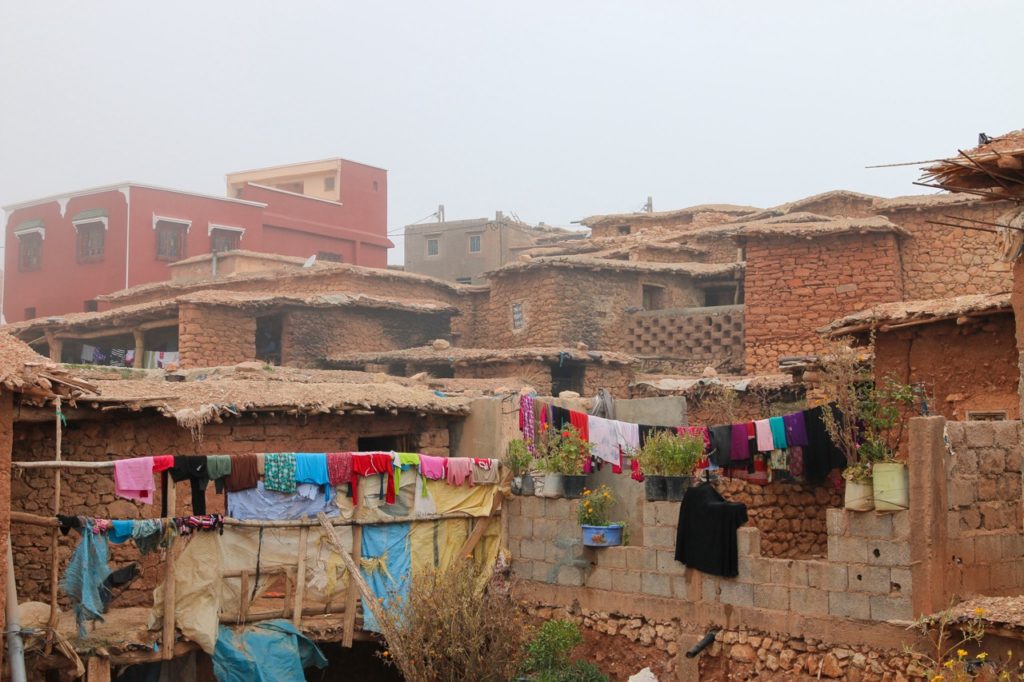
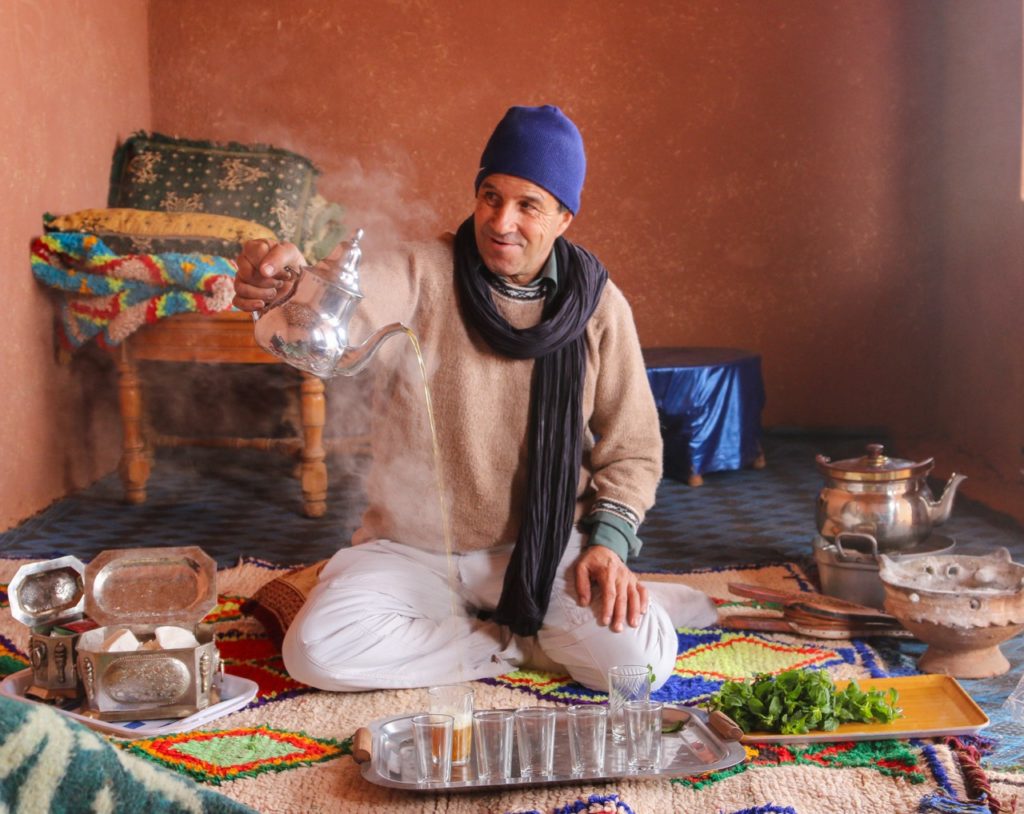
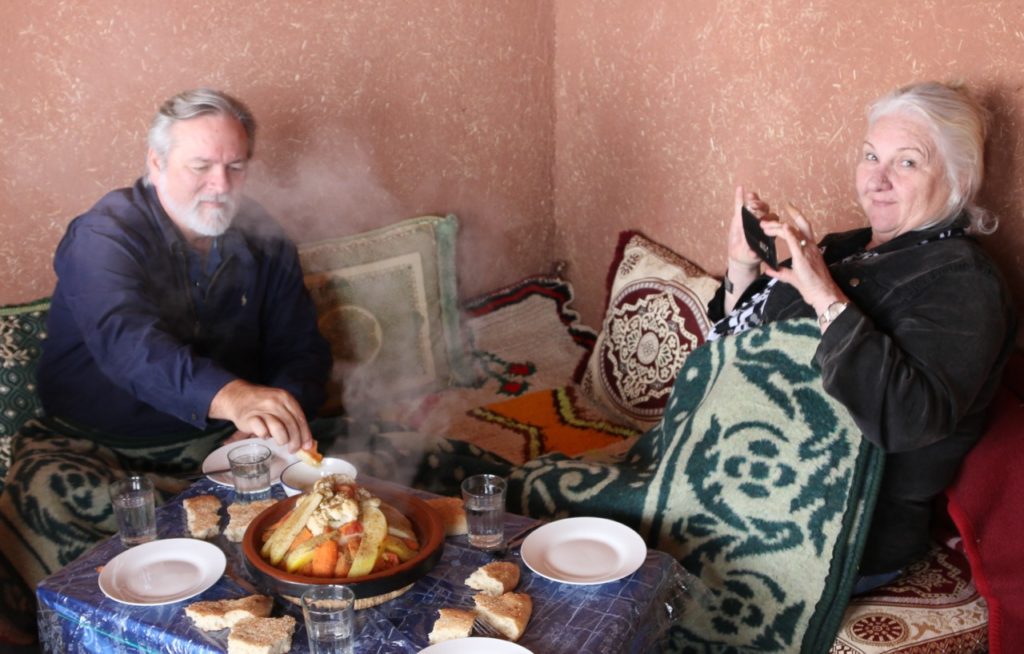
We returned to the van with a new sense of the Berbers as a community – generous, sharing, welcoming, and self-sufficient. By our standards, they live in abject poverty. However, when we asked Jose about the young people – if they had ambitions for a different life – he patiently explained that they loved their homes in the mountains, and almost all stayed to work within their village. The rest of our day was spent driving the single lane road into the cloud shrouded High Atlas, trekking across a mountainside to a small village, sitting on thick, hand woven carpets, our feet and legs ensconced in heavy wool blankets, as we watched mint tea prepared in the formal Berber fashion, and eating a lunch we were served from a steaming tagine of aromatic vegetables, spices, and chicken.

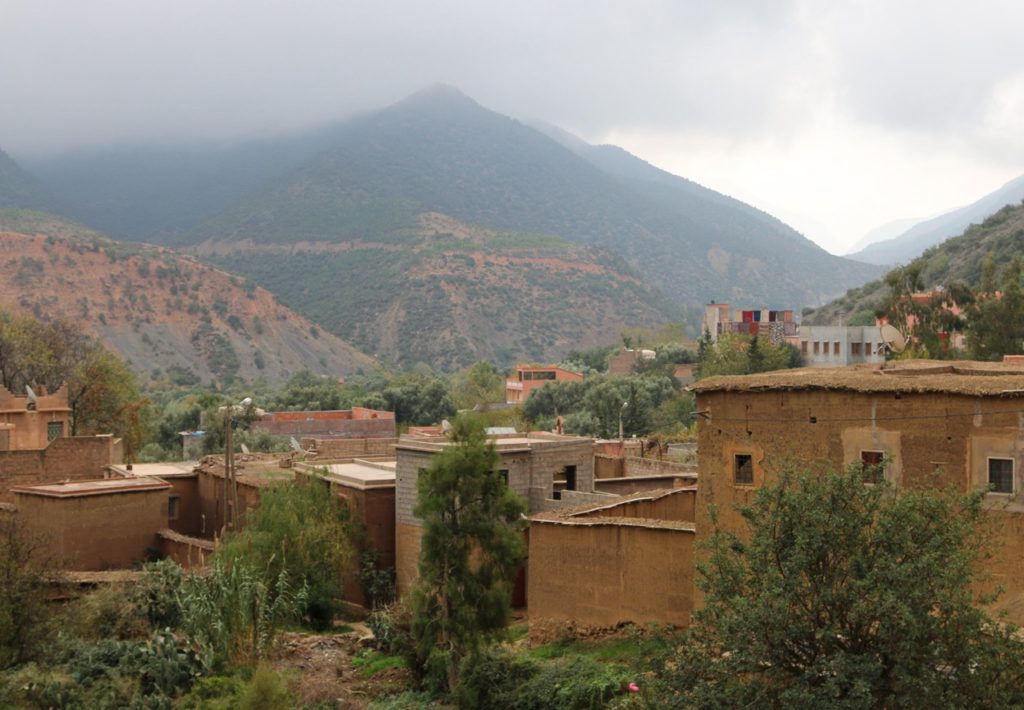
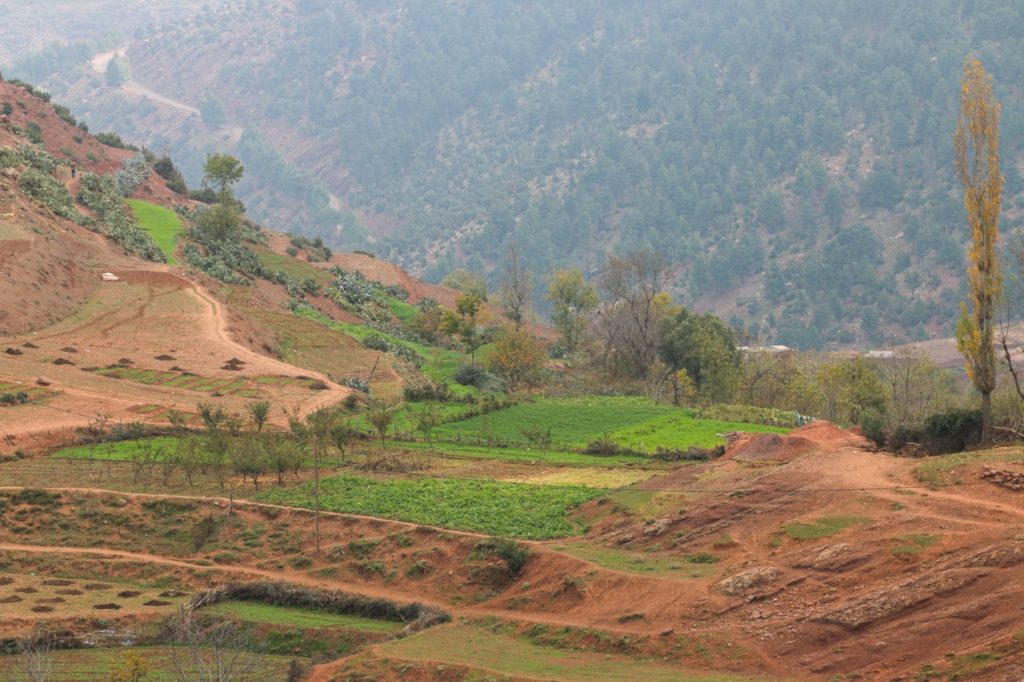
Warmed by the amazing hospitality of our Berber hosts, we slowly wound our way back through the high mountain valleys, each village clinging to the steeply terraced slopes, studded with apple trees, vegetable plots, pasture, and grain fields. Each curve revealed another small herd of sheep, a single cow tended by a woman and her children, a brook or stream tumbling through a burnt-orange clay gash in the lush green of the hillside. These quiet, peaceful, generous people live as close to nature as anyone we have ever encountered. It’s a raw, challenging landscape where the Berbers have scratched out a subsistence for uncounted generations. The village we visited for lunch had received electricity just four years ago, but most of the accoutrements – home appliances and the like – had yet to make an appearance. Nor, did they seem to be missed.

We arrived back in our riad as the sun was setting, tired, thoughtful, and contented that we had spent our day well. We had arranged to have dinner at the riad this evening. Our table awaited us in a corner of the courtyard, candles lit, a bottle of wine opened, just the two of us, served by our blue ghost in what may have been the most romantic dinner I have ever enjoyed with my wife of 42 years.

Email #3 – November 28 – Days 3 to 7

Well, our adventures in Morocco have hit a few bumps. Bonnie has acquired a head cold, and I managed to find an intestinal bug that has thoroughly drained me, if you’ll pardon the pun. The past several days we have been significantly slowed down. I am writing, once again, from a train. This time, we are headed back to Marrakesh from Fez where we will entrust the airline industry with our luggage (slow learners) and begin the trek back to California. With both of us being ill the past couple of days, we are ready to go home. Morocco has been a wonderful host. Its people are warm and generous. But this is Africa, and a third world country in every sense. It’s physically challenging, and we are feeling our age a bit. I will just briefly recap our week.

We continued to hang around the medina in Marrakesh on Monday, exploring deeper into the souks, and seeking out a few specialty areas – the wool market, and the felting shops, for example. Monday proved to be somewhat saner than the weekend, but still pretty hectic. In the late afternoon, we gathered our bags and said goodbye to Riad Miski, and took a taxi, first to the airport to pick up our final piece of lost luggage, and then on to the train station – destination Casablanca.

Rick’s Place

The best thing about Casablanca was the Hyatt Regency where we were treated to a spacious luxury suite with every conceivable amenity. After three nights in the medina, we both gave a sigh as the door swung open on that room, and the porter arranged our now complete assemblage of bags. As romantic as it sounds, it turns out there is not too much for us tourists in this busy port city on the Atlantic. There is, of course, Rick’s Café which we dutifully made our way to on our second night in town. As you probably know, the original Rick’s Cafe’ was on a soundstage in Hollywood. This one in Casablanca was actually created in the early sixties by some crazy American who was sure that the world needed the “real thing”, and it has become an institution of sorts – Morocco’s little piece of Disney-like fantasy.

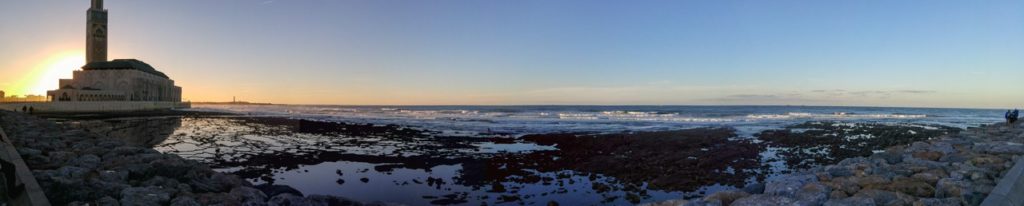
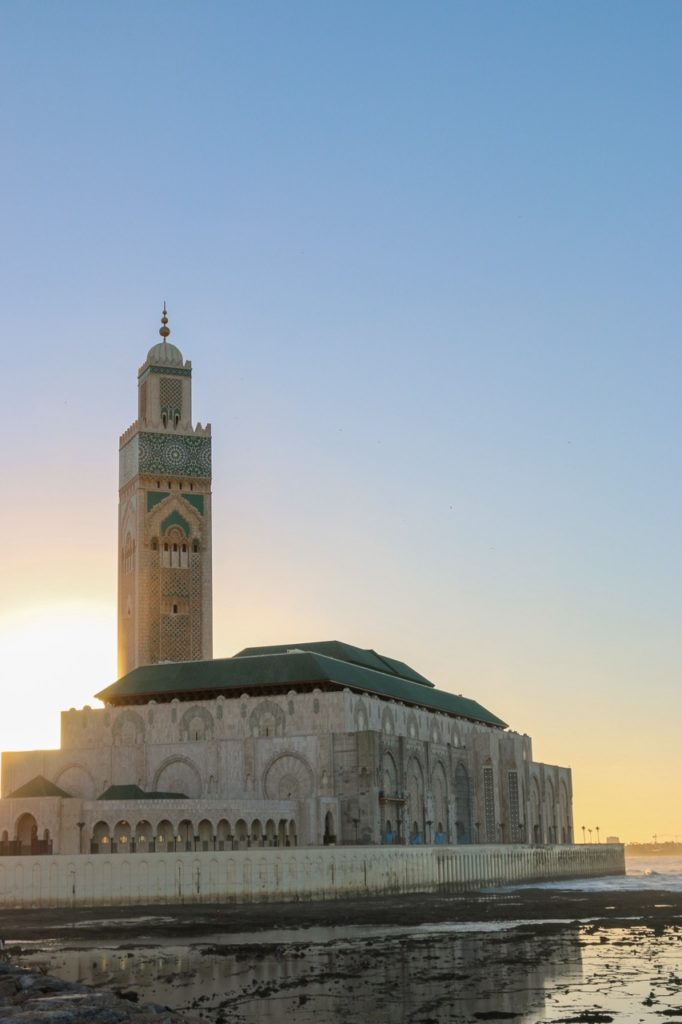
About the only thing worth seeing is the Hassan II Mosque, said to be the second (or third – depending on your source) largest mosque in the world. This behemoth piece of architecture sits rather gracelessly on a mount that juts slightly out toward the sea, protected from the Atlantic’s pounding by massive sea walls. It’s a fairly contemporary structure, built in the late 20th century by the Sultan whose name it bears, and boasts the tallest minaret in the Muslim world. I’ll leave aside speculating about the Sultan’s need for this enormous construction. The whole affair was framed, as if composed for the purpose, in the view from our 9th floor room. The “Big Mosque”, as the locals call it, does display some wonderful craftsmanship, but in all, I found it to be relatively artless. Perhaps, after our trip to Istanbul, all other mosques will seem crude. But, of course, size matters . . .

We were back on the train around noon Wednesday, headed for Fez and Riad Idrissy where we had booked three nights. All these hours of touring by train have really underscored the agricultural nature of Morocco. This is fertile farmland in a wonderfully temperate climate. Several times Bonnie and I have commented on how much it sometimes feels like California in that way.

The Labyrinth

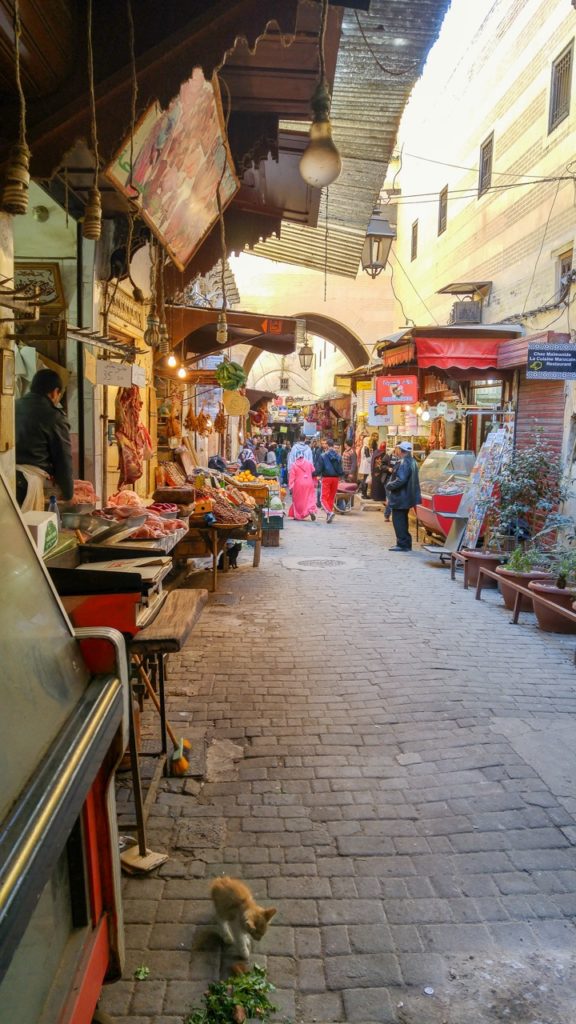
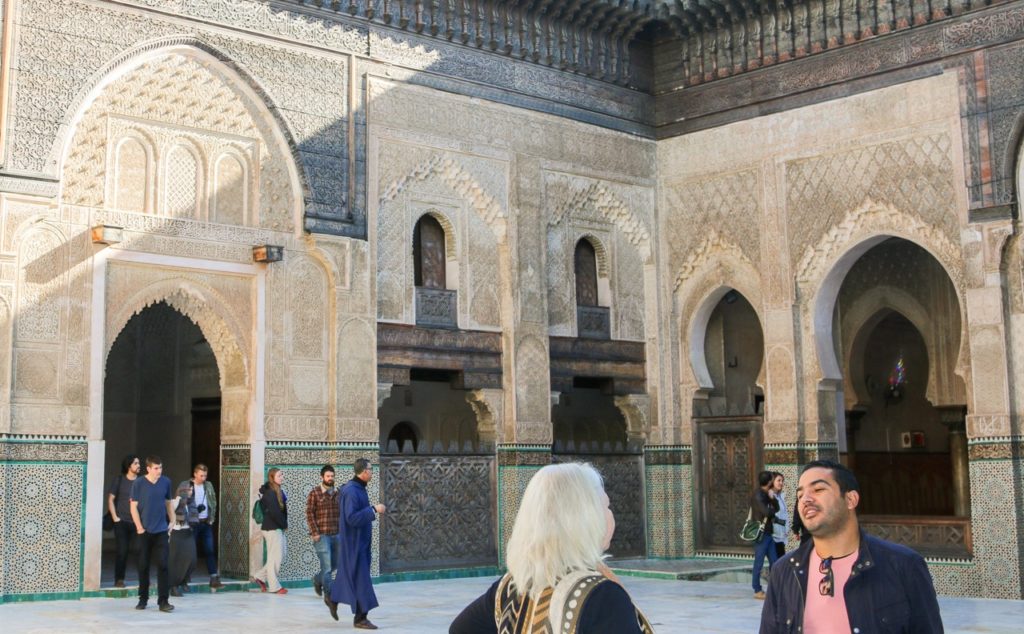
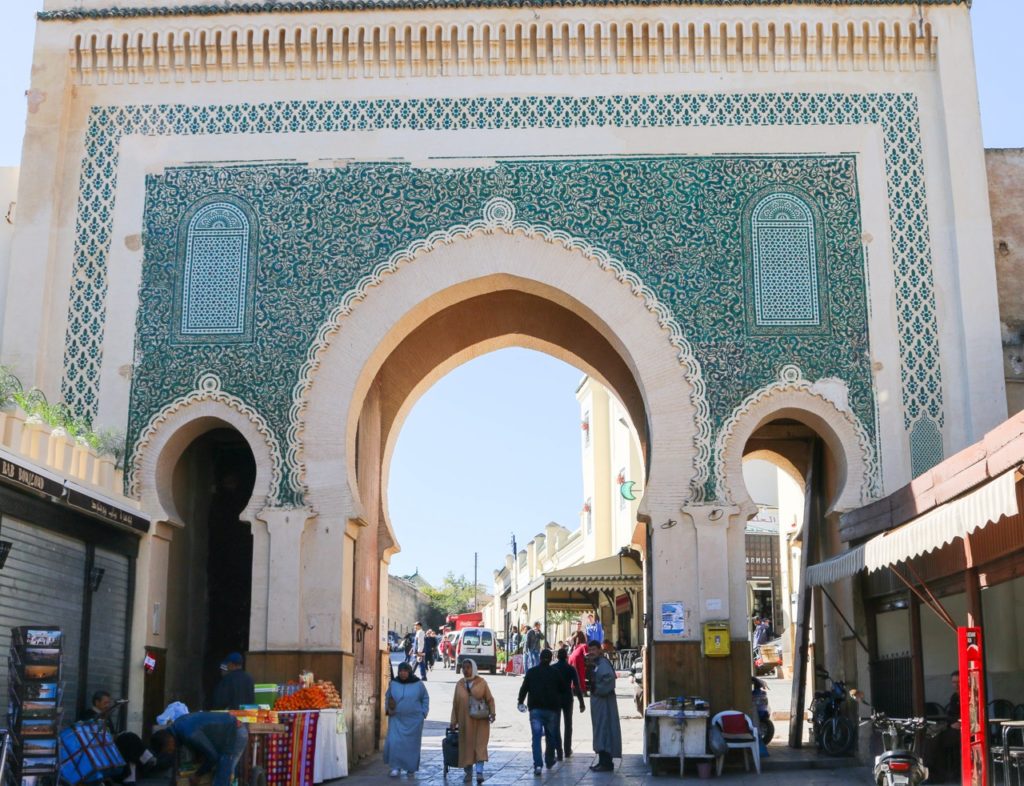
We were met at the Fez train station by a driver who delivered us to one of the gates, or babs, in the medina wall. Here we were met by an escort, with a balloon-tired pushcart for our luggage, who would guide us to the riad. You see, there are no motorized vehicles allowed into the old city at all. Once inside the walls, the only mode of transportation is your feet. Our riad was a 15-minute walk from the closest bab over cobble stone lanes that suddenly made the streets in the Marrakesh medina seem like broad boulevards laid out in orderly fashion. The Fez medina contains well over 9,000 lanes and alleyways in a confused maze that only a native of the city can possibly navigate. Robert, our English host, has lived in the Fez medina for five years, and acknowledged that he regularly gets lost. Adding to the fun, Fez is built on a hillside, meaning, that these alleyways are rarely level – very often steep enough to require steps and stairs.

Riad Iddrissy was a family home built some 300 – 350 years ago, and displays the typical ornate carvings, intricate tile work, and ornamental plaster that any successful, self-respecting merchant of the 17th century would be compelled to cover the interior of his home with to demonstrate his wealth and success. In addition to the riad, the owners acquired the abandoned property adjacent to the house which contained the collapsed ruins of another home and had become the local trash dump. Here, after clearing the site (it took six burrows, six months) they created a very informal garden restaurant, punched openings into the riad, and assembled an altogether charming, full-service hotel. The bad news is that this is a four-story building and let’s just say that 17th century building codes relative to stairs were different from our modern expectations. In addition to the 12” rise, no two treads are the same. As Robert said, “They’re built as if each one was the mason’s first ever.”

Thursday we were met mid-morning at the Riad by Yunis, our guide for the day who led us through many of the cultural highlights of Fez, including a stop at the oldest continuously operating university, founded in the 8th century. (I haven’t verified that claim about being the oldest, but given what was going on in Europe in the 8th century, I doubt there was any competition coming from there.) It was at that time, it seems that a particularly learned and progressive sultan came to Fez with the goal of turning the city into the cultural and intellectual heart of Morocco, and Islam. And, for a thousand years, that is what it became. Sultans and dynasties came and went, but the intellectual energy created by the establishment of that first university sustained Fez for centuries, up until the colonial era when Europeans began to dominate and exploit the culture.

Our education continues

Yunis, it turns out, is in the process of completing a dissertation for his PhD in Arabic literature. He completed two years of graduate work on a full scholarship at UCLA, where he has a standing offer to return and teach – an offer he is unlikely ever to accept because of his devotion to his heritage, and to Fez. Our day with him was a crash course on Islamic culture and life in the medina that we will long treasure. He was equally eloquent and informed whether the subject was terrorism or the question of why there were cats everywhere. As we strolled, he brought the medina to life for us, changing the inhabitants from costumed backdrop to vital, striving people whose daily concerns and responses to life were reflected in a hundred details around us for which we had no eye.

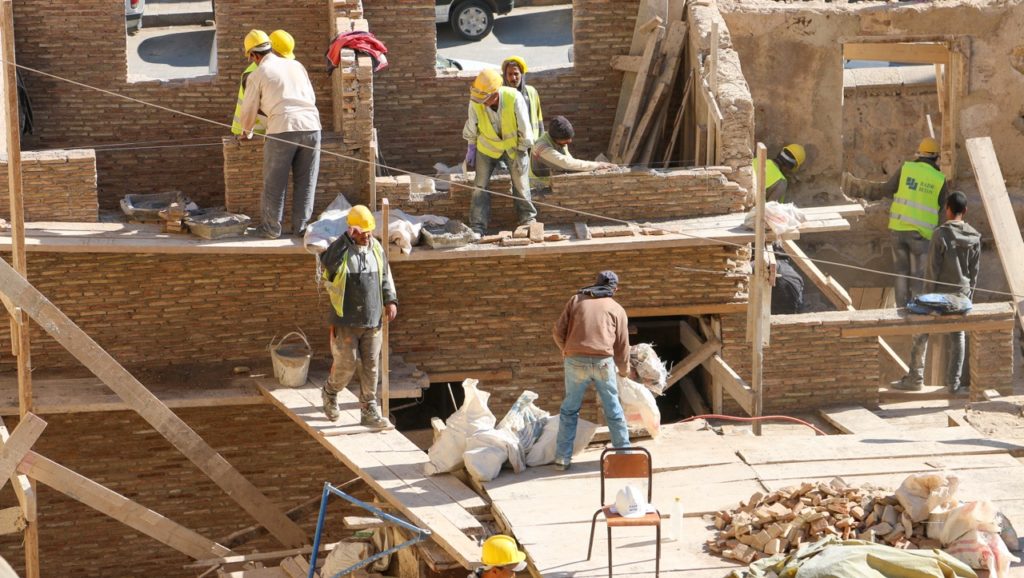
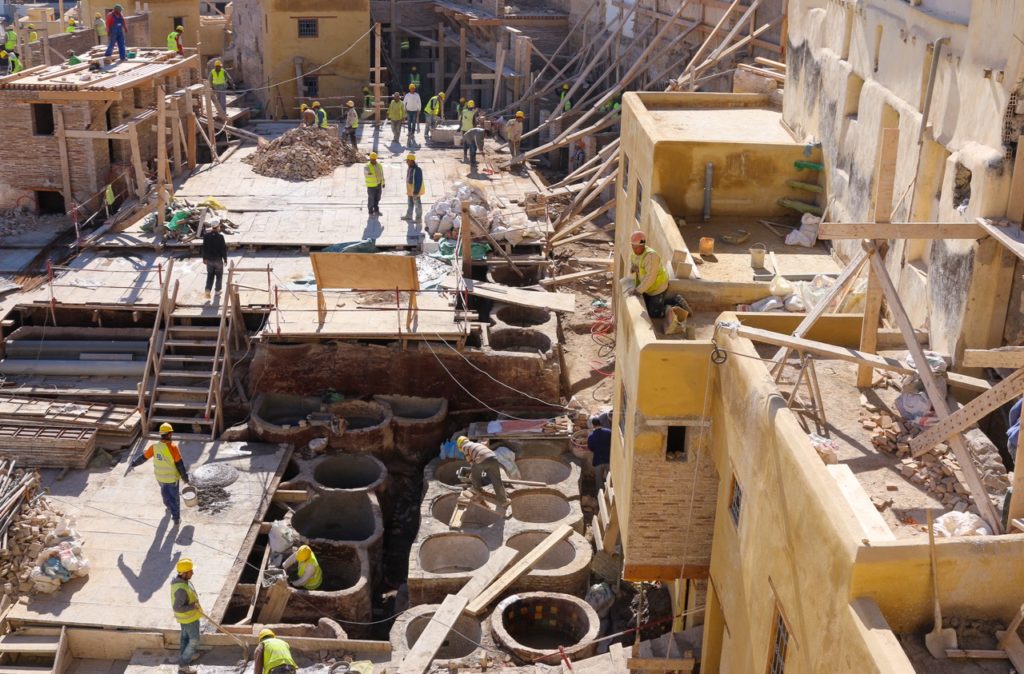
Another highlight of the day, for me at least, was a visit to the tannery section of the city. The tanneries date from the 9th century and have been in continuous operation since. Normally, I am told, the stench of the open tanning vats is nearly unbearable. However, on this occasion there was no smell and, alas, no leather. That’s because as part of the UNESCO World Heritage designation that has been given to the Fez medina, they are restoring the tannery. But this is no decades long, painstaking restoration by archaeologists. These people depend on the tannery as a job producing, economic engine. They need it back in working order, UNESCO or no. So, what you see today when you visit the tanneries is a work site with more than 150 workmen going at it 24 hours a day to rebuild and restore every element to its original working condition by the end of the year. I was suddenly on a job site, again! It was glorious. I have pictures.

Friday, I couldn’t make the bell when it was time for our Moroccan cooking class. We spent the day resting and feeling sorry for ourselves. In the evening, we snuggled into bed and shared an iPad viewing of “Casablanca” in which it became clear to me that Rick’s Cafe was not even close to the “real thing.”

We are treating ourselves to the Marrakesh Four Seasons, tonight, and if we are recovered enough, one last night out in the Kasbah.

All our love,

Ed and Bon

Marrakesh – A look Back Read More »
January Adventures

Gran Canaria

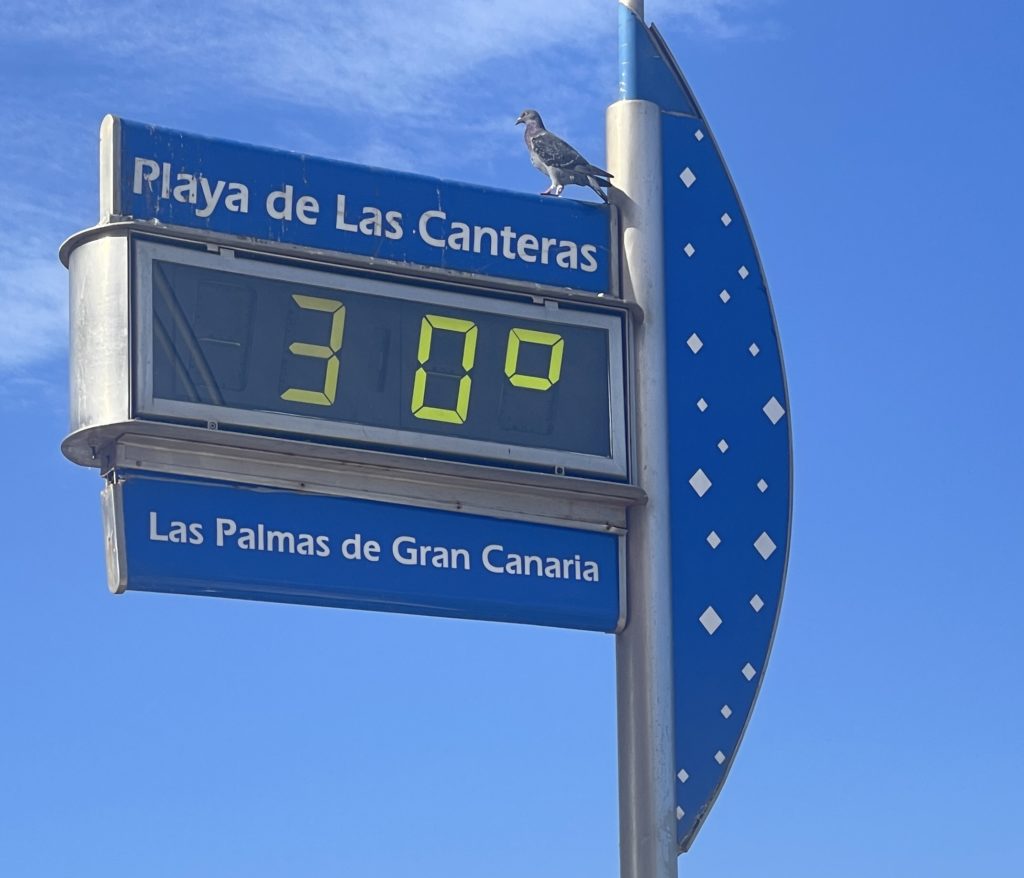
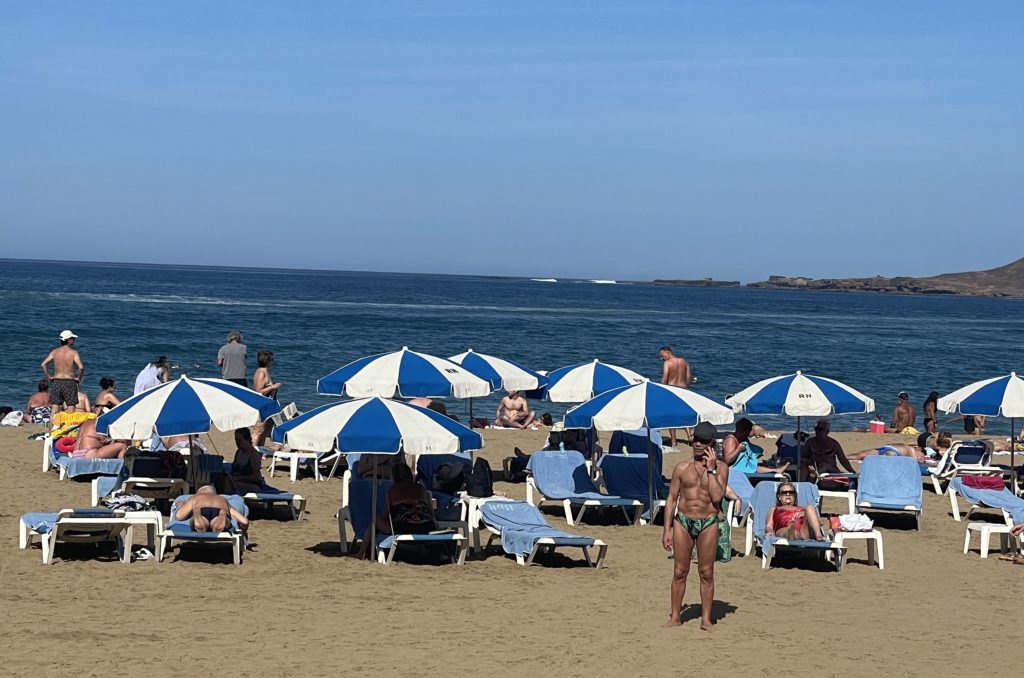
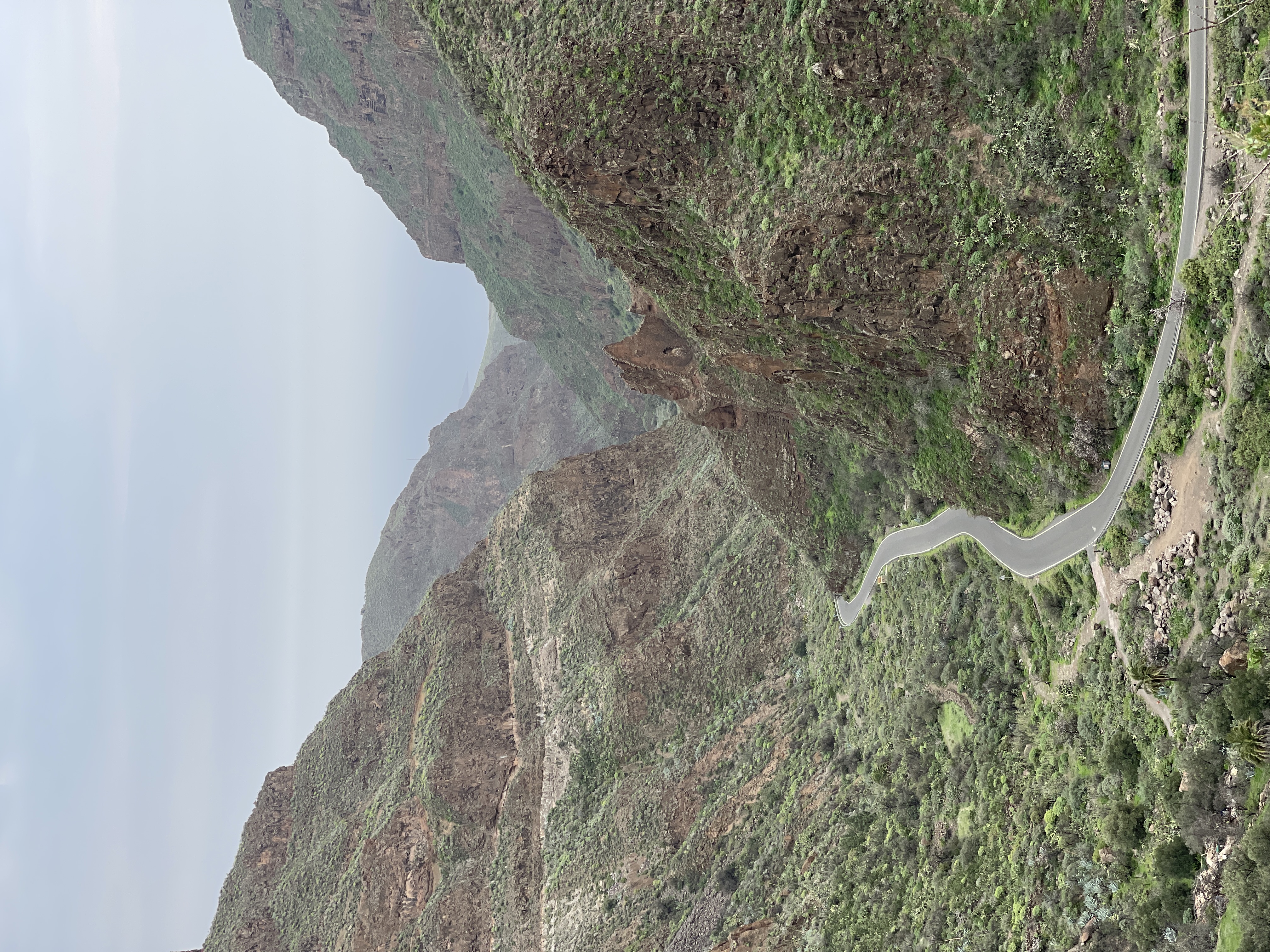
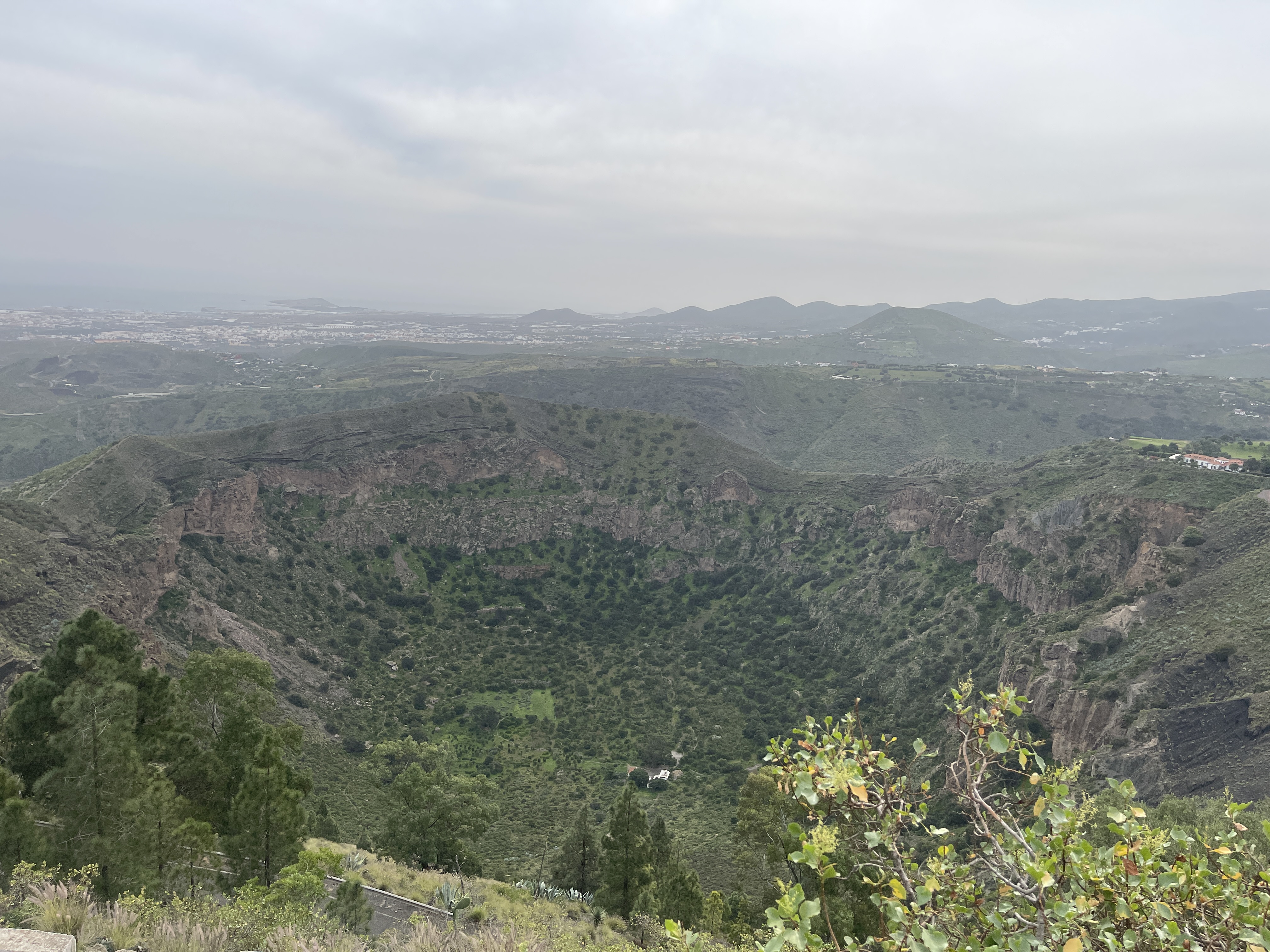
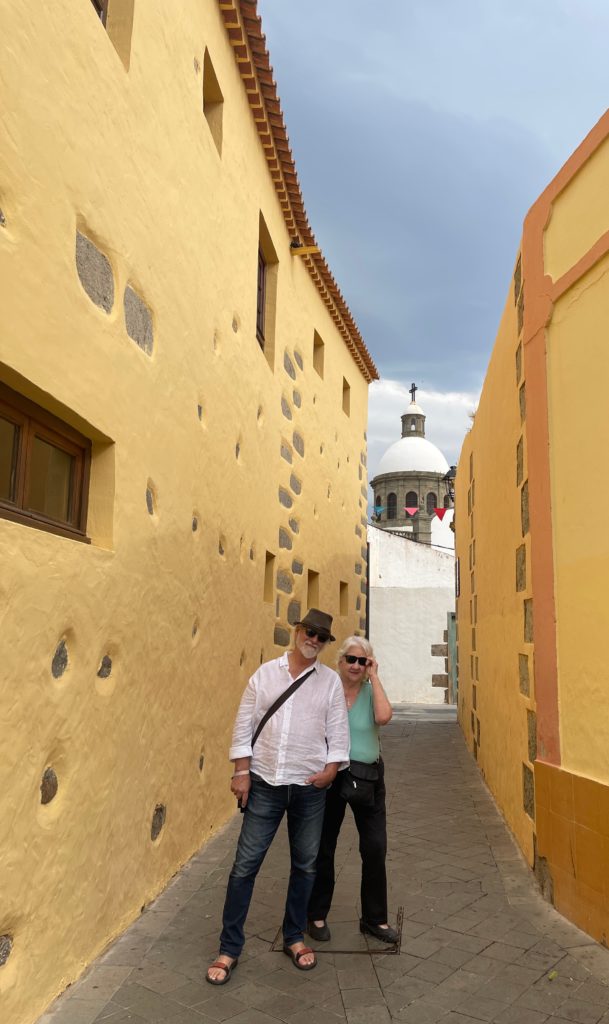
The first weeks of January have been busy and quite wonderful. In the middle of moving to a new apartment (which we love), we popped over to Gran Canaria (Canary Islands) for a few days. It was warm (think 80’s), sunny, and beautiful. Not a bad way to spend a January birthday!

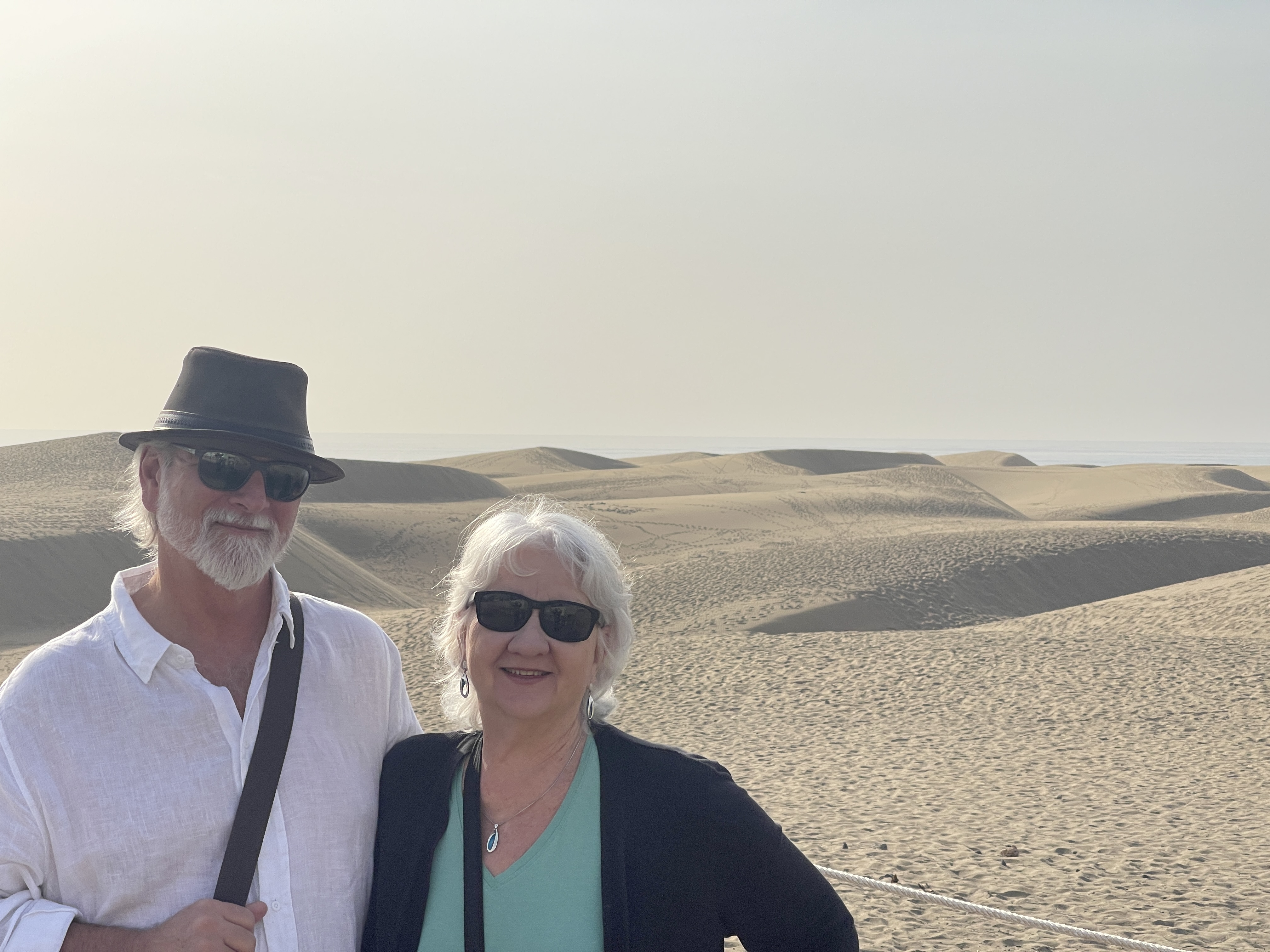
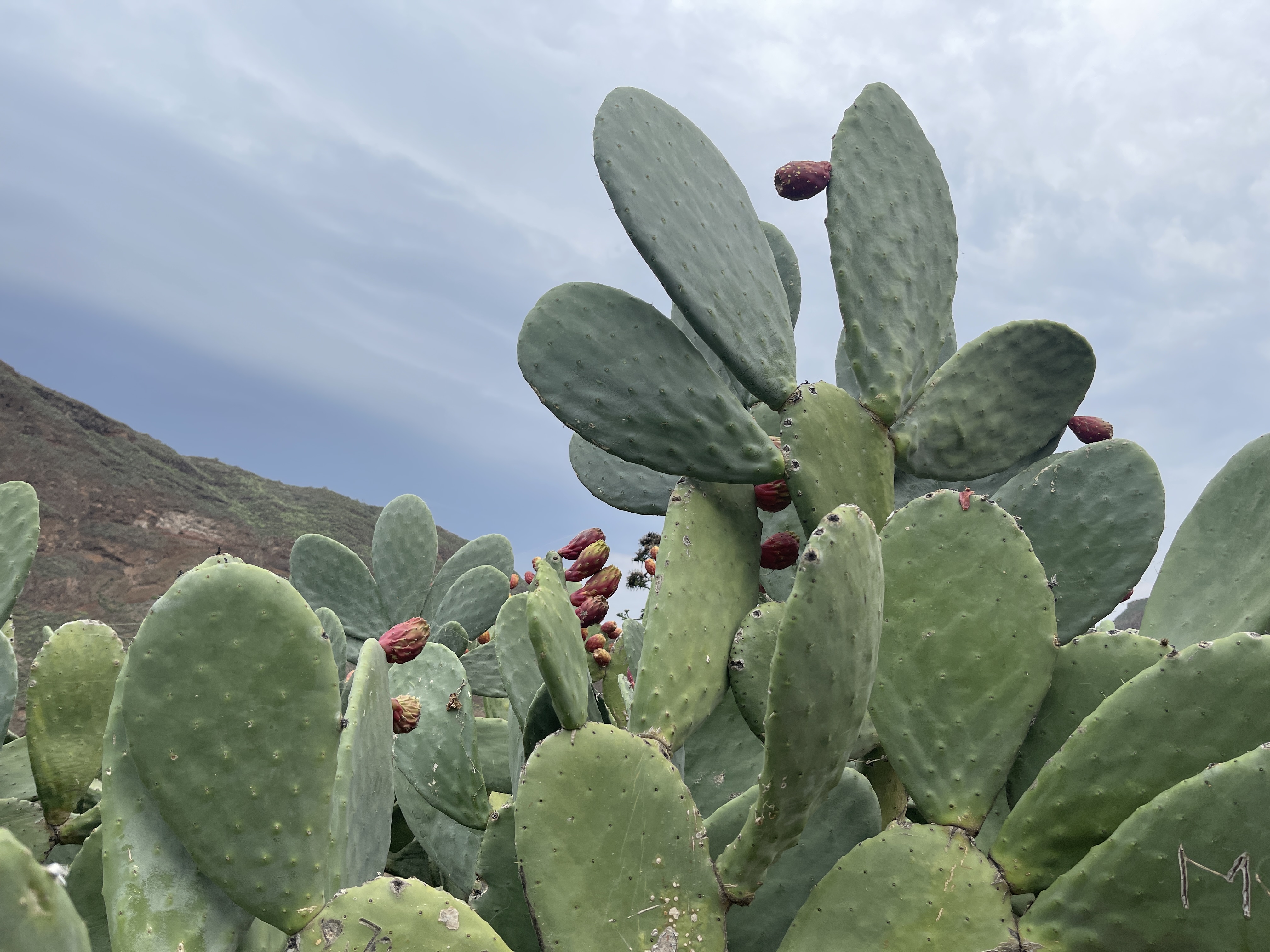
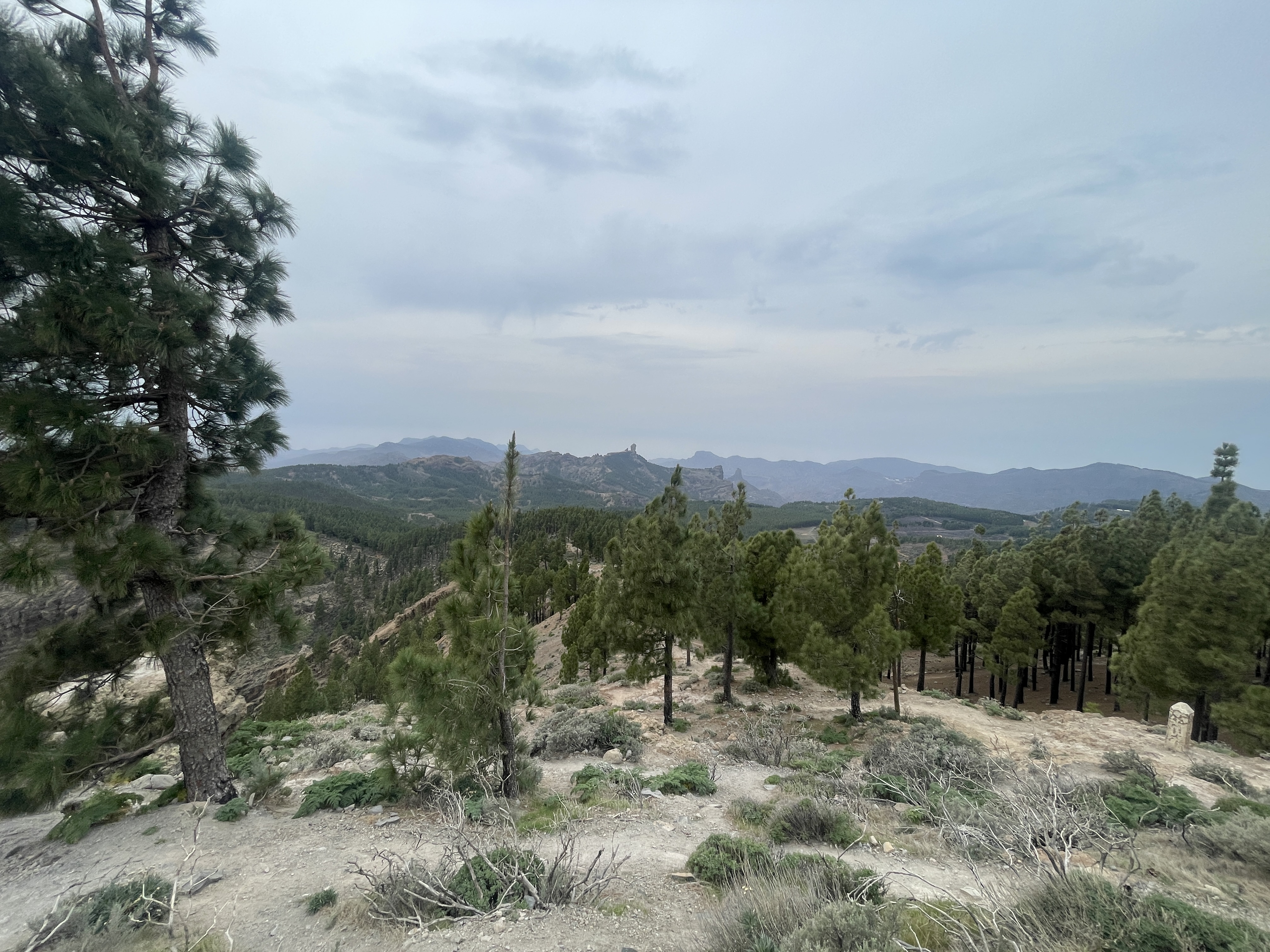
Of the 8 Canary Islands, Gran Canaria is the 3rd largest (a little bigger than the city of Houston, TX) and the most biodiverse. Of course, there’s the beaches crammed with tourists in bikinis, but there’s also several kilometers of pristine sand dunes, mountains, deep ravines, volcanic calderas, cave dwellings, charming villages, and pine forest. It’s fitting that Gran Canaria has been called the world’s smallest continent with its diverse landscapes and extreme microclimates.

A Wine Adventure

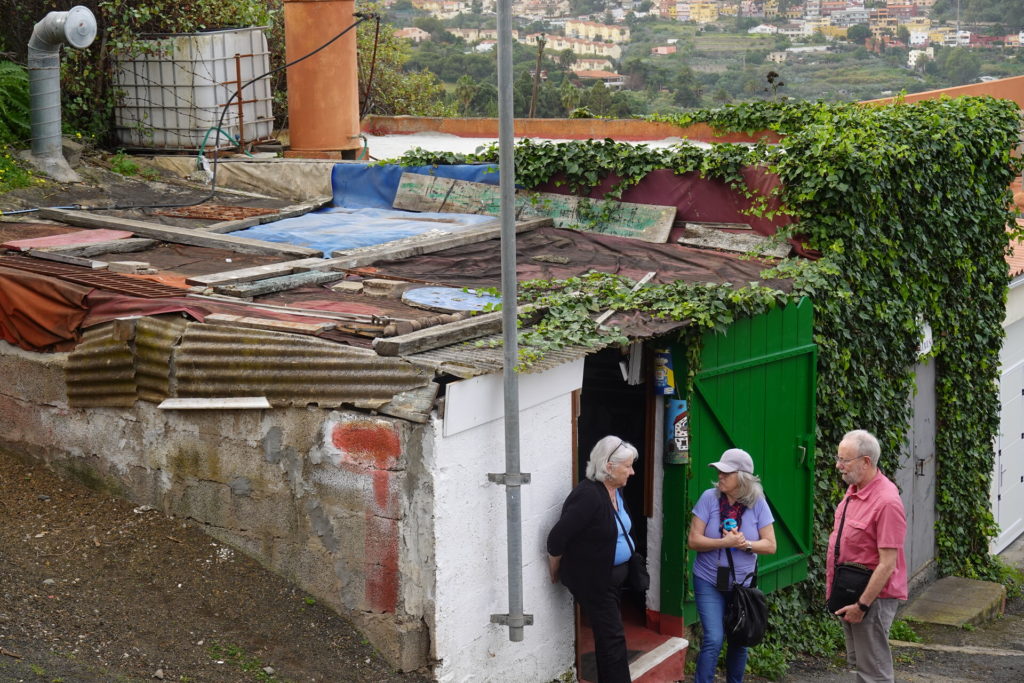
As you know, we love wine! So, I booked a wine tasting tour on Gran Canaria and it was an entirely unique experience. We met our guide, José and three other oenophiles at the central market in Las Palmas (capital city of Gran Canaria). After winding our way through the beautiful countryside, we stopped at a winery to pick up a bottle or two. It turns our main destination was what José referred to as a “club” where the locals hang out to drink wine…and just be together (it’s that Spanish social thing, as always!).

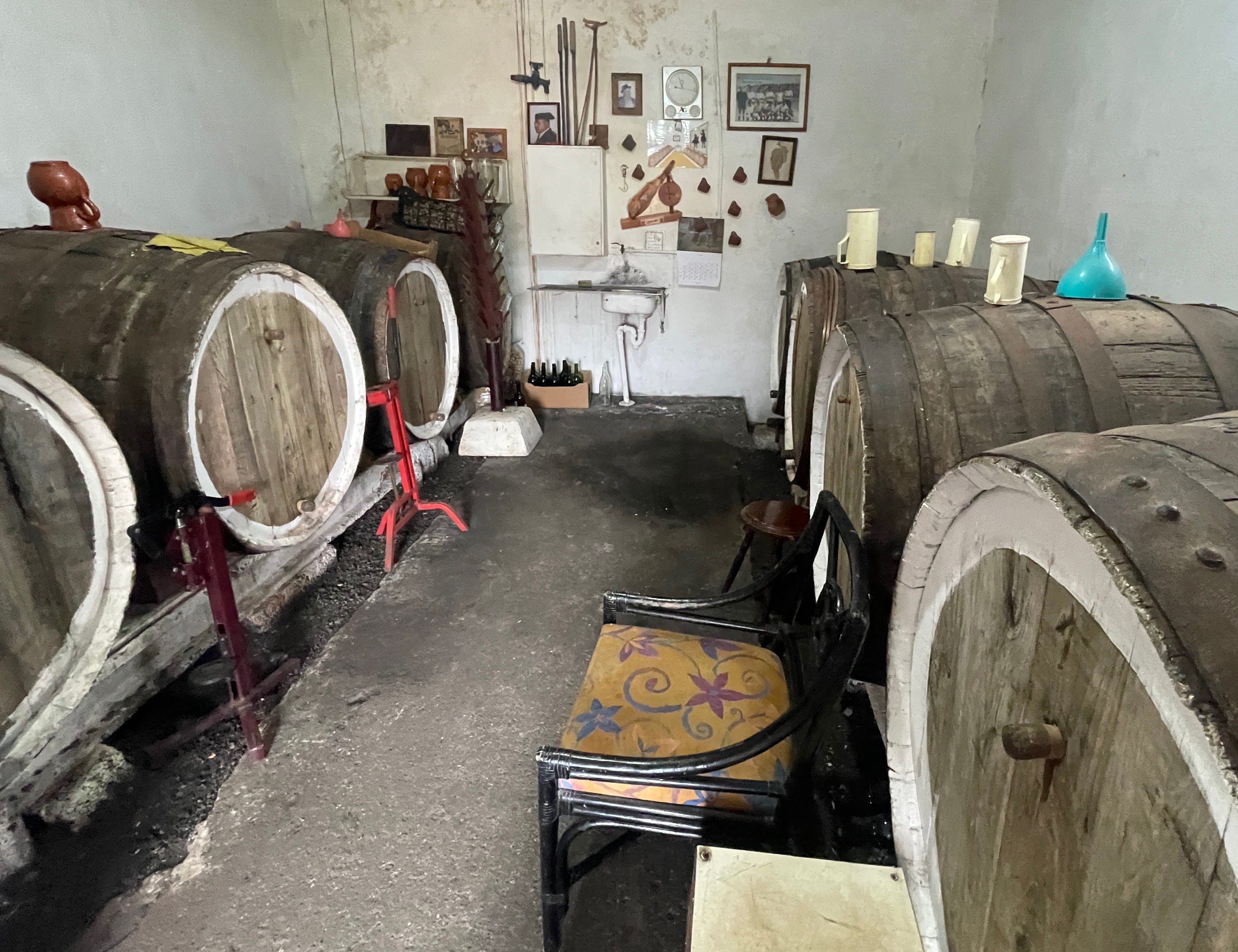
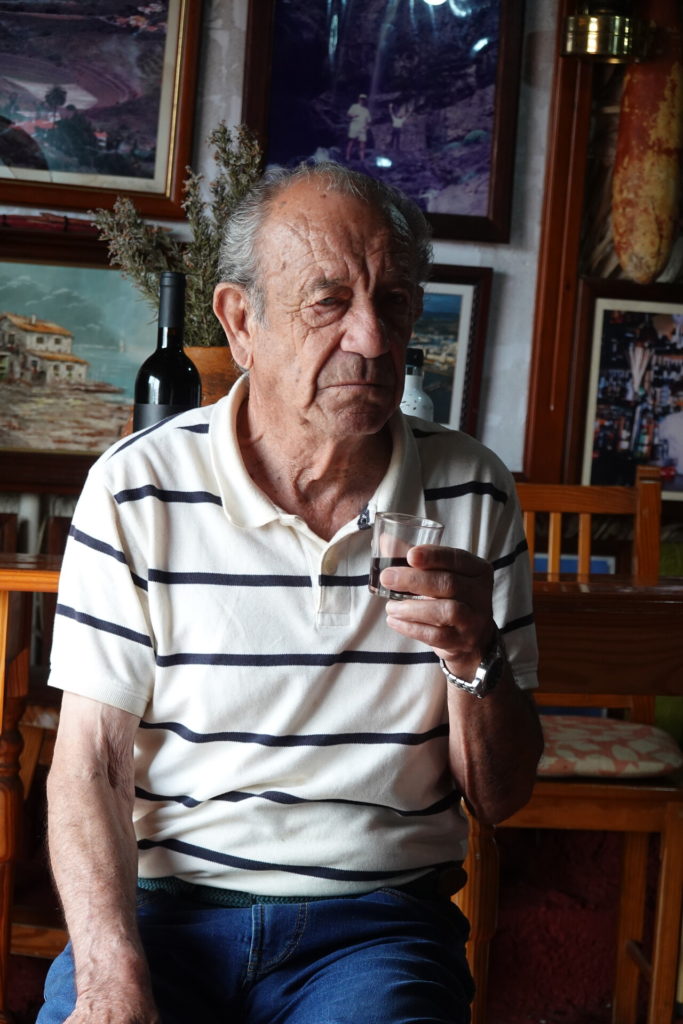
The owner of the club is a vintner in his 70’s who learned wine making from his father and grandfather. He harvests the grapes himself, crushes them using the stomp-on-them-with-your-feet method, and fills about a couple barrels each year. We’re talking totally au natural – just grape juice in a barrel – from this year’s harvest. To retrieve the wine, we all filed into the garage next door where the proprietor produced a glass pitcher, bent down, and opened the cock on the front of an old oak barrel, and began filling it directly from the barrel.

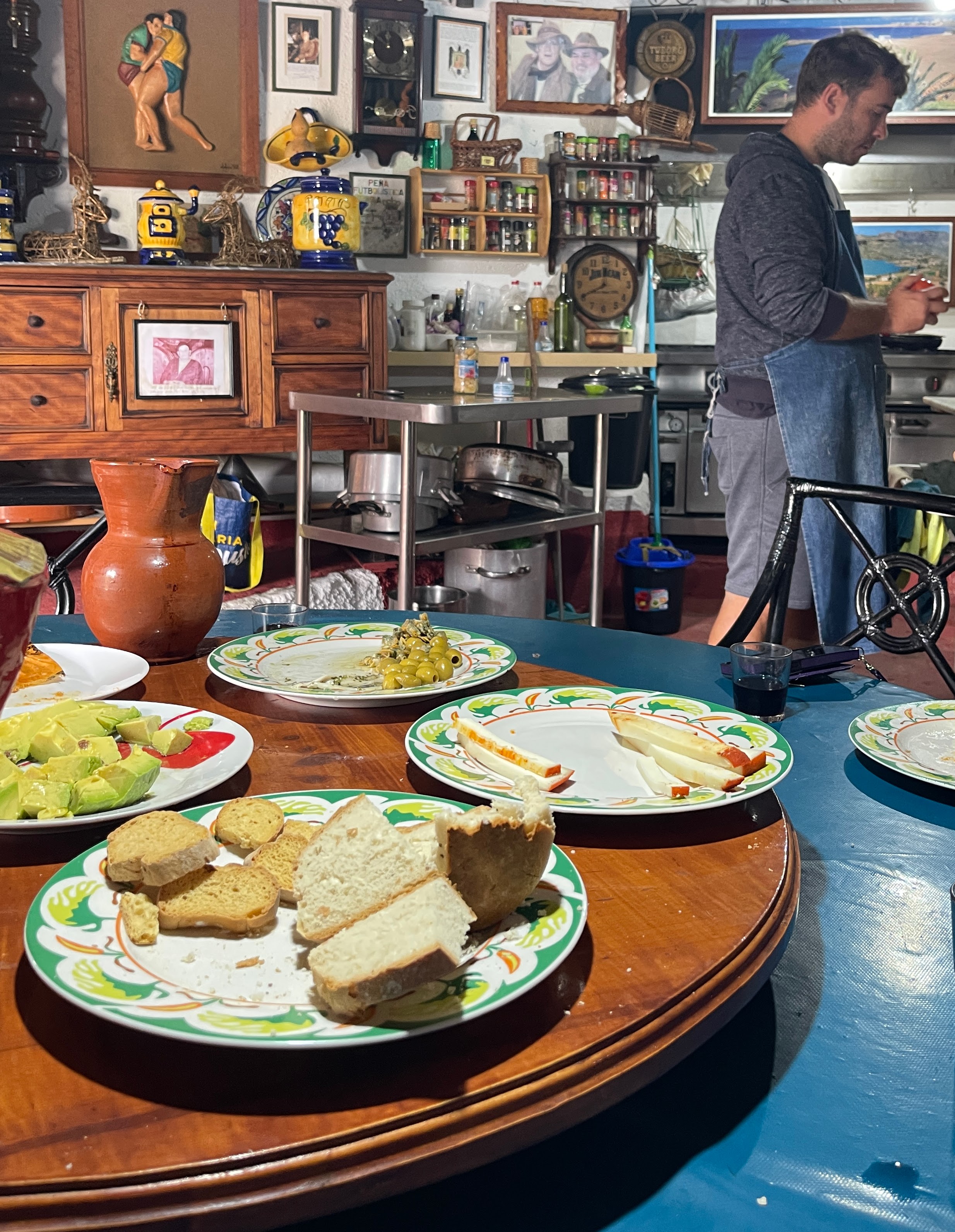
José served a delicious lunch, and we sipped wine, talked, and laughed, sipped more wine (the pitcher made a couple more trips to the garage) laughed more . . . . After a couple of hours, we had made some wonderful new friends! Oh yes, and the wine was delicious: deep ruby colored, fruity, fresh, lightly tannic, about 14% ABV. What a great wine tasting.

Back in Valencia – our “secret” treasure

Meanwhile, life in Valencia we’re settling in and feeling quite proud of our new city. When we chose Valencia back in 2022, it felt as though we’d discovered a little-known European treasure. It turns out the rest of the world has caught up.

Inspiring Places to Visit

Every January, we eagerly await and then carefully study the New York Times annual “52 Places to See in . . . ” article. Well, this year, Valencia made the list!  https://www.nytimes.com/interactive/2024/travel/places-to-travel-destinations-2024.html 

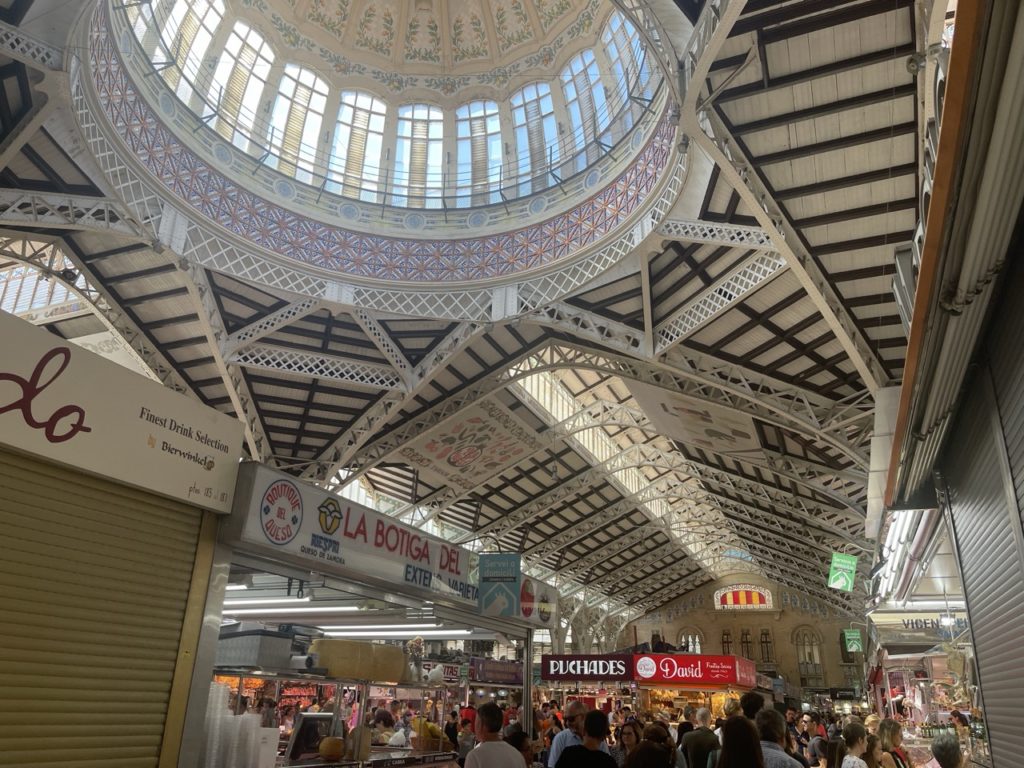
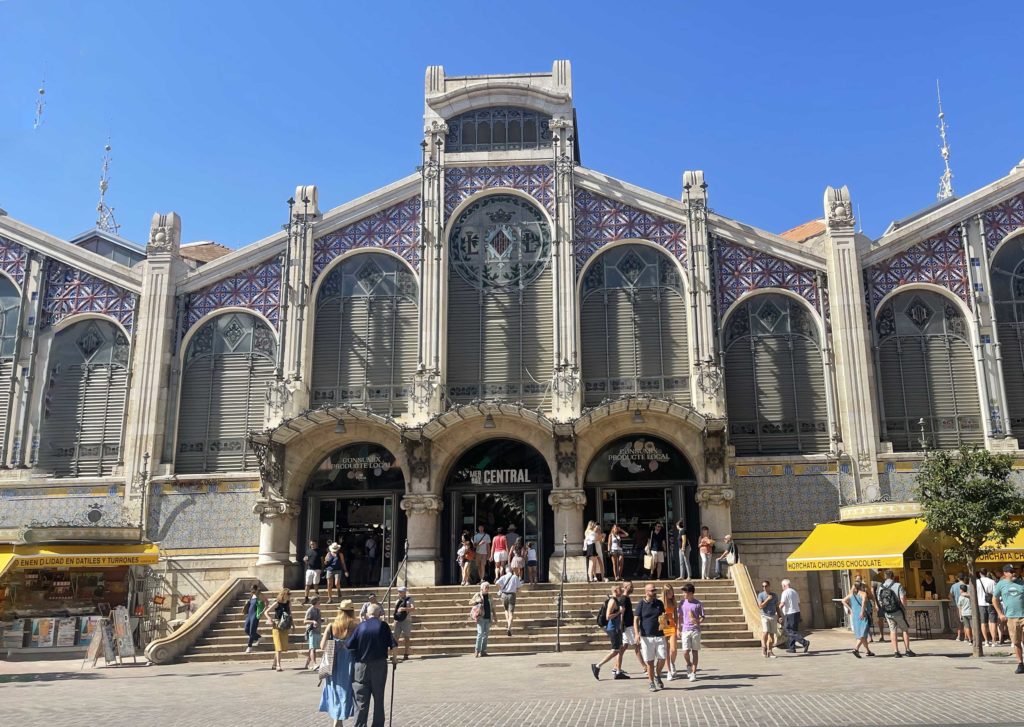
This is both good news and not-so-good news. We’re already checking the cruise ship schedules to plan our day around the throngs of tourists checking out our grocery store – the amazing Mercat Centrale.

It’s Not Easy Being Green

As mentioned in the NY Times article, Valencia is the winner of the “European Green Capital Award” for 2024. This award recognizes and rewards “local action towards a transition to a greener, more sustainable future” – very cool, right? Check it out: https://environment.ec.europa.eu/topics/urban-environment/european-green-capital-award/winning-cities/valencia-2024_en

So, pack your bags and come on over for a visit to our wonderful city. To entice you a bit, here’s the Valencia tourism site to peruse: https://www.visitvalencia.com/en 

In the meantime, we’re headed out to an artichoke festival!

January Adventures Read More »
A QUICK TRIP SOUTH

SALUDOS DESDE VALENCIA!

Typical of us, we only stayed put in Valencia for a couple of weeks after arriving on the first of November. We boarded a train to head south. Our first stop was an overnighter in Madrid to see a special Picasso exhibit at the Reina Sophia – Spain’s national museum of 20th century art. This is one of more than 50 exhibits around the world celebrating Picasso’s work at the 50th anniversary of his death. The exhibit at the Reina Sophia includes only works completed in 1906, a transformational year for Picasso. It was fascinating to see these early works and other than marveling at his (obvious) incredible talent, I loved seeing the early genesis of his influence on modern art.

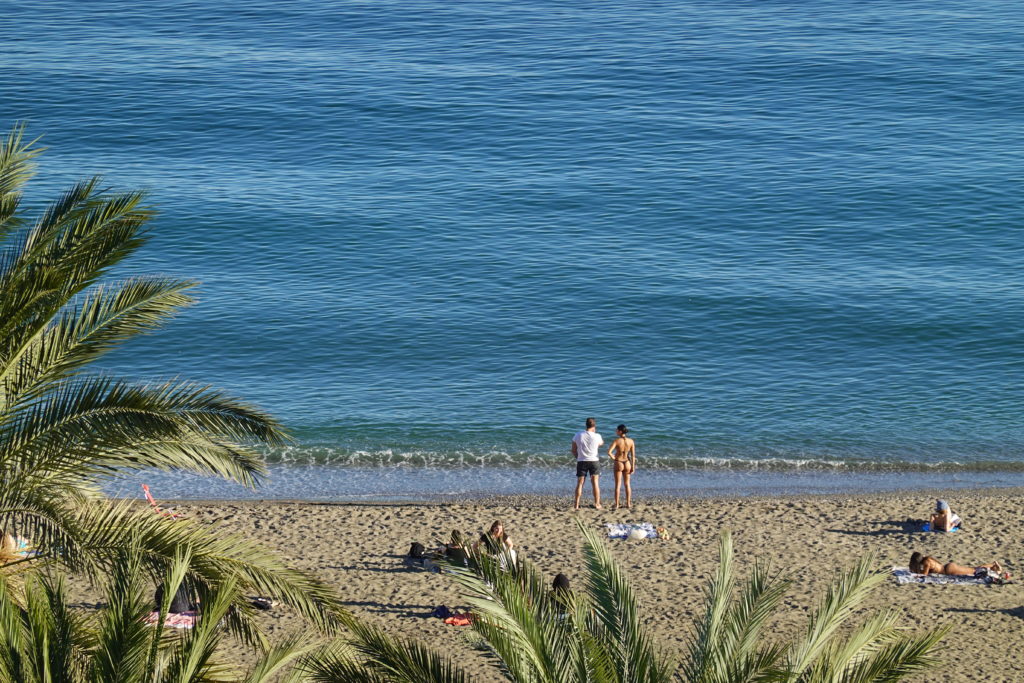
After a wonderful 24 hours in expansive, bustling, regal Madrid, we boarded a train for Malaga. Sitting on the beautiful Costa del Sol, Malaga is part of the autonomous region of Andalusia. The sixth largest in Spain (Valencia is #3), Malaga is a vibrant port city with a rich history, stunning Mediterranean beaches, and great food. It’s famous for its ancient landmarks such as an 11th century fortress (the Alcazaba https://visita.malaga.eu/es/que-ver-y-hacer/visitas/monumentos-historicos/monumentos/alcazaba-p103303) and a Roman Theater. Malaga also happens to be the birthplace of Picasso.

We were delighted to have our dear friend, Susan, join us in Malaga. We spent several days exploring Malaga, hanging out at the beach, enjoying a flamenco show, and spending time talking about life. A day trip by train to Cordoba was a highlight and while it was our second time in Cordoba, and we’d happily go back!

HOLIDAY CHEER

When we arrived back in Valencia, Christmas decorations were everywhere – Christmas trees in the major plazas and lots of lights strung about. Our weather has been a near perfect mid-60’s to low 70’s, although it’s getting cool at night dipping into the 40’s occasionally.

This week we are celebrating two major holidays. Wednesday, December 6 is Spanish Constitution Day. This national holiday marks the day when the country’s constitution was approved by the Spanish people – a crucial step in Spain’s transition to democracy following the death of Franco in 1975.

Friday, December 8, while not a national holiday, is a Christian holiday that commemorates the immaculate conception of Mary. Most people take off the Thursday in between and enjoy a 5-day weekend! It’s a festive time in Valencia!

We’re participating in the IWC Valencia annual “Adopt a Child” program which involves buying Christmas gifts for needy families. We’ve had a great time shopping for gifts for a family with six children (ages 8-15). Interestingly, the Spanish tradition is to exchange gifts on January 6 honoring the arrival of the Magi.

LIFE’S LITTLE DETAILS

Our days are so full that we decided to use a project management app to keep track of all the things we need/want to do. (This might also have something to do with our obsessive personalities.) Daily life here includes lots of walking, but we decided to join a gym to up our game on the fitness front. We’ve been eating at home more (again, trying to be healthier), getting together with expat friends, and doing lots of travel planning.

Ed keeps busy too! He’s enjoying shopping for food at our fabulous Mercat Centrale. Just a 5-minute walk from our flat, Mercat Central has an amazing array of fresh produce, incredible seafood, and many other yummy things!  Besides being one of the largest and oldest markets in Europe, it’s also but also a cultural and architectural gem in the heart of Valencia’s old city.

Ed is also busy working on getting a Spanish driver’s license. Since we have been residents of Spain for more than 6 months, we are no longer able to drive in Spain using our International Driving permits. It’s quite a lengthy and onerous process, but he’s making progress. I’m content to be the passenger!

COMING UP

Next up is a 4-day get-away to Barcelona. It’s a 3-hour train ride and we’ll be there from December 20-24. We’ve booked a culinary walking tour in a not-so-touristy neighborhood https://culinarybackstreets.com/tours-food-tours/tours-barcelona/2016/day-sants-feasting-off-grid/ and tickets for a fútbol game the night we arrive. Ed’s very excited about that one.

Happy Holidays!

A QUICK TRIP SOUTH Read More »
Scroll to Top