Germany

Kraków: Facing History, Embracing Hope

Sandy Beaches to City Streets

After an idyllic week of sun, sea, and Greek salads on the island of Kefalonia, we exchanged the relaxed warmth of sandy beaches for bustling city streets as we flew north to meet friends in Kraków, Poland. Our good friends from Sacramento, Debby and John, were planning to spend a few days in Kraków after finishing up a Budapest to Prague river cruise. And our Valencia friends, Mary and John, were also going to be in Kraków the same week. Admittedly, Kefalonia to Kraków is an unusual itinerary, but when it comes to spending time with good friends, we’re always ready for an adventure.

A Brief Slovakian Stop

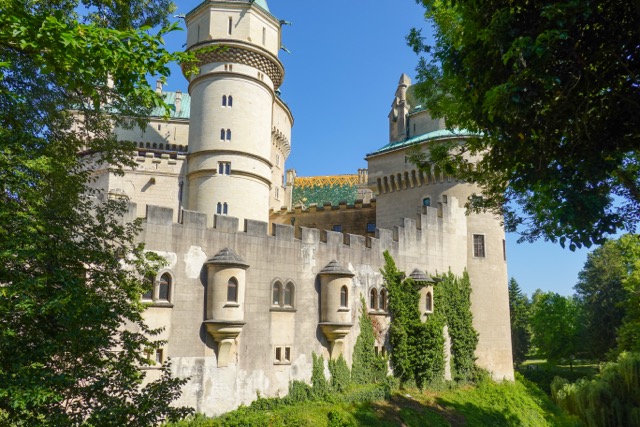
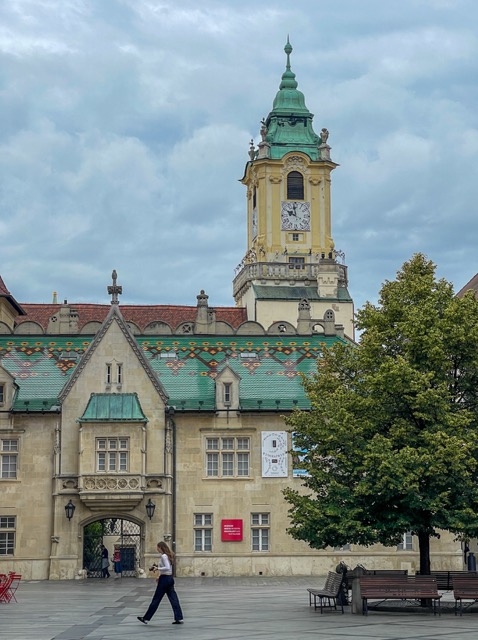
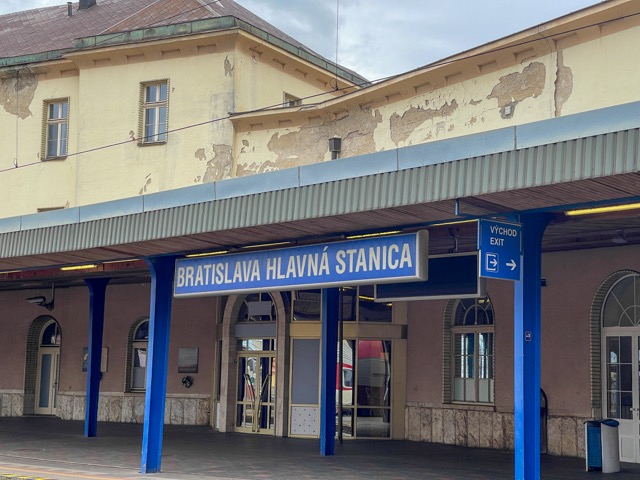
The first leg of our journey began with a two-hour flight from Kefalonia to Vienna. Tempting as it was to stay a few days in the Austrian capital, our curiosity got the better of us and we hopped on a bus to cross the border into Slovakia. We had just one full day to spend in Slovakia and made the mistake of booking a “five castle tour” in the countryside outside of Bratislava, Slovakia’s capital city. While Slovakia boasts more castles per capita than anywhere in the world, we were disappointed with the tour (beginning with the fact that our guide had laryngitis). Nevertheless, Bratislava has captured our interest, and we’ve added it to our “we need to go back there” list. We’re thinking two weeks split between the urban delights of Vienna and Bratislava as well as some down time in the villages and towns of the beautiful Carpathian Mountains, along with a bit of cruising on the Danube. Maybe three weeks!
One of Travel’s Greatest Gifts

After two nights in Bratislava, we boarded a six-hour train bound for Kraków which turned out to be a highlight of the trip. We struck up a conversation with Matthew, an American who has called Poland home for the past three decades. A luthier by trade, Matthew shared stories of his four-year apprenticeship with an Italian master in Rome and his decision to specialize in crafting instruments for Medieval, Renaissance, and Baroque music (https://www.earlymusicinstruments.com/main). The hours flew by as we chatted—a perfect reminder of one of travel’s greatest gifts: the people you meet along the way.
The Square at the Heart of Krakow

Dating back to the 13th century, Rynek Glówny, the main square at the center of Kraków’s old town, is the largest medieval square in Europe. Laid out in 1257, the square was designed to be the hub of the city, and it serves this same purpose today. Filled with medieval era buildings, horse-drawn carriages, a 14th century brick gothic church, and more sidewalk cafés than one can count, its vibrancy feels timeless. 
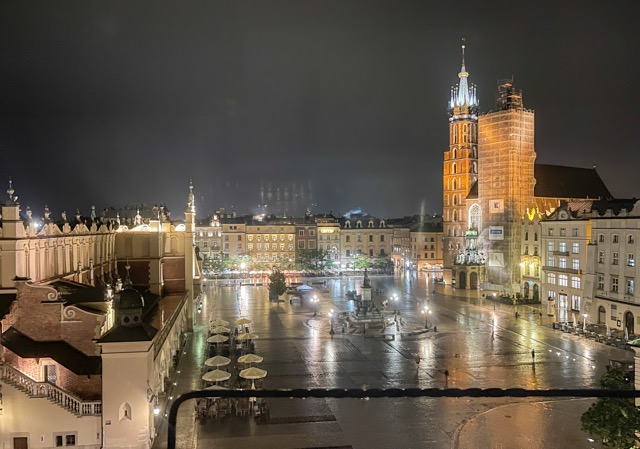
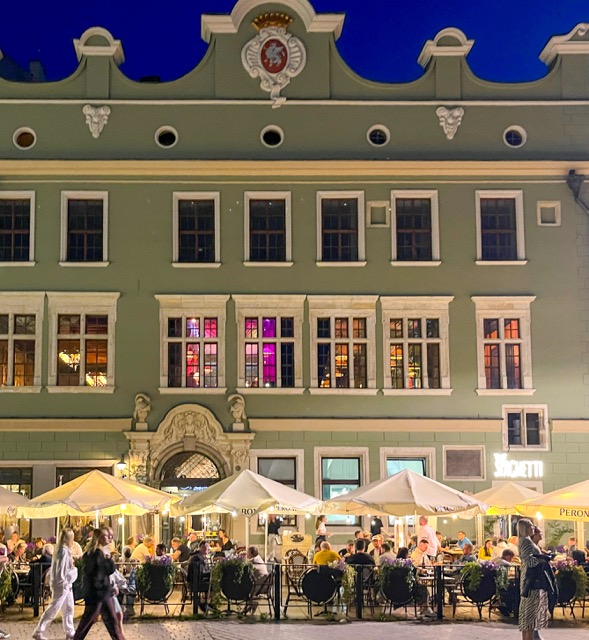
One half of Kraków’s Main Squareafter after a light evening rain.
A Medieval Masterpiece

St. Mary’s Basilica, a masterpiece of medieval architecture, dominates the square and the surrounding skyline. The asymmetry of the two towers catches your eye. The taller one, at 80 meters, is almost double the height of the shorter one and the explanation for this goes back to the Middle Ages.
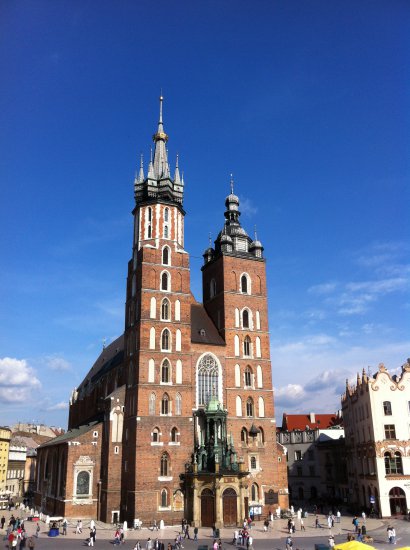
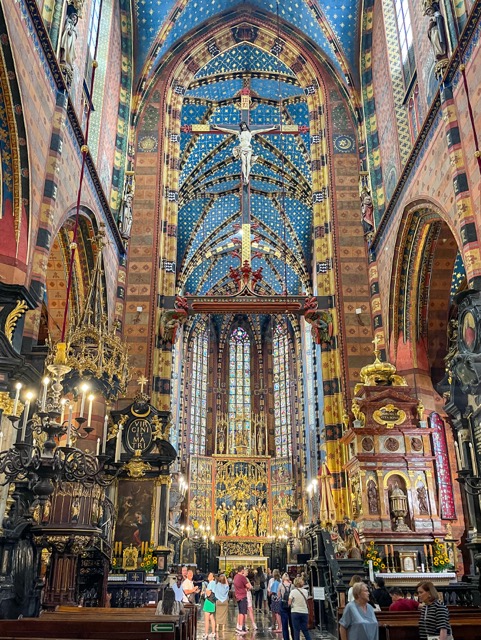
Under the reign of Duke Boleslaus the Modest (Bolesław Wstydliwy, 1243-1279) a decision was made to add two towers to the body of the church standing by the Main Market Square. Soon two brothers embarked on the task. When the younger realised that his tower was much shorter, he murdered his brother out of envy, and the construction stopped. However, the murderer was wracked with remorse: on the day when the church was to be consecrated, he pierced his heart with the same knife he used to kill his brother, and dropped dead from the top of his tower to the ground below.

https://krakow.travel/en/artykul/117/legend-of-the-two-towers-of-st-marys

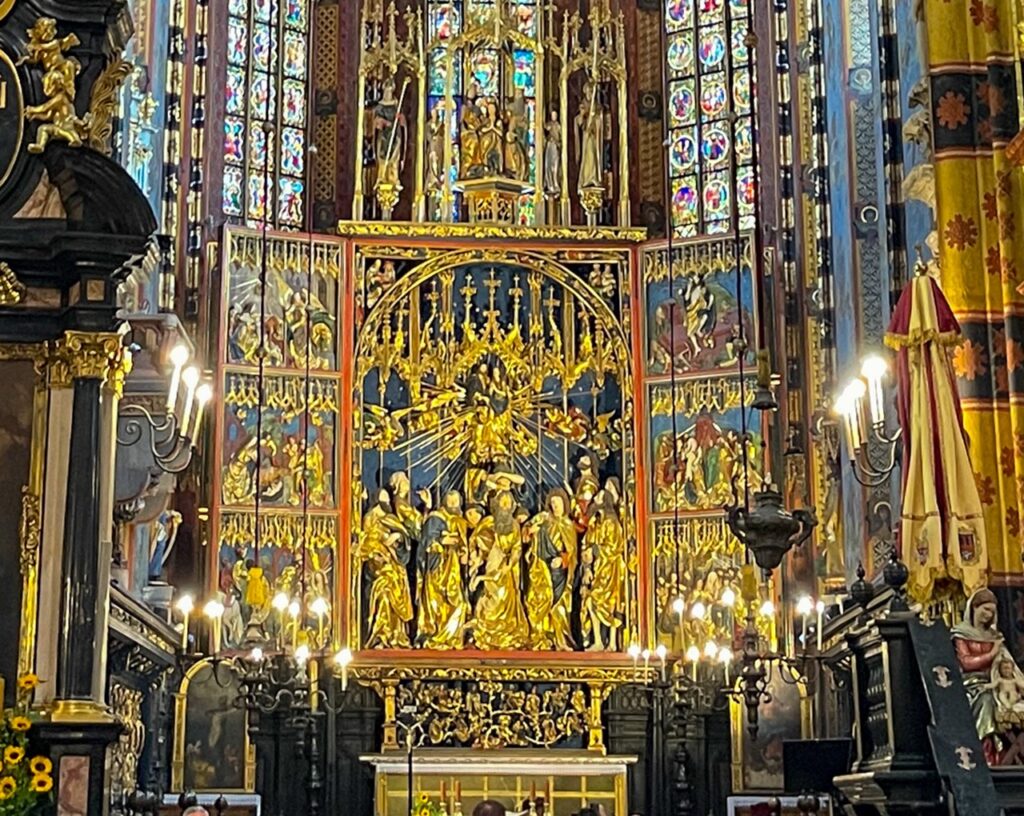
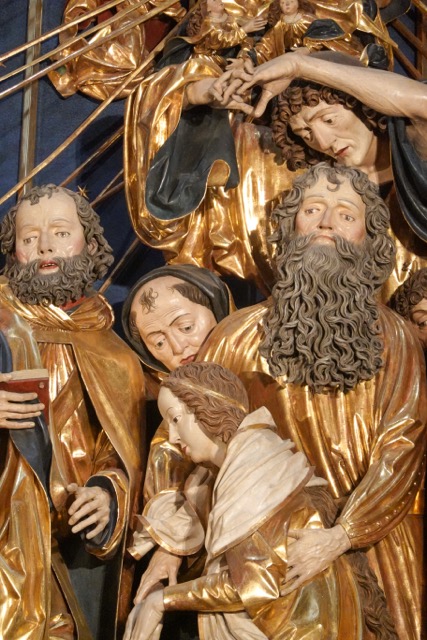
Gory legend aside, the interior of St. Mary’s Basilica, a striking example of Polish-Gothic architecture, is filled with beautiful stained-glass windows and intricate carvings. The altarpiece is one of the great masterpieces of European wood sculpture. It spans the entire length of the church’s altar and took the German artist Veit Stoss 12 years to complete in the late 15th century. The intricately carved panels, gilded in gold leaf, depict scenes from the life of the Virgin Mary. Medieval art typically displays flat, static figures but Stoss’s carvings provide a sense of movement and life that was revolutionary for its time. It is believed that the artist used local Krakow citizens as models for the piece which contributed to the rich, detailed facial expressions that communicate a depth of emotion not generally seen in his era.
 Bugle Time

Every hour, on the hour, a bugle player appears at the top of the taller of St. Mary’s Basilica towers and plays the Hejnał – a beautiful, haunting sound that echoes across the square. The tune is played four times, once in each direction, so that every corner of the city can hear it. Of course, there’s a great story behind this unusual tradition.

In the 14th century, during a Mongol invasion of Poland, a trumpeter was stationed in the tower of St. Mary’s Basilica to watch for any approaching enemies. When the Mongols began appearing at the walls of the city, the trumpeter began sounding the alarm to the four corners of Kraków. The attackers, recognizing the bugler was warning the city, began firing arrows at the tower. One found its mark piercing the bugler’s throat and cutting off the tune mid-note. In honor of his bravery and sacrifice, the Hejnał is played every hour, but the music stops mid-note, just as the trumpeter was silenced. This unfinished tune serves as a solemn reminder of that moment in history. It was moving every time we heard it and particularly poignant at the moment it stops. The music, sounding a bit like taps, is simple yet it seems to fill the city with pride.
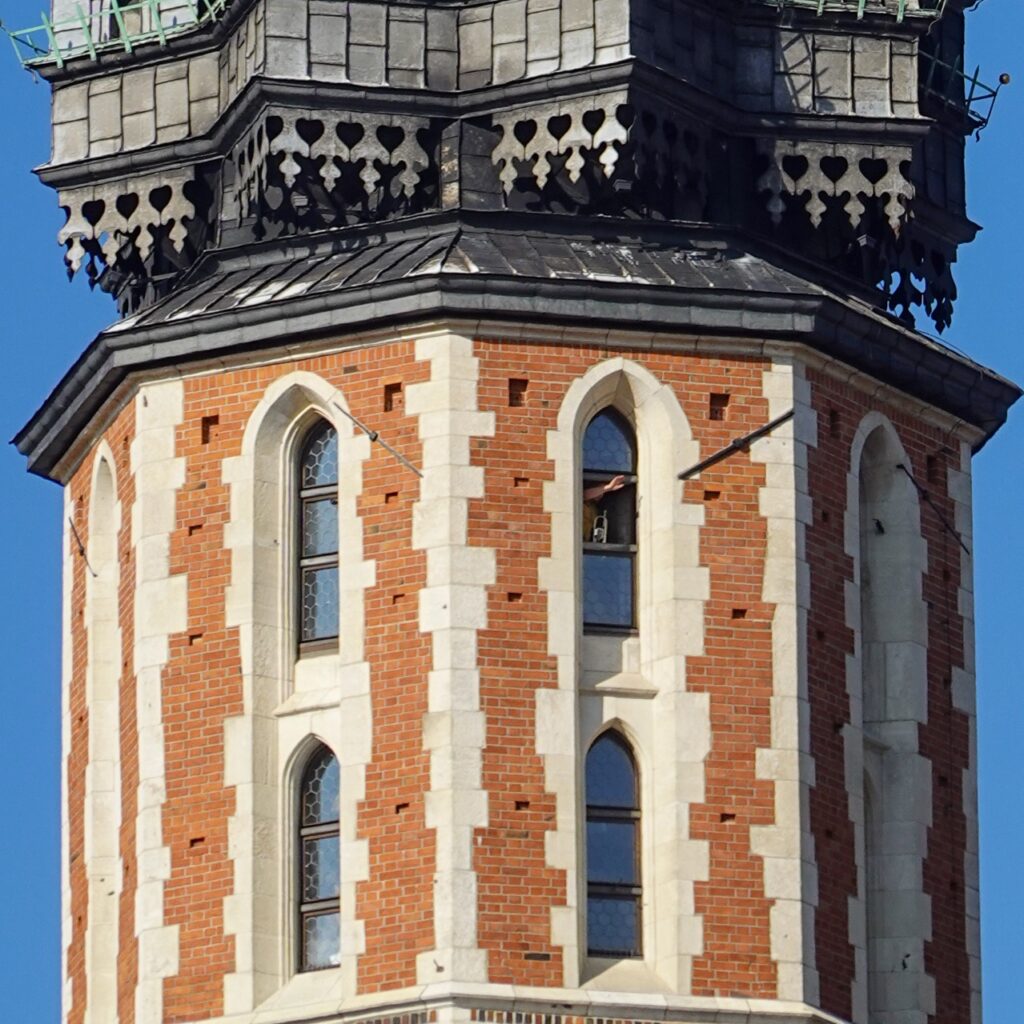
After playing the Hejnał the bugle player waves from a window in the tower of St. Mary’s Basilica.
A Neighborhood with a Long Memory

Tucked just south of Kraków’s Old Town lies Kazimierz, the historic Jewish Quarter – a neighborhood that echoes with history and hums with creativity. While the Main Square is Kraków’s heartbeat, Kazimierz seems to be its soul. It feels lived-in and deeply human. Founded in the 14th century as a separate town, Kazimierz became home to Kraków’s thriving Jewish community for hundreds of years. By the 16th century, it was one of the most important centers of Jewish life in Europe and it flourished with synagogues, schools, kosher bakeries, and bustling marketplaces.
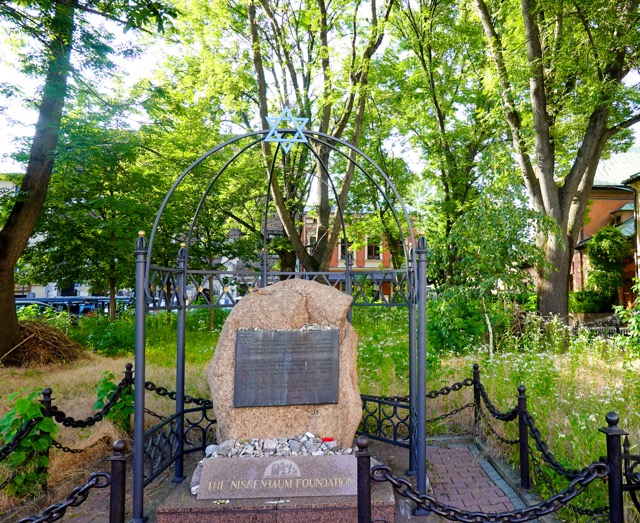
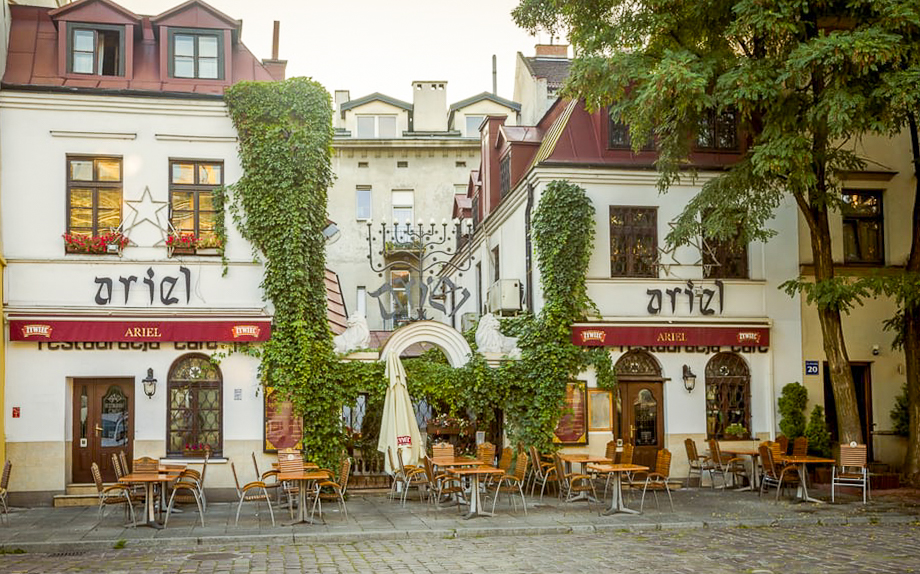
That vibrant life came to a devastating halt during World War II. Under Nazi occupation, the Jewish population was forcibly relocated to the nearby Podgórze ghetto, and much of Kazimierz was emptied and left to decay. But in recent decades, the neighborhood has undergone a quiet revival that honors its history while breathing new life into its streets.

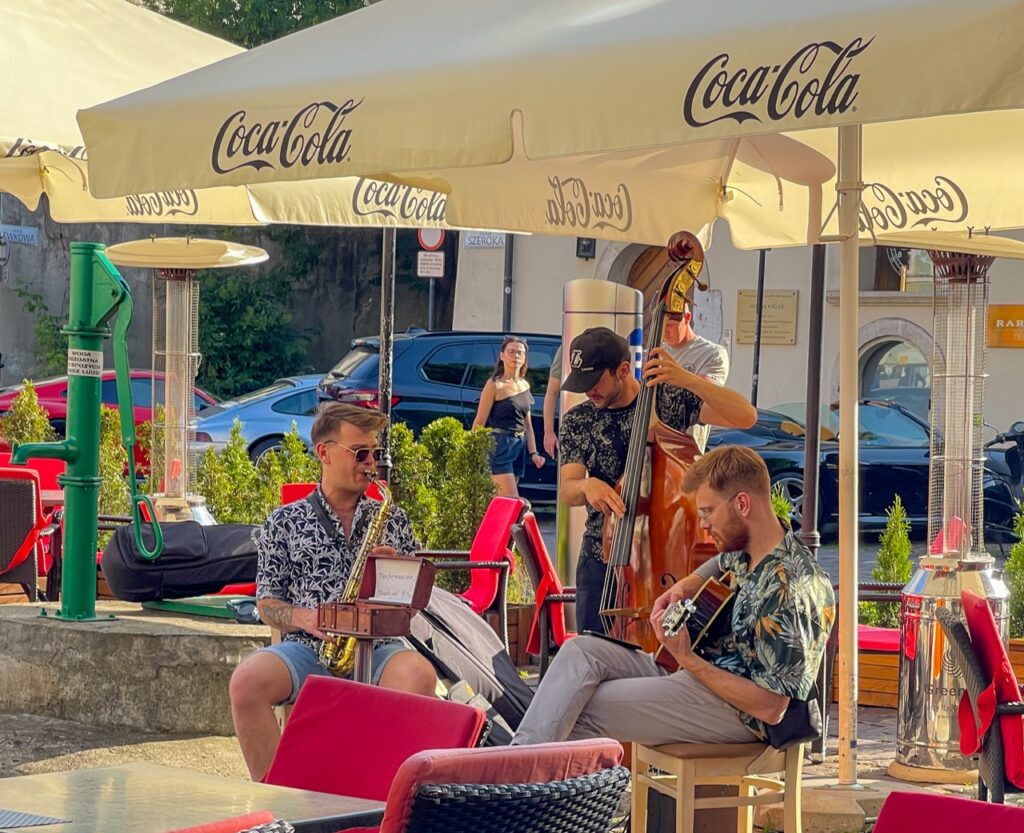
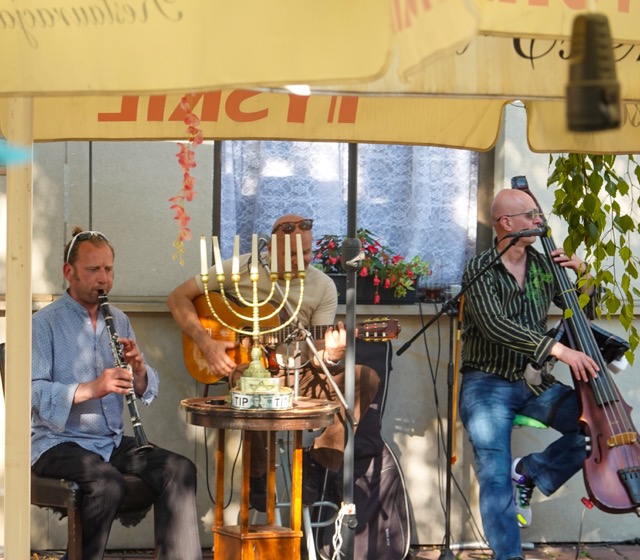
A neighborhood that’s seen it all and is still standing, there’s both a grittiness and a warmth to be felt here. Crumbling tenement buildings sit next to hipster cafés. Both modern jazz and Klezmer music can be heard in the plazas and outside the sidewalk cafes. Menorahs and Hebrew signs are etched into old walls and street art covers the alleyways. There are seven historic synagogues in Kazimierz, including the Old Synagogue, dating back to the 15th century. Moss-covered gravestones lean gently in every direction in the old Jewish cemeteries.
Across the River – Kraków’s Jewish Ghetto

A thirty minute walk across the river from Kazimierz, is a museum on the site of Oskar Schindler’s Factory. As you likely remember for Steven Spielberg’s movie “Schindler’s List” this is where more than 1200 Jewish workers were employed and protected during the Nazi occupation in WWII. The museum is dimly lit with many immersive exhibits that transport visitors into the daily life of Kraków under the Nazis.
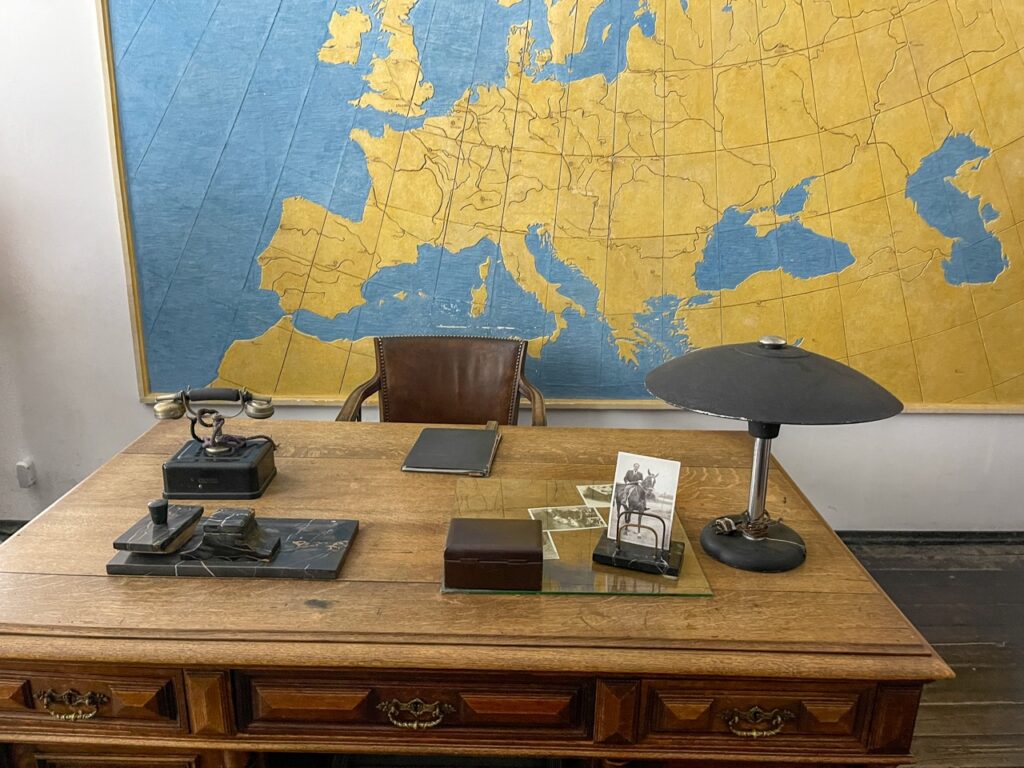
Oskar Schindler’s Desk

In 1941, the Nazis moved Kraków’s Jews from Kazimierzi to an area near Schindler’s factor where they set up a ghetto in the Podgórze District of Kraków. As we walked through this area, we often felt the weight of history along with a reminder of the difference one person’s actions can make in the darkest times.
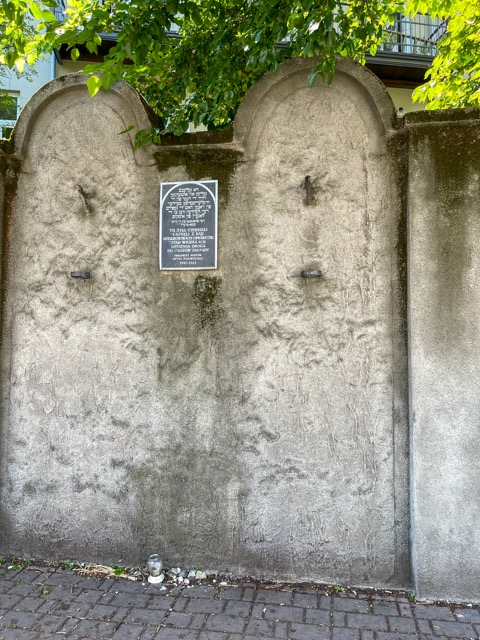
The ghetto was enclosed by a wall of barbed wire and stone. The stones used were designed to look like tombstones, but also included actual Jewish monuments and tombstones from the cemetery.
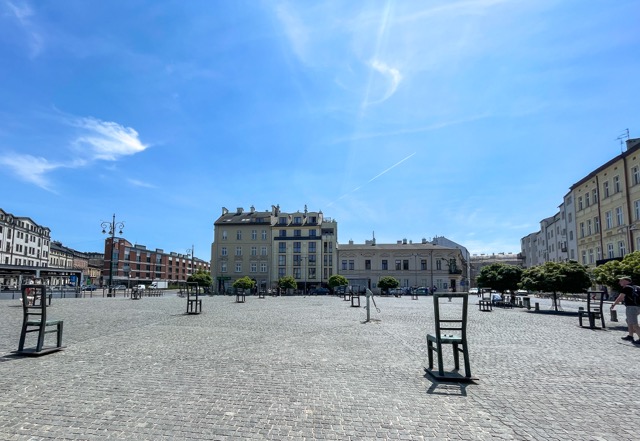
 Ghetto Heroes Square in Kraków’s Podgórze district.

The heart of the Jewish ghetto established by Nazi Germany in March 1941, this square was used for deportations. Victims assembled in its western part, while looted property was stacked in the center. Executions occurred in the square and nearby courtyards. During the ghetto’s liquidation in March 1943, many elderly, sick, and unemployed residents – along with children – were shot on-site.

In 2005, the city commissioned a monument inspired by Tadeusz Pankiewicz’s memoir, The Kraków Ghetto Pharmacy. He wrote: “In Plac Zgody, an incalculable number of wardrobes, tables, sideboards and other furniture was rotting.” These words inspired an installation of oversized metal chairs, symbolizing what was left behind – and the absence of those who once sat there.

https://krakowbooking.com/blog/empty-chairs-ghetto-heroes-square

Castle on a Hill

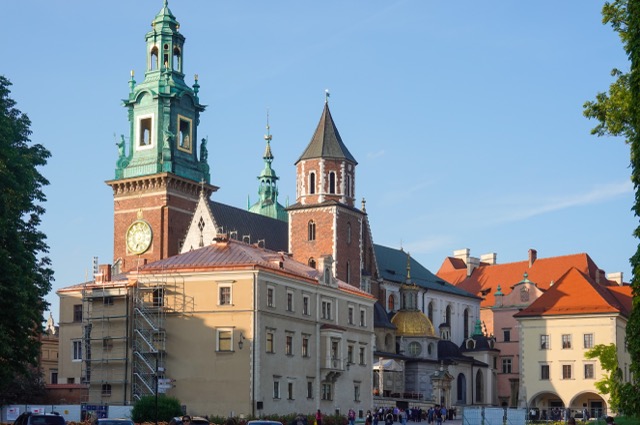
For more than 500 years Wawel Castle was the seat of Polish royalty. Perched above the Vistula River, its blend of Gothic, Renaissance, and Baroque styles is a walk through history. The castle has been invaded, plundered, rebuilt and restored over several centuries making it a symbol of Poland’s resilience.
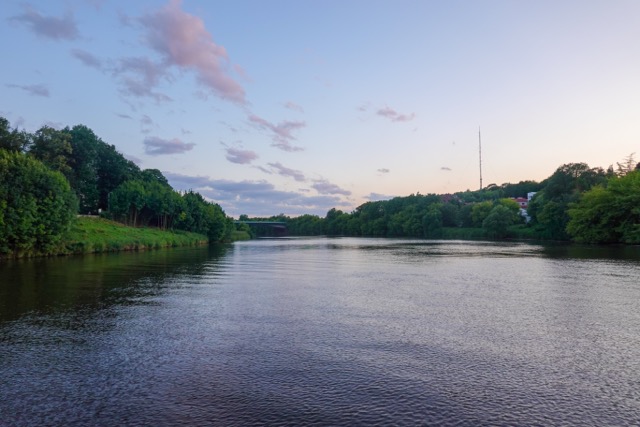
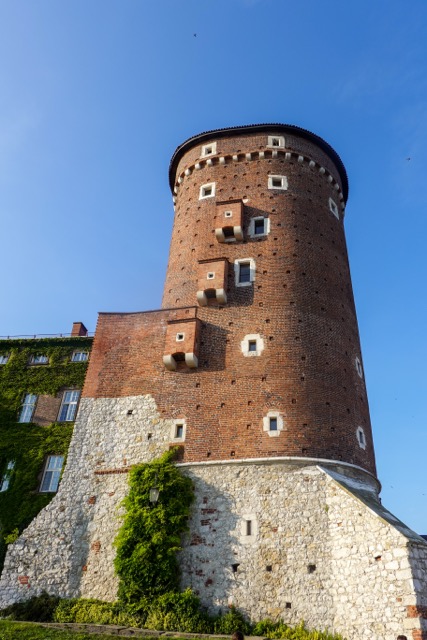
Vistula River in Kraków
A Place Beyond Words

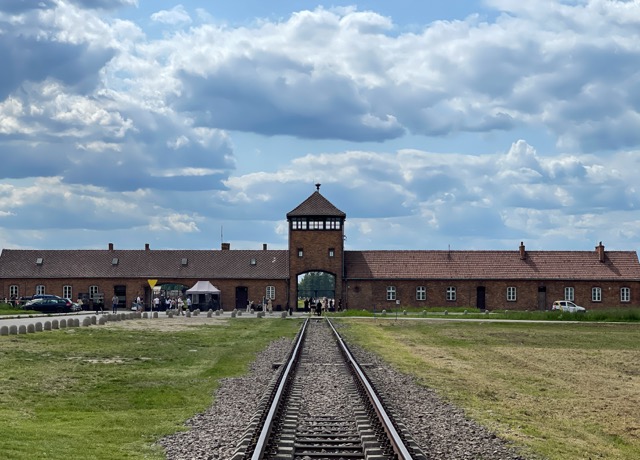
On our last day in Kraków, Debby and I took a day trip from Kraków to visit Auschwitz-Birkenau, the former Nazi concentration and extermination camps. Of course, this was a solemn, heavy, and profoundly moving experience. We walked through rows of brick barracks, stood beside barbed wire fences, and saw rooms filled with the belongings of victims – eyeglasses, shoes, suitcases, photographs.
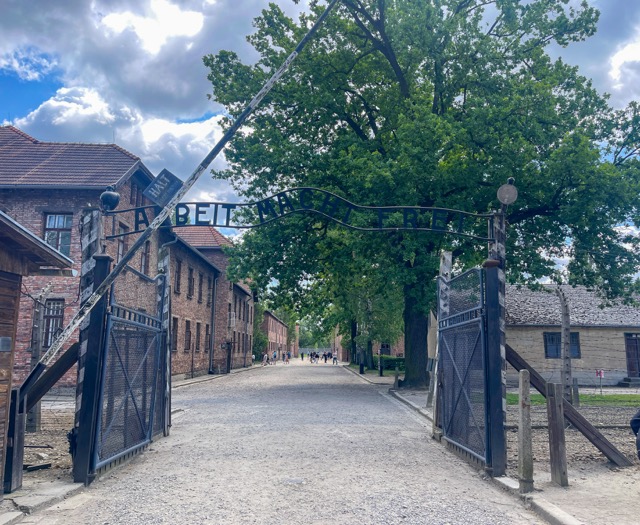
The scale of the tragedy is overwhelming. I found myself listening, absorbing, and trying to make sense of something that defies understanding. At the end of the tour, as we walked through the vast, open space of Birkenau, I knew there was nothing to say. No right words. Only the promise to remember.
Salt Mine – Ed’s Experience

With the ladies off on their guided tour of Birkenau and Auschwitz for the day, John and I arranged a little excursion of our own to a location not far outside of Kraków – the Wieliczka Salt Mine. Now, I don’t know what you think of when you hear the term “salt mine,” but I am pretty sure whatever you’re imagining will fall short of this place.

First, you must understand that salt is a mineral, meaning it can form rock like any other mineral. The resulting rock is relatively soft, but stable, nonetheless. So, imagine a salt mountain – maybe the size say of Mount Tamalpais – except below the earth. And when I say a salt mountain, I mean solid salt – not veins of salt through granite, not pockets of salt, solid salt. There is apparently nothing like it anywhere else in the world.

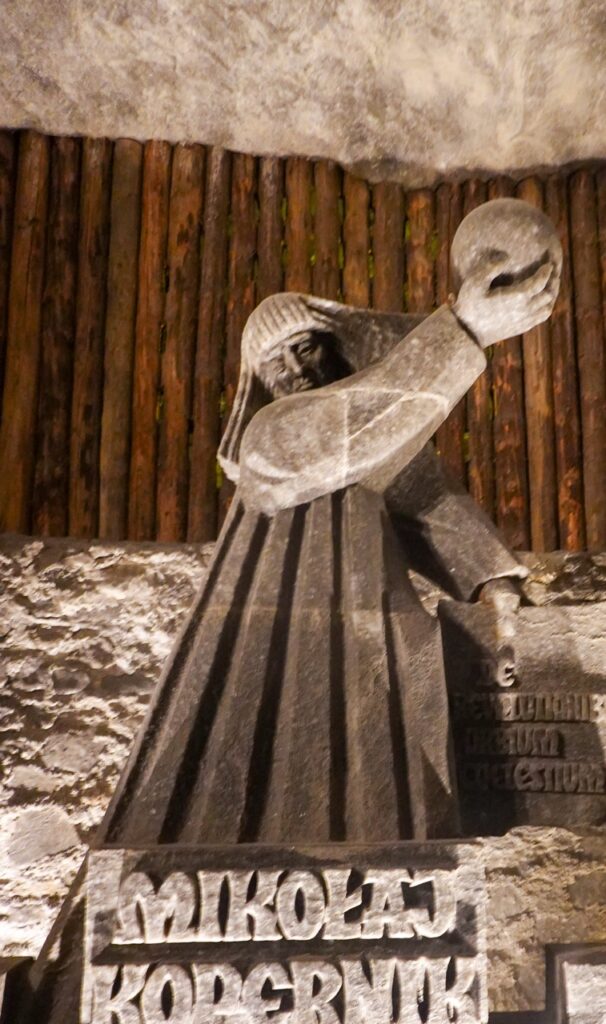
Sometime in the 11th century, people began to mine this underground salt mountain. That is, they began chipping away at it, pulling up big, huge chunks of salt rock to process into smaller crystals of salt for all the typical uses – preserving food, seasoning, etc. This was an extremely valuable commodity. By the 14th century, the saltworks at Wieliczka had become such an important part of the Polish economy that King Casimir the Great began to take a very active interest, building a hospital for the miners and generally providing for their care. To be a salt miner became a revered and honored trade. Kraków became a wealthy and prosperous city.
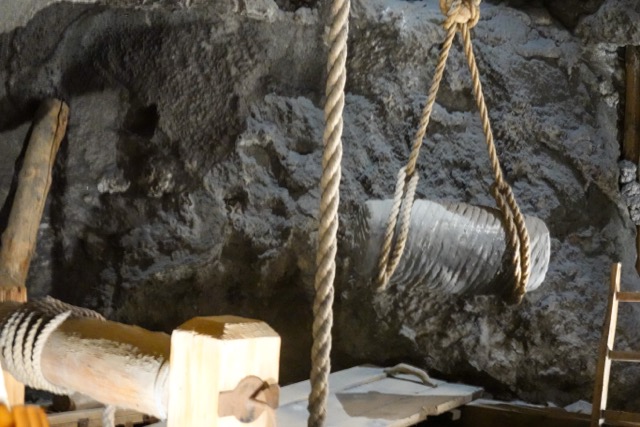
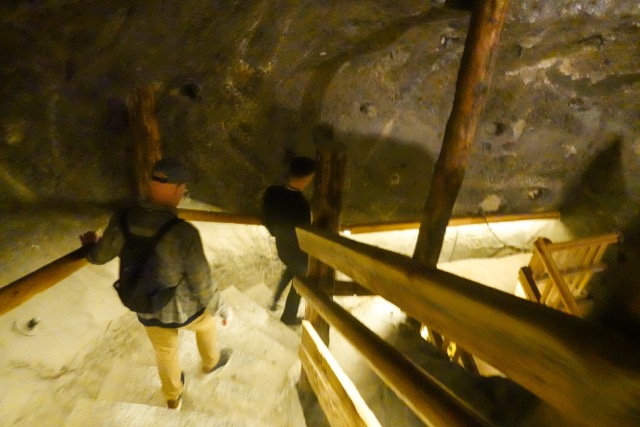
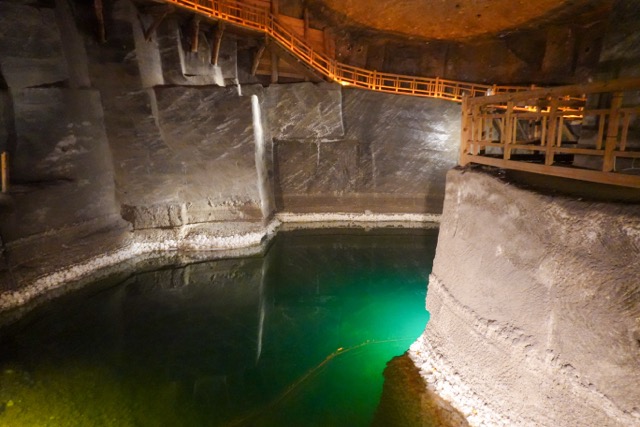
Now imagine the network of tunnels, chambers, and caverns that would result from 900 years of continuous labor, invention, and technological development. Trust me, you can’t. Nine centuries of digging and hauling, non-stop. The mine reaches a depth of almost 1100 feet with 178 miles of tunnels and passages. And everywhere it is solid salt. John and I walked 2 ½ miles of tunnels and descended almost 800 steps to a depth of 450 feet over three hours. We covered less than 2% of the mine. It is an unimaginable labyrinth.
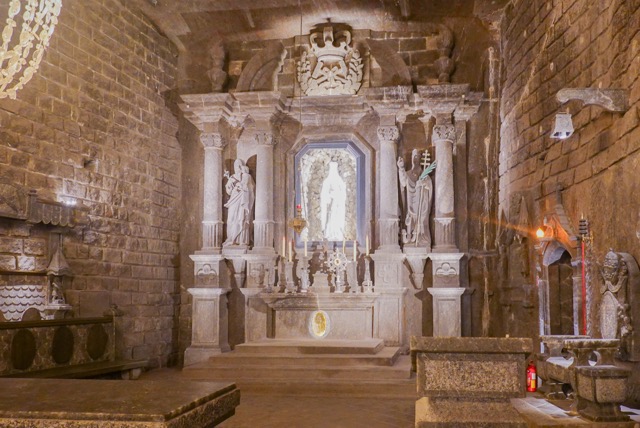
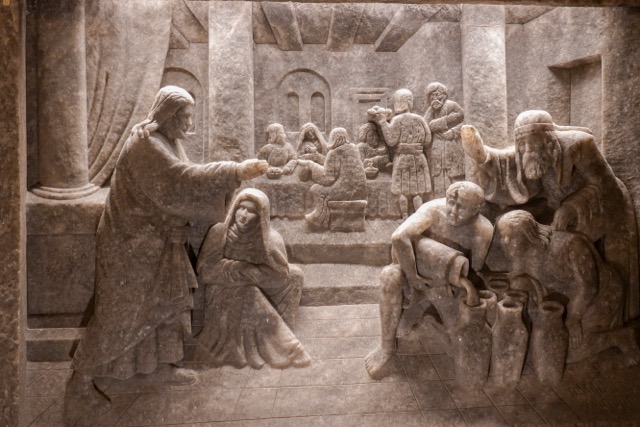
Down in the mine, it’s a fairytale land of exotic caverns, underground lakes, and salt sculptures. It seems that as the mine became more and more celebrated, the miners began to decorate their pride and joy. Eventually, the mine came to include chambers for music, for worship, a tavern, and a theater – all carved from the salt. Crystal chandeliers hang in some caverns; the crystals all made of pure salt. The floors of formal spaces are polished salt, carved to resemble floor tiles.
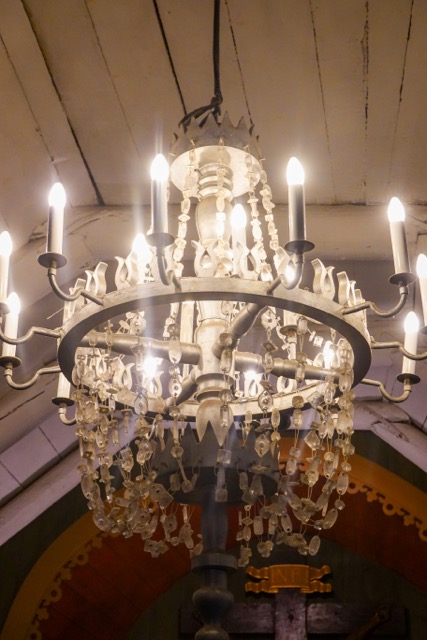
Crystals in the chandeliers are made of pure salt.

In 1978, when UNESCO began attempting to identify and preserve the world’s great heritage sites, this mine was on the first page. Very appropriately so.

Kielbasa and Much More

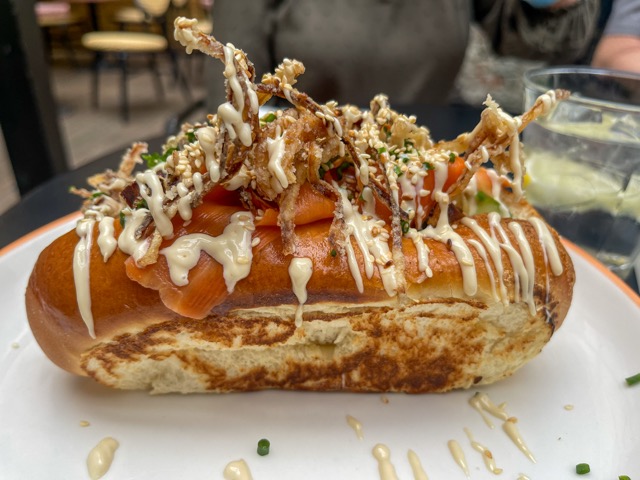
Other than kielbasa, I didn’t know what to expect when it came to food in Kraków and I was pleasantly surprised. Every meal felt like a discovery and while Polish cuisine is rooted in tradition, in Kraków it’s served with creativity, care, and more than a few delicious surprises.
Pierogi: Poland’s Most Beloved Dumplings

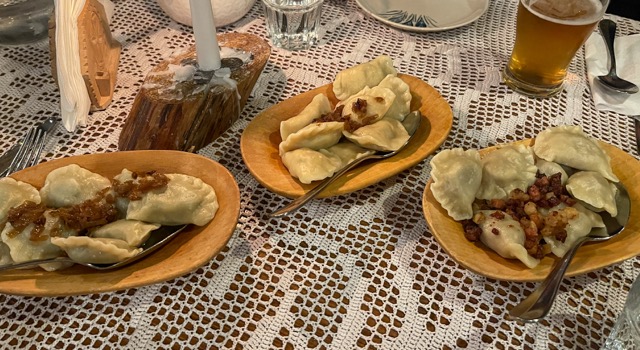
Let’s start with the star of the show – pierogi. These half-moon dumplings are Poland’s comfort food. The classics are Pierogi Ruskie (filled with potato,  twaróg – white cheese, and sautéed onion), Pierogi z Mięsem (filled with minced pork or beef, often with onion and spices), Pierogi z Kapustą i Grzybami (filled with sauerkraut and mushrooms), Pierogi z Szpinakiem i Serem (filled with spinach and cheese pierogi). We ordered pierogi several times and found them all to be delicious. Who doesn’t love dumplings?
A Splurge

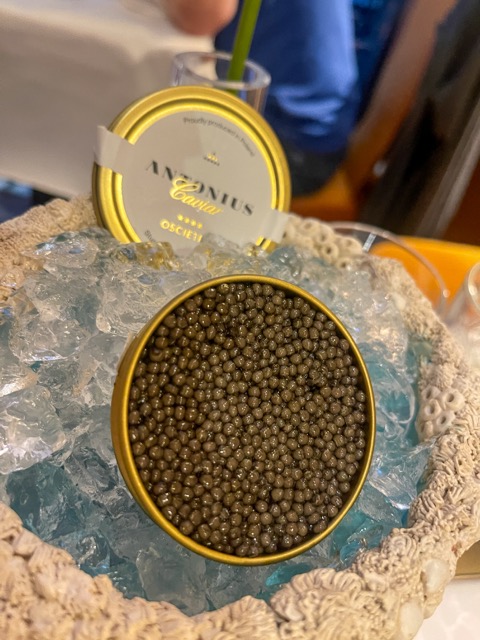
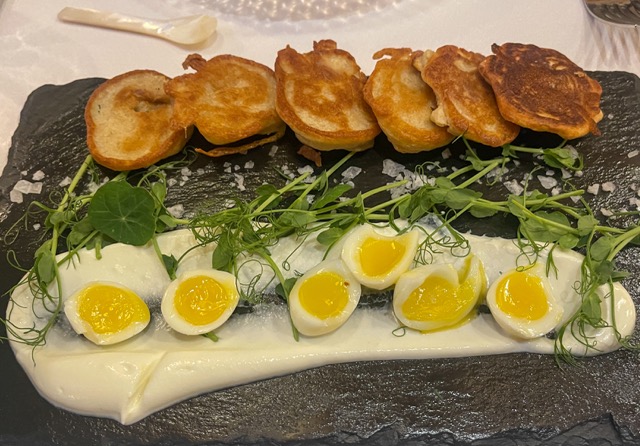
Our first night in Kraków, we treated ourselves to dinner at a Michelin starred restaurant – Pod Noseum (https://kanonicza22.com/restauracja/). We splurged on the starter, sharing a tin of Oscietra (also called Ossetra), one of the world’s most prized (and expensive) Russian caviars served with blini, quail egg, and crème fraîche. While champagne or vodka are the traditional pairings for caviar, we enjoyed it with a smokey Islay whiskey. Disclaimer: I did confirm that it is now harvested sustainably from sturgeon who are raised in wild river fields and aquacultures.
Pink Soup – Hot or Cold?

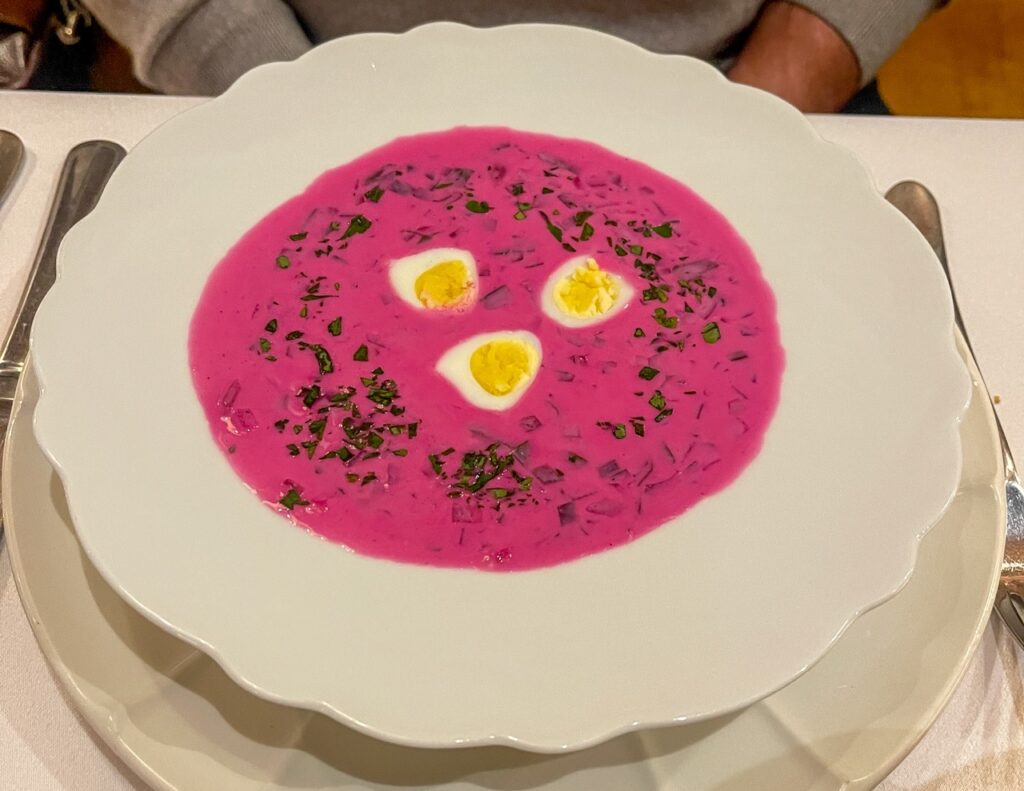
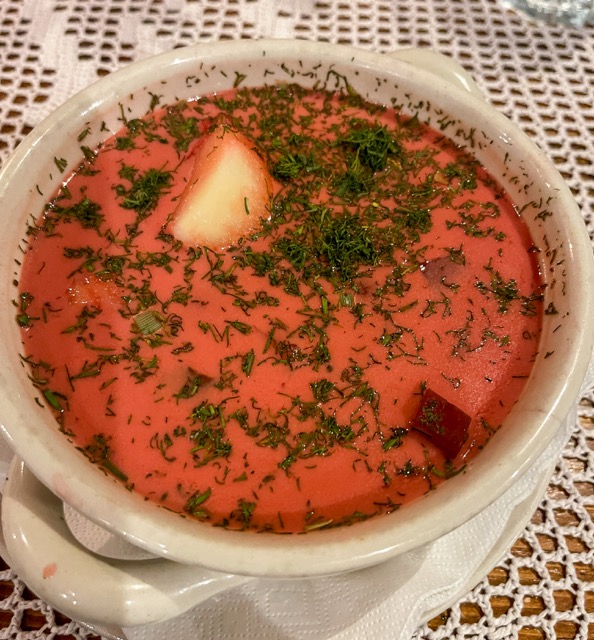
Ed’s first course at Pod Noseum was Chłodnik, Poland’s cold beet soup. It was a vibrant magenta color dotted with herbs and a halved quail egg. The next day, on a walking food tour, we were served Barszcz which is a warm beet soup that’s earthy and slightly sweet. Hot or cold, both were delicious!
Street Food

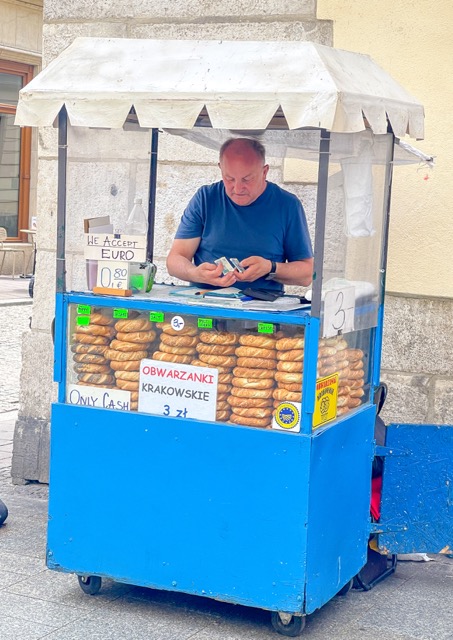
Sold on Kraków’s main square for well over 600 years, obwarzanek is a sort of bagel meets pretzel. A chewy, braided dough ring sprinkled with salt, poppy or sesame seeds, obwarzanki are sold from blue rolling carts on street corners all over Kraków. Claimed to be the predecessor of the bagel, it was invented by Cracovian Jews. With a sell-by-date of about three hours, the bakers of Kraków are kept busy producing up to 200,000 obwarzanki per day in the summer.
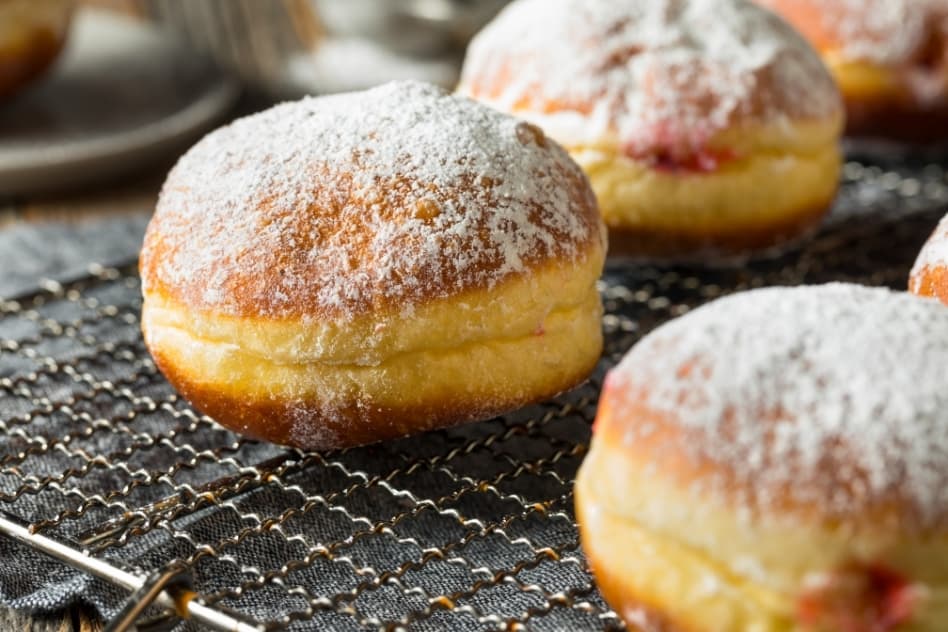
Pączki are plump, pillow soft donuts that are traditionally filled with rose petal jam. Yum! This wonderful Polish pastry is so popular it has its own holiday (Tłusty Czwartek or Paczki Day) which is celebrated before Lent and involves binge-eating paczki in the company of family and friends. Using up all the ingredients that can’t be eaten during Lenten fasting – lard, sugar, eggs – provides a reasonable excuse for this madness.
Papal Cake

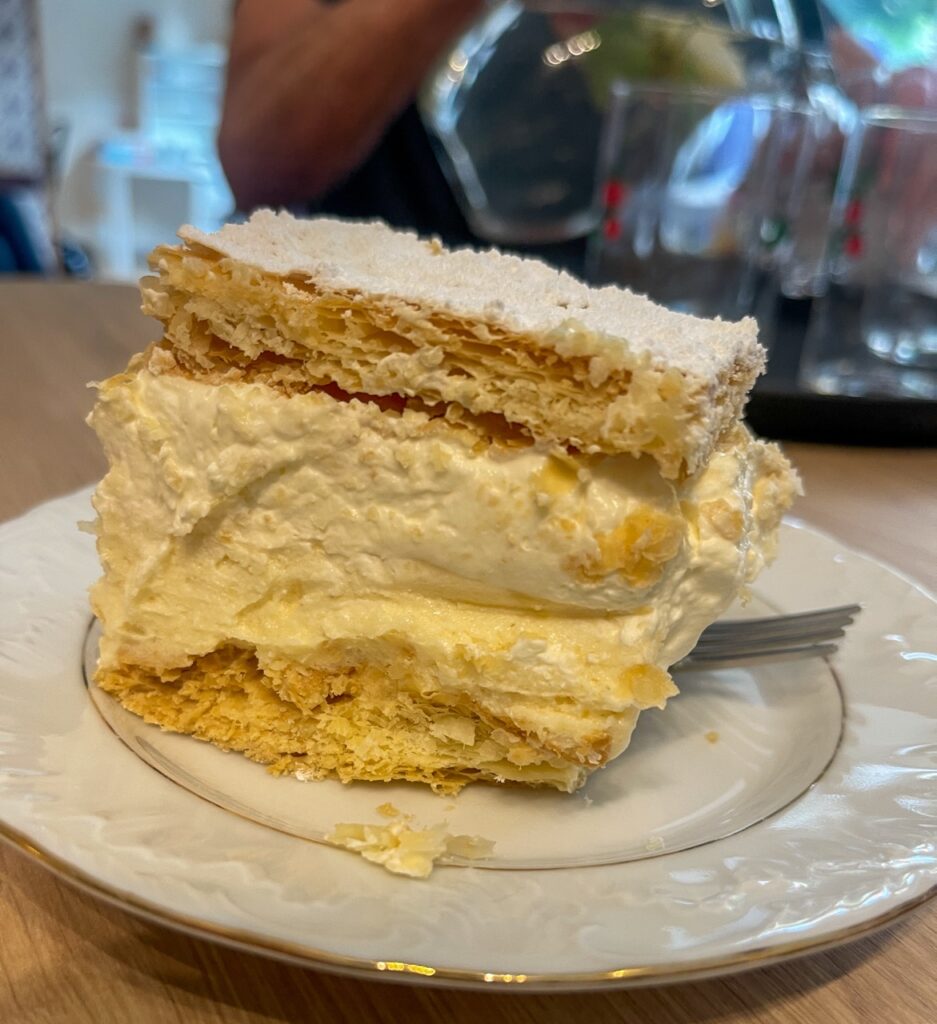
The famous Kremówka, also known as Papal Cake, was a favorite of Pope John Paul II who was born and spent his childhood in a small town near Kraków. This “cake” is actually a dense block of vanilla cream custard sandwiched between layers of pastry and sprinkled generously with powdered sugar. Amazing!
Too Many Vodkas, Not Enough Time

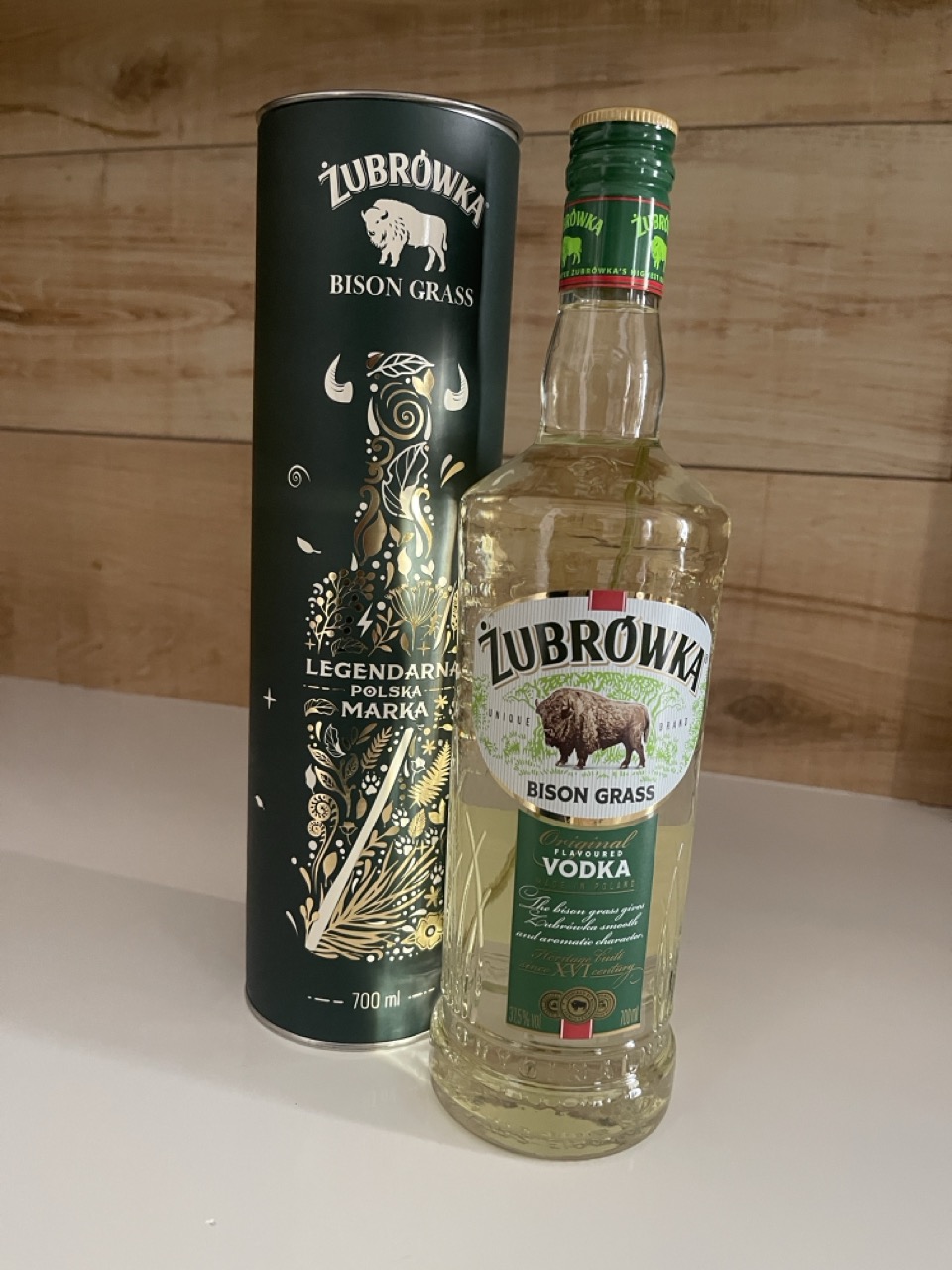
Poland takes vodka seriously. There are dozens of different types, each with unique flavors and ingredients. There is traditional plain vodka made from grains (rye or wheat) or potatoes. Flavored vodkas are infused with herbs, fruits or spices with the most famous being Żubrówka or Bison Grass Vodka (our favorite!). You can also find small-batch artisanal vodkas and premium aged vodkas. With so many to try, it looks like we’ll have to return for another round or two.
Na zdrowie!

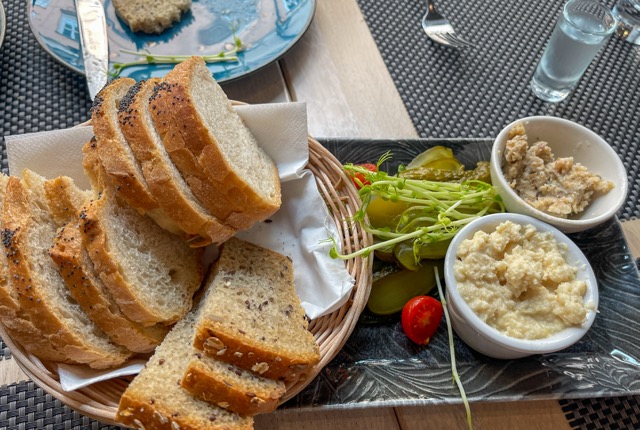
One of our favorite rituals when we travel is learning how to say “cheers” in the local language. It’s a small gesture, but it always makes a toast feel more meaningful—and more connected to where we are. In Poland, the word is “Na zdrowie!” (pronounced nah ZDROH-vyeh), which literally means “to your health.” In addition to raising your glass, the Polish toasting etiquette includes making eye contact with each person. The clink of glasses, the warmth of the spirit, sharing a table, all bring us closer to one another and remind us to live in the moment. To your health!

Holding on to Hope

Poland in the 20th century is a compelling narrative of resilience. After literally being wiped off the map for 123 years by the Prussians, Hapsburgs, and Russians, Poles regained their independence as a nation in 1918 after WWI. Then, less than 20 years later, Poland was the first country in Europe to experience World War II and suffered the heaviest proportionate human losses – nearly 20% of its population. Of course, Poland’s occupation didn’t end when the war did. Beginning in 1945, the Soviet Union’s Red Army occupied Poland, along with much of Central and Eastern Europe, installing an authoritarian system of government. Like other Eastern Bloc countries, Poland only became a free nation again in 1989, as the fall of the Soviet Union began. The adoption of a fully democratic system, integration with NATO, and the embrace of the European Union have sparked the regeneration of a thriving Polish economy and culture that perhaps hasn’t been seen since its heyday as a salt empire.

Reflecting on all of this has helped me place our despair over the current ascendency of brutal authoritarians into some context. There is hope. Poland’s current renaissance gives testimony. The darkness is not permanent.

There will be light again, someday.

Kraków: Facing History, Embracing Hope Read More »
Belgium, You Surprised Me

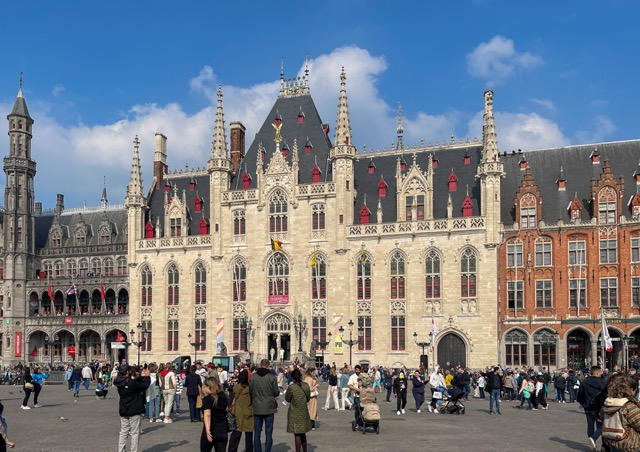
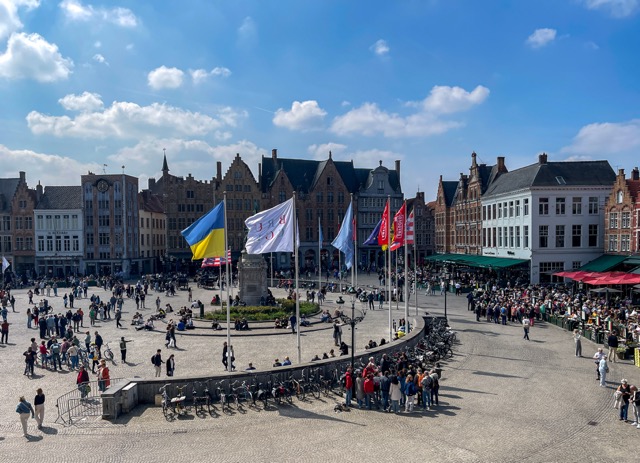
There’s something magical about arriving in a new country for the first time. Something unexpected appears around every corner – the sound of a foreign tongue, the smell of unfamiliar food, the gleam of buildings from another era. Belgium had not been particularly on our radar. But our youngest son, Michael, visited last year with his partner, Charlotte, and after hearing their reports, we decided on a meet-up with Mark in Belgium (not far from Mainz, Germany where he is currently residing). Nestled between France and Germany, this small nation makes an impression far beyond its size. We explored Brussels, Gent, Bruges, and Antwerp. It was a bit much to squeeze into just five days, but we were delighted by the combination of old-world charm and modern vibrancy. 

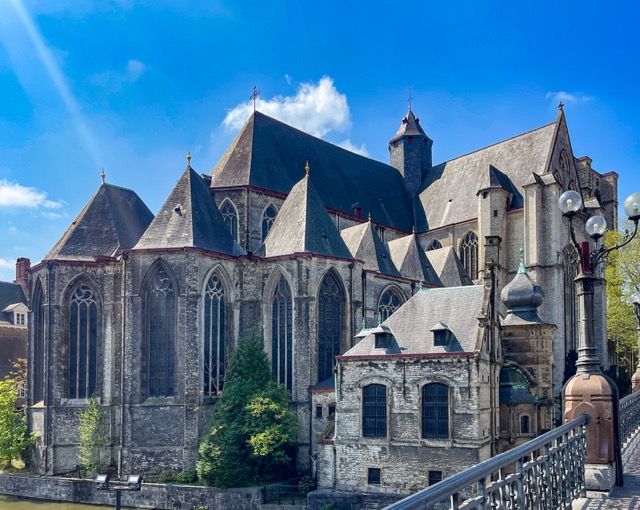
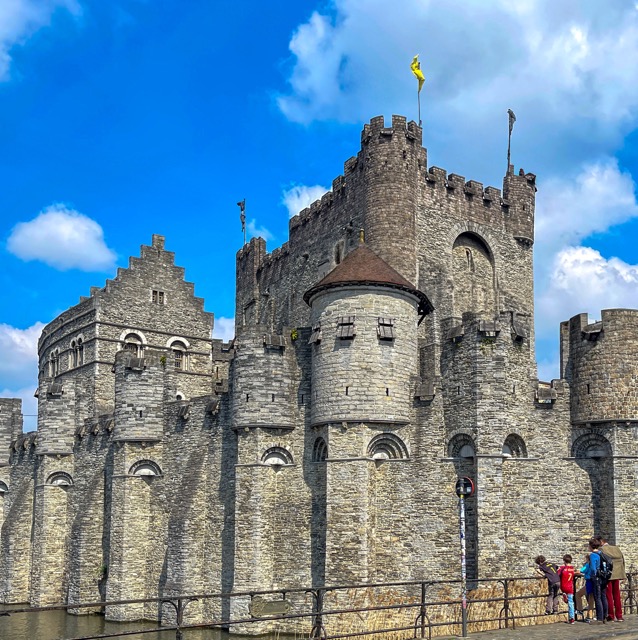
Gent’s Saint Michael’s Church dates back to 1105 when a chapel dedicated to Saint Michael was first documented on the site. The current late Gothic church began construction around 1440.

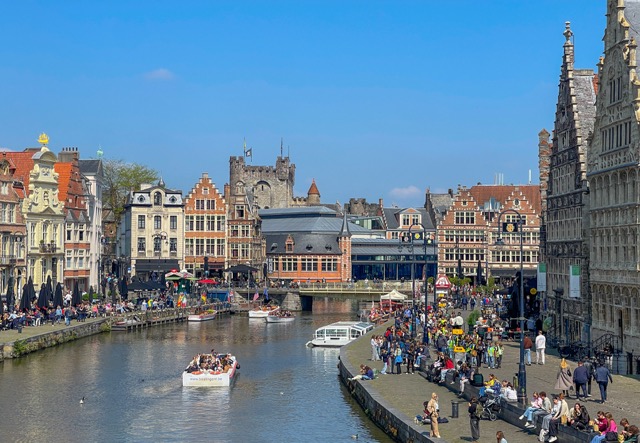
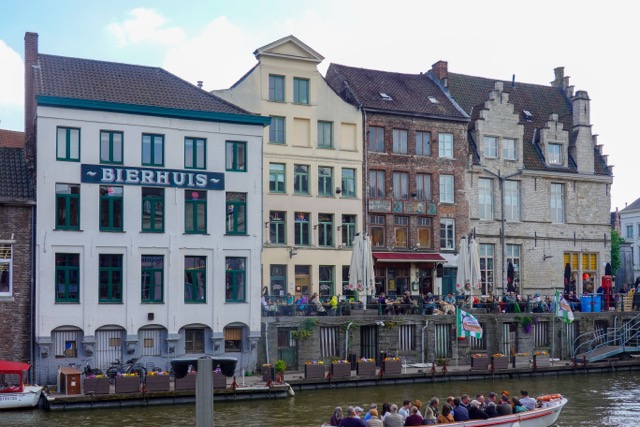
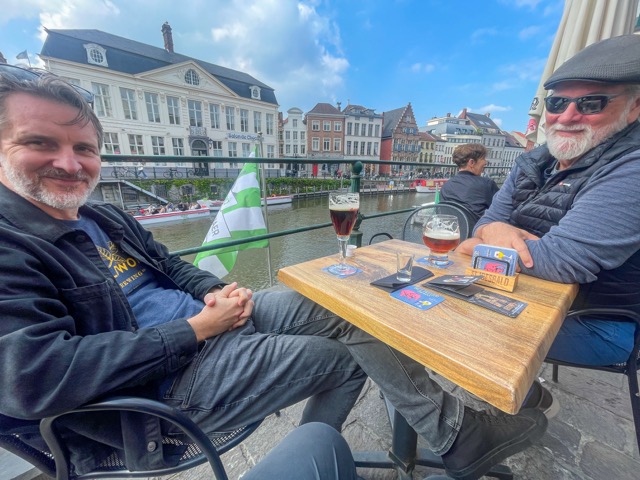
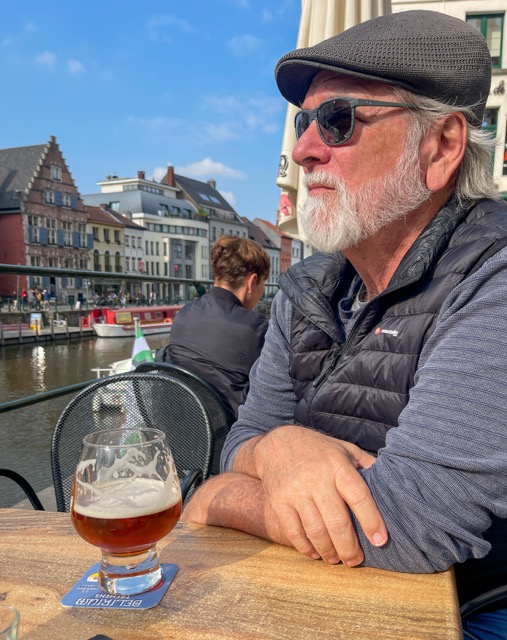
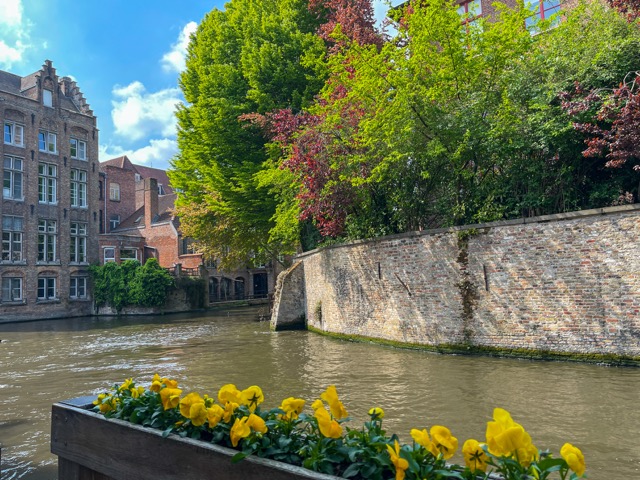
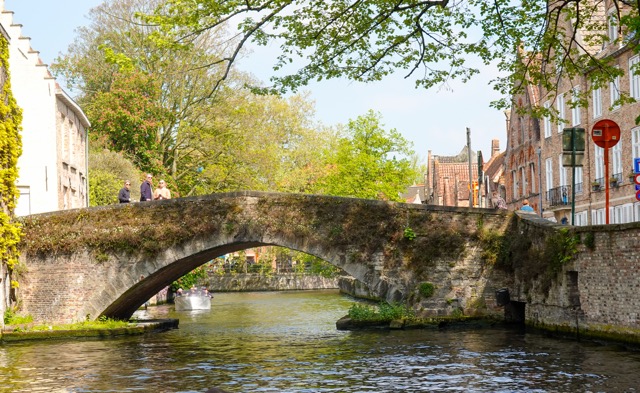
Gent is at the confluence of two rivers – the Scheldt and the Leie and there are some great spots on the river to enjoy a beer.

An Art & Poetry Lesson

We had just one day to spend in Brussels before hopping on a train to meet Mark in Gent for dinner. Our plan had been to join a walking tour of the city followed by lunch at a small estaminet (a small café selling alcoholic drinks) featuring Belgian cuisine. However, the cold rainy day we woke up to was less than ideal for a walking tour of the old city. So, after getting a late start, we wandered over to a small café, enticed by the wafting odors of fresh coffee and pastries.

The late start was due to a bit of insomnia on my part. I woke up about 4AM and couldn’t get back to sleep. That’s when I read a message posted on our blog by our dear cousin Nayan.

“When you are in Brussels, you will most likely remember Auden’s poetic comment on Brueghel’s Musee de Beaux Arts, I believe to be one of the greatest poems in Western literature. (I have committed it to memory.) Nayan xo”

 For those of you who don’t know Nayan, she graduated from Cal Berkeley in 1955 with a double master’s degree in English and Rhetoric and then in 1988 with a PhD in Educational Philosophy. She taught college for decades and served as the Dean of the English Department at a Bay Area community college before retiring and becoming ordained as an Episcopal priest in 2002. Nayan turned 94 as I was finishing this blog post, and she continues to amaze and inspire me.

I must admit, I was not aware of either Auden’s poem or Brueghel’s painting. But I am always eager to learn and was inspired by Nayan’s message. So, while Ed slept, I spent a couple early morning hours reading. One internet search led to another, and I learned much about W.H. Auden, Pieter Brueghel the Elder, ekphrastic poetry (when a poem is written in response to another work of art, such as a painting or sculpture), a poem by William Carlos Williams about the same Brueghel painting, a refresher on the Icarus myth, and modernism vs. postmodernism. Whew! It was quite a morning!

Musée des Beaux Arts
By W. H. Auden, 1938

About suffering they were never wrong,
The Old Masters: how well they understood
Its human position; how it takes place
While someone else is eating or opening a window or just walking dully along

How, when the aged are reverently, passionately waiting
For the miraculous birth, there always must be
Children who did not specially want it to happen, skating
On a pond at the edge of the wood:
They never forgot
That even the dreadful martyrdom must run its course
Anyhow in a corner, some untidy spot
Where the dogs go on with their doggy life and the torturer’s horse
Scratches its innocent behind on a tree.

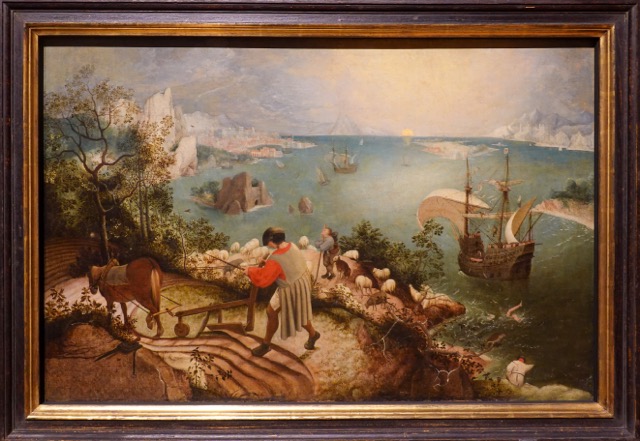
In Brueghel’s Icarus, for instance: how everything turns away
Quite leisurely from the disaster; the ploughman may
Have heard the splash, the forsaken cry,
But for him it was not an important failure; the sun shone
As it had to on the white legs disappearing into the green
Water; and the expensive delicate ship that must have seen
Something amazing, a boy falling out of the sky,
Had somewhere to get to and sailed calmly on.

As we sipped our coffee and tea that morning, I shared what I had learned with Ed. I also told him that we were a mere two blocks from the  Musées Royaux de Beaux-Arts de Belgique (Royal Museum of Fine Arts of Belgium) where the “Old Masters Museum” proudly displays the Brueghel painting that inspired Auden’s poem. We had a new plan for the day!

We arrived at the museum, stood in line for tickets, and as soon as we were inside, made a beeline for the Brueghel room. There it was!

Landscape with the Fall of Icarus – Pieter Brueghel, c. 1560

Landscape with the Fall of Icarus
William Carlos Williams, 1960

According to Brueghel
when Icarus fell
it was spring

a farmer was ploughing
his field
the whole pageantry

of the year was
awake tingling
near

the edge of the sea
concerned
with itself

sweating in the sun
that melted
the wings’ wax

unsignificantly
off the coast
there was

a splash quite unnoticed
this was
Icarus drowning

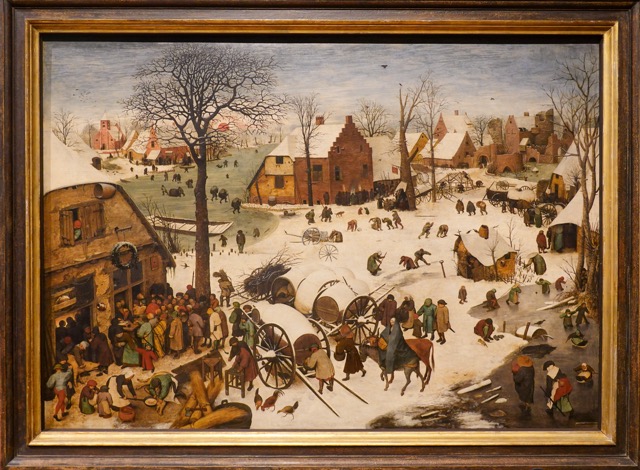
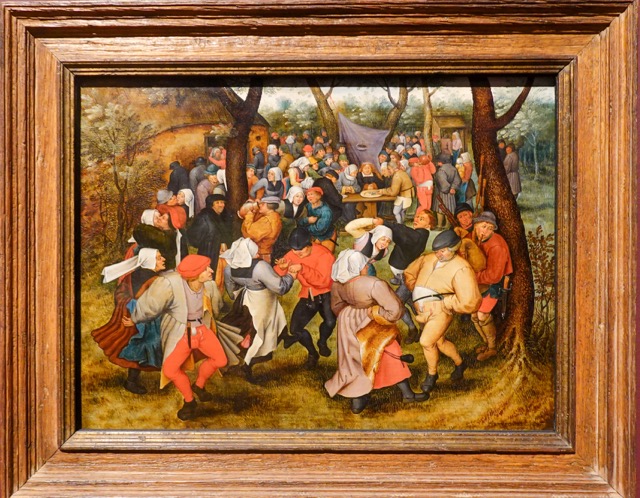
The Census at Bethlehem is another Pieter Brueghel the Elder masterpiece. And, his son painted Peasant Wedding Dance.

I Had Some Questions

What the heck does all this mean? Why is the mythological tragedy of Icarus barely noticeable in the corner of the canvas? Why are the shepherd, the farmer, and the fisherman, all absorbed in their work, seemingly unaware of the boy’s demise? Brueghel, Auden, and Williams all seemed to be saying that the fall of Icarus was just another unnoticed event in the rhythm of everyday life. They describe the isolation of individual pain in a world that neither pauses nor offers consolation. Pretty dark, right? Can this be true?

We had a long conversation with Mark over dinner and then I read what a few art and literary critics had to say about all of this.

“The painting is about the invisibility of suffering. It is not seen. It happens while the sun is shining and the ploughman is at his work.”  John Berger (art critic), Ways of Seeing, 1972.

 “Auden’s insight is that suffering is always private, while indifference is public and communal.” Edward Mendelson (literary critic), Later Auden (an Auden biography), 1999.

 “Williams’s sparse diction and flat tone reflect the painting’s quiet irony, refusing to elevate Icarus’s death above the seasonal rhythms of peasant life.” Marjorie Perloff (literary critic), The Dance of the Intellect, 1985.

Is it true? Do we, more often than not, look away? We are, of course, overwhelmed by a 24/7 news cycle describing countless tragedies –  wars, humanitarian crises, environmental disasters – many of which barely sink in beyond the fleeting headlines.

Collective Indifference

Perhaps the COVID-19 pandemic is an example of our collective indifference. As we all recall, there was a moment in early 2020, when the streets cleared, cities quieted, and our fear turned to expressions of solidarity. But that didn’t last. Before long, the American creed of individualism and productivity reemerged. Masks became a political statement, reopening was seed as liberation, and the dead began to accumulate quietly, mostly out of view. More than 1.2 million Americans perished from Covid-19, many of them in isolation. Nursing homes turned into morgues and hospital workers buckled under the pressure. Yet, the national mood increasingly mirrored Brueghel’s painting –  a slow turning away. The suffering became background noise.

We can see this turning away today in the ongoing global refugee crisis. With millions of people being forcibly displaced, the response is often apathy and political posturing rather than meaningful action. As Auden wrote: “They never forgot…That even the dreadful martyrdom must run its course…Anyhow in a corner, some untidy spot…” Border crossings, overcrowded boats, and refugee camps have become today’s “untidy spot.”

Gent

Climate change is another slow-motion Icarus tragedy. Scientists warn of rising temperatures, ecosystem collapse, and mass displacement, yet our consumer culture, economic systems, and political timelines continue mostly undisturbed – plowing ahead, like Bruegel’s farmer. William Carlos Williams’s line—“a splash quite unnoticed”—feels distressingly prophetic. Catastrophes like wildfires, floods, and droughts strike with increasing regularity, but then fade quickly from media attention.

Today’s tech oligarchy aims to “fly” ever higher through space colonization, artificial intelligence, and biotechnology. Their oversized ambition seeks to outrun any attempts at restraint, embracing economic inequality, digital surveillance, and exploitation of workers. Yet, we avert our gaze from the human suffering their “disruptions” create, blithely accepting the growing crisis our planet is facing. Just as the plowman in Brueghel’s painting keeps working while Icarus drowns, people around the world continue their routines while others suffer. As writer Rebecca Solnit puts it, “The failure to imagine a world in which everyone matters is a kind of moral failing—but also a failure of imagination.” (Hope in the Dark, 2004).

Our first day in Brussels was, for me, an encounter with Brueghel’s message and to understand it as an ethical imperative. Of course, making sense of this is deeply personal. Neither the painter nor the authors offer easy answers. Perhaps all I can do is avoid the temptation of hopelessness and rather than despairing about indifference attempt to break it, in small quiet ways. Brueghel’s painting, and the poems it inspired reveal to us what is, so we can determine what ought to be.

Another Surprise

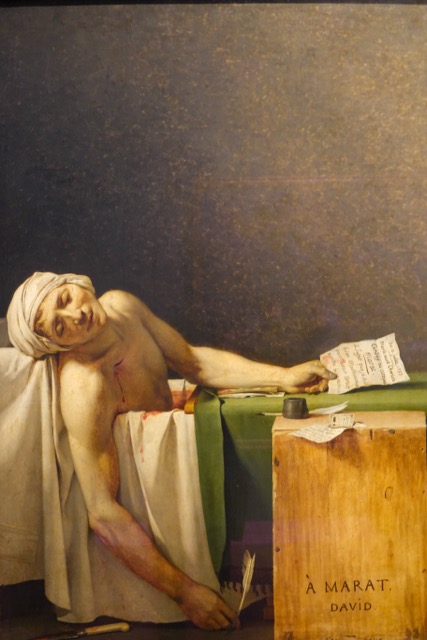
The Museé Oldmasters Museum was not through surprising us, however. As we strolled through one gallery after another of amazing paintings, Ed stopped with a gasp, staring across the room. “Oh my god, they have David’s masterpiece! ” He took me by the hand, and we slowly approached the piece as he began to explain its significance.

Ed: The Death of Marat is a painting that has long haunted me. Jacques-Louis David created the painting in 1793 basically as a propaganda piece for the radicals of the French Revolution. It depicts the assassination of a leading revolutionary figure, Jean-Paul Marat, who was stabbed to death by a woman from the French nobility while sitting and working in his bath. David was a passionate supporter of the revolution and had become a key voice in rallying the people of France. He created The Death of Marat in just three months following Marat’s murder with the full intention of giving the revolution an image of martyrdom that would incite support. It worked.

For me, it is one of the most challenging paintings ever produced. On the one hand, it could be said to be the first modernist painting ever created. David looks humanity in the eye and renders an unflinching image of contemporary reality, challenging the viewer, forcing you to confront the moment. And yet it is executed with the glowing, flawless beauty of an old master.

And yet, this painting came to represent all the horror and death of the Reign of Terror. The ten years that followed its unveiling saw thousands murdered in the streets of Paris touching off a cataclysm that did not end for decades.

And yet, this is the revolution that truly put the western world on a course for democracies to flourish. It is truly the dawn of modernity.

Unsettling, disturbing, luminous, surreal, it is the kind of profoundly moving work that could only be produced from the confluence of factors it embodies – David’s passion, the urgency of the moment, the pressure to work quickly – all conspiring to extract the artist’s greatest achievement. And yet . . .

Our first day in Brussels had taken us on a wholly unexpected journey and it wasn’t even cocktail hour! Still animatedly discussing all that we’d seen in the museum, (thank you, Nayan) we collected our bags and headed for the train to Gent, anticipating dinner with Mark. We enjoyed a couple of days exploring Gent and Bruges with Mark, checked in on Antwerp, and spent our final day back in Brussels before returning to Valencia.

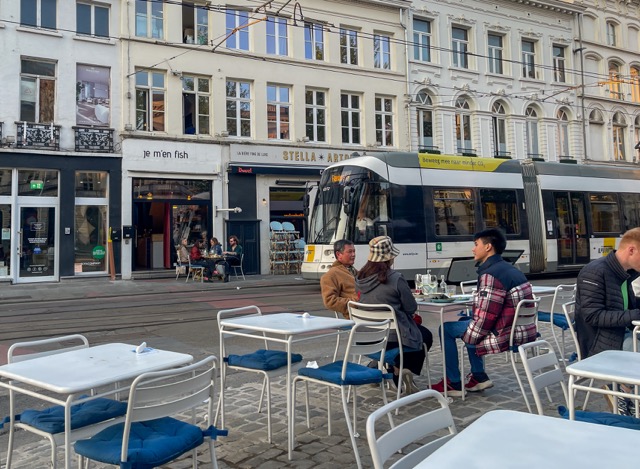
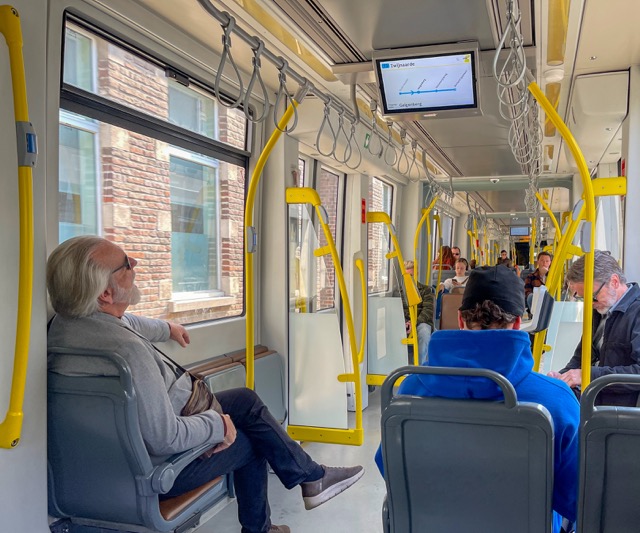
There was lots of train and tram time during our visit to Belgium. One evening we had dinner al fresco at a table across the street from the restaurant and tram track. A delightful urban experience!

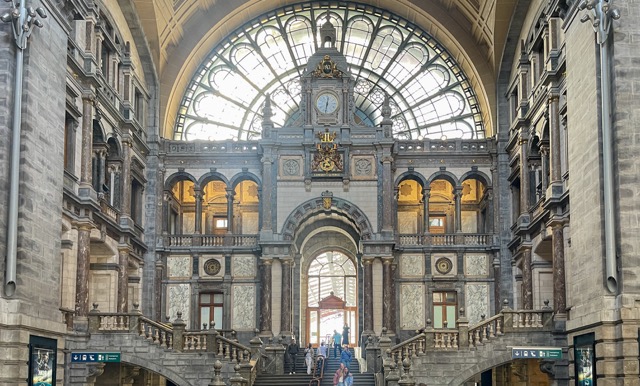
Antwerp Train Station – Wow!
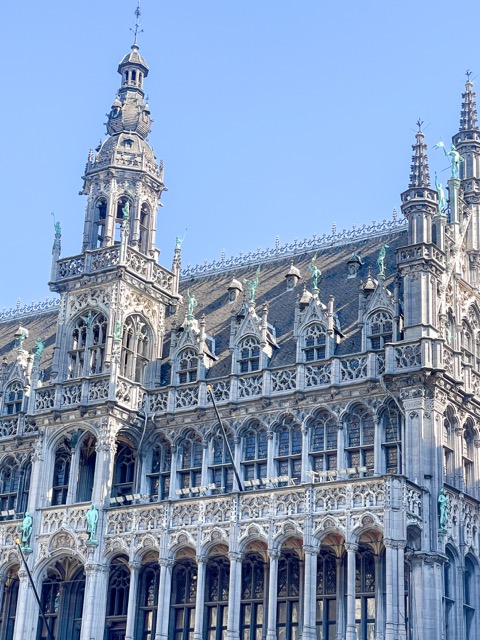
Brussels City Museum

Belgian Culinary Adventures

Belgium is a small country (about the size of the state of Maryland), but its culinary reputation is anything but modest. In Belgium, food isn’t just about sustenance. It’s about heritage, indulgence, and joy. And, food can be a powerful salve for human suffering offering a tangible form of care, presence, and connection. Bon Appétit! Smakelijk! (Dutch)

Waffles and Chocolates and Beers, Oh My!

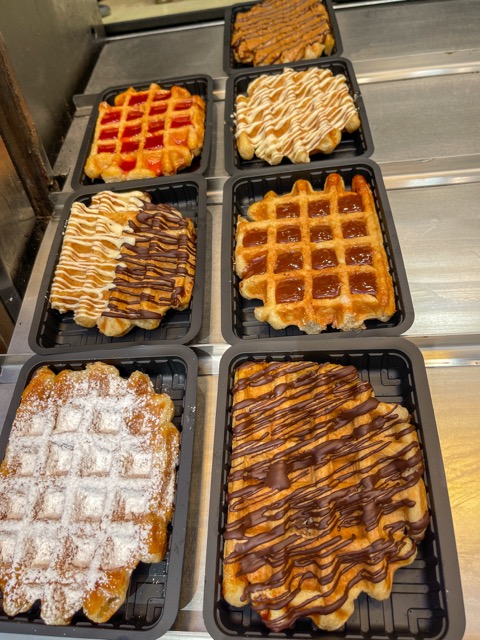
Waffles aren’t what you think. In Belgium, they’re an anytime indulgence, not just a breakfast treat. The two types of Belgian waffles, Liège and Brussels are both are delicious. A Liège waffle, dense and chewy, has a sweet, crunchy glaze that is created with caramelized embedded pearl sugar. A Brussels waffle, light, airy, and crisp, is typically dusted with powdered sugar or topped with whipped cream and berries. Whichever you choose, a warm waffle eaten on the go is one of Belgium’s most satisfying pleasures.

Luxuriously Chocolate

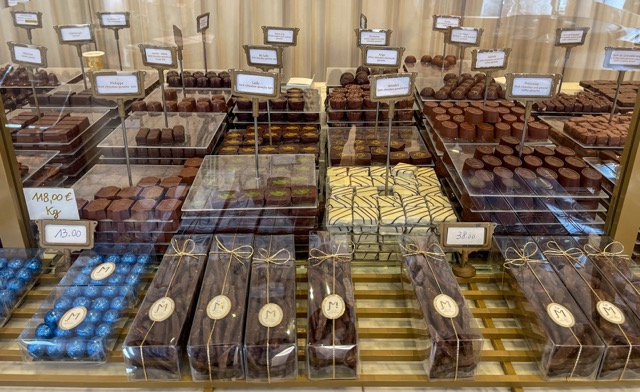
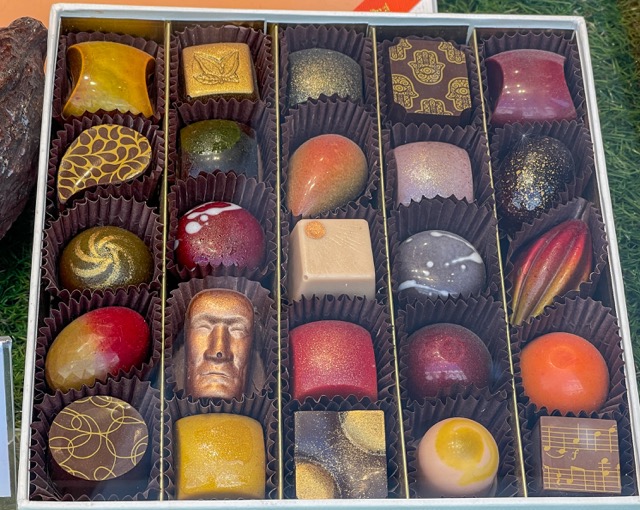
Few things feel more quintessentially Belgian than chocolate. But why is Belgian chocolate so good? It starts with selecting high-quality cocoa beans from specific origins. Three West African countries –  Côte d’Ivoire, Ghana, and Nigeria – are the key suppliers of cocoa beans to Belgium. Next, the exceptionally fine grind of the cocoa beans results in a very smooth, melt-in-the-mouth experience. Then, there’s the higher percentage of cocoa compared to other chocolates, contributing to a richer, more intense flavor and the use of pure cocoa butter which enhance the smooth texture. Each bite feels like a little moment of luxury.

A Sacred Craft

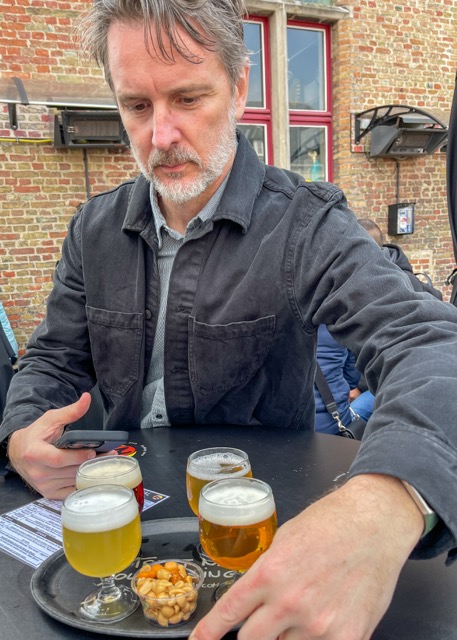
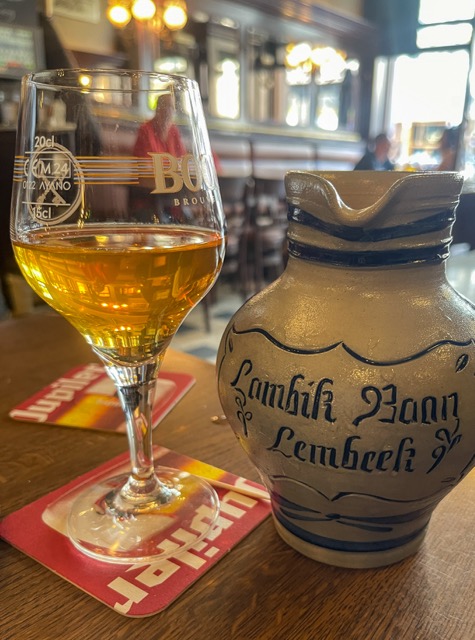
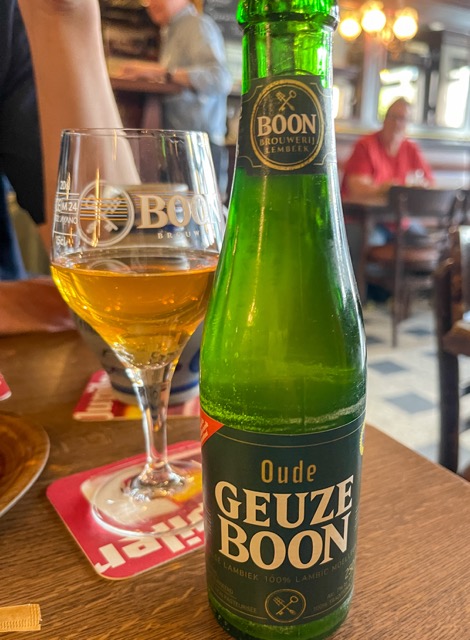
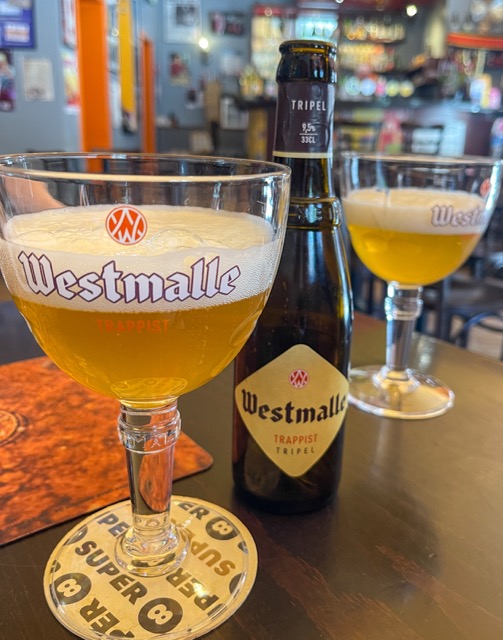
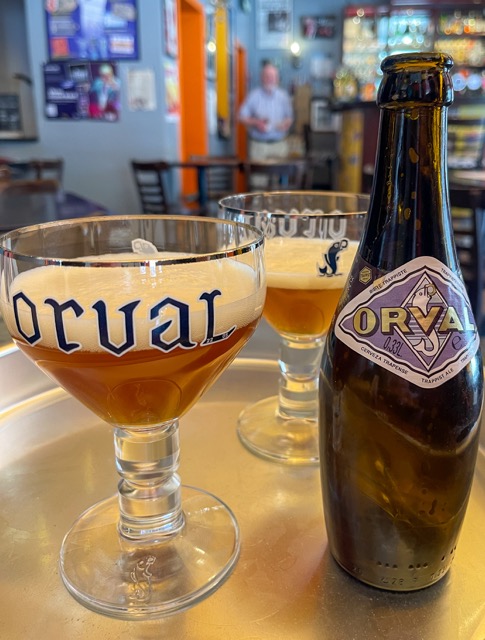
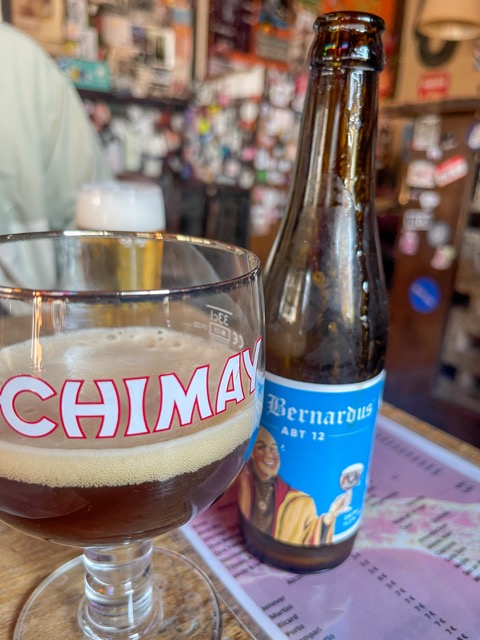
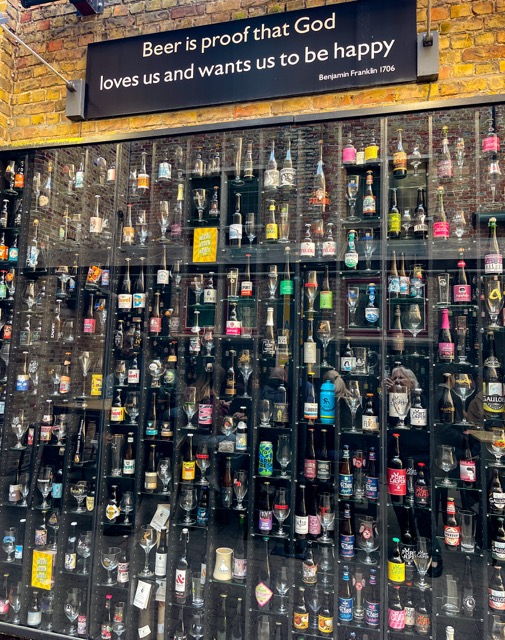
The beer culture in Belgium is world-renowned. With over 1,500 varieties and a brewing tradition dating back to the Middle Ages, Belgian beer not just a drink, it’s an art form. Each beer style has its own unique character—and often its own specific glass to enhance the experience. The Trappist beers, brewed by monks within abbey walls, are particularly revered. We did our best to sample as many as possible over our five-day visit and were fortunate to have the guidance of our youngest son, Michael (via text messages) and Mark’s good company, as we tasted our way through Gent, Bruges, and Brussels.

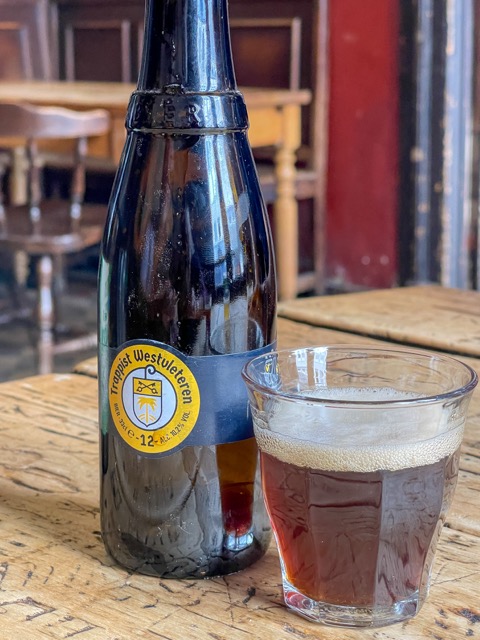
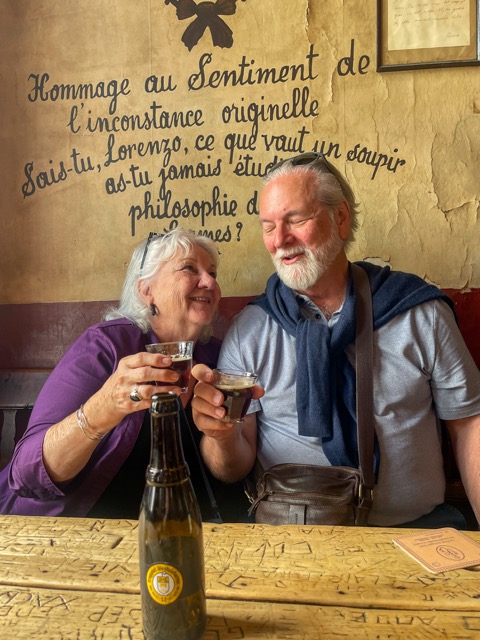
On Michael’s recommendation, we were fortunate to taste what some consider to be the best beer in the world. Westvleteren 12 is a Trappist ale, brewed by monks at the Saint Sixtus Abbey in western Belgium. There are just five monks who oversee the production of this beer which is very low because the monks only brew as much as they need to maintain their quiet lifestyle. After shelling out a mere €17, we split a small bottle with our guide for the day. It was delicious!

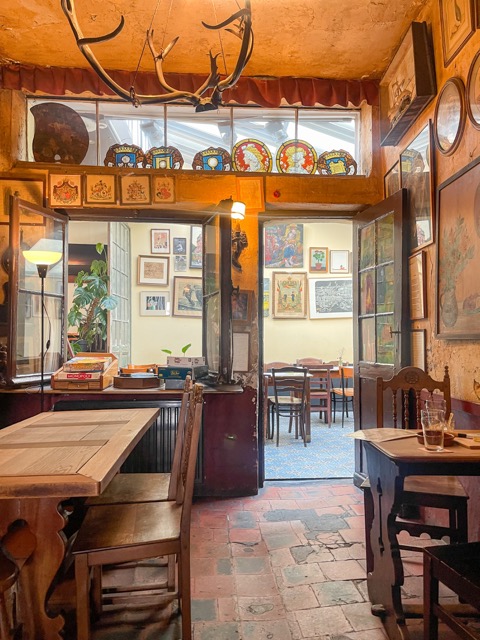
Vieux Spijtigen Duivel (the “Vieux Spijt” or “the Spijt” to its regulars) is the oldest surviving estaminet in Brussels – opened , between 1726 and 1741. However, legend has it that the Vieux Spijt has actually existed since 1500. This is where we had the “world’s best beer” (for €17 a bottle). This is where we sampled the World’s Best Beer – Westvletern 12.

Moules-Frites: The National Dish

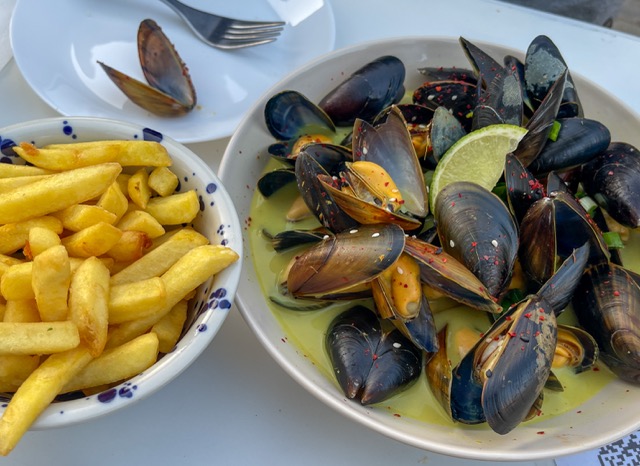
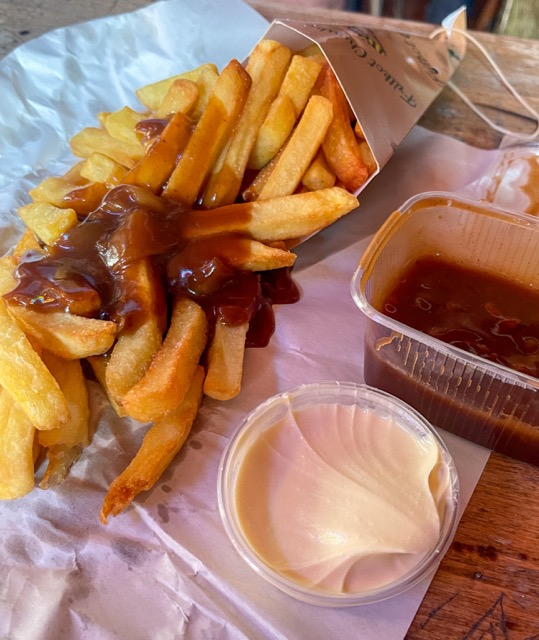
Few dishes capture the soul of Belgian comfort food like moules-frites—steaming mussels served in a fragrant broth with a side of golden, double-fried Belgian fries. Belgian mussels have a particular taste, reflecting the blend of North Sea nutrients they feast on during their 18-month growing period. Strong currents carrying plentiful nourishment mean Belgian mussels grow more quickly and become plumper than those grown in calmer waters, Cheap and plentiful, they were originally considered food for the poor, and they’ve long been paired with fried potatoes at the country’s famous fry shops, known as friteries in French and freetkoten in Dutch, the language of Flemish Belgium.

Frites are taken seriously by Belgians. They are fried twice for a perfect crispy exterior and fluffy interior and are served with homemade mayonnaise or a variety of gravy-like sauces. Belgians will tell you that Belgium, not France, is the true home of fries. The earliest recorded history of fries is in Belgium, specifically in the region of Wallonia (the southern area bordering France), in the late 17th century. Nearly three centuries later, American soldiers stationed in Belgium during World War I encountered the dish and because French was the dominant language in that area, the soldiers mistakenly believed the dish was French. And so, the name “French fries” stuck.

A Lifestyle to Envy

Belgians seem to enjoy a high standard of living. We noticed well-maintained infrastructure, excellent public transportation, and bicylces everywhere. We sensed a mix of traditional values and progressive ideas as well as multi-cultural diversity (especially in Brussels). The people we interacted with were reserved but always polite, and they switch effortlessly between Dutch, French, and English. When making a dinner reservation by phone on our last evening in Gent, the person answering the phone initially spoke in Dutch. When Ed asked, “Is English possible?” the response was “Of course, we speak English!” We always felt welcomed whether asking for directions, ordering a beer, or talking with a chocolatier. While Belgium may not shout for your attention like other European destinations, that is a part of its charm.

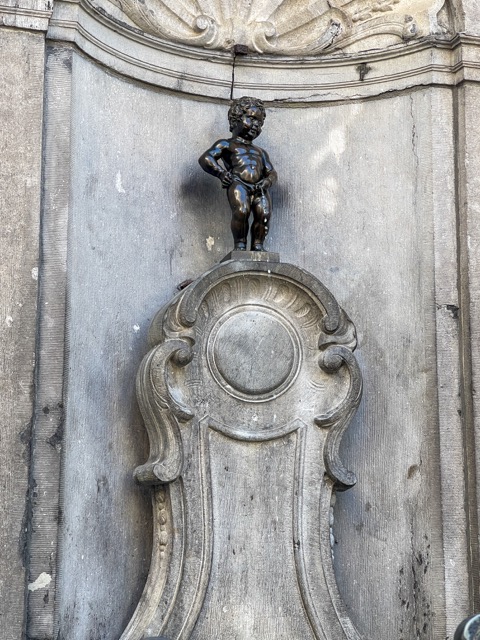
Manneken Pis (Dutch for Little Pissing Man) is a landmark bronze fountain sculpture in central Brussels.

We’d come to Belgium with the expectation of sampling world class beer. We found that, of course, but were also far more deeply affected and accumulated a new trove of experiences to ponder and assimilate into our world view. To this end we travel.

Belgium, You Surprised Me Read More »
A Meet-up in Mainz

Guten Tag!

As many of you know, our oldest son Mark, is a Professor of English at Georgia State University (GSU). He and Shannon have a lovely home in Atlanta, and we always have a great time visiting them there. The good news is that they are going to be much closer to Valencia for a while. Currently, Mark is a visiting professor at the Johannes Gutenberg University (JGU) in Mainz, Germany – a wonderful adventure and career opportunity for him. And, since and it’s just a 2-hour flight from Valencia to Frankfurt and then a brief 40-minute train ride to Mainz, we are looking forward to seeing more of him as we explore Europe together between now and the end of June when we leave for Pennsylvania.

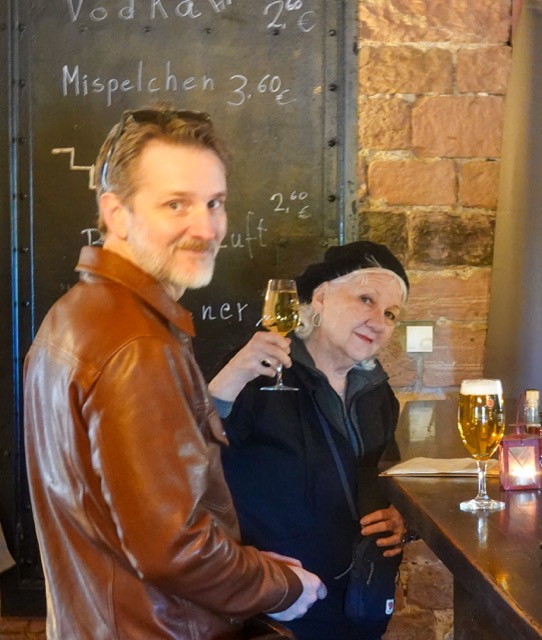
Eager to see him, we didn’t allow Mark much settling in time. He arrived in Mainz on April 2 and we showed up at his door on April 5. The first night, we had the obligatory schnitzel dinner and a glass of Riesling. Mark, still a bit jet-lagged, managed to show us around Mainz the next day to the tune of 20,000 steps.

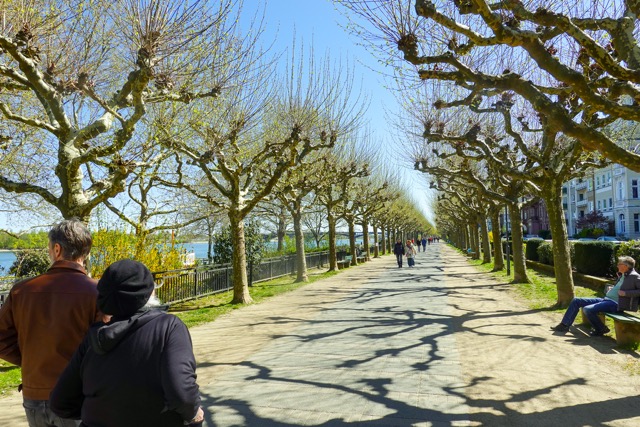
A stroll along the Rhine River.

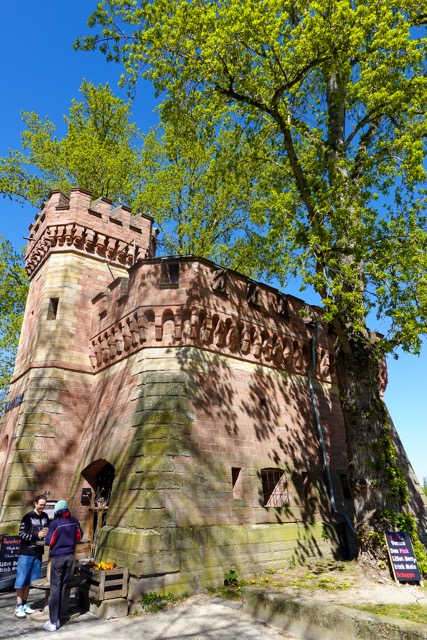
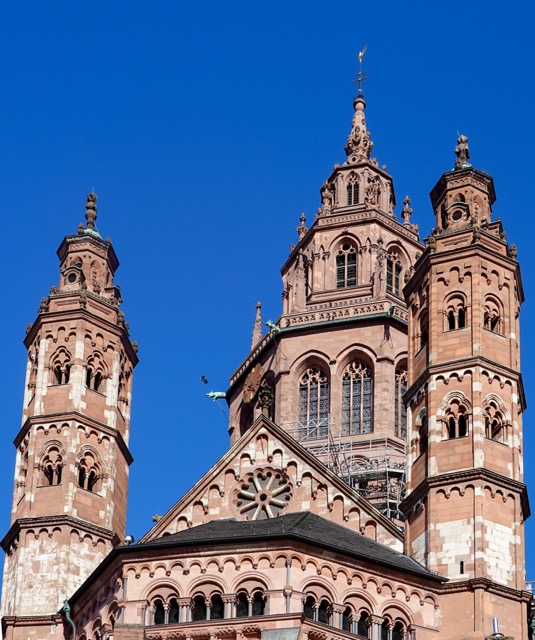
Mainz, one of the oldest cities in Germany, is located on the west bank of the Rhine River. It’s a lovely small city with a mixture of old and new and a relaxed vibe.

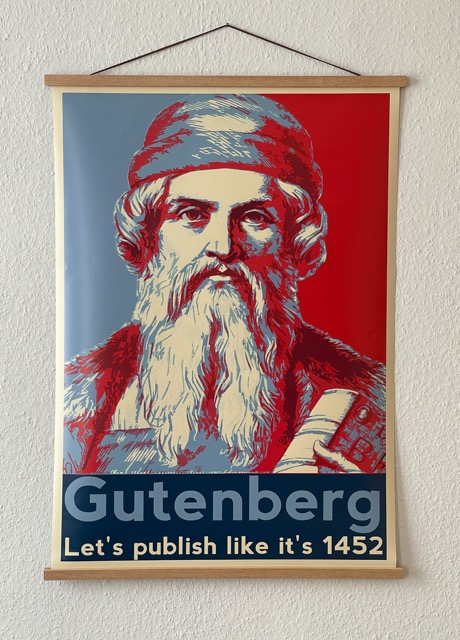
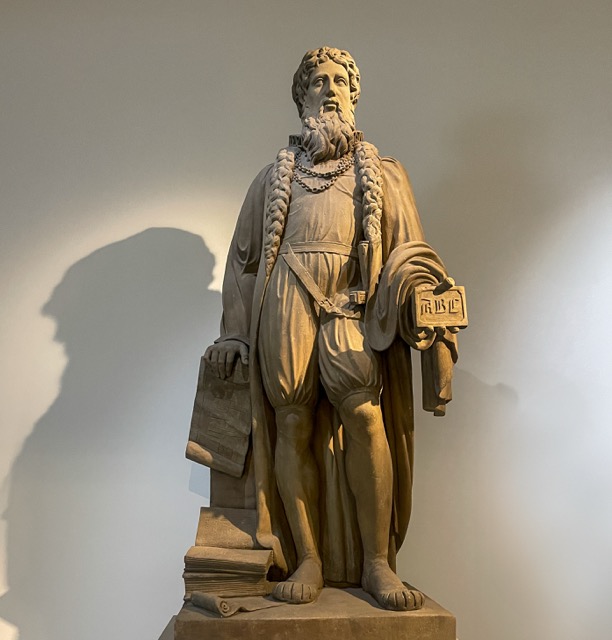
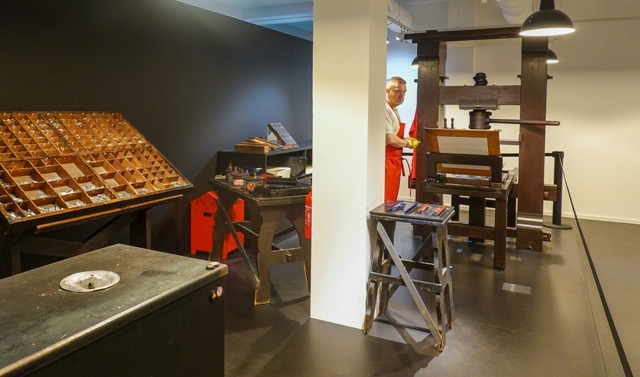
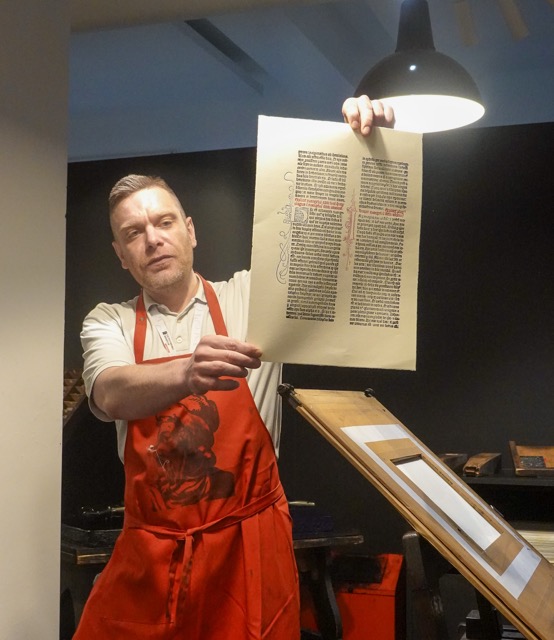
Mainz is best known as the home of Johannes Gutenberg, the inventor of the movable-type printing press around 1440.

In addition to teaching for a semester, Mark is working to strengthen the relationship between GSU and JGU. In particular, he is collaborating with the Obama Institute for Transnational American Studies – a research and teaching program focused on the Americas in a global context – to establish opportunities that will enhance students’ academic experiences and support various research activities. Obviously, we’re very proud of him and treasure every moment we spend together.

We’ll be meeting Mark in Belgium in about two weeks for another adventure. Then, Shannon arrives (YEAH!) in Mainz in early May. We’re letting her have an entire week to timezone-adjust before an adventure in Strasbourg, France where we’ll explore the Alsace wine region together. More Riesling along with Gewürztraminer, Pinot Gris, and Pinot Blanc are in our near future. We’re also hoping to meet-up in Kefalonia, Greece in early June to celebrate some birthdays.

Auf Wiedersehen (until we see each other again)

A Meet-up in Mainz Read More »
“Ich bin ein Berliner” – JFK 1963

There was a moment, early in our recent visit to Berlin, that jolted me.

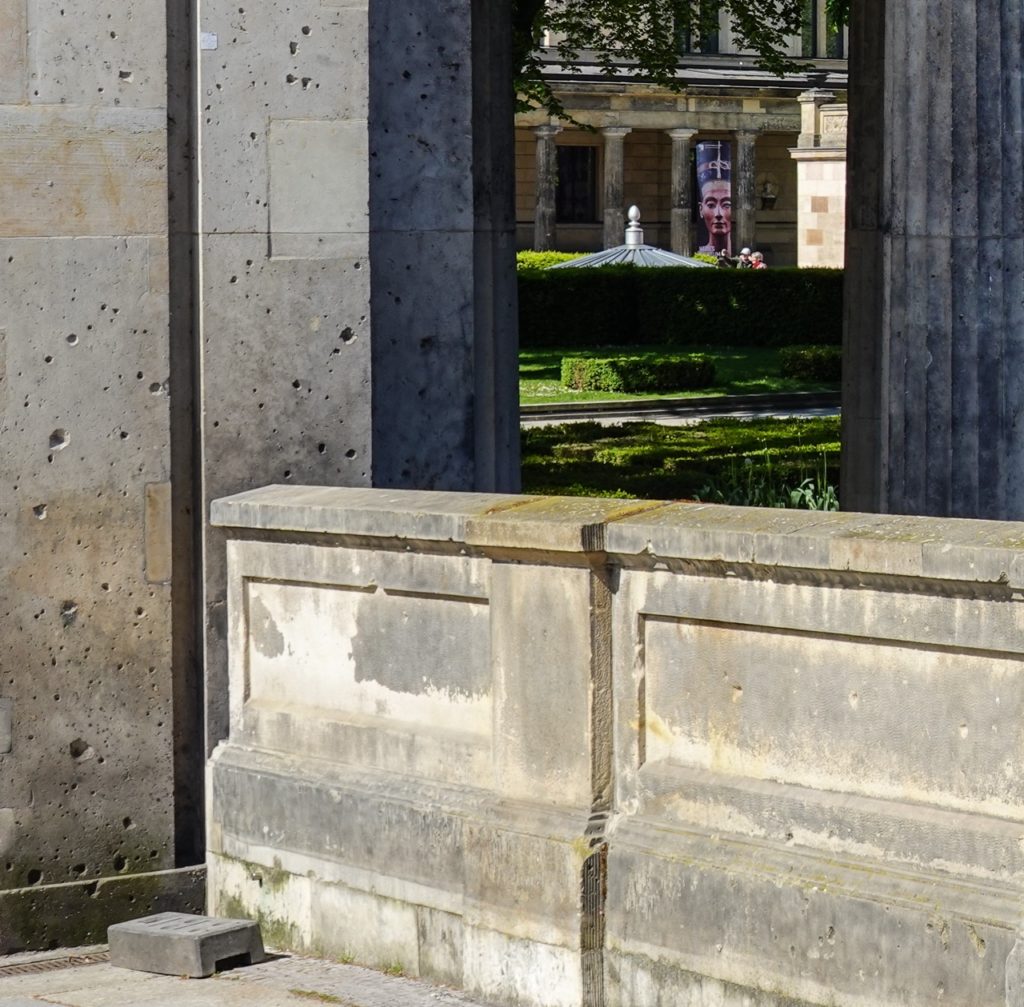
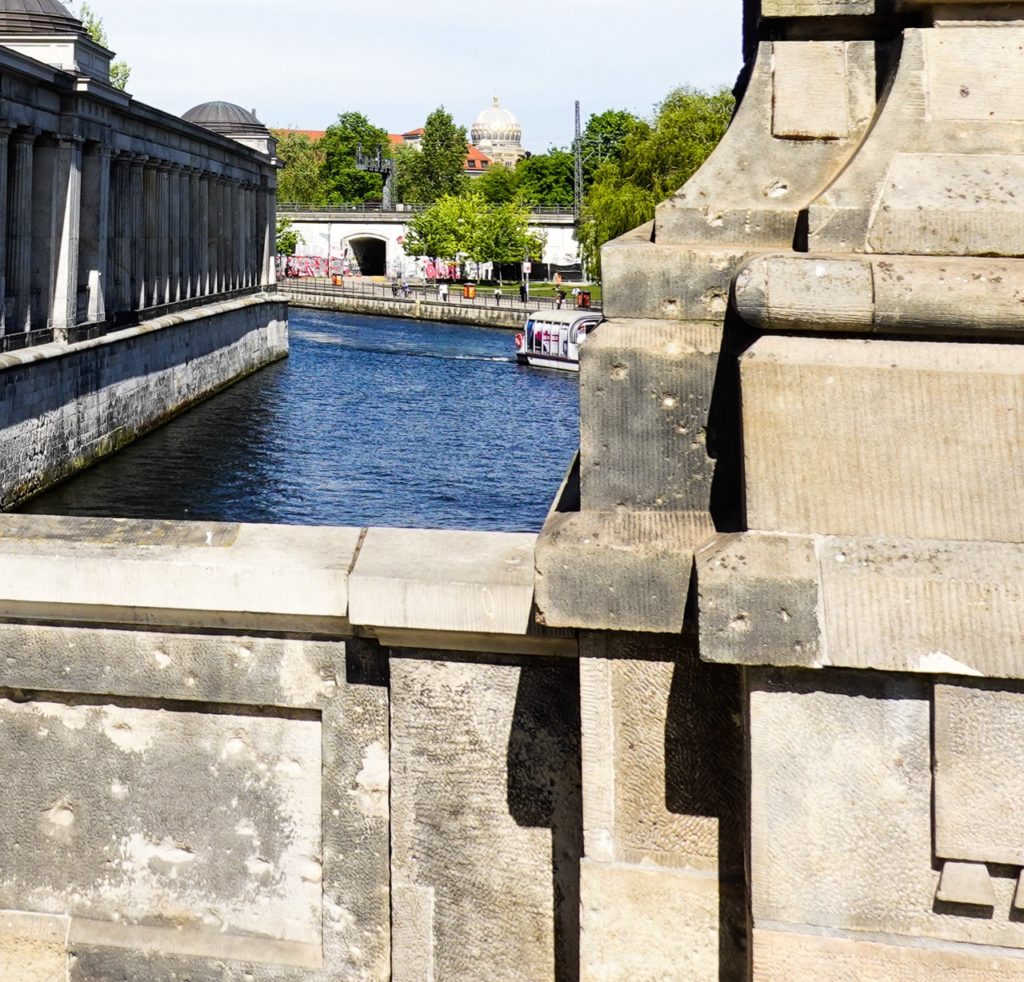
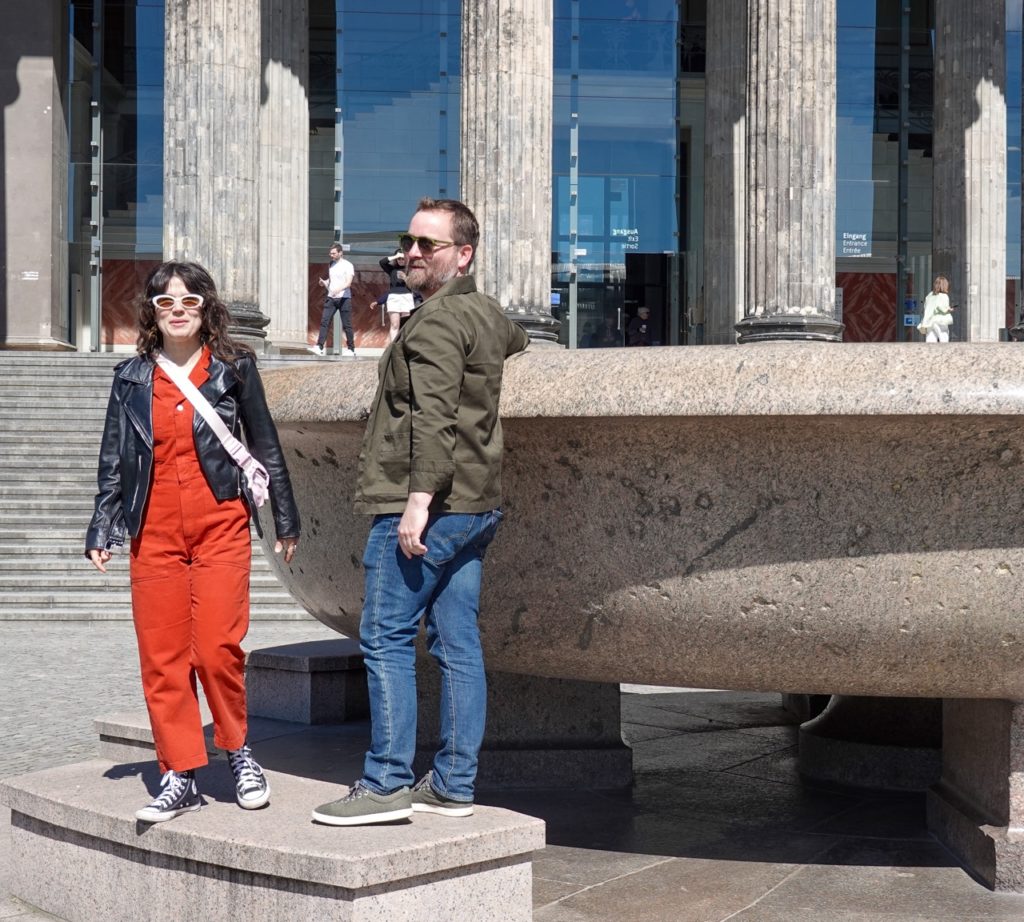
Our first morning, we found ourselves strolling an area at the heart of the city known as Museum Island, admiring some of Berlin’s most important monuments and buildings. Initially, it was subtle, just below consciousness, part of the texture of the stone all around us. Slowly, however, observation gave way to understanding. Bullet marks. Thousands. Everywhere. And in an instant, the horror of what had taken place here came rushing back from a past that cannot be escaped or erased. The stone remembers. The stone testifies.

Priorities

We were in Berlin primarily to hang out with our son Michael and his partner Charlotte. We’d been carefully managing our spring schedule to make sure we could fit in a few days to pop up to the German capitol. Germany has not been high on our list of places to travel, but a chance to spend time with Michael and Charlotte was not to be missed. So, we were off to Berlin, albeit with some trepidation. In our minds, Berlin is associated with all the darkest decades of the twentieth century. Wouldn’t a tour of this city inevitably be a bleak, somber experience? On the other hand, Berlin is the home of a relentlessly youth-focused art, music, dance, and political scene that has made it internationally famous for night life, street parties, and a wildly popular musical genre called “techno” which is pretty much lost on me. It was clearly going to be a challenge to reconcile all these themes.

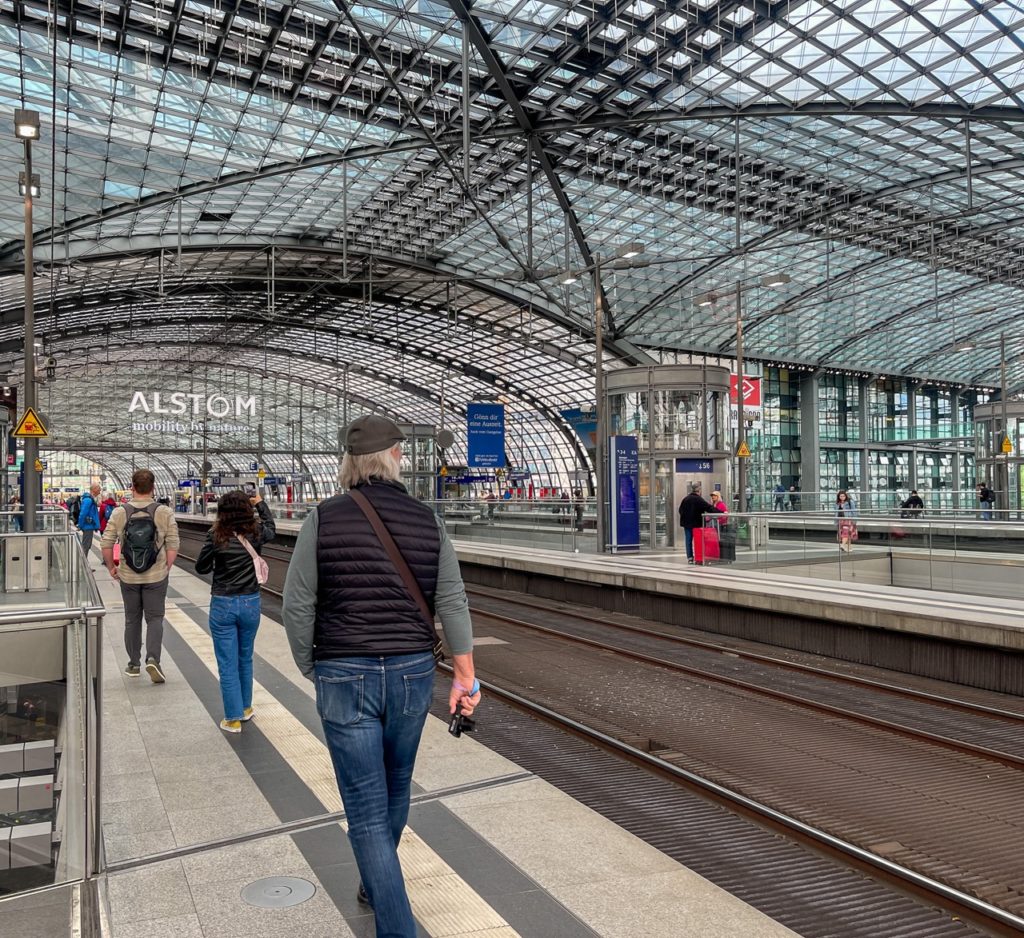
As we made our plans, we quickly came to understand that Berlin’s diversity extends to its neighborhoods which include something for everyone. After some deliberation, we decided to locate ourselves in the Prenzlauer Berg quarter of the city at a charming boutique hotel created from a Victorian era public pool complex. Located in part of what was once the German Democratic Republic (East Germany), it proved to be a wonderful location – saturated with cafes and shops, dotted with parks, and on tree-lined streets of elegant apartment blocks from another era. We bought a week-long pass to the public transportation system which seems to cover every block of the entire city with hop-on-hop-off ease. The city center was three tram stops from our lair and connecting trains to destinations around the city were as easy as stepping off one conveyance and strolling on to another. Berlin might have the most complete and convenient public transportation we have ever experienced.

History Lessons

With logistics sorted, we began to explore the Mitte, or city center. As I admitted earlier, we approached the historic heart of Berlin with some reservations. In the culmination of WWII, the Nazi’s made it clear they intended to resist defeat down to the last man. It took the complete destruction of the capitol to bring the war to an end. In the last six weeks of the war, American and British planes dropped as many tons of explosives on the city as had been expended in the entire three years prior. Something like 90% of the city was damaged, and the center was reduced to rubble. Then, the Russian army arrived, and the fighting went street by street until every remaining German soldier lay dead or captured. Total victory was accompanied by the long honored “code” of war for conquering armies: rape. It’s estimated that nine in ten of the surviving women in Berlin were brutalized and, of course, anything of value was looted. Walking through the heart of this “ground-zero”, identifying the surviving pre-war buildings from the reconstructed ones became unmistakable. The stones testify.

Today, the area is a tranquil, gracious collection of museums, monuments, gardens, and open plazas, splitting the flow of the river Spree, connected by stately bridges at every avenue. For the most part, Berliners have recovered and moved well beyond their history. To their credit, however, it has not been left behind, so much is woven into the fabric of life in the city.

Timeless Grief

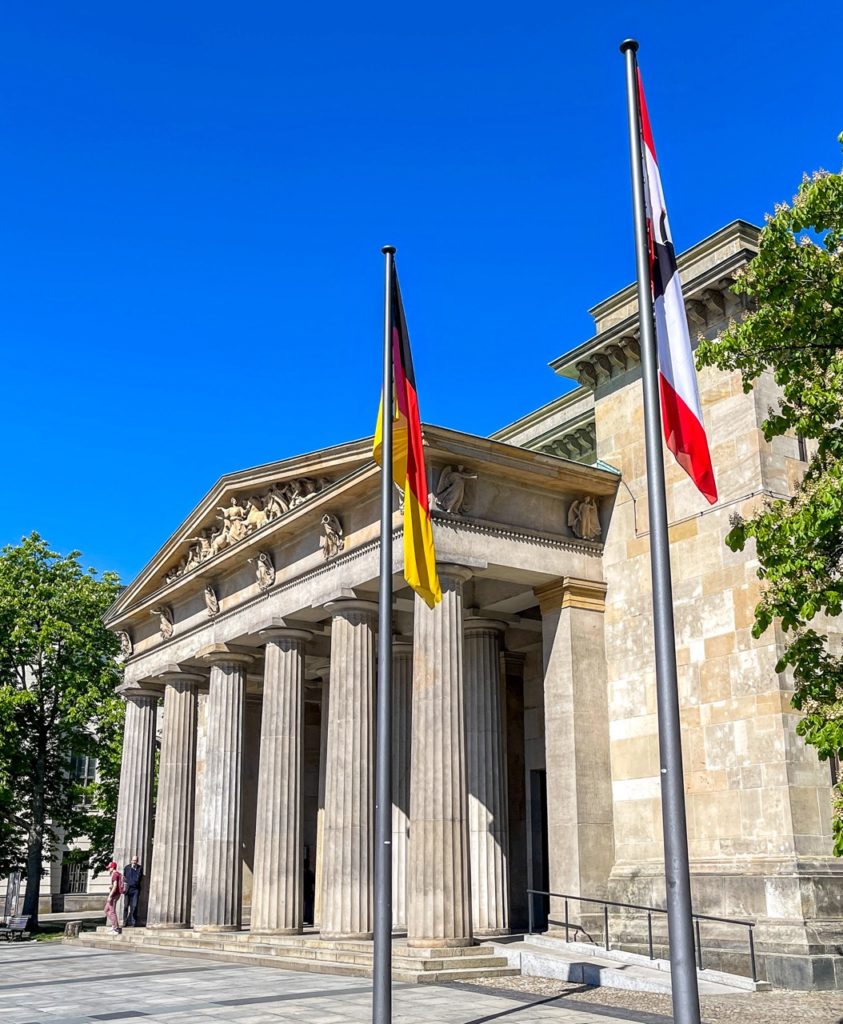
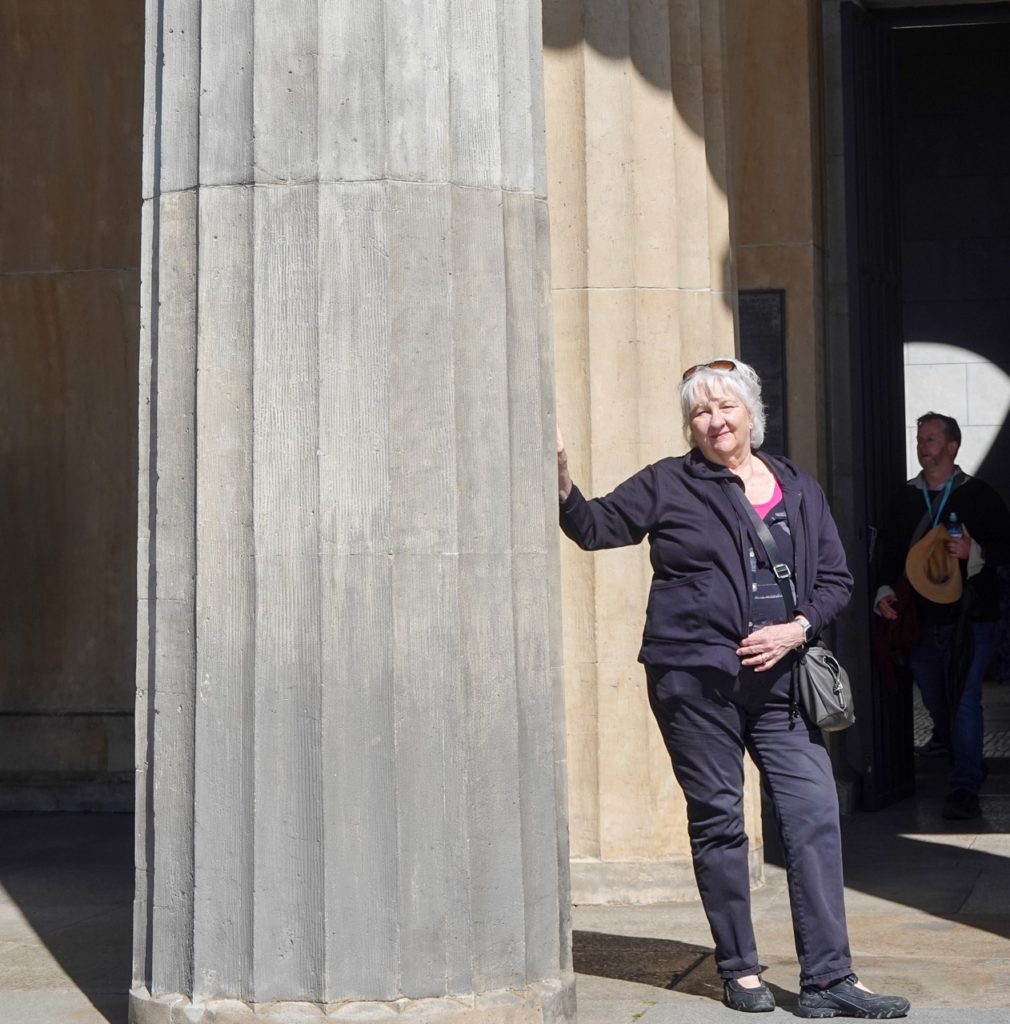
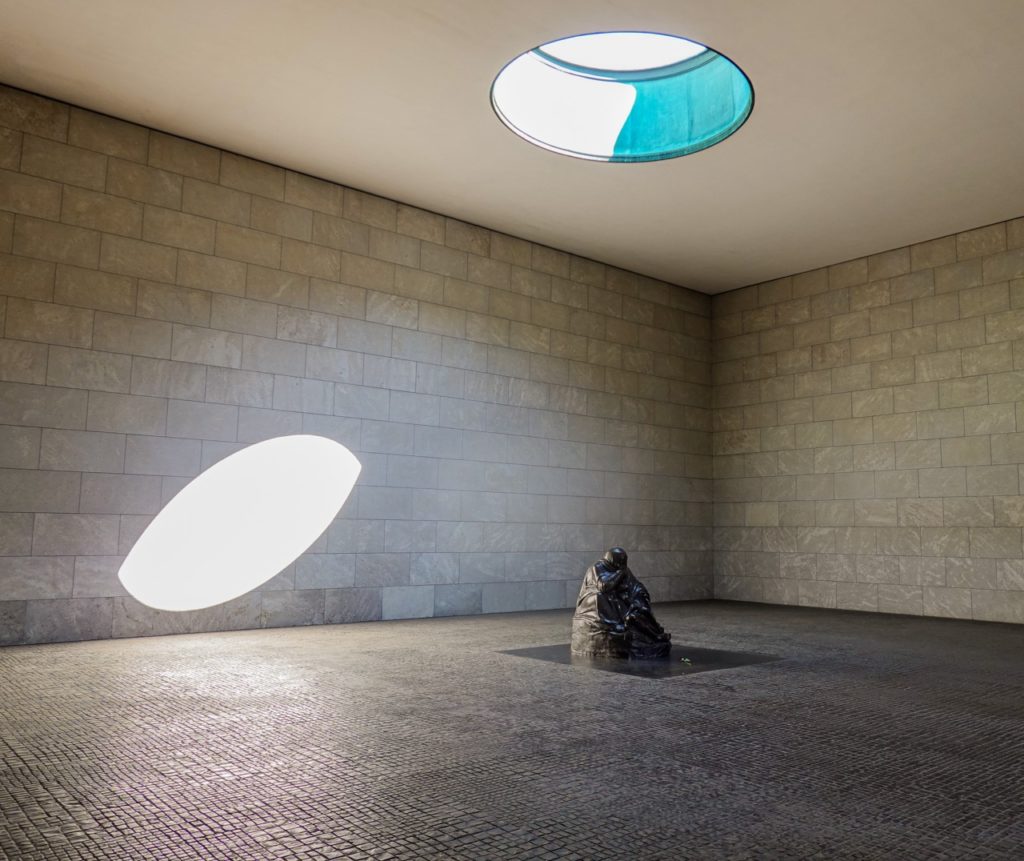
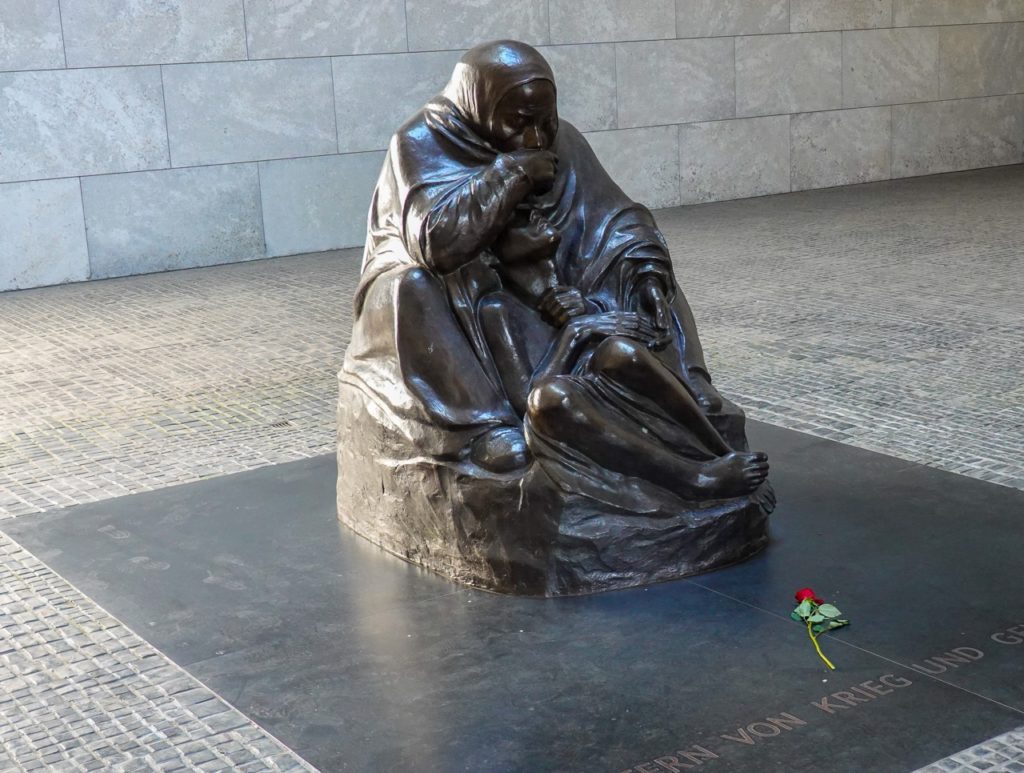
Among the monuments I found most moving was the Neue Wache (new watchhouse) located just a block west of the island. Originally built as a guardhouse for the royal palace which sat opposite, it was designed by a Jewish architect and constructed in 1818. At the end of The Great War, it was turned into a monument honoring the dead from that conflagration called The Memorial of the Prussian State. The Nazis repurposed it as the Heroes Memorial. In 1960, the East Germans dedicated it as the Memorial to Victims of Fascism and Militarism. Finally, after reunification, the monument was rededicated as the Monument for the Victims of War and Tyranny. Beyond the neoclassical façade, in a minimalist void, sits a bronze pieta – a mother cradling her dead son – under an open oculus, exposed to the elements. For me, this symbol of the suffering visited on the civilian populations is about more than the two world wars and it couldn’t be more appropriate that it has been renamed by each new regime. It originated in, and speaks to, the current era of human destruction. Modern war has evolved beyond a clash between the militaries of competing states. We now rationalize the all-out destruction of whole societies of innocent citizens if it suits our aims. That this monument was originally designed by a Jew is simply one on a list of ironies that defines modern Berlin.

Life is too ironic to fully understand. It takes sadness to know what happiness is. Noise to appreciate silence & absence to value presence.

Abhysheq Shukla, KARMA

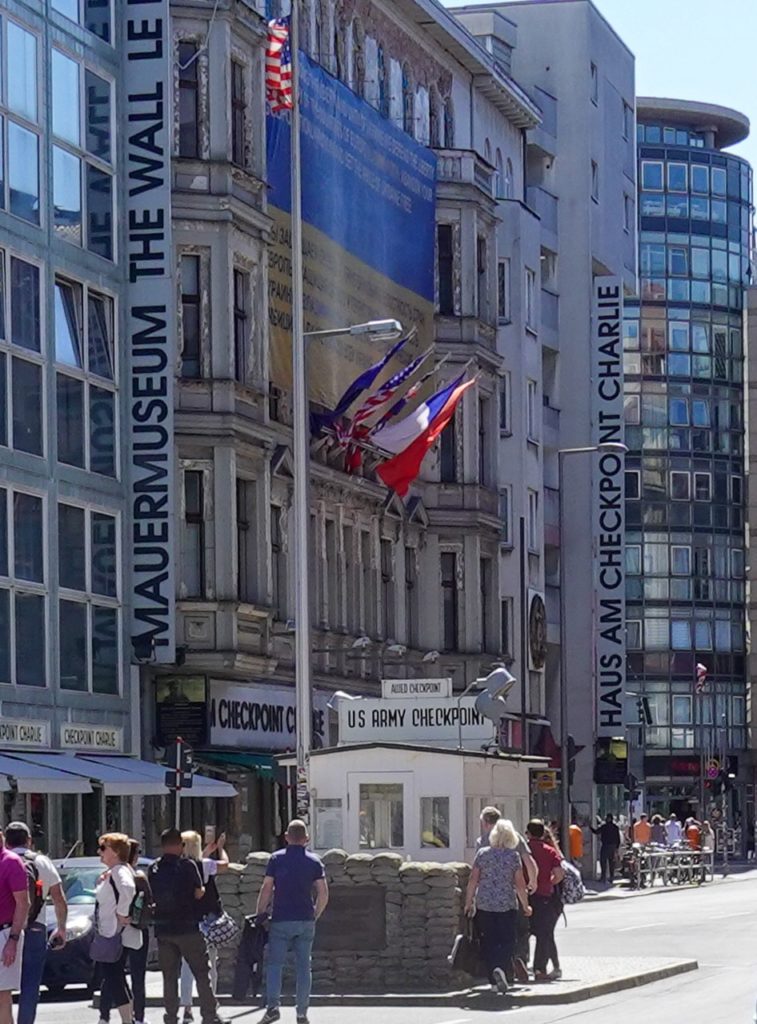
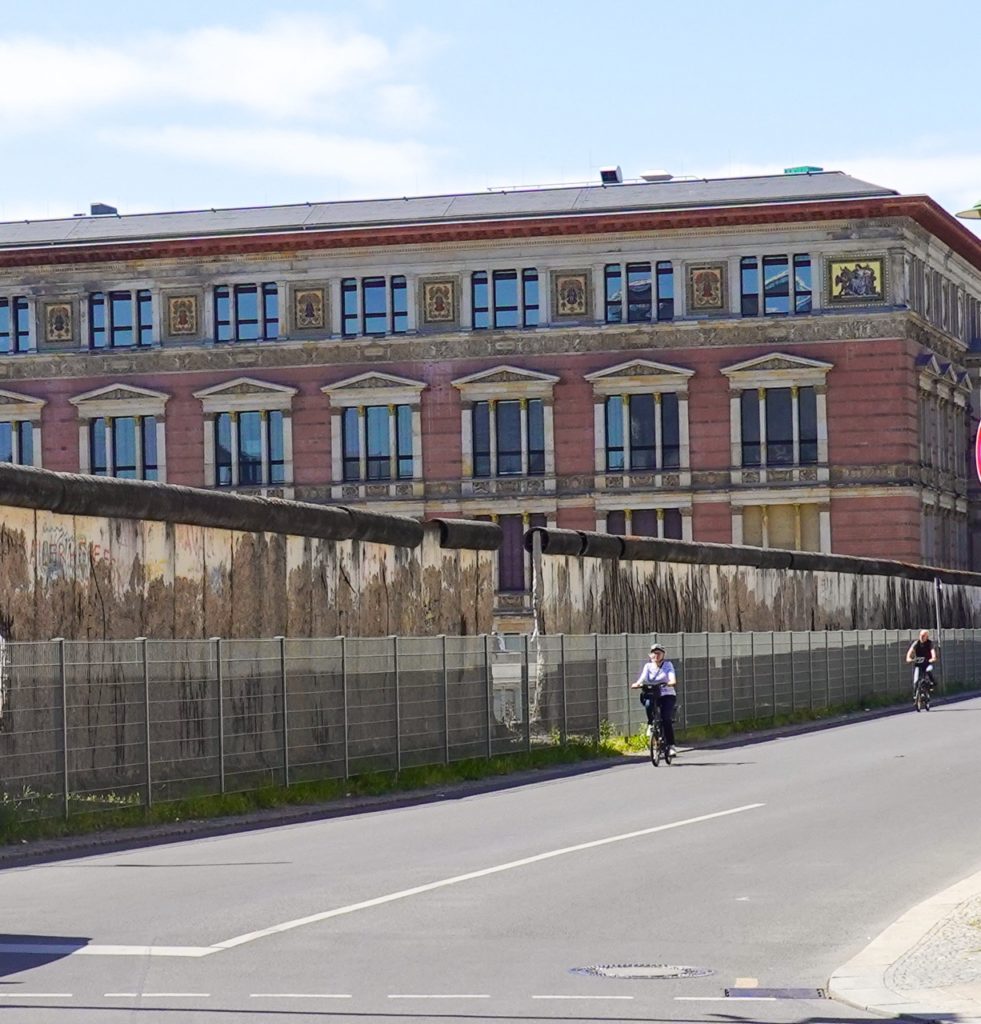
The next stop on our stroll through the city was another of its enduring symbols: the wall. Popular images of the Berlin wall, razor wire, the death strip, and Checkpoint Charlie are so ubiquitous and iconic for members of my generation that seeing the remnants 35 years after the rest was removed proved to be a bit anti-climactic. It was startling to realize that it only existed for some 28 years, from 1961 to 1989. And, in that time, there were only around 200 deaths associated with attempts to cross. Of course, it came to symbolize far more in the struggle between communism and democracy that followed the struggle between fascism and democracy and which now . . . we . . . well, anyway . . .

As you can see from the photo, the wall is now surrounded by a fence to keep people away from the wall. This fence, of course, is made entirely of irony. (I’m afraid I must give credit to our guide for this joke but could not resist including it here.)

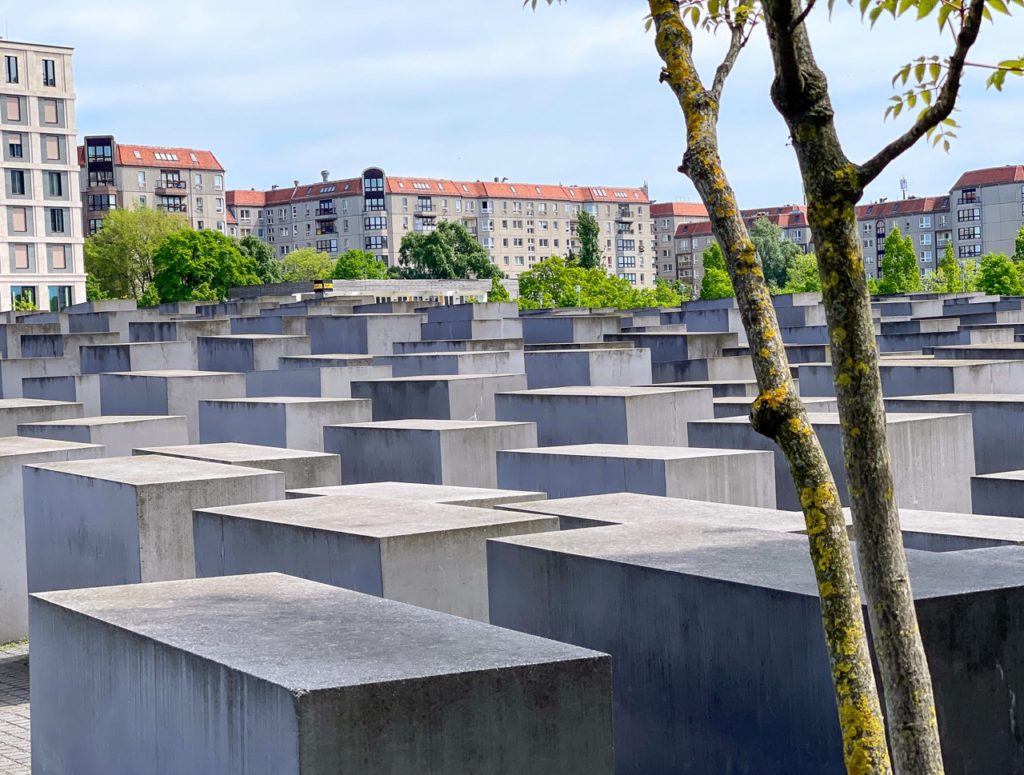
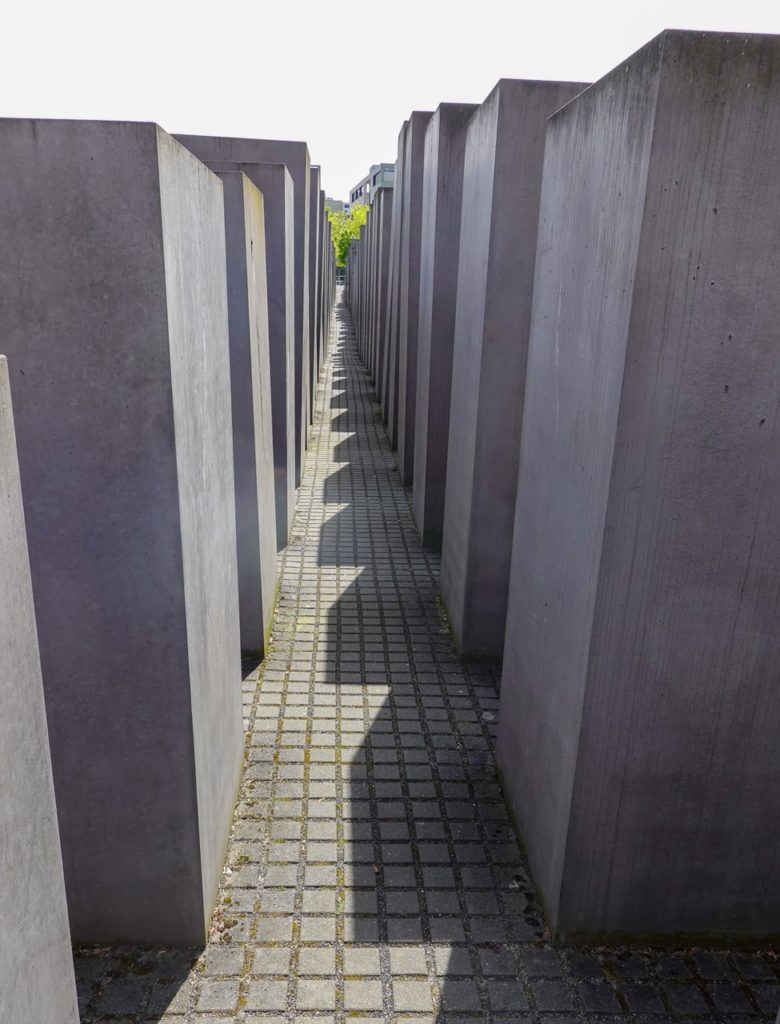
Finally, we were greeted by one of the most enigmatic and sublime monuments I have ever confronted in the Memorial to the Murdered Jews of Europe. As Germans wrestled with their history, a memorial to the 6,000,000 jews murdered during the Nazi regime was proposed and a design competition held. The selected design resulted from a collaboration between architect Peter Eisenman and the artist Richard Serra, and was constructed on nearly five-acres that had once been part of the death strip. It consists of 2,711 monolithic concrete “stelae” of various heights arranged in a grid across the undulating site, creating an environment that is simultaneously orderly and totally disorienting.

The project represents the instability inherent in a system with a seemingly rational structure and the potential for its gradual dissolution. It makes it clear that an ostensibly rational and orderly system loses touch with human reason when it becomes too large and grows beyond its originally intended proportions . . . it becomes clear that all closed systems must fail. . .

Peter Eisenman

I’m a huge Richard Serra fan and found this monument to be a very moving expression of his art encapsulating an unimaginable concept: the systematic murder of millions of innocent people in service to profane, ideological, inhuman constructs of purity. As a monument and a work of art, it is wholly unsettling and completely defies interpretation or understanding. It is, in my opinion, a total success.

Thus ends our first day in Berlin.

A Bucolic Refresh

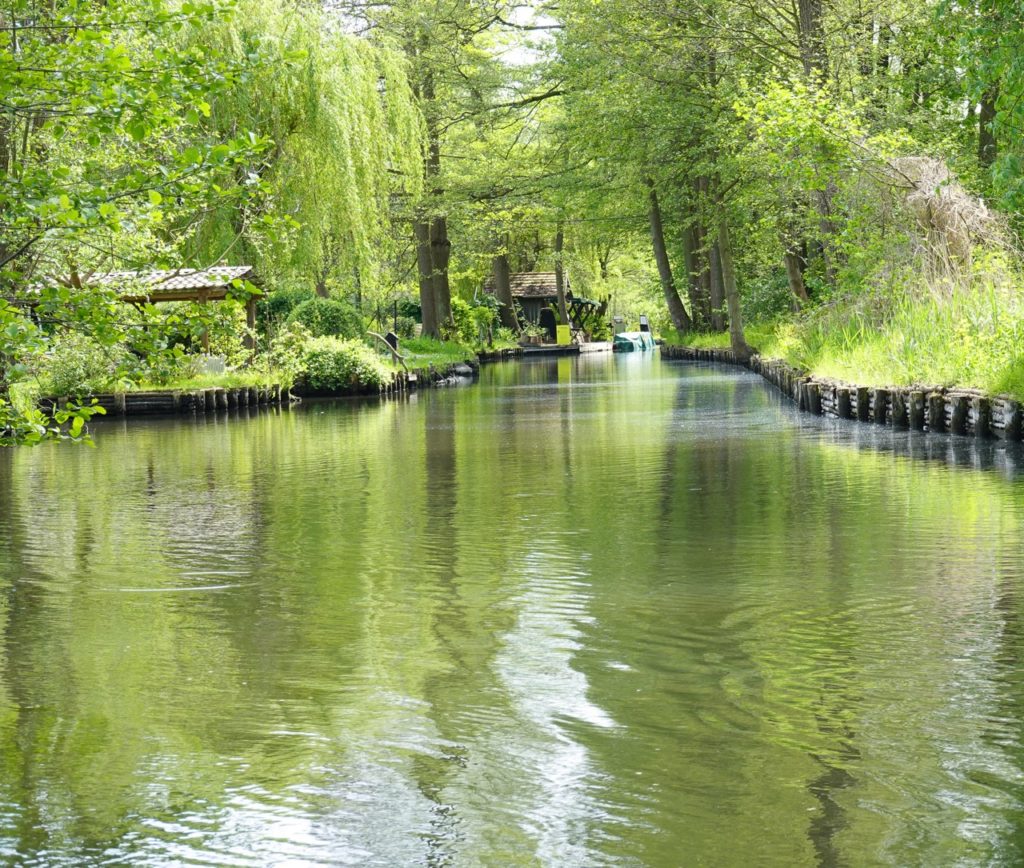
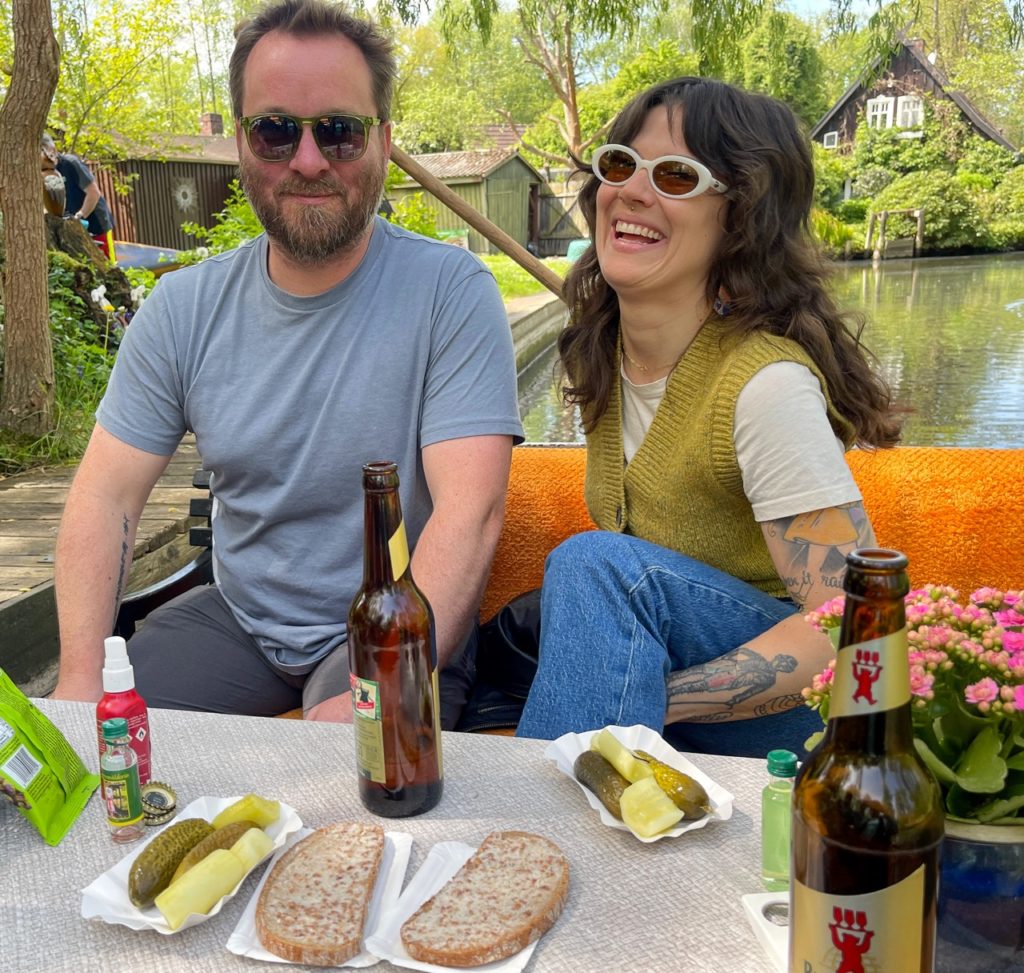
In a stroke of fortuitous planning, we had scheduled a day trip an hour out of the city for our second day. I say this was fortuitous because I felt the need to process our first exposure to the historic center of Berlin, and it happened that our outing in a verdant, ecological reserve was just the right tonic. We boarded a train and set out for the town of Lübbenau and the UNESCO heritage site known as Spreewald to relax into the meditative, healing arms of mother nature. Also, beer, pickles, currywurst, pretzels . . . well, you get the picture.

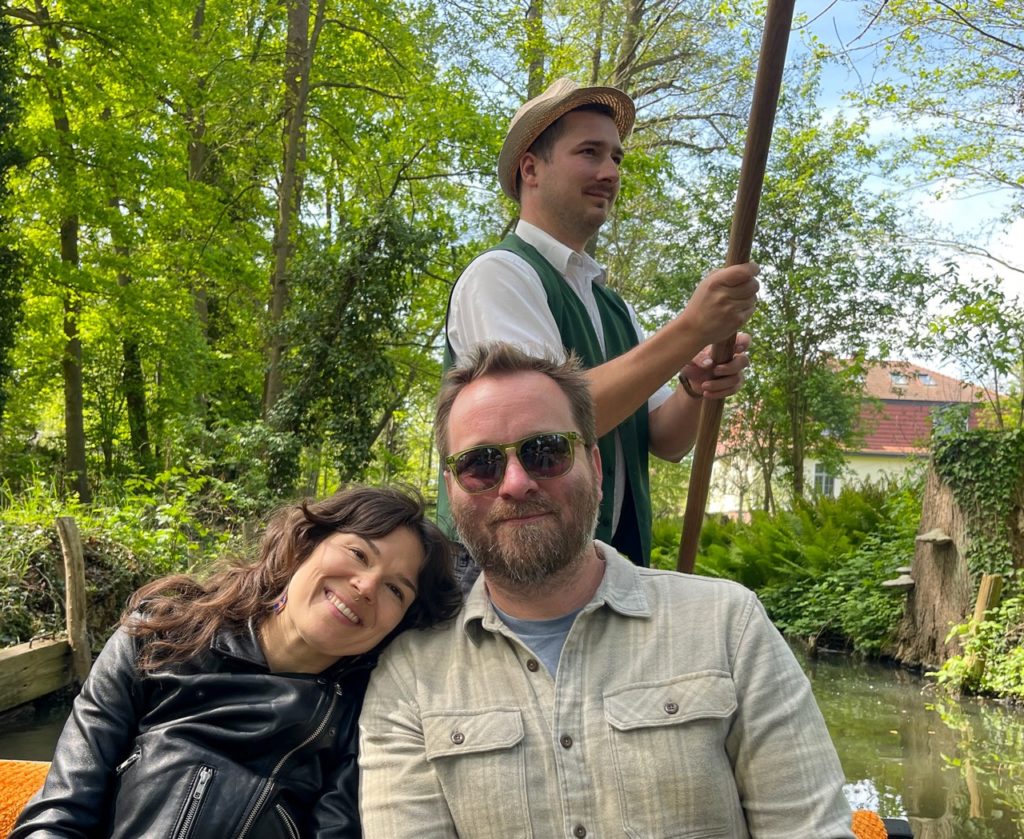
It seems that we constituted a rare contingent of tourists to Spreewald. According to our punt boat driver and guide, 90% of their visitors are vacationing Germans, not touring Americans. It turned out to be a very authentic afternoon of beauty, sun, and time together to discuss the meaning of life, schnitzel, and schnaps.

Refreshed by our excursion, we were ready the next day to tackle the GDR. So, we headed off to the DDR Museum to gain a perspective on what life in East Berlin was like from 1949 to 1990. (The official name of East Germany was the Deutsche Demokratische Republik or DDR) This museum is a very interactive and fun presentation of all elements of life in the east from the iconic East German car, the Trabant, to the all-plastic bathroom fittings in the “luxury” apartments, and a diorama of a nude beach with very detailed modeling. Apparently, the nude beach was important because as much as the Soviets attempted to repress the life of its citizens, the Germans drew a line in the sand at not being allowed to take of their clothes. (For those that didn’t catch it, that’s a Dad joke.)

Honestly, humor is a pretty consistent theme when you look back at the bumblings and fumblings of the totalitarian communist government, and that was certainly reinforced in this museum. I do not mean to make light of the repression and suffering of the population under the GDR. However, my great take away from this museum visit was that people go on with their lives, despite the absurdity of the society where they may find themselves living. Also clear to me, is that most of the angst we all suffered over the “cold war” was mostly propaganda. The east was doomed to fail and would have succumbed with or without any intervention. It was an absurd system that toppled from its own instability.

Ooops . . .

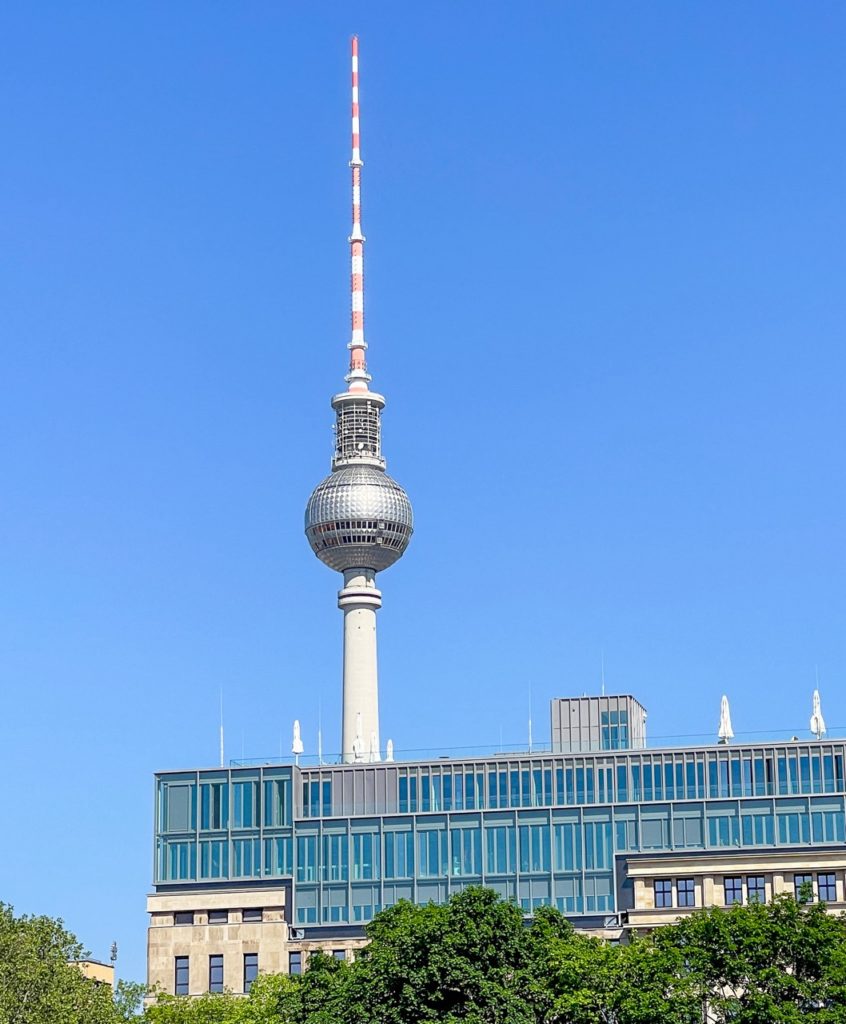
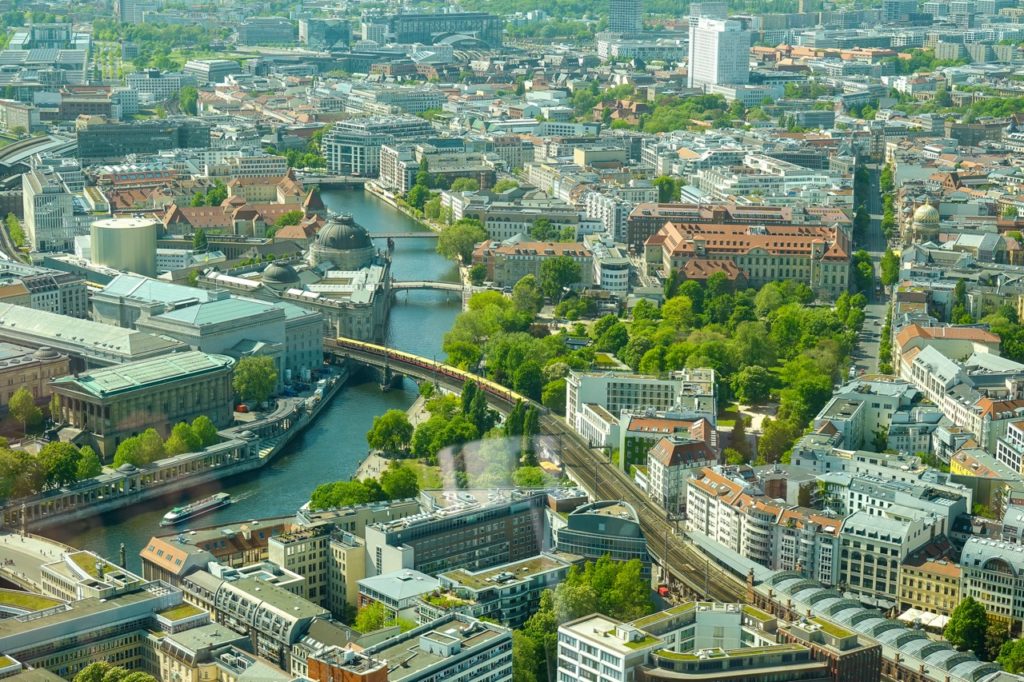
To conclude our GDR adventure, we wandered over to the great symbol of East Berlin, TV Tower. The communists built the Fernsehturm as a broadcast and communications facility, but also as a statement of power and prestige. At 1,207 feet, it is the tallest structure in Germany. It’s also the object of one of my favorite stories about the silliness of the totalitarians. You see, when the great sphere that sits about two-thirds of the way up the tower was completed, it was discovered, to the horror of the state that the sun’s reflection created a giant cross that could be seen all over Berlin. Dubbed the “Pope’s Revenge” by Berliners, officials demanded that the builders erase the reflected religious symbol. All manner of resurfacing and coatings was tried to eliminate the reflection on the stainless-steel skin, all to no avail. For our part, we happily lunched, toasted Papa’s retaliation, and enjoyed the spectacular views from the rotating restaurant that now occupies the ball.

I want to be sure I correct the record. I’ve written nearly 2,000 words about Berlin’s past and it is something that must be reconned with. However, this is a city that is future oriented, not stuck in its history. It is an amazingly diverse and international culture. Only in London did we hear more languages spoken on the street. And its people are without exception friendly and welcoming. Culturally, it is as diverse as its people, featuring music, art, dance, and theater that spans the entire spectrum of creative production from ancient to futuristic. Bonnie and I try, when we’re traveling to experience live performances whenever possible, and Berlin made this an easy goal to meet.

The future depends on what you do today. . .

Mahatma Gandhi

A Crescendo of Wind

For me, there is nothing on this earth to match the sound of a live orchestra in full throated celebration of a great composition. So, among our strategies for experiencing the great capitols of Europe is to find performances in their symphony halls and opera houses where we can both enjoy live music and admire the inevitably interesting architecture. In Berlin, we struck gold.

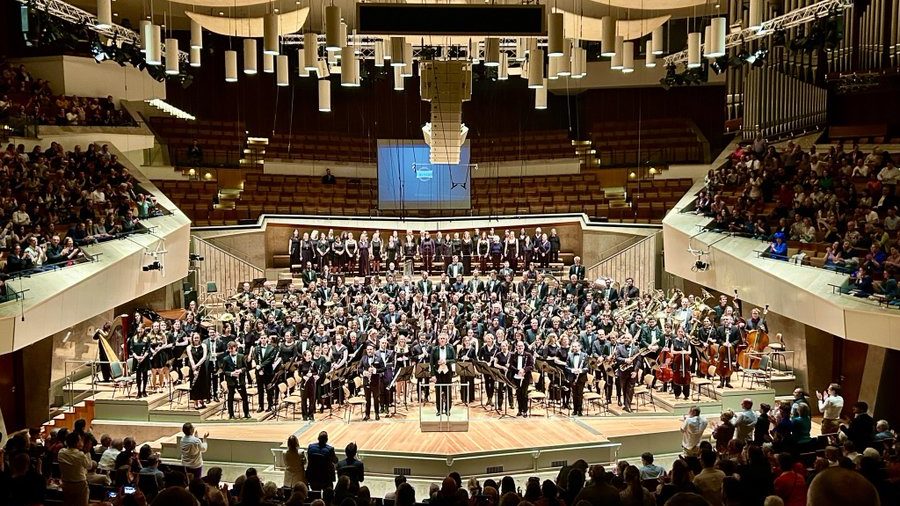
First, we discovered that the Berliner Philharmonie was hosting a performance of “Planet Earth” – Symphony #3, by Johan de Meij, for wind orchestras. The program also included three other compositions for wind orchestra by Mr. Meij, who, it turned out, would also be conducting his own music. Michael and Charlotte have proven to be adventurous when it comes to live performances (get them to tell you about the opera I drug them to in Valencia) so, I was confident they would go along with my notion of a good time.

The concert hall itself is a modern design built in the early 1960’s and when we entered, I was immediately intrigued by the interior arrangement of seating levels jutting at odd angles. In the early 1980’s I had been privileged to play a role in the construction of the Orange County Performing Arts Center which shared a similar design approach based on sophisticated acoustical modeling that seeks to reduce the interior space of very large halls to smaller, resonant modules. (See me after class if you’re interested in a more detailed explanation.) Anyway, as the evening unfolded, it became clear that the acoustics for this hall are a success. The first half of the program was performed by two different, Berlin based, wind orchestras. After the intermission, the orchestras were combined to perform “Planet Earth.” I have never seen that many instruments crammed onto the platform together. Toss in a large choral ensemble, the joy of the composer himself conducting, a symphony written to take full advantage of the power brass and wind instruments produce, and you get a rare musical thrill that I will not soon forget.

Bodies in Motion

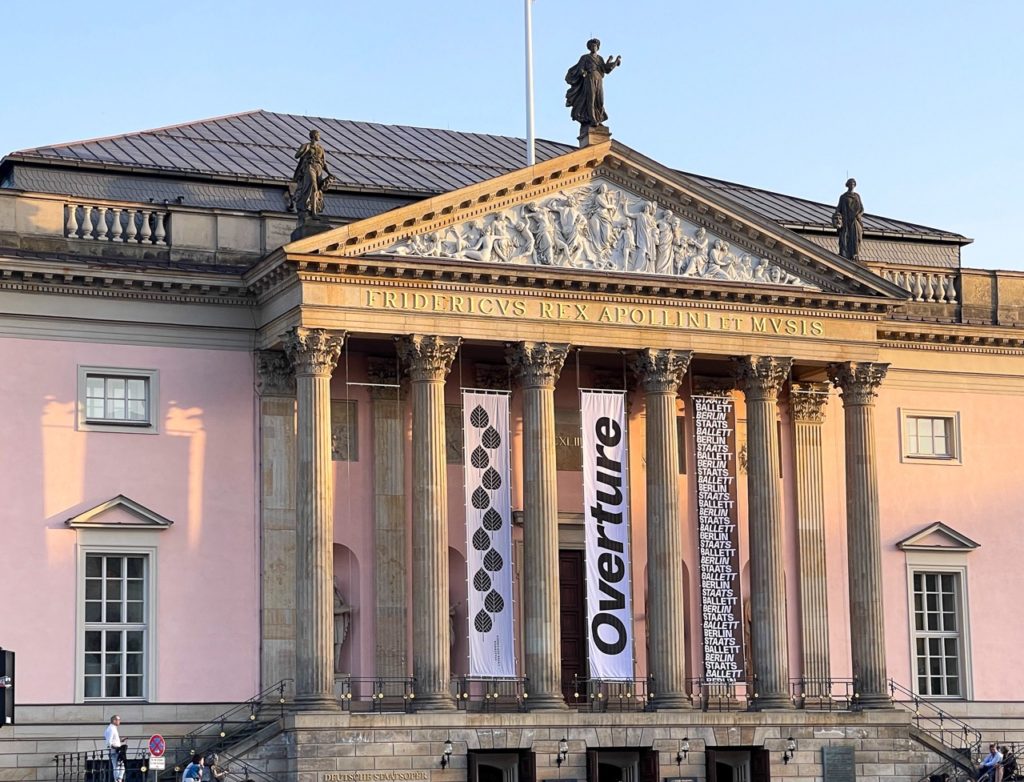
As an encore to our evening at the symphony hall, we planned an evening at the Berlin opera house, built by Fredrich the Great in 1743 (and rebuilt, as you might imagine, in 1955). I was convinced that our karma for this trip was good when I found a dance program called “Overture” composed by a young choreographer from Valencia, Spain. Modern dance is one of Bonnie’s passions, and this performance at the Staatsoper Unter den Linden (State Opera under the Lime Trees) would be a world premiere from an extraordinary artist, Marco Marau, who is fast becoming a superstar in the world of dance. Set to Mahler’s 5th Symphony, the production took modern dance to a level of beauty, narrative, and emotional impact beyond anything we have previously experienced. Combining music, stagecraft, costuming, and human movement, Marau weaves a magical tapestry that has as its theme the cyclical construction and destruction of societies.

I am preoccupied with the question of how long a culture and society can survive without change. What happens when the new generation no longer initiates change? We build temples, then we destroy them, build and destroy civilizations and even ourselves… and then we begin to erect new columns again. . . When you understand the past and are curious about what others before us have done, you understand the present. I want to mix the past and the present and leap into the future.

Marco Marau

Gratitude

We could not be more grateful for the chance this trip provided us to spend time with Michael and Charlotte. Now that our boys are all grown up and we live thousands of miles and a few time zones from each other, it it’s not easy to carve out time to spend together. Of course, we send texts, emails, and arrange an occasional Facetime call, but there’s nothing like being in the same place for a while. Spending 6 full days with Michael and Charlotte in Berlin was the most important element of this trip for us. It was wonderful to slow down and hear about their lives and it was delightful to see the world through their eyes. Their joy and sense of adventure was truly contagious. We are fortunate to have such wonderful sons. Exploring the world with them is magical.

“Ich bin ein Berliner” – JFK 1963 Read More »
Scroll to Top