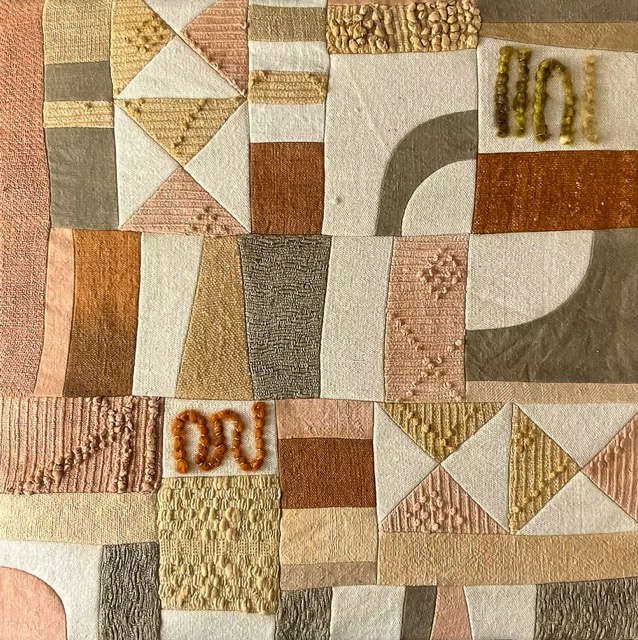
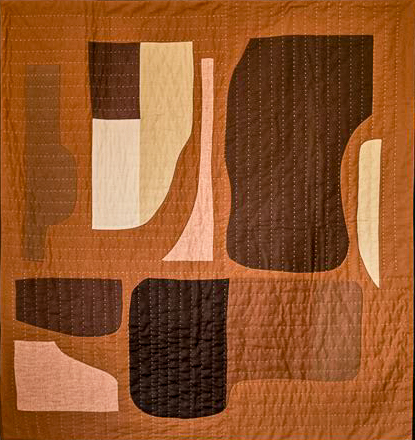
I discovered Selvedge a few months ago, a British magazine dedicated to textiles, craftsmanship, fashion, and global textile culture. It reignited something I’d been missing. I’ve been neglecting my studio lately and a Quilt Jamboree felt like exactly the push I needed. Besides, it was the perfect excuse to escape Valencia’s heat and see live theatre on the West End. Since it’s just a two-hour flight to London, we’ve committed to making that pilgrimage at least once a year.
The East End Calls
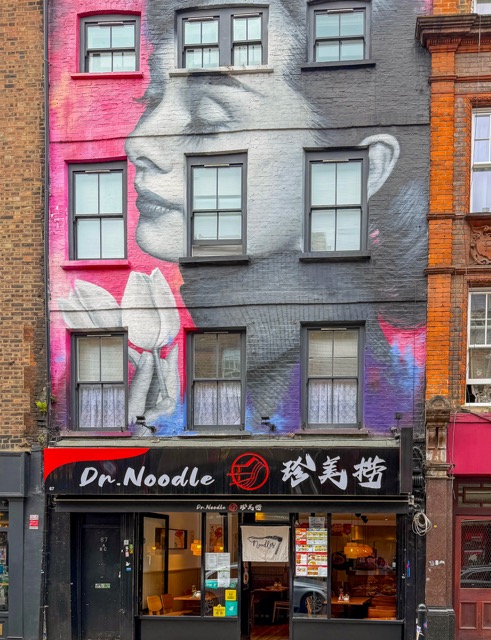
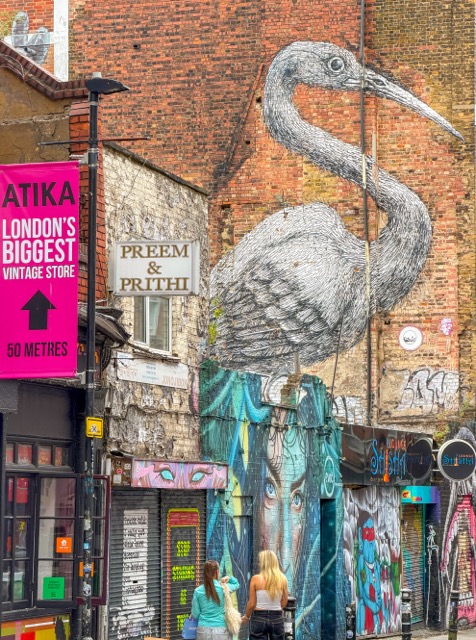
London’s Museum of the Home was the venue for the workshop and that was a bonus. Located in the Shoreditch neighborhood in the East End, this would be a new area of London for us to explore. It did not disappoint. From the moment we arrived, it was obvious: this was a different London. The East End pulses with an energy you don’t feel in Central London. Gritty industrial history—warehouses, railway arches, immigrant working-class neighborhoods—sit alongside a vibrant creative scene.
Stories at the Jamboree
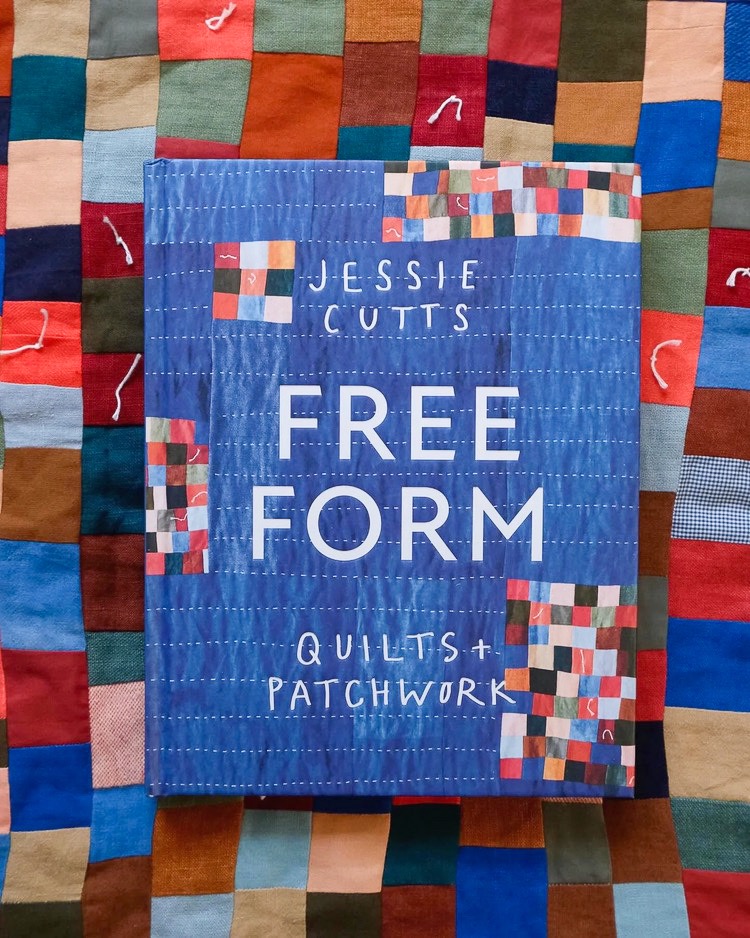
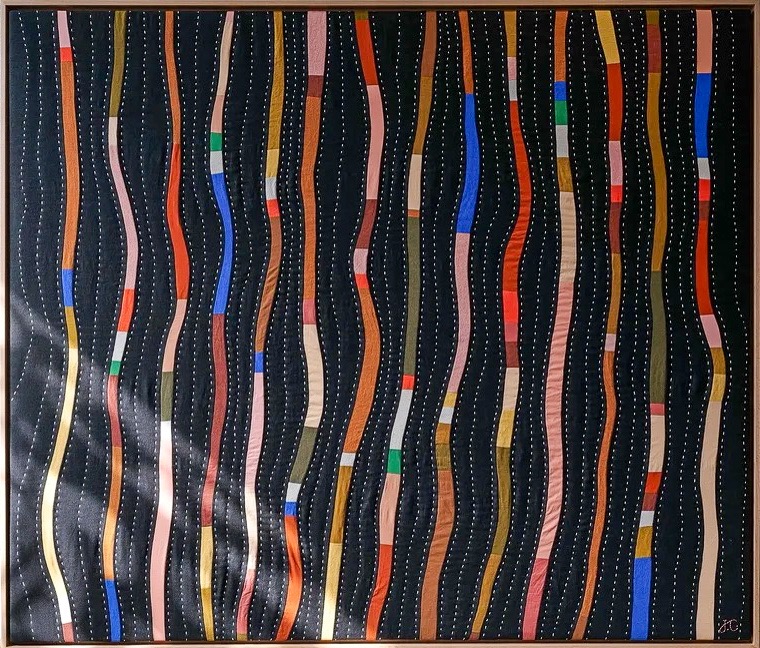
At the Quilt Jamboree, I listened to the stories of several well-known quilters. Jessie Cutts spoke about working intuitively, without a predetermined pattern—an approach that immediately resonated with me. Ellie Beaven described the entire arc: growing plants on her Galician property, extracting natural dyes, and using them in her work. Julius Arthur drew inspiration from growing up in the Cotswolds, landscape informing every design. What struck me most wasn’t just the technical skill—it was the deeply personal way each quilter had found their own entry point into the work. No two approaches were the same.
Ellie Beaven – Whole Cloth StudioJulius Arthur – House of Quinn
After the Quilt Jamboree, we celebrated with dinner at Cinnamon Bazaar; an Indian dining experience is a London ritual we never miss. Then we headed off to the Noël Coward theatre for Cyrano de Bergerac (Ed will tell you about that experience). But a real discovery was waiting for us the next day, in the East End.
Makers & Markets
We spent our second day at Spitalfields Market and Brick Lane. Spitalfields is that rare thing—a market that’s both genuinely local and genuinely polished. You’ve got independent designers and artisans mixed in with mainstream shops and tourist draws, but it works without feeling staged.
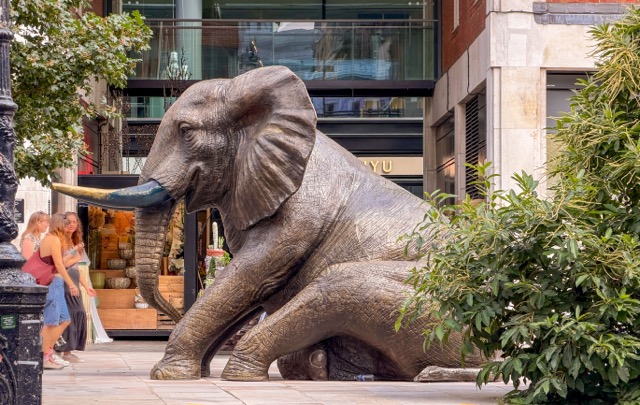
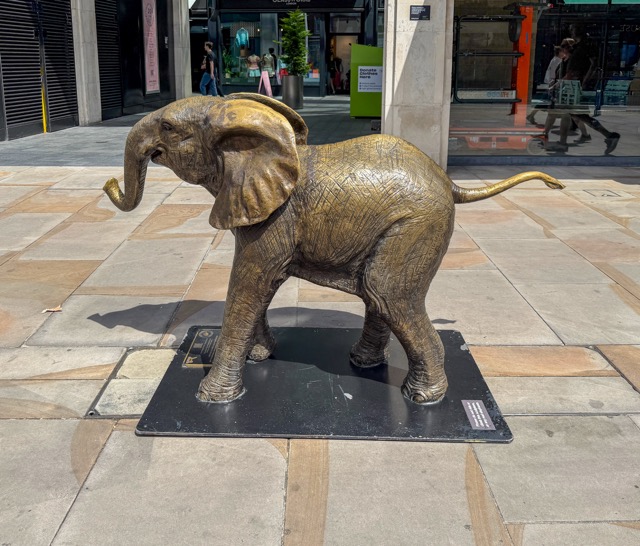
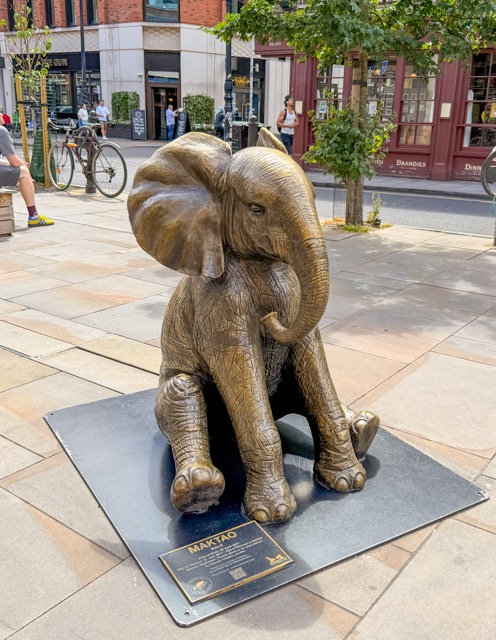
These elephant statues on Brushfield Street in Spitalfields are promoting the Sheldrick Wildlife Trust. The installation, called the “Herd of Hope,” features 21 life-sized bronze elephant sculptures created by artists Gillie and Marc. Each sculpture represents a real orphaned elephant rescued and raised by the Sheldrick Wildlife Trust’s Orphans’ Project.
Ritual and Hospitality
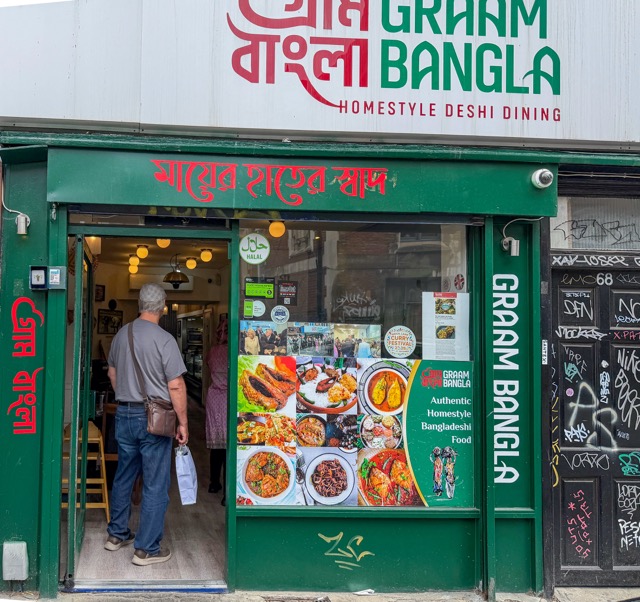
Brick Lane has been a neighborhood of immigrants for centuries and when I learned that there are many people from Bangladesh living there today, I decided we must have a Bangladeshi lunch. On the spot research revealed that one of the best in the area was just a four-minute walk. Graam Bangla is a tiny and humble restaurant on Brick Lane loved by locals. It seems I’d selected the right place for our first Bangladeshi meal.
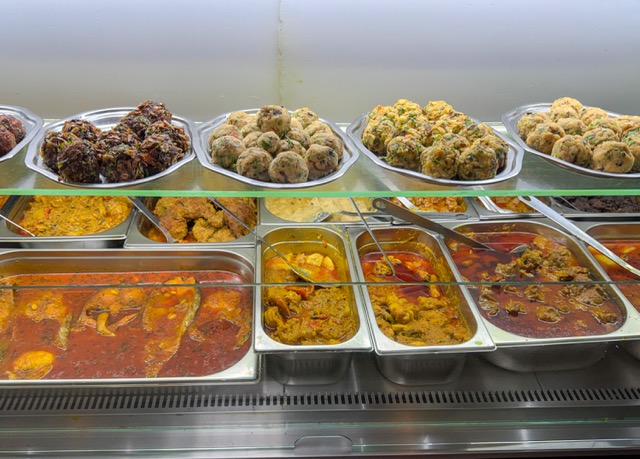
As we were seated, a lovely woman swathed in a pink sari asked if it was our first time. Having answered in the affirmative, she did something I hadn’t expected. She led us to the kitchen counter and asked us to taste—progressively spicier offerings on tiny spoons—to understand not just our tolerance but our worthiness to eat there. This was something deeper than the usual restaurant transaction. We’d been invited into her care.
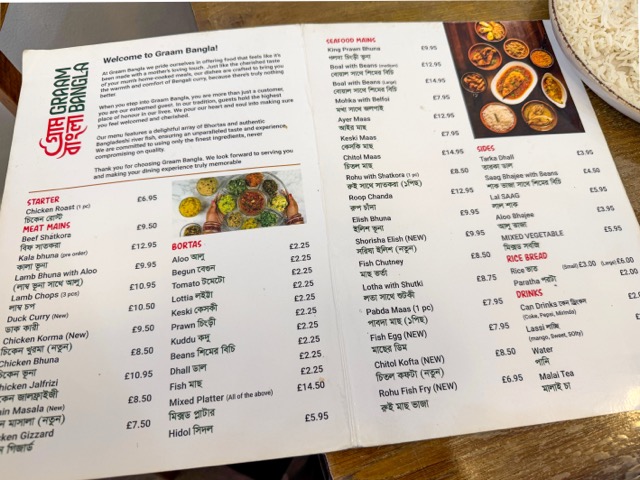
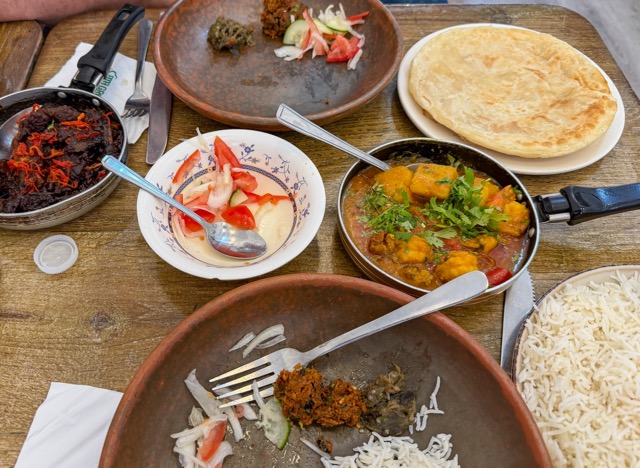
Our hostess guided us through the menu with the thoughtfulness of someone sharing family recipes. Under the Bortas section, she recommended Lottia—a classic Bangladeshi starter of sun-dried fish rolled into piquant balls with aromatic spices and chilies, each bite rich and intensely savory. Then came Aloo Chingri, shrimp and potatoes in a spiced tomato sauce fragrant with turmeric and garlic. And Kala Bhuna, beef that had been braised so slowly the sauce had turned glossy and nearly black, thick and deeply concentrated. Each dish represented hours of technique. Rice and paratha—unleavened, crisp, and flaky flatbread—were our accompaniments.
This was craft—culinary craft—as genuine as anything I’d seen at the Jamboree. I don’t remember seeing a Bangladeshi restaurant in Valencia, but I plan to look for one.
Trading Slow for Intentional
We broke one of our cardinal rules—stay three to four days minimum. Normally this would feel like a failure. But two days in the East End, moving from inspiration to discovery to ritual, compressed something that might have taken twice as long elsewhere.
Sometimes intensity is what you need. Sometimes a city that challenges you to move fast forces you to pay closer attention to what matters—the quilters’ stories, the rituals of hospitality, the creative spirit embedded in every neighborhood. We returned to Valencia with exactly the inspiration I came seeking.
We agreed, Ed and I, that we would write about overtourism. It was going to be thematic, maybe even brutally honest. We had the titles ready: Rome: The Weight of the Past, and the Weight of the Crowd; Tuscany: Beauty Under Pressure. Cute, right? We had the evidence. We had, in fact, been traumatized by the crowds in Tuscany — turned away from not one but two restaurant reservations in two different hill towns, which is either a travel disaster or at least a feat of impressive logistical failure, depending on how you look at it.
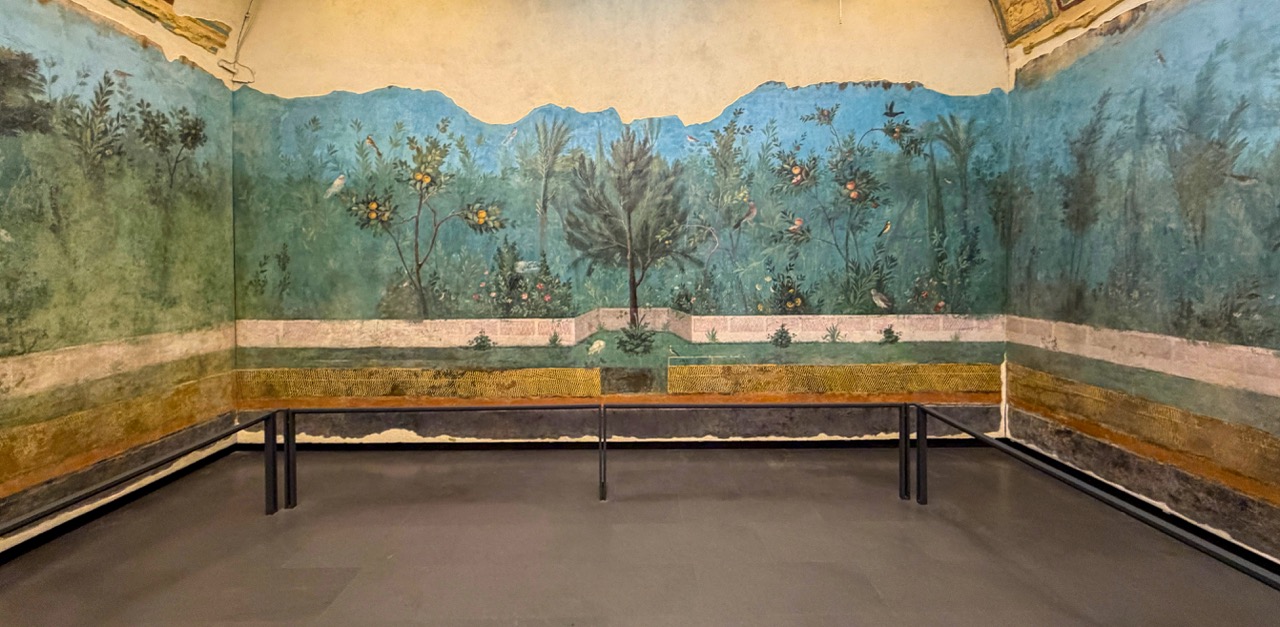
Then Ed sat down with our photos. And he blinked. One look at Livia’s garden room and the whole overtourism thesis evaporated. “I just want to bask in the beauty and joy of Italy,” he wrote. So here we are. Someone must file the actual report.
More Than One Kind of Friction
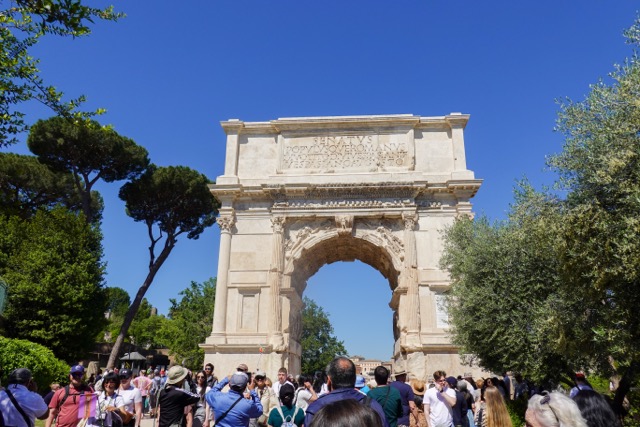
Rome was magnificent and full — full in the way that a container is full when someone keeps adding things to it anyway. There were queues that had been there long enough to develop their own social dynamics. Piazzas where the crowd itself had become the attraction. Monuments visible primarily through a forest of raised phones. At some point you stop asking whether something is worth seeing and start asking whether it is worth seeing right now, alongside everyone else who had the same idea at exactly the same moment. The answer, more often than not, is yes — but you need to brace for impact.
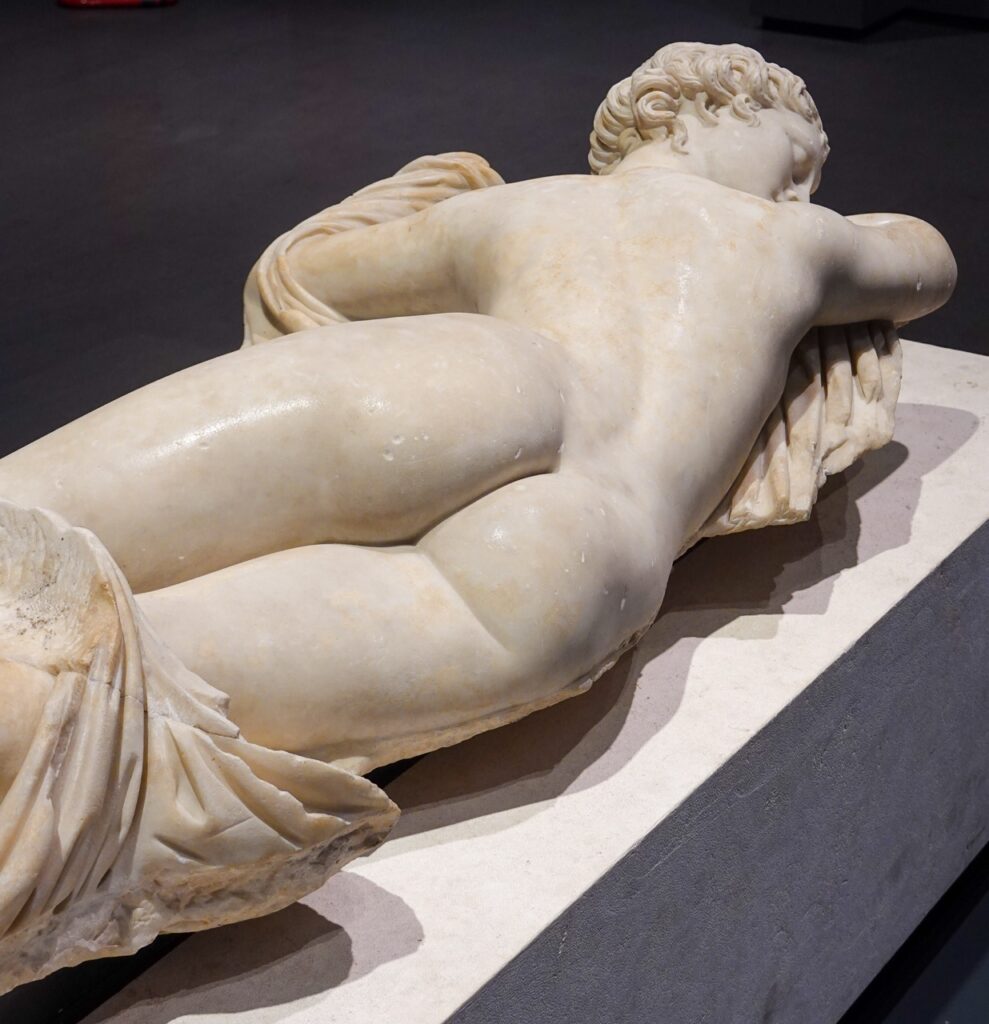
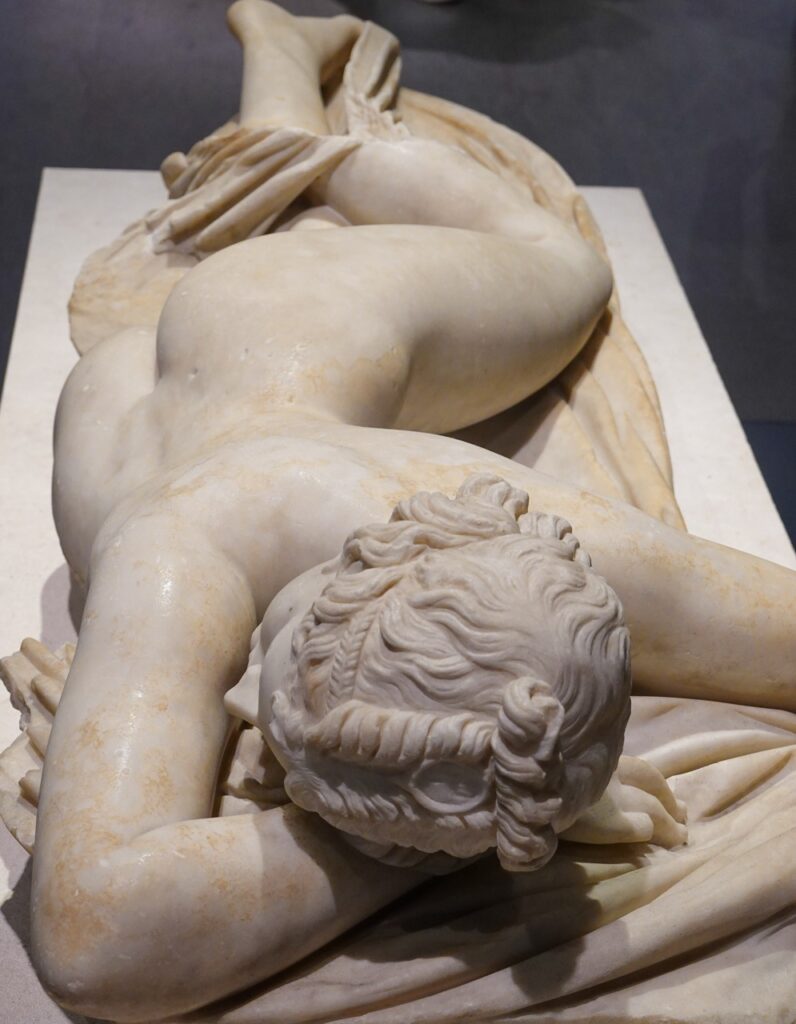
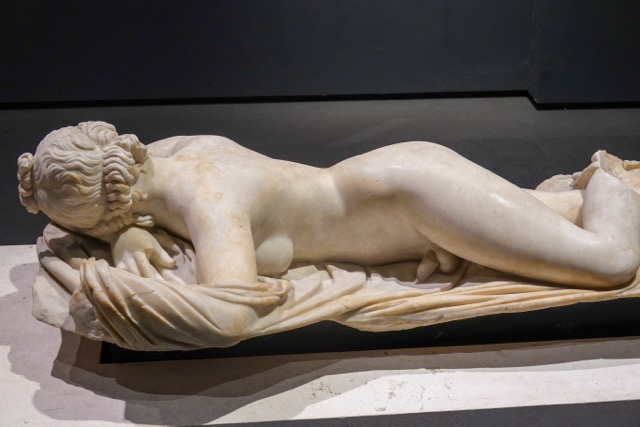
The crowds, though, were only one kind of friction. Not every moment of wonder landed the same way for both of us. Ed was moved by the Sleeping Hermaphroditus in ways he describes with considerable feeling. I stood there thinking about who made it, who it was made for, and what exactly was supposed to be surprising. Ed was also captivated by Livia’s garden room — and honestly, so was I. But where he felt the calming beauty of the space, I kept thinking about the woman herself: powerful, strategic, influential, and still remembered primarily as someone’s wife. But that’s a different essay.
The Cheat Codes, Demystified
It feels a bit unfair to complain about overtourism while actively participating in it — like criticizing traffic from inside your rental car. But the difference between Ed’s account and mine is that he found the cheat codes (his words — used twice) while I was busy wondering what he meant by cheat codes. In practice: a nearly empty courtyard directly across from the Colosseum that almost no one finds, and a museum Ed had identified doing his pre-trip research. I don’t play video games, but I believe a cheat code is supposed to feel like cheating. This felt like being organized.
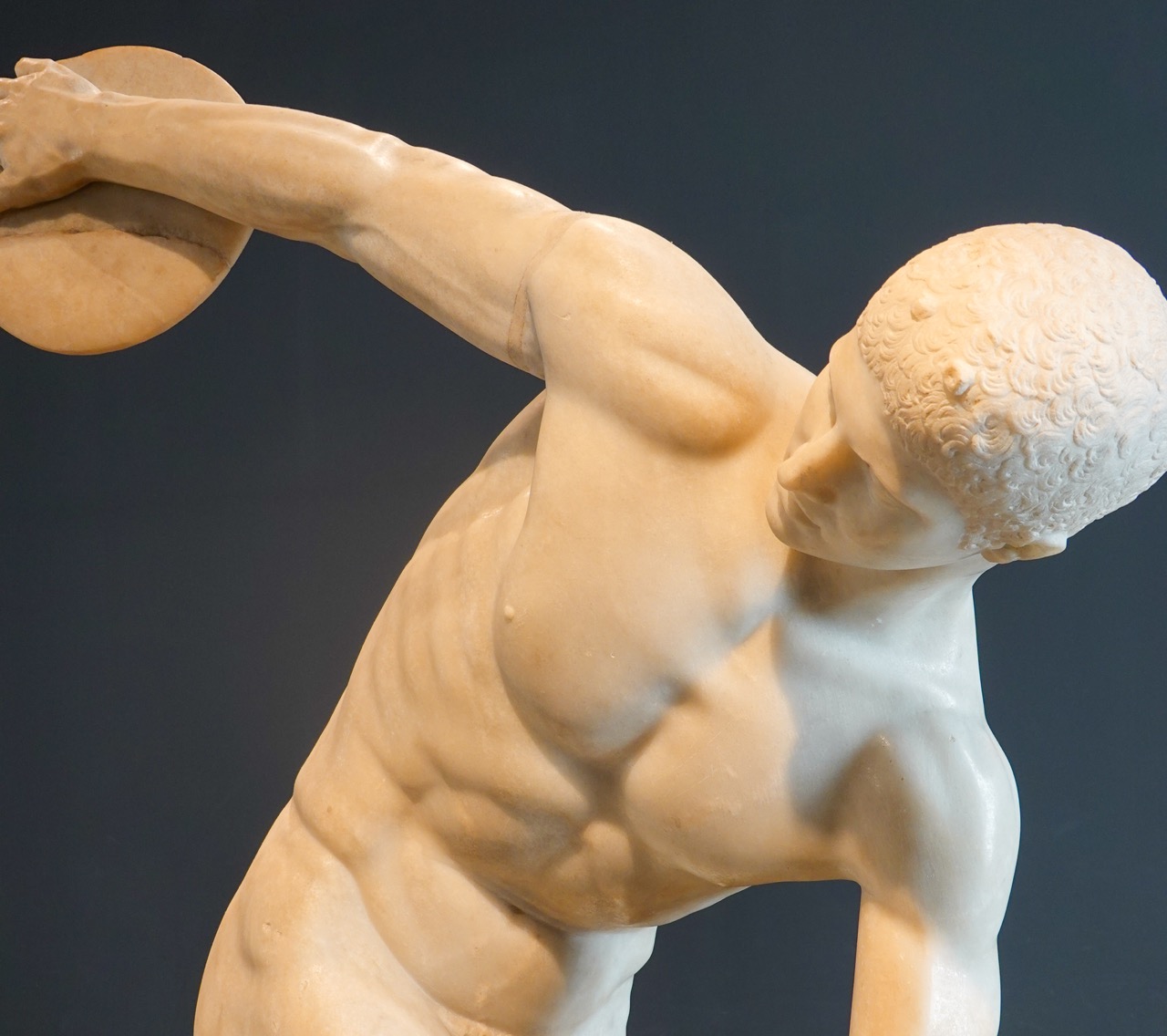
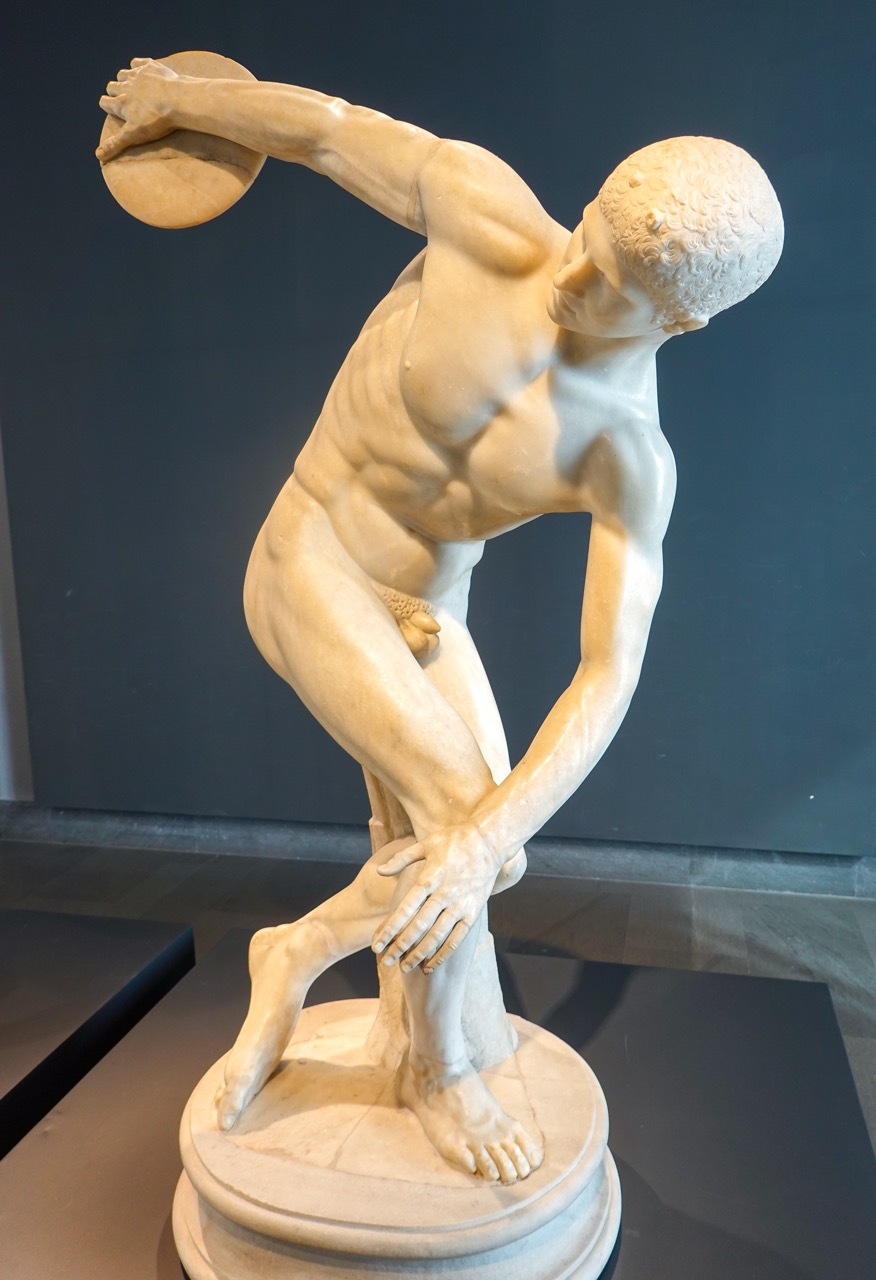
This is, roughly speaking, the dynamic of our relationship: he’s the romantic who tears up at a perfectly thrown discus frozen in marble, and I’m the pragmatist wondering whether I’d applied enough sunscreen, whether the Palatine Hill is ever not crowded, and whether anyone was going to suggest a cold drink soon. After more than fifty years together, we’ve, more or less, stopped trying to fix this.
Prati: The Illusion of Being a Functional Adult in Rome
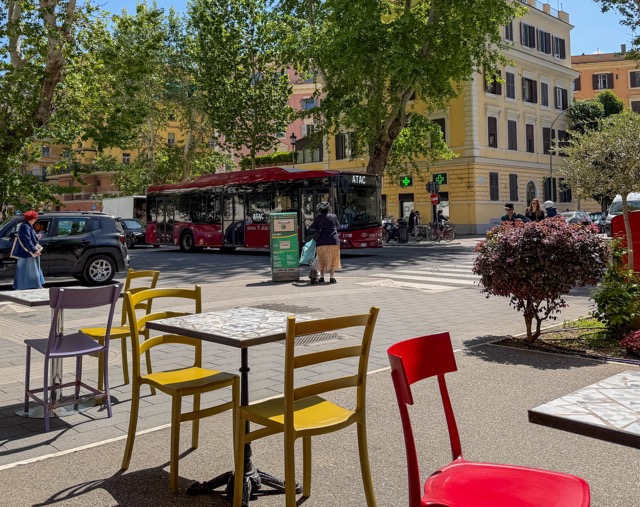
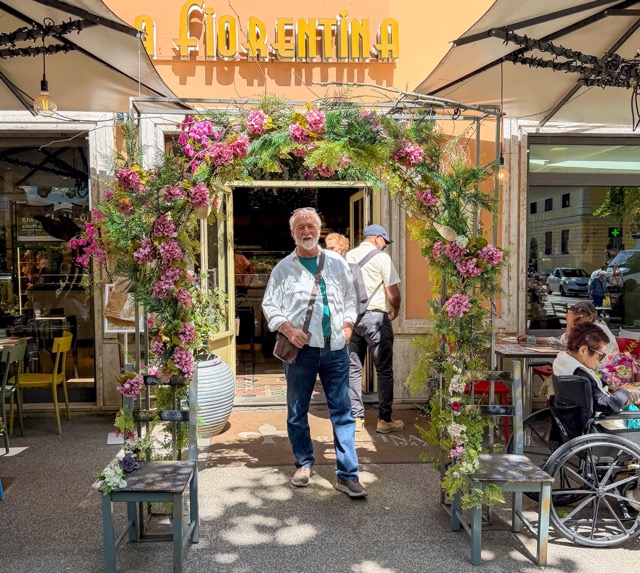
While in Rome, we stayed in Prati, a neighborhood near the Vatican, which has the distinct quality of feeling like the Rome where Romans actually live. Orderly, residential, refreshingly short on selfie sticks. Just far enough from the Vatican that you can almost convince yourself you are not, in fact, part of a global migration pattern of people following umbrellas held aloft by someone walking too fast.
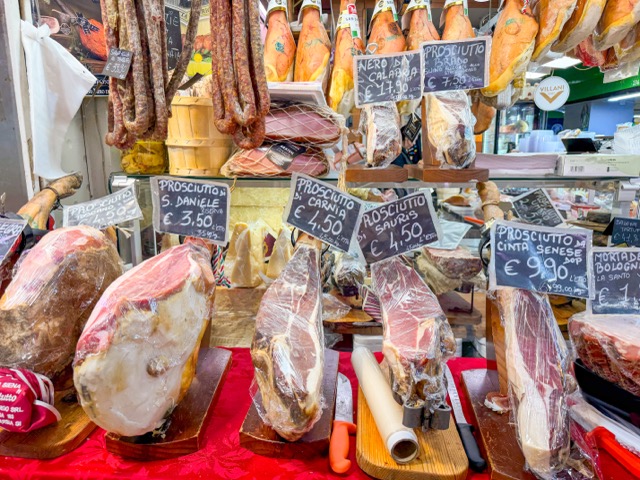
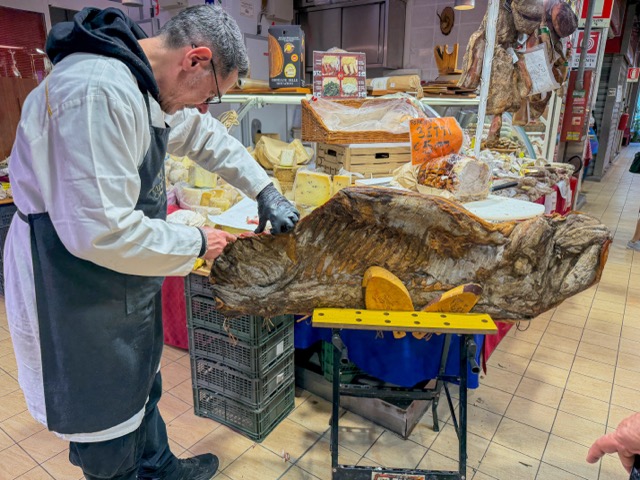
Prati’s local market, Mercato Trionfale, is known for its vast selection of fresh foods and local products.
Prati is where dangerous thoughts come to mind. Specifically, “We could live here.” Ed said this on day two, with the confidence of a man who had found excellent coffee within a two-minute radius of our hotel. I did not point out that this is how he felt about Lyon, Porto, and that neighborhood in Istanbul. Rome, to its credit, did not discourage this fantasy.
Tuscany: Beauty Under Pressure (We Were Right About the Title)
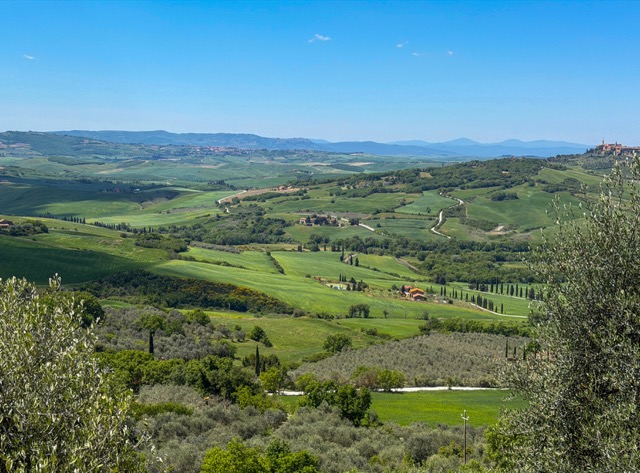
We headed north into Tuscany with considerable optimism. The rolling hills, the medieval towns, the famous light. We were ready to be charmed again. What followed was a comprehensive lesson in the difference between a place’s reputation and its current operating capacity. To be fair, much of it delivers. Just not always where — or when — you expect it.
Our first full day in Tuscany was May 1st. Italian Labor Day. Which means the crowds were not merely international tourists doing their scheduled appreciation of timeless beauty — they were also several million Italians who had the day off and the same idea. Montepulciano and Pienza, two of the most beautiful hill towns in a region built entirely of beautiful hill towns, were operating at a capacity I can only describe as festive gridlock.
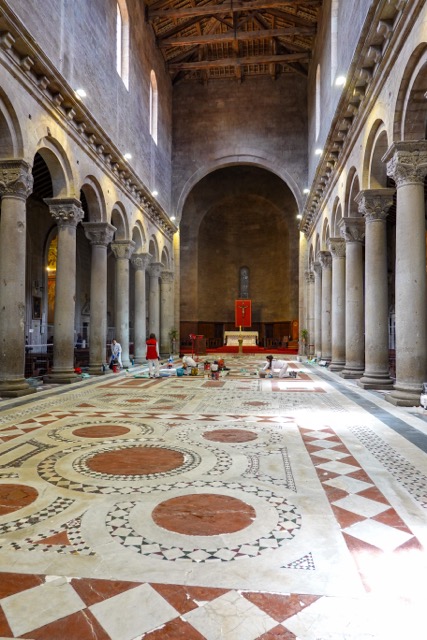
Restoring the 12-13 century tile floor of the cathedral of San Lorenzo in Viterbo.
One of ours stops was the small village of Viterbo where the longest papal conclave in history took place –from December 1, 1268, to September 1, 1271, totaling nearly three years.
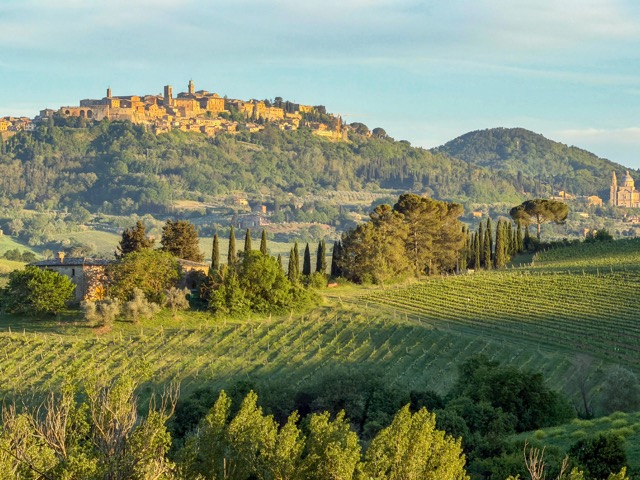
Montefollonico, the small village nearest to our agritourismo.
There was no place to put the car that wasn’t a hike several kilometers uphill. Narrow medieval streets were filled with people sharing the collective understanding that everyone was here at the same time to experience something timeless. The effect: history was currently hosting a queue.
This was also where the reservations died. Lunch in Pienza was not happening — we couldn’t get the car within reasonable walking distance. Montepulciano for dinner: same outcome, different piazza. At the suggestion of a local, we found a tiny hill town with almost no tourists and one café on a narrow street. The chef was running the whole operation — seating guests, taking orders, cooking, serving — with the calm of someone who had decided this was exactly enough. It turned out to be one of the better meals of the trip. This is either a useful lesson about travel or a very specific argument for always having a backup restaurant. Probably both.
Follonico: Twelve Guests, One Pond
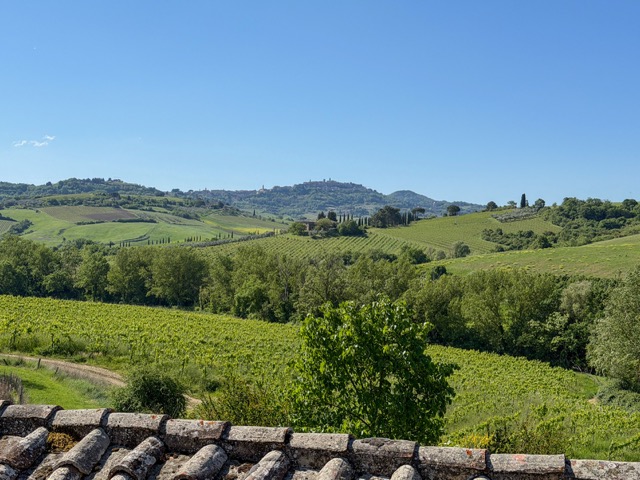
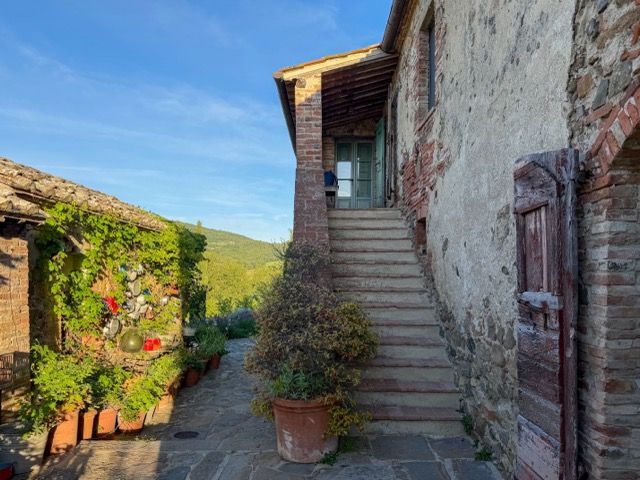
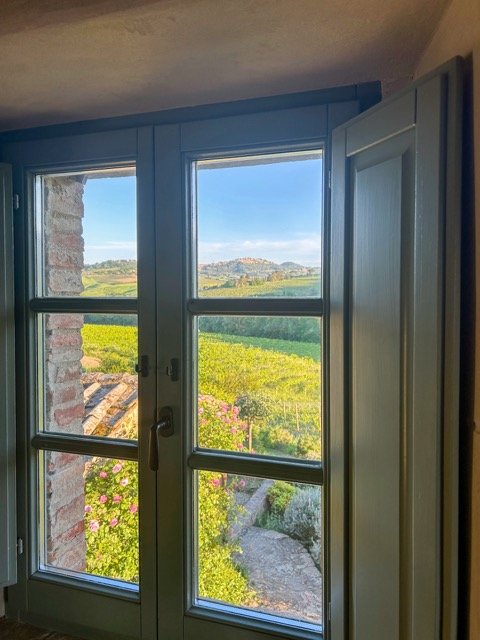
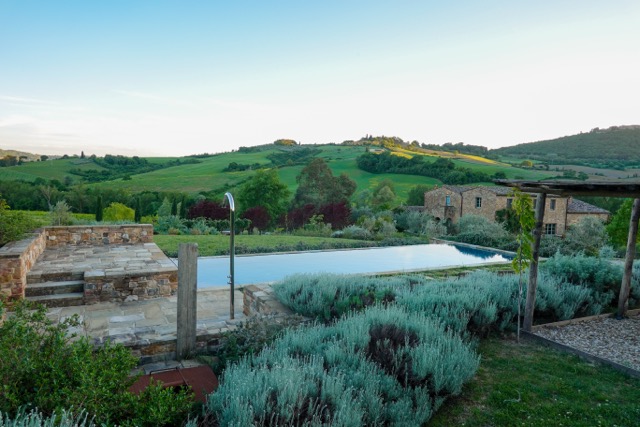
Tuscany, like most places that survive on tourism, has a quieter side. You just have to want it more than you want the famous version. We stayed at Follonico, an agriturismo near the village of Montefollonico — six guest rooms, a garden, a pond, vineyards on the surrounding hillsides, and a couple who had built something genuinely lovely and wanted to share it. Breakfast was unhurried. Dinner, when we stayed for it, felt like eating at someone’s table rather than in someone’s restaurant. The wine was theirs. The olive oil was theirs. The view was, improbably, also theirs. Compared to the festive gridlock of May 1st in the hill towns, the scale of it was the thing. Twelve guests. One pond. A pace that had no interest in competing with anything. We both exhaled.
There is a particular adjustment period in places like this where you realize: nothing is curated for you in the commercial sense — it is simply someone’s life, and you are briefly, gratefully, a guest in it. We both found this deeply restful. Here, Tuscany stops being a place to pass through and becomes a place to simply be. This is a meaningful difference.
One Bite at a Time
Tuscany did not simplify itself for us. We simplified ourselves for it — smaller towns, fewer plans, one meal at a time. We got bad logistics and sublime beauty, sometimes on the same afternoon. We got turned away from two restaurants and found an unexpected one. We got overtourism and one pond. The philosophy we’ve earned is that travel works better when it is reduced — not in ambition, but in scale. One bite at a time.
Filed. Report complete. Findings: Italy is worth it. Have a backup restaurant. Ed will bask regardless.
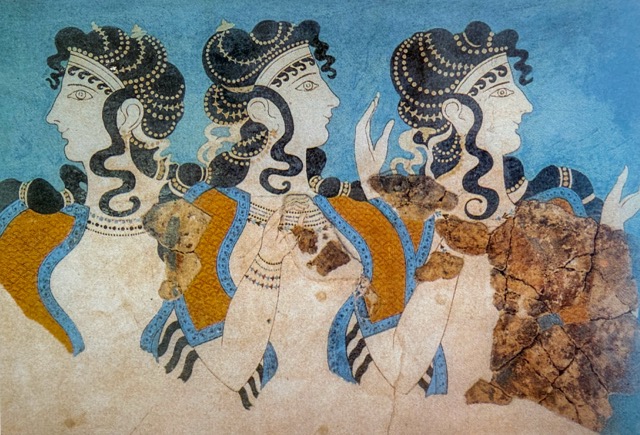
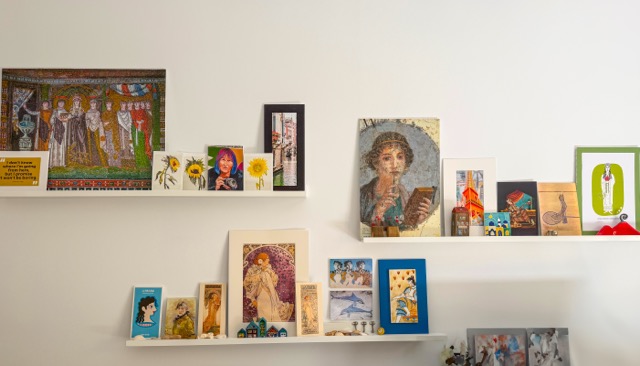
Since we’ve lived in Valencia and started traveling more consistently, I’ve been collecting something I don’t really have a name for — women I encounter, read about, or remember long after I’ve left a place behind. Over time, I’ve realized I’ve been building a quiet archive of presence and of persistence – women who make an impression and leave a trace. I call it my wall.
It’s in my room — part studio, part office — and displays posters, postcards, and sometimes printed photographs of women I’ve encountered while traveling. Some are historical figures I’ve learned about in museums. Some are artists, activists, or writers I’ve come across in exhibitions or conversations. And some are unnamed entirely, preserved only in fragments of ancient imagery.
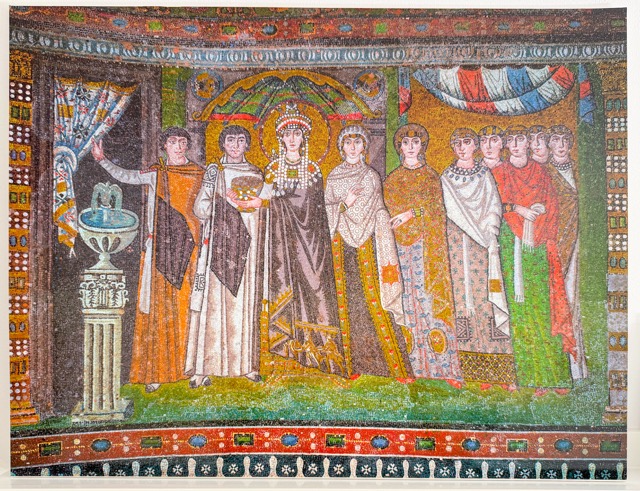
Among them is Theodora, whom I encountered in Ravenna, Italy, standing in front of the extraordinary Byzantine mosaics. In those golden, still figures — imperial, severe, and luminous — she felt less like a distant historical figure and more like someone whose influence had been encoded into the walls themselves. Empress of the Byzantine Empire from 527–548 CE, she is remembered not only for political power but for legal reforms that expanded protections for women, including making rape punishable by death and strengthening women’s rights to own and inherit property.
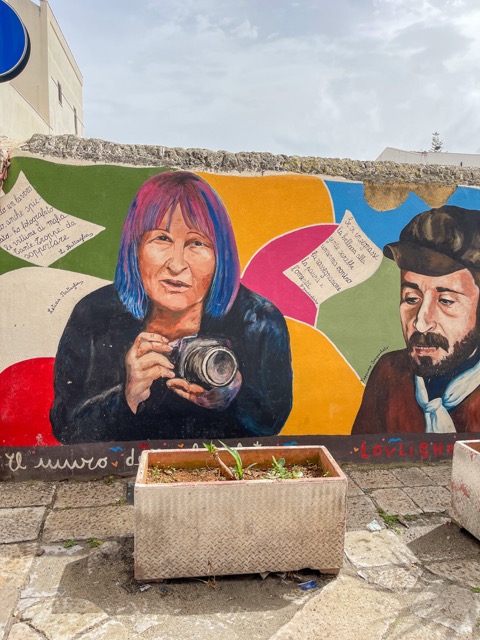
Then there is Letizia Battaglia, whose image I found in Palermo, Sicily, on a wall honoring those who resisted the Mafia. Seeing her honored in a public tribute — among others who had fought for truth and accountability — made an impression instantly. Her life’s work as a photojournalist documented both everyday Sicilian life and the violence of the Mafia with an unflinching clarity that refused to turn away.
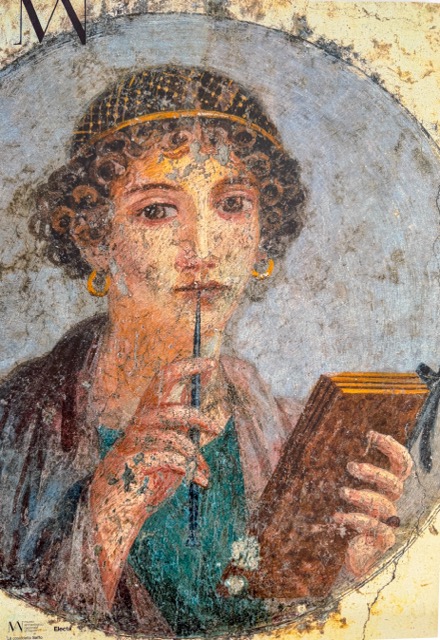
Some figures on the wall are not identifiable at all. There is an image from ancient Athens of a woman holding a book and a stylus, which I discovered at the Acropolis Museum. No name survives, but the symbolism is unmistakable: a woman aligned with writing, thought, and authorship in a world where such roles were rarely preserved in the historical record. She remains on my wall precisely because she is unknowable.
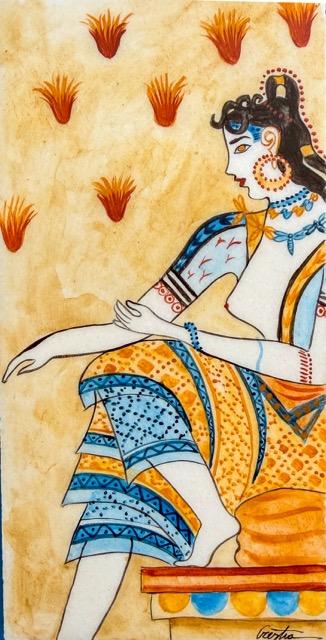
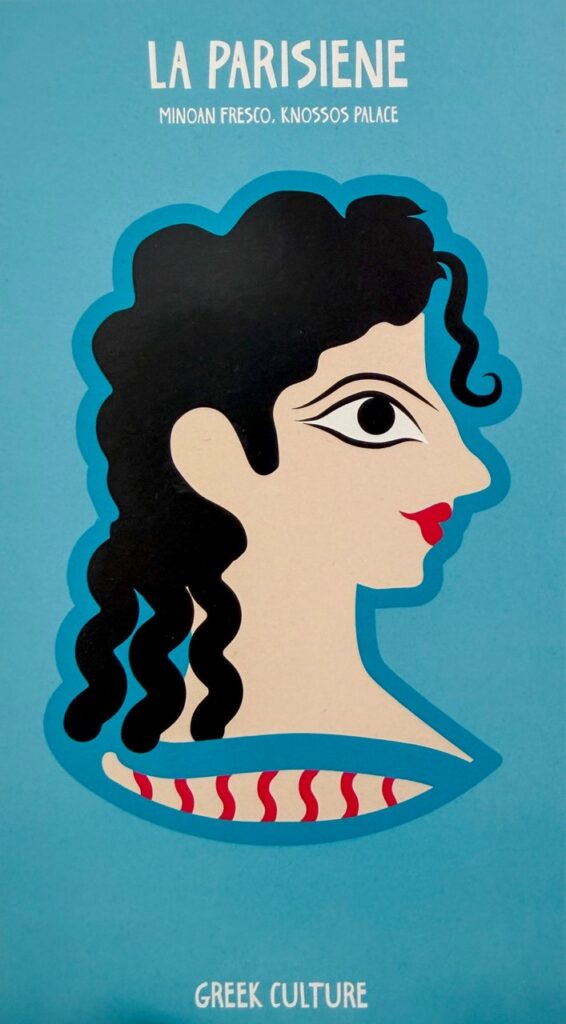
There are also the Minoan women — the figures known as the Ladies in Blue and The Parisienne — whom I first encountered in the frescoes displayed at Knossos on Crete. Dating to around 1600 BCE, they predate everything else in the archive, yet they don’t feel ancient in the way that word usually implies distance. They are animated and richly ornamented — women who appear central to whatever world they inhabited, not peripheral to it. Minoan civilization remains only partially understood; its script has never been fully deciphered, and scholars still debate the social roles these figures represent. But the frescoes themselves are unambiguous in one sense: these women were worth painting large, in color, with attention.
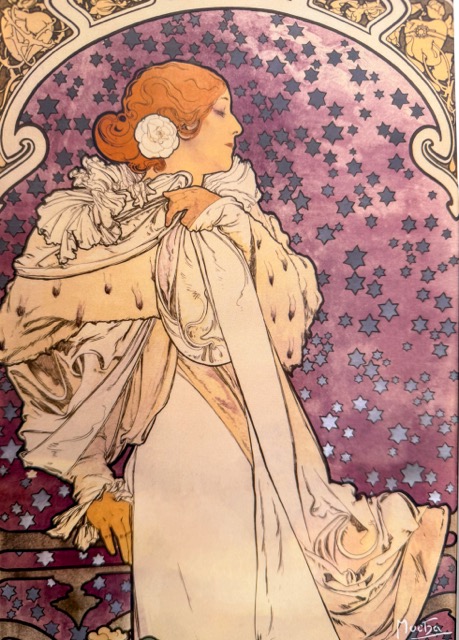
Sarah Bernhardt, whose image I encountered through the Art Nouveau paintings of Alphonse Mucha while visiting his museum in Prague, holds a place on my wall. In Mucha’s work, she appears almost mythic — elevated, stylized, iconic — but her real life was even more compelling. A celebrated French stage actress, she challenged gender norms of her time and used her fame to advocate for women’s rights and support other women artists.
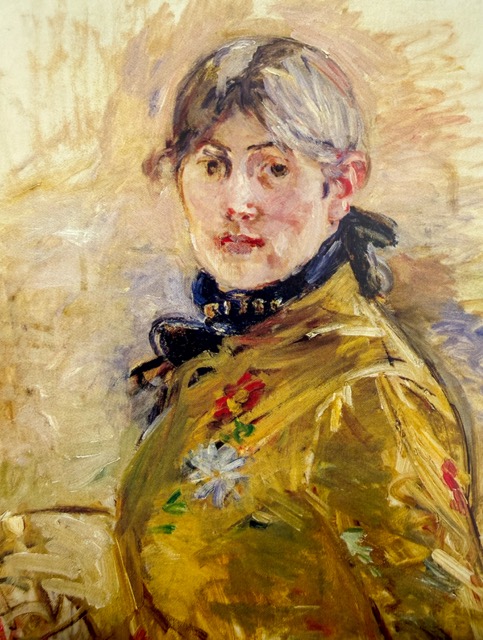
I discovered Berthe Morisot at the Musée Marmottan Monet in Paris when we went to see a special exhibit of Eugene Boudìn’s works. The first woman Impressionist, she worked alongside artists like Monet, Renoir, Degas and Pissaro. Unlike her male peers, Berthe worked within strict social limits placed on women in the 19th century. She couldn’t freely visit cafés, studios, or public nightlife scenes to paint. While she built a professional career in a male-dominated art world, she sold relatively few works in her lifetime, and her art is little represented in museums. For me, she is a model for a quiet but powerful challenge to gender norms.
These women, though separated by time and circumstance, are connected by a shared spirit of resistance and imagination.
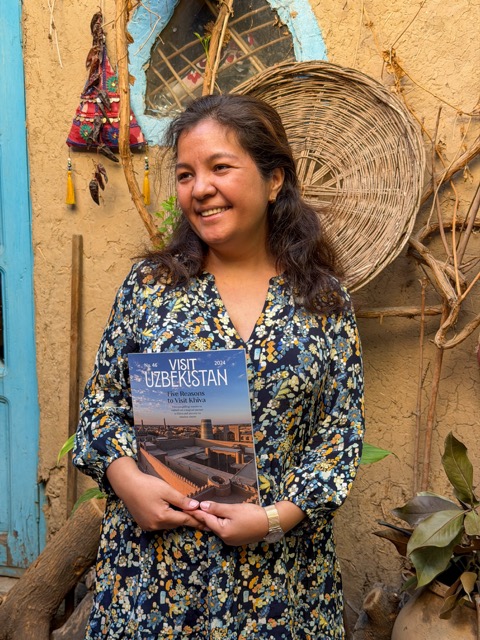
On my recent trip to Uzbekistan, I added another. I was traveling in Tashkent with the San Diego Diplomacy Council when we met Dinara Dultaeva. She spoke to our group in a way that felt both grounded and expansive — less a speech and more like sharing something she had been building for decades.
Dinara is the founder of her own publishing and media company. Over the years, her work has included more than 50 magazine editions promoting Uzbekistan as a place to live, travel, and understand. She has also published books about the country, including a coffee table volume titled 10 Reasons to Visit Uzbekistan, which I was able to purchase while in Tashkent — filled with photographs of deserts, cities, mountains, and everyday life.
What makes her work particularly striking is not only its content, but its timing. She began building her company roughly 20 years ago — around 2006 — fifteen years after independence, in a country still negotiating its identity, and in a cultural context where professional space for women is just emerging. What stayed with me was not only the scale of what she built, but the clarity of her vision. Her work is not passive documentation — it is active storytelling. It participates in how Uzbekistan is seen, imagined, and remembered by others.
Rome offered a different kind of encounter — one shaped more by what was missing than what remained. On a recent visit, as Ed described in his recent post, we spent hours with an archaeologist walking through ancient Rome. As I listened to his stories I was struck as much by what was missing as by what remained. Women surfaced occasionally in the stories, and more than once our guide reminded us that this was a deeply patriarchal society — one where women’s lives were often recorded through the perspectives of men and shaped by the demands of power and survival.
We visited Livia’s garden room; a space often associated with Livia Drusilla, wife of Augustus, the first emperor of Rome. The interpretation of her influence is still debated — whether she was a political strategist, a stabilizing force, or simply a woman whose proximity to power defined how history remembers her. Livia’s record is filtered through the men around her — and something about that framing kept her off the wall.
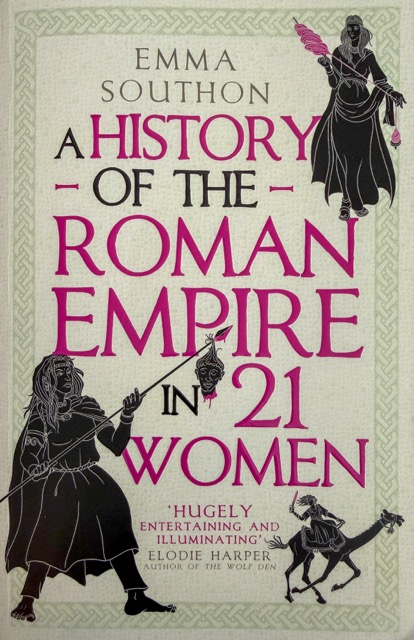
Instead, what I carried forward from Rome was something else. While browsing in a bookstore (a favorite pastime), I found myself drawn to A History of the Roman Empire in 21 Women by Emma Southon — an irreverent, sharp, and intentionally unsanctified retelling of Roman history through the women who are often sidelined or flattened in its telling. It is witty in a way that feels corrective, refusing to treat history as neutral or complete. I’ve only just started it, but I already find myself wondering which women will emerge from its pages and whether some of them will eventually find their way onto my wall.
Maybe that is the next layer of this archive — not only the women I meet in places, but the ones I meet through someone else’s insistence on seeing differently. Because whether it is Theodora in Ravenna’s mosaics, Letizia Battaglia in Palermo’s memorial walls, Sarah Bernhardt in Mucha’s Prague, an unnamed woman in Athens holding a book and pen, the intriguing Minoan women, or the voices reconstructed in Southon’s Rome — the thread is the same. A persistence of presence across time, even when recognition is uneven or incomplete.
What I’ve been practicing, I think, is a kind of attention — noticing who is building, who is preserving, who is resisting invisibility. My wall is not finished. I don’t think it ever will be. But it keeps growing — one encounter, one image, one story at a time.
Reflecting on our recent brief sojourn in Rome and Tuscany, Bonnie and I sat down to discuss the approach we’d take to writing a blog post about it. We’re feeling a need to change it up a bit. Maybe go a little deeper or find a fresh angle on our travel experiences – not just recount what impressed us in chronological order. So, we decided we would tell this story with overtourism as the major theme – “Rome – The Weight of the Past, and The Weight of the Crowd” and “Tuscany – Beauty Under Pressure” (cute, right?) – because, well Rome and Tuscany are overwhelmed at times by tourists. And yes, we had some miserable experiences – particularly in Tuscany – where the crush of people literally prevented us from keeping both a lunch and a dinner reservation in two different hill towns.
Then, I sat down and began reviewing the photos, remembering and reliving precious moments, and I couldn’t do it. Maybe in the future there’ll be a rant about the scourge of overtourism. But today, I just want to bask in the beauty and joy of Italy.
Only a Few Steps Off the Beaten Path
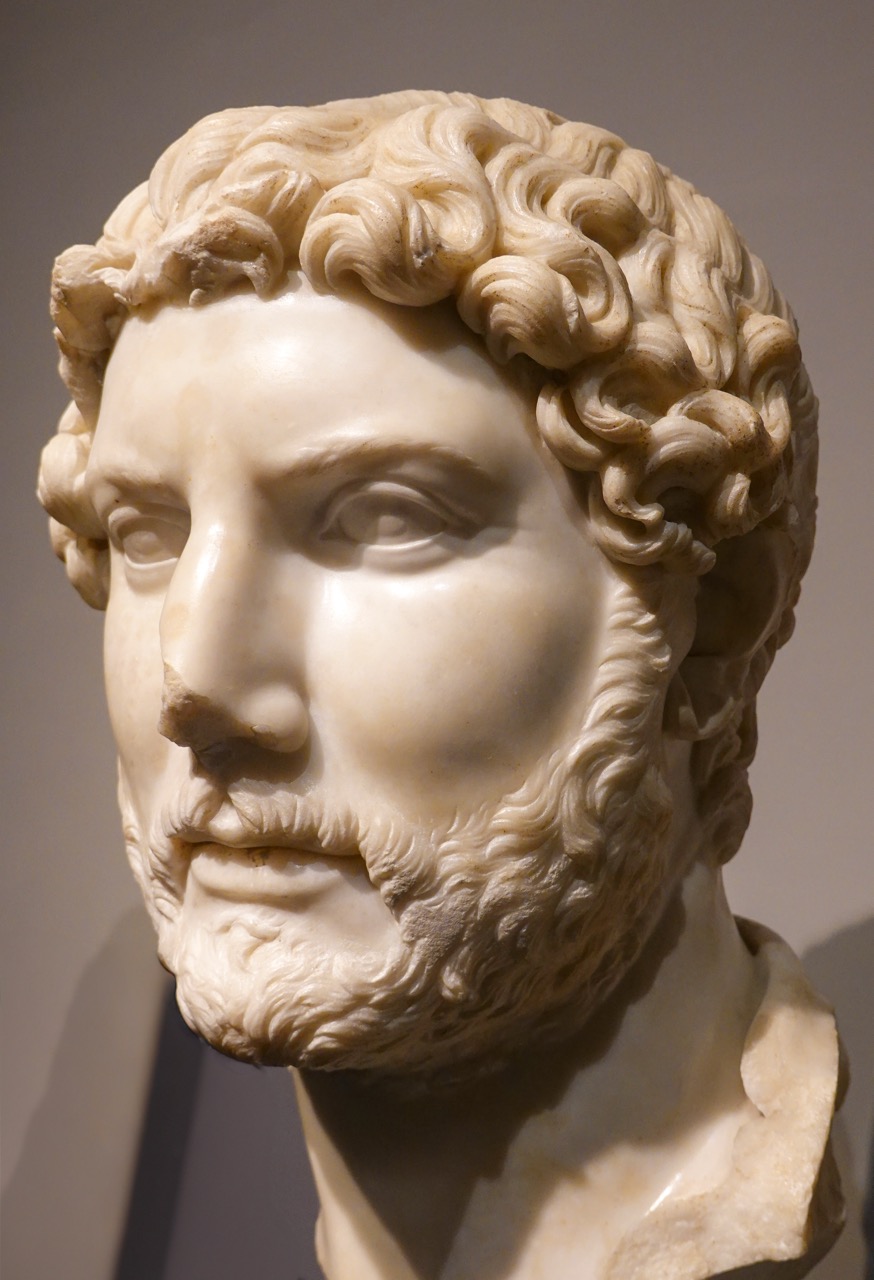
Yes, Rome is crowded with tourists – hordes of people massed around the Colosseum, the Spanish Steps, and the Trevi Fountain in a forest of selfie sticks. And the Vatican? Fuhgeddaboudit. And yet, it requires only a minimal amount of initiative and curiosity to step out of the crush into quiet spaces of sublime beauty. For example, The Museo Nazionale Romano, Palazzo Massimo alle Terme became one of our sanctuaries on this visit. It sits across the street from Rome’s main train station, just 1500 meters from either the Colosseum or the Trevi Fountain. In other words, in the middle of what Google Maps identifies as “Centro Storico” – tourist central.
Maybe the name is too long for the average visitor to grasp what is on offer here. Or perhaps the notion that the National Museum of Rome is spread among four different sites is simply too confusing. Or maybe our thirst for a deeper understanding of the places we visit is just weird in this go fast, digitized age. Whatever the case, we stepped away from the hordes around us, approached the front doors and walked straight in without queuing. It felt like we’d discovered some sort of secret cheat code to Rome. Stepping inside we were suddenly immersed in a cool, hushed ambient of ancient beauty and priceless treasures with perhaps a couple dozen other like-minded souls. Truly surreal.
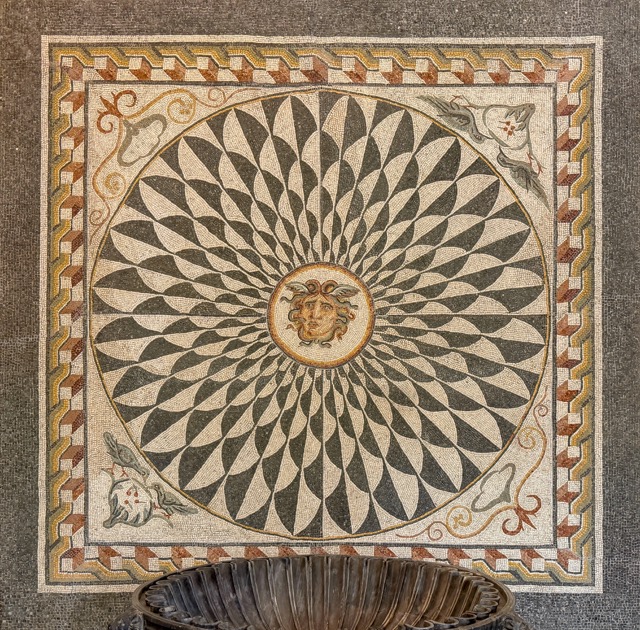
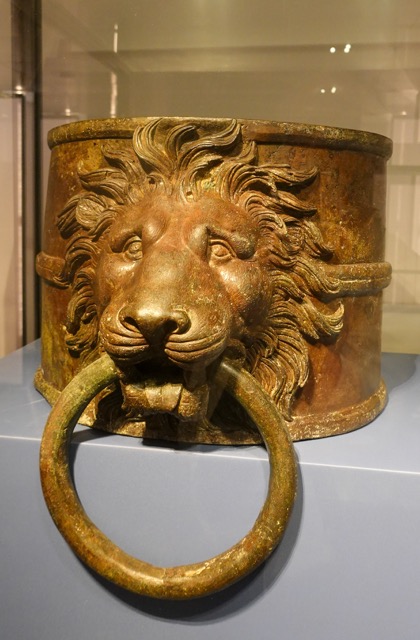
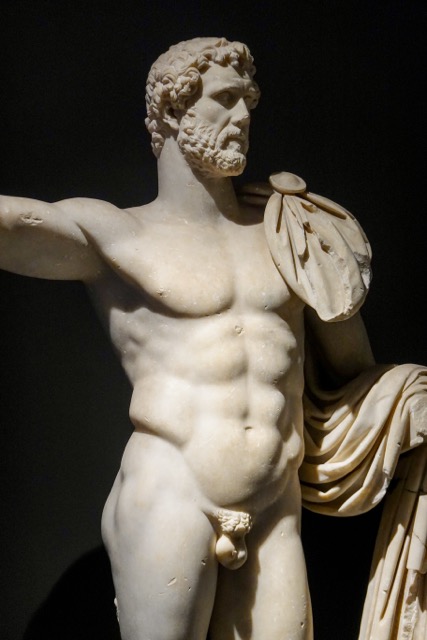
Each room of the Massimo Palace is filled with the art and treasure of empire that has been uncovered by the excavation of ancient Rome since the 19th century, or claimed from the collections of Rome’s medieval elites. We were overwhelmed by the fully intact floor mosaics, wall frescoes covering entire rooms, countless portraits in marble and bronze, and a collection of coins that spans a thousand years of history. There were two moments, however, that really took my breath away: entering the garden room from Livia’s Villa and standing in front of the Lancellotti Discobolus.
The Unnatural Natural World
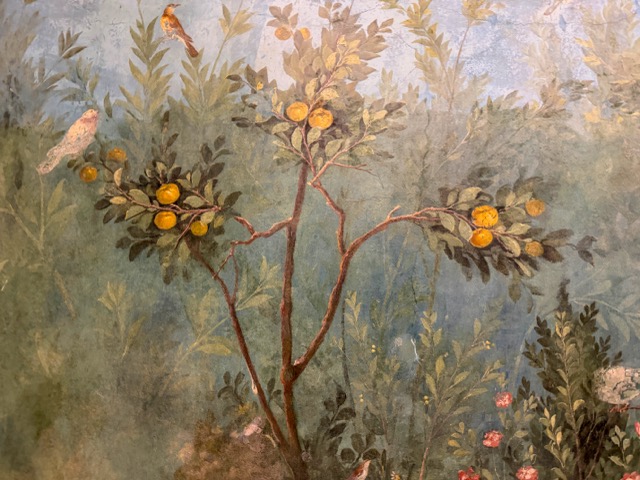
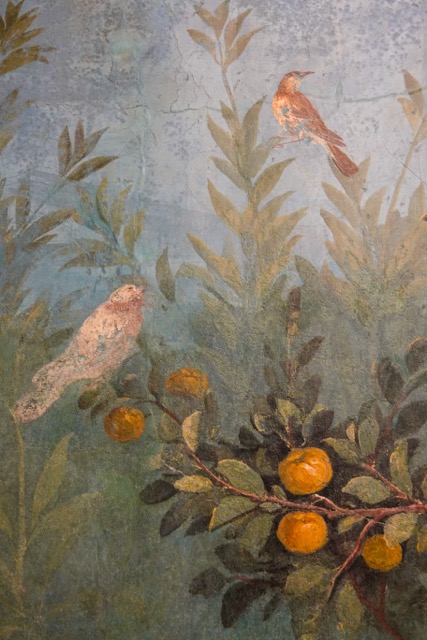
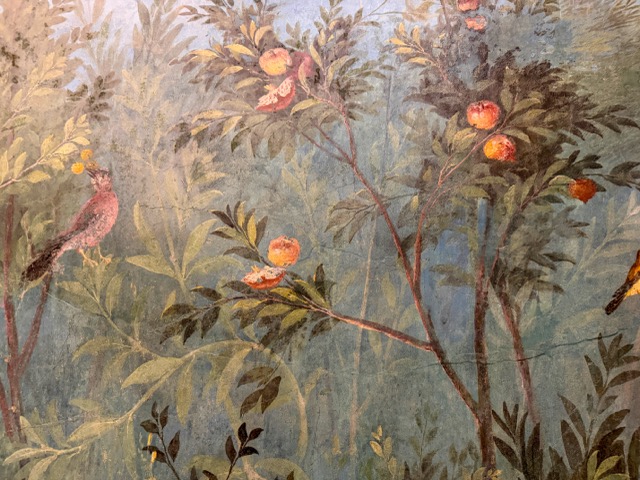
Livia married Octavian (Caesar Agustus) in 39 BC. It was her second marriage, and she came to the arrangement with her own wealth which included a property on the outskirts of Rome – a country house – where she lived for much of her life. It was a lavish estate where Livia could entertain and enjoy life as a woman at the pinnacle of power and status. In a world where her every move was subject to comment by the Roman elite, she created a space in the villa, known today as “The Garden Room,” which has been reinstalled, intact as part of the National Museum at the Massimo Palace. We literally walked alone into the room where Livia served refreshments to her guests 2,000 years ago, lounging on chaises, admiring the recreation of a garden world perfected by the imagination of the artist. The original room was, in fact, built below grade, accessed from the rest of the house by a short tunnel. So, the illusion created was of a wondrous, temperature controlled, subterranean garden where nature could be enjoyed sheltered from the intense heat of summer or the icy cold of winter.
It was with a sense of wonder that I felt the calming power of the room. Somehow the color palette, the sense of depth, and the uncluttered composition combine to provide a balm to the senses that invites you to sit and contemplate the joy of being in a garden despite it being an entirely enclosed, indoor space. Even with our jaded, overloaded senses, where we expect our daily media to immerse us in the impossible and awe us with the fantastic, this is a magical experience. I can only imagine what the effect must have been on Livia’s innocent visitors two millennia ago.
My Copy’s Better than Your Copy
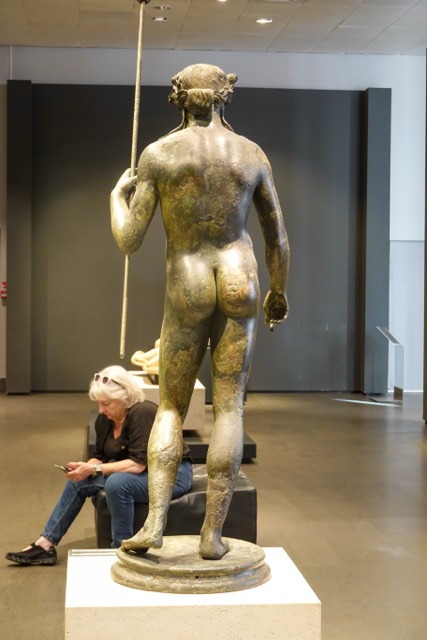
The Romans were obsessed with Greek art. No self-respecting patrician Roman could do without a collection of sculptures, either captured or copied from the great Greek masters. Among the hundreds of examples assembled at the Palazzo Massimo, one of the most iconic, the discus thrower, caught my imagination. Did you know I threw the discus in high school? So did my brother! Here I found myself standing in front of a figure first created by the Greek sculptor, Myron, around 450 BC depicting an activity linked to my own youth 2,500 years later. And with the idealized physique captured by Myron, it was of course, like staring in the mirror. No really. This a chunk of marble so beautifully fashioned that as you stare you find your own humanity cast before you. You hold your breath waiting for the flesh to pink up, for the muscle to tremble, anticipating the explosive, graceful movement that will launch the elegantly shaped missile into the sky – an athletic game, idealized, timeless, and purposeless. Human.
The glowing white figure I found myself admiring was a copy of Myron’s original bronze, which has been lost. However, thanks to the Roman’s obsession with Greek art, there are lots of copies in both bronze and marble, spanning hundreds of years. This particular copy is considered to be the finest in existence and I am certainly in no position to argue the point. As I turned away from my youthful alter ego, I found one more startling moment of beauty awaiting me.
Emotion and Ambiguity
Among all of the sculpted figures standing upright about the gallery, a single prone figure lies at the center of the room. It is a form created to be as alluring and seductive as the artist’s imagination and talent would allow. Its beauty is such that you experience a confusing ache of wonder and desire. Then, slowly moving around the sculpture, another shock – she is, rather obviously, actually a he! The original Sleeping Hermaphroditus was created by a Greek named Polycles around 155 BC in bronze and I would love to have a conversation with the artist. Just like the Discus Thrower, there are copies all over antiquity and in museum collections around the world. Still, there should be a warning sign – “gender bending, emotional confusion ahead.” Or something.
Structural Engineering – Humbled by Antiquity
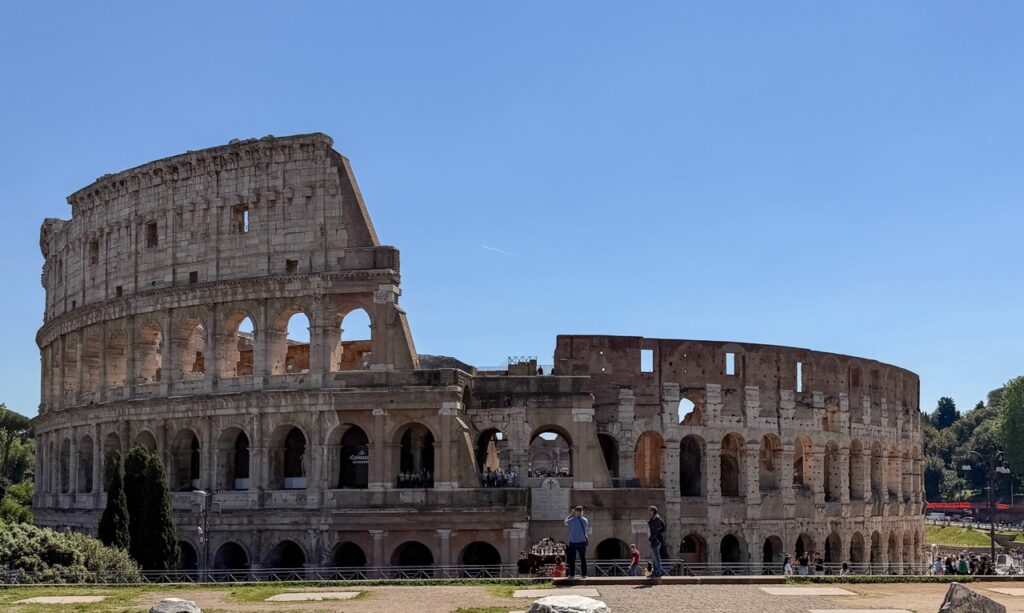
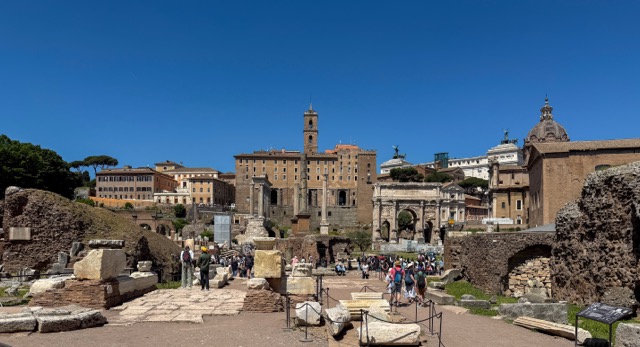
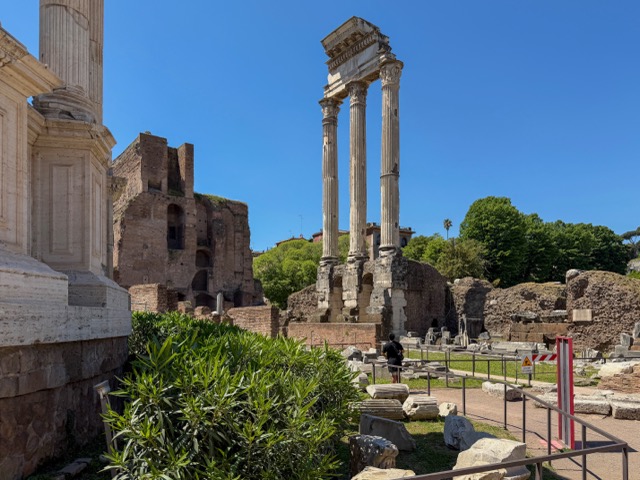
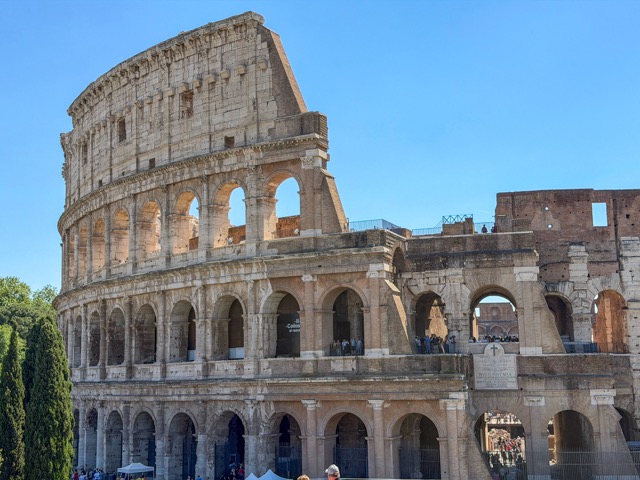
The other major event of our Roman holiday was an in-depth visit to the Colosseum and Palatine Hill area of the ancient city. Over the last couple of years, I’ve found it very difficult to sort out the jumble of ancient, old, and recent constructions at the center of Rome. One manifestation of its nickname, “The Eternal City,” is that it has been continuously occupied for almost three thousand years, nearly always as the capital of one kingdom or another. As a result, it has been built and rebuilt, over and over, century after century, remodeled, repurposed, and rediscovered endlessly. Then, in the last two hundred years or so, it has been excavated to uncover and preserve the remodeled, repurposed, and rediscovered buildings from the Roman Republic and Empire. As you gaze at the Centro Storico district you are confronted with a smorgasbord of buildings, monuments, and ruins seemingly smashed together with no delineation between millennia, era, or architectural style. Can someone please bring some order to this chaos?!
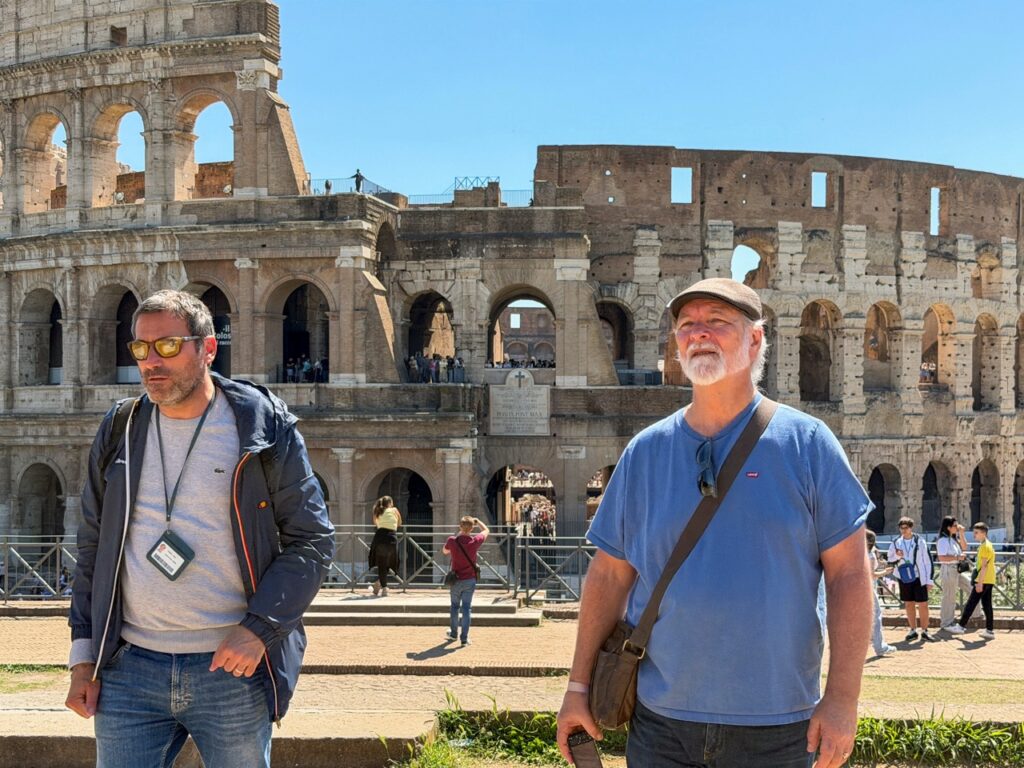
Enter Paolo Gardelli, PhD, archaeologist and history professor, moonlighting as our guide to the heart of Rome. It was a big splurge, hiring a private guide with the credentials of Paolo, but it turned out to be one of the true highlights of all our travel adventures in Europe. The three of us wandered about the ancient city for almost five hours, during which Paolo lectured, explained, clarified, answered our questions, and entertained us without a pause. He displays total mastery of the subject while managing to tell story after story in an engrossing and illuminating monologue.
In addition to being a working archaeologist with an active site in Pompeii, Paolo has a particular expertise in ancient structural engineering and design which was an especially good fit with my interests. We spent a considerable amount of time discussing the innovation and expertise of the Romans, particularly during the era of the Colosseum’s construction. For me, it was particularly jaw-dropping to hear that this incredible building, sitting on a mat slab foundation more than 20 feet deep, was completed in just 8 years of intense work. I won’t bore you with all of the technical construction stuff but let me simply say that I could not get enough. I was spellbound. When it came to building, the Romans were sophisticated and advanced in ways that we are still just beginning to understand. And the comparisons to the modern era does not end with construction technology.
The History & Politics of the Colosseum
It turns out that “cancel culture” was institutionalized by the Romans two thousand years ago. At the death of an emperor, the Senate and Consul would debate the merits of the recently deceased to determine if he had been a worthy ruler. If he was found to have achieved the goals of the empire, he was deified and a temple for worshipping him erected. If he was found inadequate, he would be erased – literally. His buildings torn down, palaces replaced or repurposed, engravings scratched off stone monuments: he was totally canceled.
I’m sure many of you know that the brutal, matricidal emperor Nero famously presided over the greatest conflagration ever to strike Rome, a fire that burned down roughly two-thirds of the city in 64 AD. Being a certified sociopath, Nero had a keen eye for real estate development and saw the great fire as a wonderful opportunity to pick up a few choice parcels on the cheap. (Any similarities to recent events in Gaza are purely coincidental, of course.) Among them was a nice flat site at the south end of the Forum that he decided to turn into a lovely water feature (no word if the bottom was painted blue) to enhance the monumental palace he was also constructing from the ashes of his city. Nero eventually met his end in 68 AD, and after a year of chaos, Vespasian came to power and commenced the evaluation of Nero’s rule to determine his qualification for God status. Uh, no. Definitely not up to standards.
And so, Nero’s water feature was drained, and the foundation for the great Colosseum was laid on the lake bottom, thereby erasing part of Nero’s legacy. My favorite part of Nero’s canceling is how they managed the “Colossus.” Nero had ordered a giant hundred-foot-tall bronze statue of himself that he placed at the center of Rome to celebrate, well, himself. (Again, I disclaim any similarity to current events.) Vespasian, being the practical sort, decided that it would be a shame to waste this massive piece of metal, so he simply had the thing relocated, and the head on top replaced with a likeness of the sun god. No more Nero.
The Greatest Show on Earth
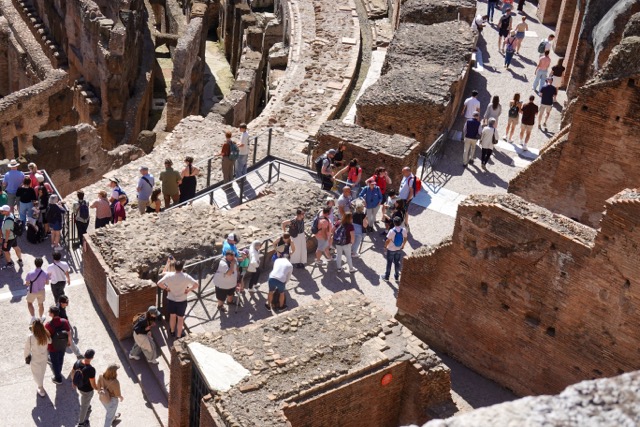
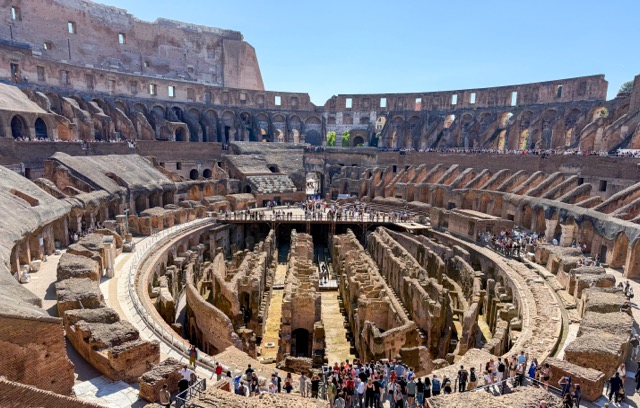
It wasn’t until the 1930’s that the “basement” level of the Colosseum was excavated to reveal the complex warren of rooms and stage equipment that made it possible to provide the citizens of Rome with the greatest spectacle on earth. The entire floor of the arena was a wood structure covered by at least a foot of soil and sand serving as a battle ground capable of soaking up the various organic residues produced by carefully staged blood sport contests that made up the typical Roman games. As many as eighty shafts penetrated the arena floor from below with an array of lifts, ramps, pulleys and cages arranged to allow the producers and directors of the games to have props, actors, animals, and gladiators suddenly appear in the arena through trap doors. Tunnels connected the subterranean level of the arena to the nearby gladiator training grounds and animal enclosures.
The games were designed and choreographed as elaborate shows recreating a romanticized version of Roman power projected to the ends of the earth – the more fantastical the better. The opening games, when the construction was completed, witnessed the deaths of between 6,000 and 8,000 exotic animals of all descriptions, primarily captured and transported to Rome from North Africa. Paolo informed us that for every animal transported in serviceable health to the Colosseum games, three or four died in transit, meaning that the opening games alone required the death of at least 30,000 animals. Such was the thirst of Romans for this bizarre entertainment that, over the centuries of the empire, North Africa was left barren of all such species and remains so today. It is a striking example of how capable humans are of destroying the earth’s eco-systems, when incentives align.
In fact, one of my greatest takeaways from the time we spent with Paolo was a new appreciation for the massive scale and power, not of Rome’s military, but of their logistics and transportation systems. The sheer volume of stone, timber, and other construction materials imported from around the Mediterranean is mind boggling. Just the outer wall of the Colosseum required 3.5 million cubic feet of travertine marble, quarried, cut, shaped, shipped, and placed in the wall. Another example Paolo gave of their logistics ingenuity related to the various obelisks around Rome. The largest of these is the Leteran obelisk which was removed from Alexandria, Egypt and shipped to Rome as a decoration for the Circus Maximus. Here’s the thing – the largest stones shaped and placed at the base of the great Giza pyramids weighed around 8 tons each, an impressive bit of engineering that we still marvel at today. The Leteran obelisk originally weighed 455 tons! The Romans shipped it across the Mediterranean in two pieces and reassembled it in Rome without damage. Mind blowing.
Another Quiet Respite
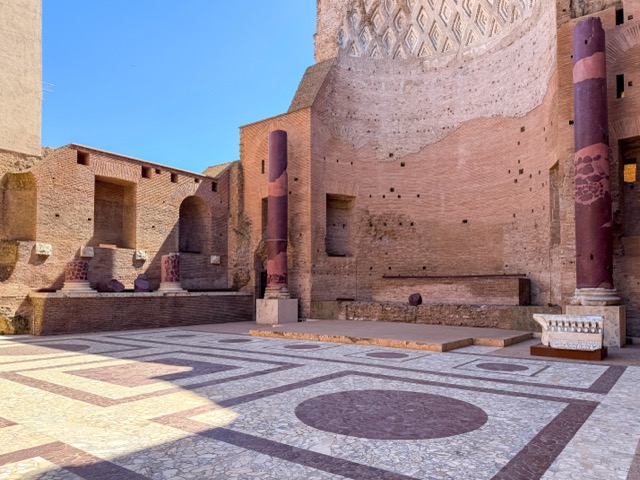
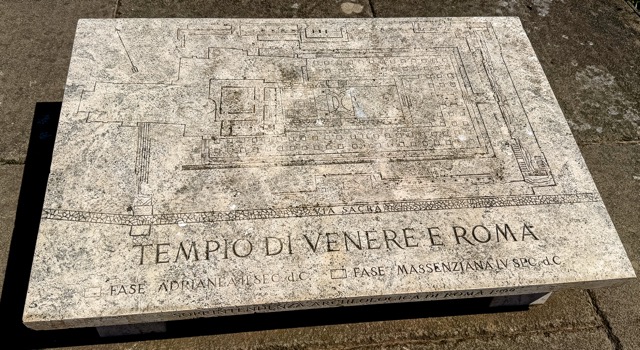
As we wandered about the Palatine and Forum areas, Paolo continued to provide an enlightening and entertaining explanation of the key features. Of course, throughout the day, we were accompanied by a few thousand of our fellow sightseers. Yes, there are lines, and security checks, and it is genuinely distressing to realize that this greatest of all tourist sites may ultimately be too popular for anyone’s good. Then Paolo quietly directed us off to one side of the Forum and through a doorway marked “Tempio de Venere e Roma.” Once again, I had the strange feeling of having used a cheat code to unlock a piece of Rome for us alone. Just a few hundred feet away, the crowds hurried by, but we found ourselves alone in Hadrian’s temple of Venus, walking across polished marble placed 2,000 years ago. Paolo smiled at our obvious delight and directed us around the back-to-back cellae that once housed the images of the goddesses. “I want to show you my favorite view of the Colosseum,” he said, as the courtyard opened up to reveal the Arch of Constantine and the great arena beyond. We left Paolo at the site of Julius Caesar’s murder, and the small, ruined temple built to mark the moment. And we left with a profoundly improved understanding and appreciation of this most Urbs Aeterna.
A Most Ambitious Project
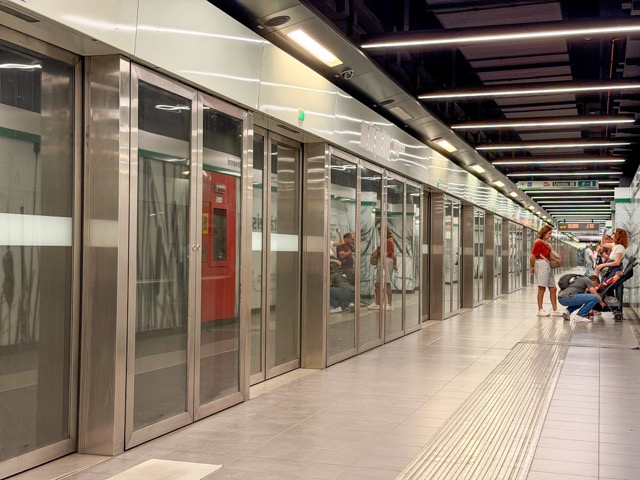
There was one last stop we wanted to check out before moving on to Tuscany for a few days. Once again, a construction related item had caught my attention: the crazy Romans are building a new subway line . . . straight through the heart of the ancient city! As you can easily imagine, this turns out to be at least equal parts construction project and archaeological dig. While modern tunneling equipment allows the actual track to be located well below any of the ancient artifacts of the city, each location where a station is constructed must be excavated with painstaking care and full archaeological recovery of the city’s heritage. So, the crazy Romans hit upon a brilliant scheme: each metro station is also a museum displaying the finds from that location. Off we went to get our metro tickets for a ride on Line C with stops at the two most recently completed archaeostations – Porta Metronia and Colosseo.
In the excavation of the Porta Metronia stop, the crews uncovered an entire military barracks complex complete with mosaic floors, frescoed walls, and the commander’s house. These treasures were either left in situ, or reinstalled, integrating the museum directly into the metro station. We were disappointed to find the exhibits closed when we arrived but still enjoyed wandering around the five levels of the station, marveling at the wall graphics detailing the geologic and archaeologic eras as you descend down to the platforms. On to Colosseo.
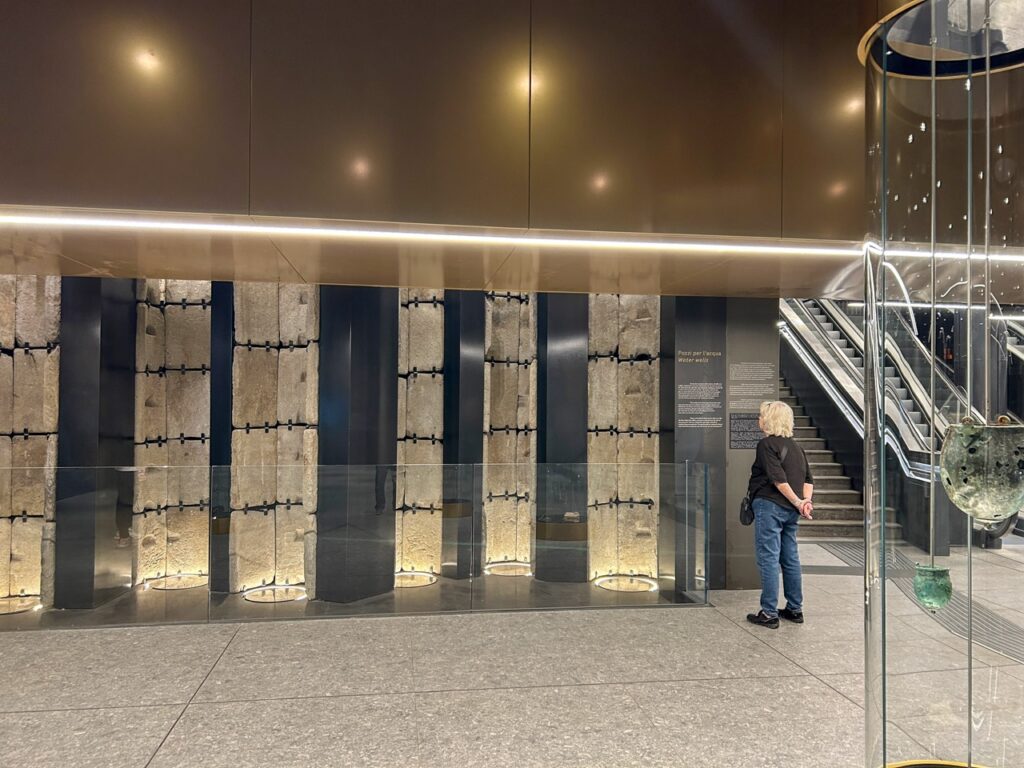
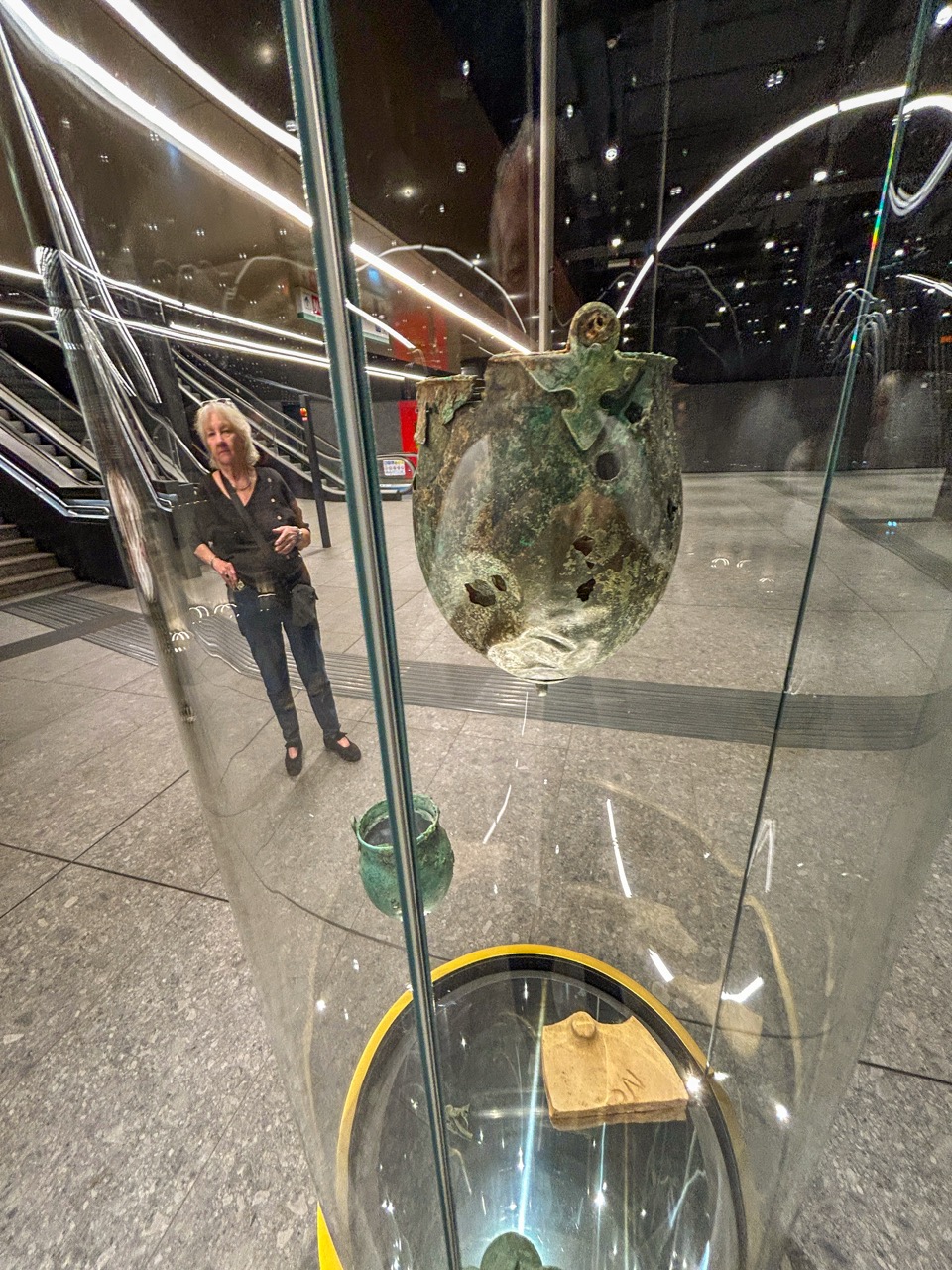
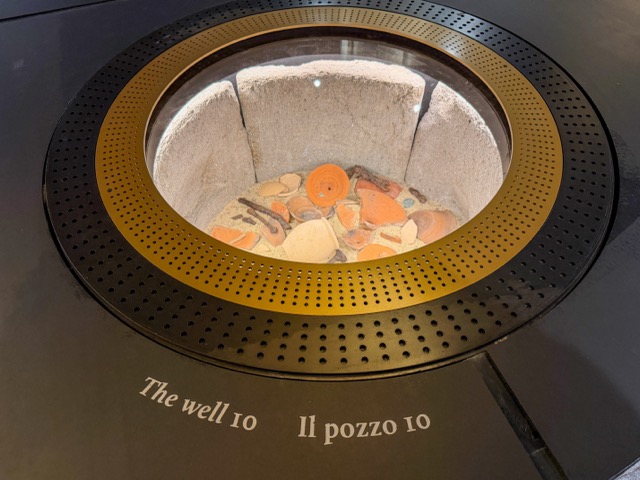
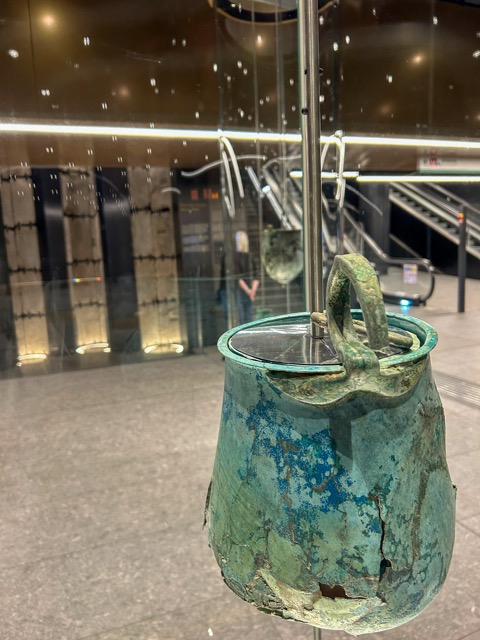
Here we were more fortunate. The excavation in this area uncovered 28 ancient water wells from the era of the Roman republic – before the age of empire and aqueducts – when the city was still forming and water was sourced from the water table. The result is another small museum displaying the related artifacts and discussing the unique religious and cultural practices related to these water wells – the source of life in that ancient time. And, here again, we found ourselves enjoying a remarkable space, practically alone, in a city that welcomes more than 16 million visitors per year, for the price of a metro pass.
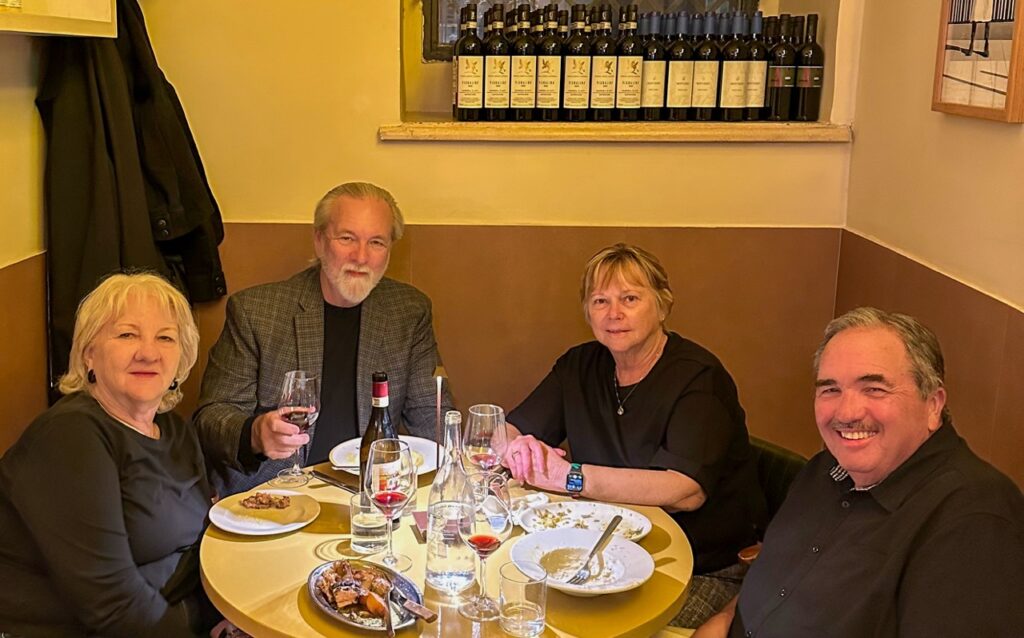
Our excuse for this visit was the arrival of Mark and Kathy in Rome, two life-long friends from our SoCal days, at the end of a Mediterranean cruise. We met at a trattoria, that final night, filled with stories of our discoveries and delight in having had our lives enriched by a deeper understanding of the civilization that begat western culture and society. And we were reminded of how precious it is to have close friends to share it with.
The thrill of the unknown gripped me as I arrived in Uzbekistan with the kind of anticipation that comes from venturing somewhere truly off the beaten path. In the months leading up to the trip, I had worked to prepare myself. I read about the history of the Silk Road, traced ancient caravan routes across maps, and watched several Great Courses lectures on Central Asia – but nothing could truly prepare me. There were stories and images that I had never imagined. Yet here I was, touching down in the capital city, Tashkent. How did this happen?
The Message
It started with a message from Maria last September.
“Where are you and Paola going next?” I asked her.
I’d met Maria in Tbilisi in September 2024 on a Culinary Backstreets trip (link) where she was on her annual trip with her childhood friend, Paola. For a week, we explored Georgian food and wine together – bonding over long meals, endless toasts, and conversations that lingered well into the evening. Since then, we’ve stayed in touch through occasional WhatsApp messages, often sharing our mutual disbelief over the political shifts occurring in both Georgia and the United States.
“Uzbekistan,” she replied.
“I want to go!” I replied immediately.
She explained that she was joining a group from the San Diego Diplomacy Council for a weeklong exploration of this Central Asian hub. Visiting Samarkand had been a dream since she was a young girl. It seems a beloved Italian song, Samarcanda by Roberto Vecchioni, was hugely popular in the 1970s and 1980s and remains a classic to this day. Inspired by an ancient Mesopotamian legend, Samarcanda evokes romantic images of distant lands and mysterious journeys. As a young girl, Maria imagined Silk Road caravans, crossing deserts, cities crowned with blue domes, and the legendary trading hub of Samarkand.
A few weeks later, I mentioned the trip to my friend Gloria. Her response was the same as mine, so I shared the itinerary: Tashkent for three days, and a couple days each in Samarkand and Bukhara. I suggested we tack on a few days in Istanbul on the way back to the West, and we were set.
Now here I was stepping out of a Hyatt Regency into the capital city at the heart of Central Asia.
Tashkent: Where Eras Overlap
It’s a modern, evolving capital where everyday life unfolds against a backdrop of Soviet era infrastructure and subtle traces of ancient history. In Tashkent, time doesn’t move in a straight line – it seems to overlap. Centuries exist side by side rather than replacing one another in sequence.
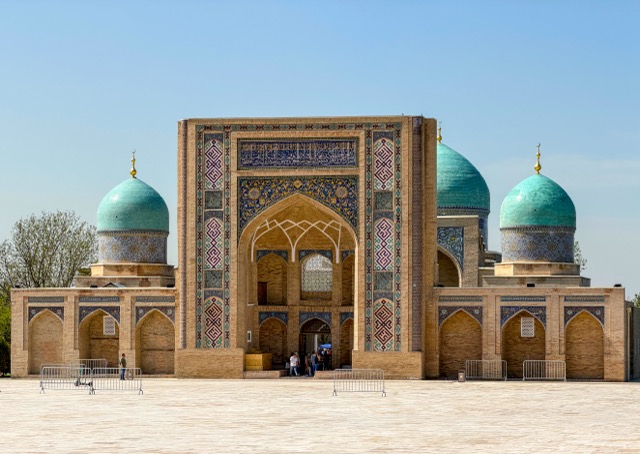
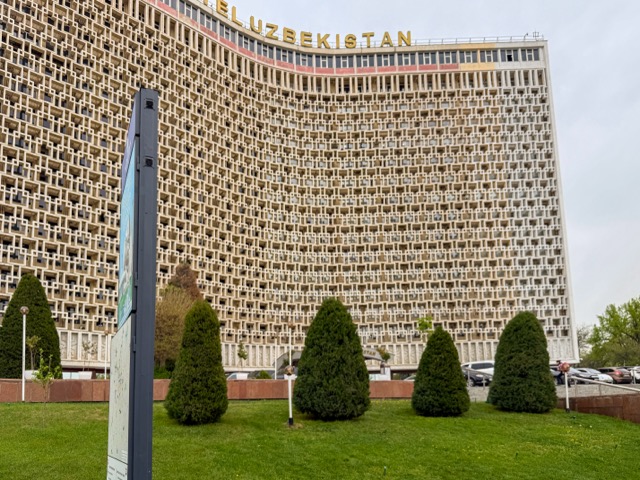
At the Khast Imam Complex, courtyards framed by turquoise domes and intricate tile work create a sense of quiet stillness – ancient and spiritual. Just beyond, the rhythm shifts. Wide avenues and imposing concrete structures, often in the brutalist style, reflect the Soviet rebuilding effort after the devastating 1966 earthquake. And then, without warning, glass towers rise into view and reflect a city that is looking forward as much as it is holding on to its past.
Barat-Khan Madrasah at the Hazrati Imam Complex
Hotel Uzbekistan, completed in 1974 and showcasing Brutalist architecture, served as the leading luxury hotel during the Soviet era.
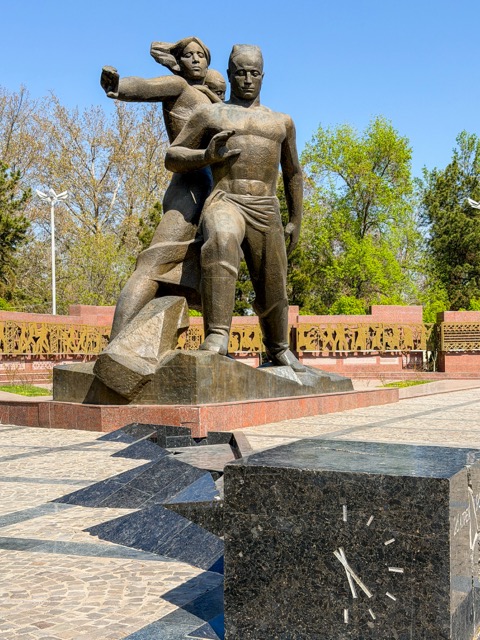
Moment of Courage – this statue commemorates the 1966 earthquake. A black granite cube split by a crack, symbolizing the earthquake, and a bronze sculpture of a man, woman, and child, representing protection and resilience in the face of disaster.
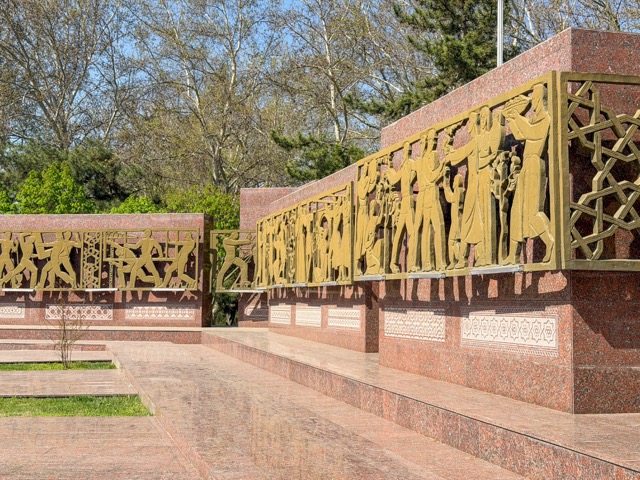
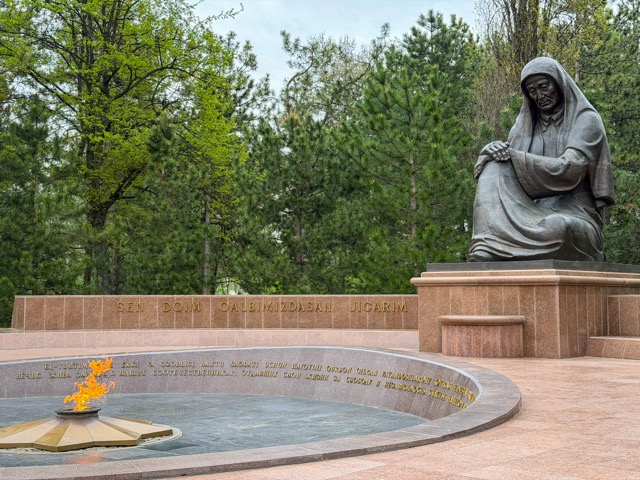
Surrounding this sculpture are 14 bas-reliefs that depict scenes of the reconstruction efforts following the 1966 earthquake, showcasing the unity and labor of various trades involved in rebuilding the city.The memorial to fallen soldiers in Tashkent is known as Memory and Honor Square, dedicated to Soviet soldiers who died in World War II. It features the Tomb of the Unknown Soldier and a statue symbolizing a grieving mother, honoring the sacrifice of over 400,000 Uzbek soldiers.
It’s about coexistence. A brutalist façade doesn’t erase the mosque nearby. A modern business center does not diminish the weight of history underneath it. It’s a layered identity where Islamic geometry, Soviet ambition, and contemporary design all speak at once.
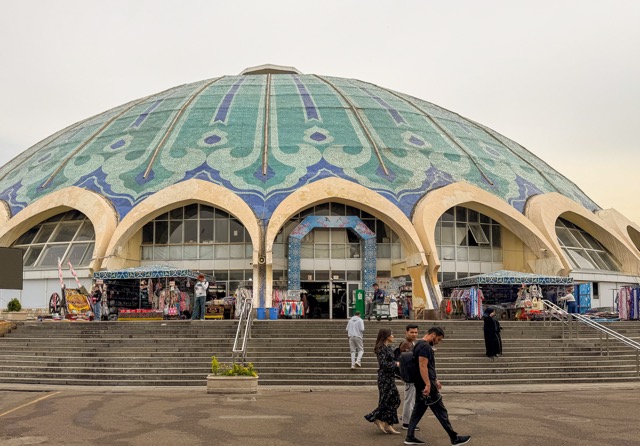
Chorsu Bazaar sits at what was once a key intersection of Silk Road trade routes, making it a natural place for merchants. Today, a massive, blue-domed structure built in the 1980s dominates the site. While the structure is relatively new, the tradition of a market at that location stretches back roughly a thousand years.
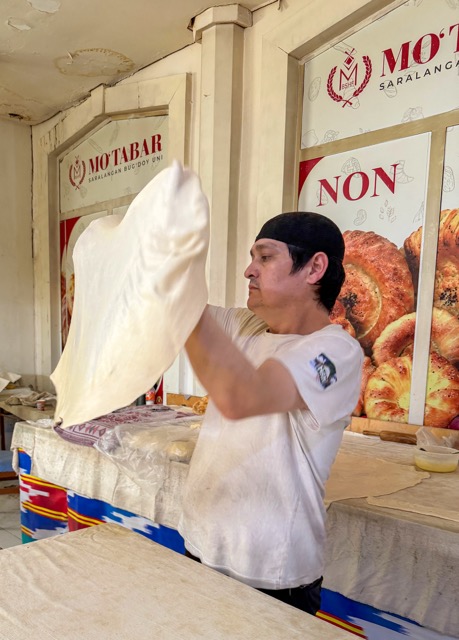
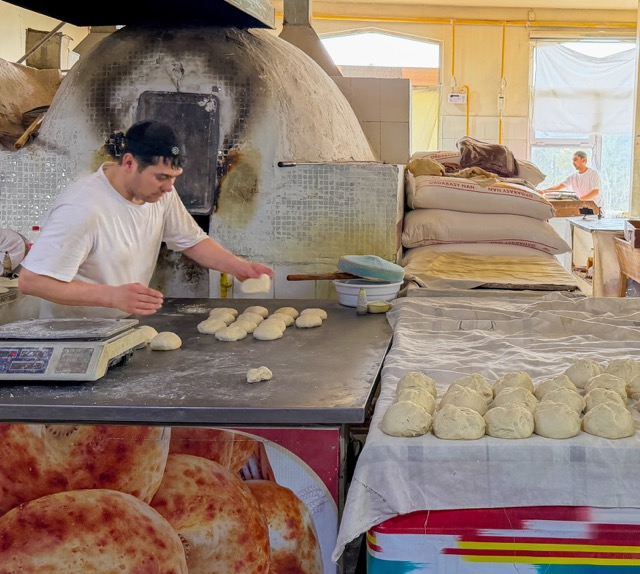
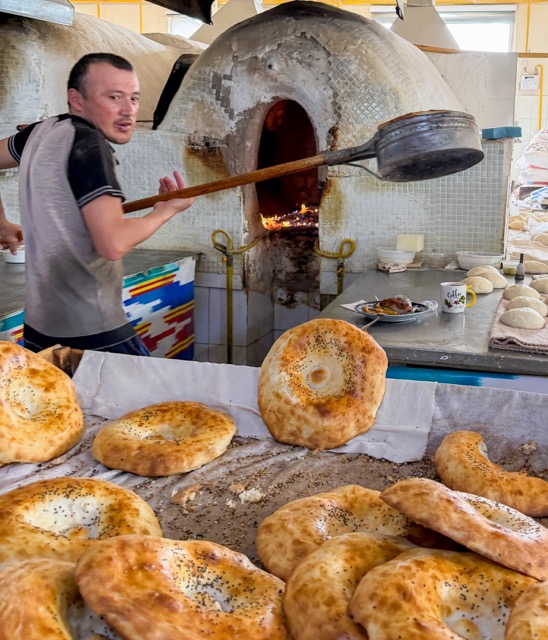
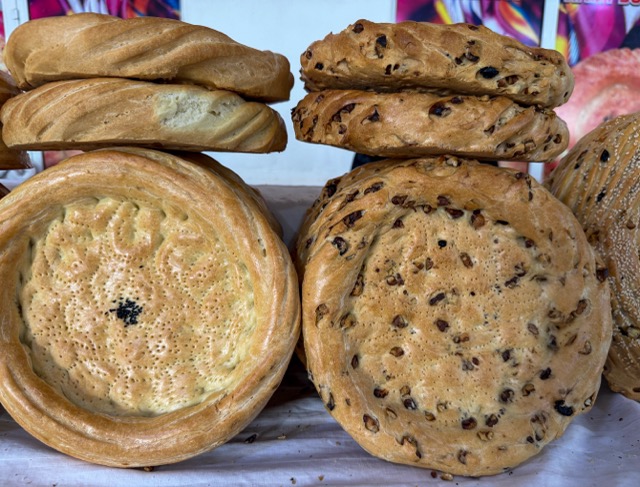
The smell of freshly baked bread is one of the first things I noticed when entering Chorsu Market. Bread is called “non” and is round with a thicker rim and a flatter center that is decorated with traditional patterns.
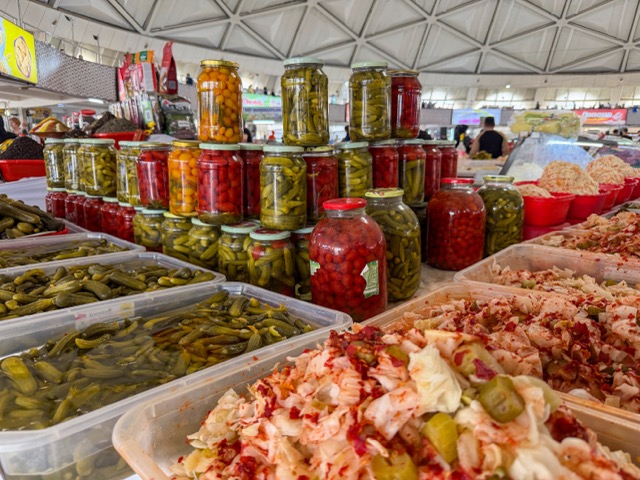
Chorsu Bazaar features pickled foods, particularly kimchi, due to the presence of the Korean community living in Tashkent.
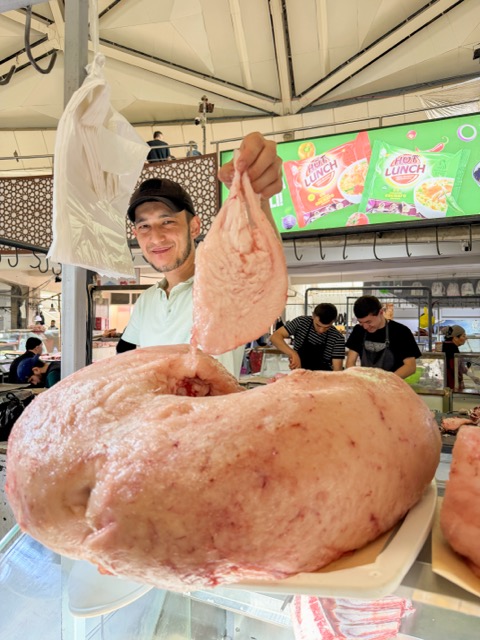
Karakul is a fat-tail sheep that deposits fat in the upper part of its tail as a hedge against starvation, always a possibility in the harsh climate in which it evolved. This tail fat, purchased by the kilogram, is an important ingredient in Uzbek cuisine.
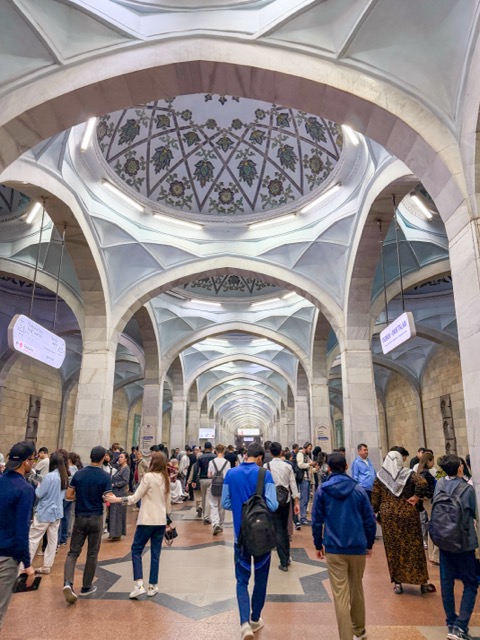
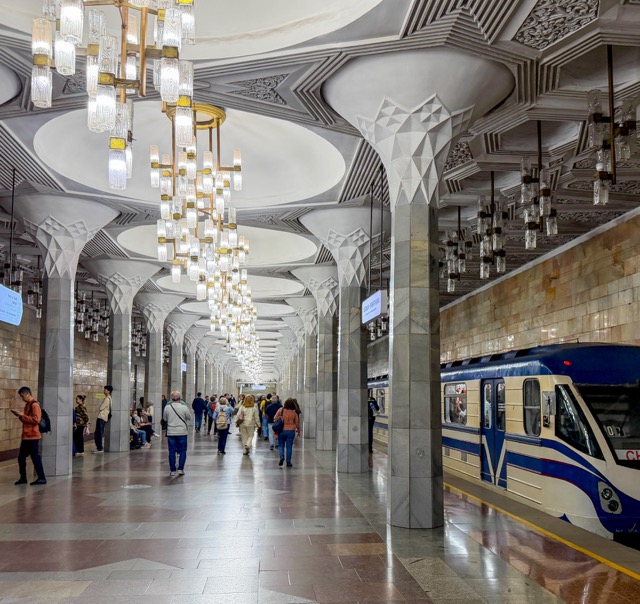
An unexpected highlight was the Tashkent metro. Often described as one of the most beautiful subway systems in the world, each station feels like an underground museum. The stations are visually stunning with marble columns and elaborate chandeliers reflecting Soviet-era artistic ambition. Intricate, colorful mosaics celebrate Uzbek history and culture. Even a short train ride is an architectural tour. It struck me that the Soviets built something beautiful here, even while imposing something heavy. That contradiction kept showing up in Tashkent. It never quite resolved, and I stopped expecting it to.
Samarkand: City of Blue
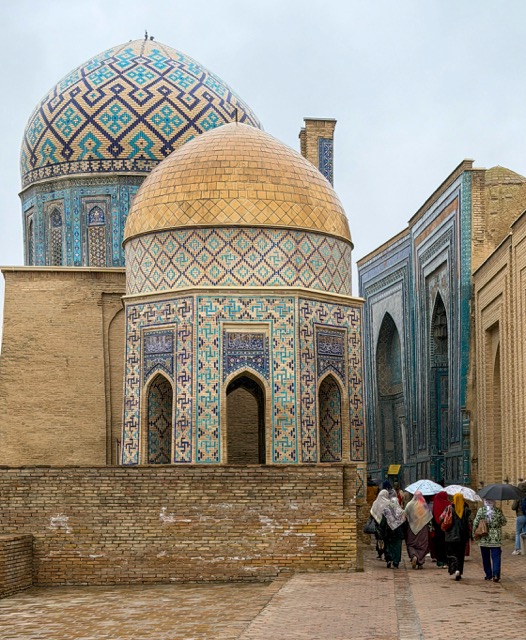
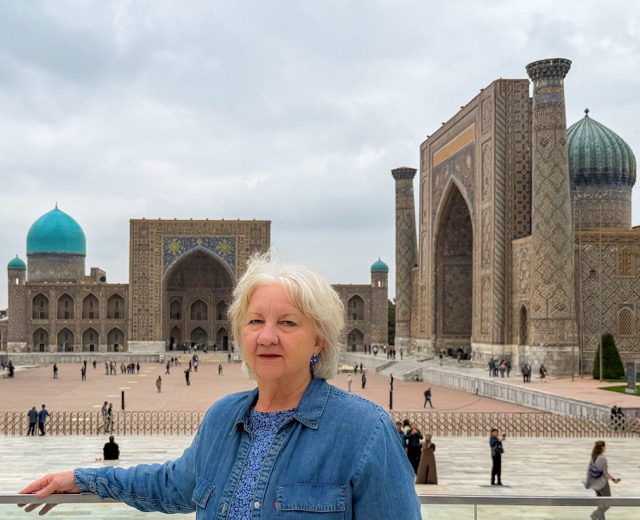
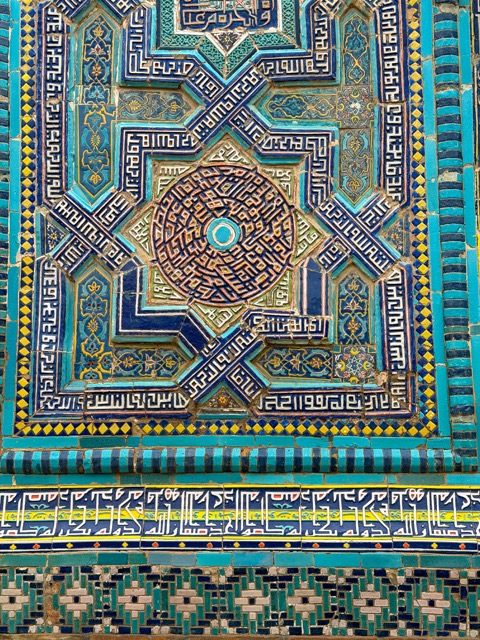
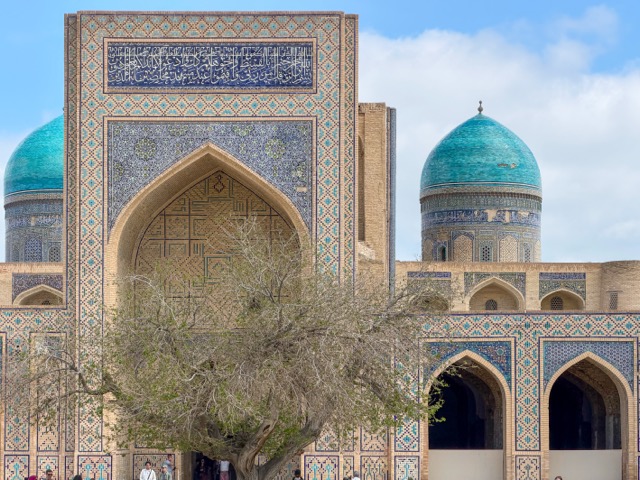
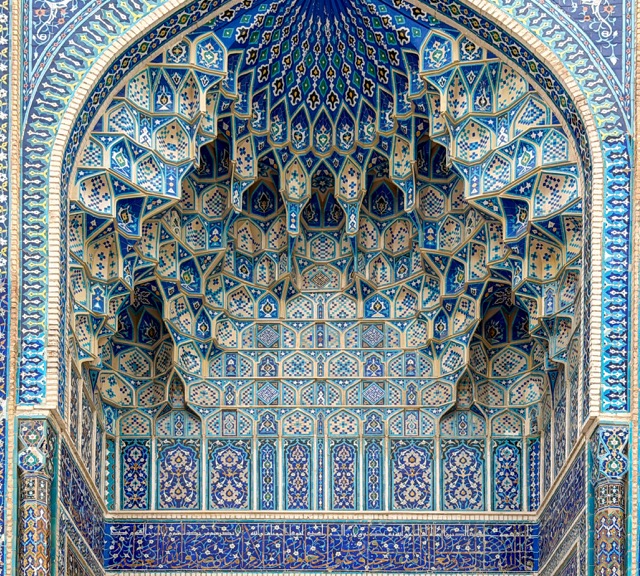
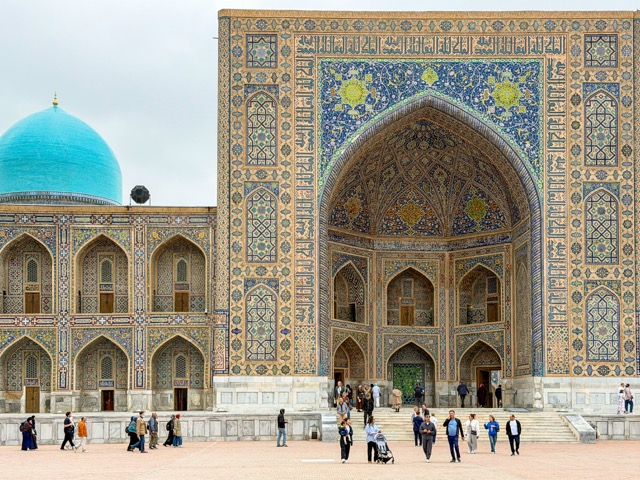
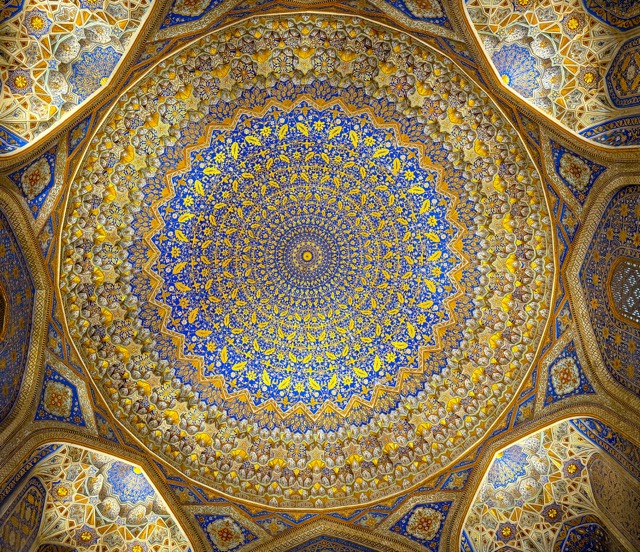
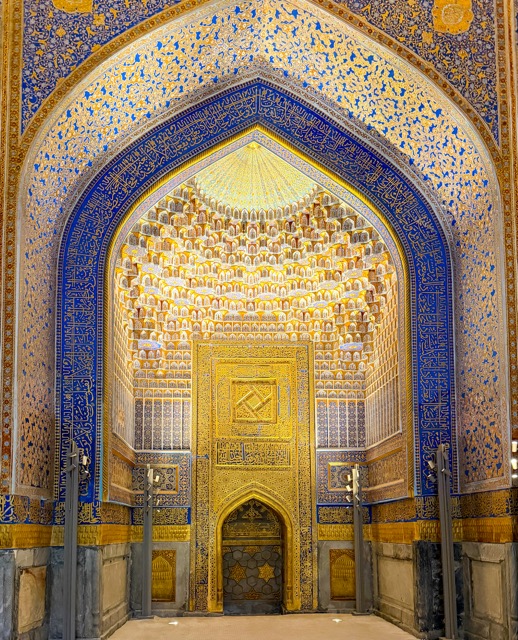
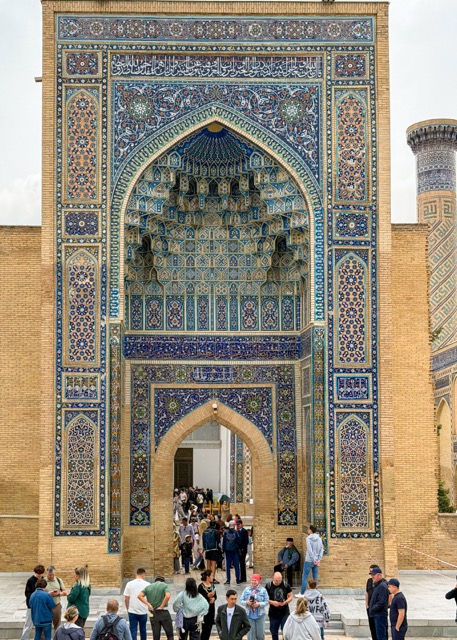
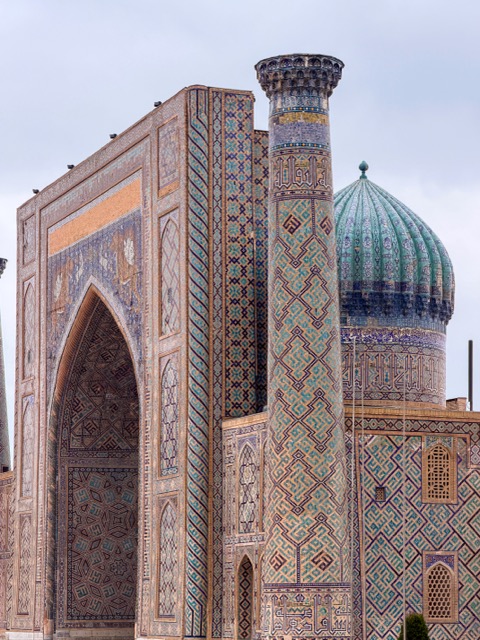
The first sensation is scale. Massive portals that dwarf the human body. Monumental facades feel as if they were built for giants. I found myself slowing down to recalibrate my sense of proportion. Then, there’s the blue. It isn’t a single blue. There is deep lapis to bright turquoise with cobalt lines forming intricate geometric patterns. Up close, I could see the slight irregularities of handmade mosaics. From afar, those same tiles dissolve into vast, unified fields of color. Everything draws your eye upward. Grandeur takes center stage. The unmistakable legacy of empire.
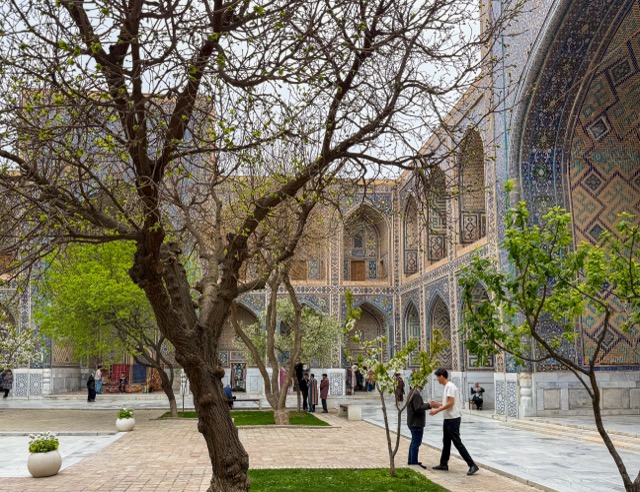
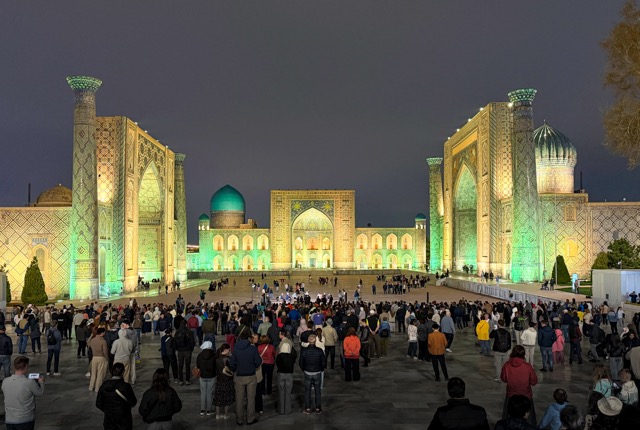
Registan Square in Samarkand is a historic public square renowned for its stunning ensemble of three madrasas.
Legend says Alexander the Great declared Samarkand the most beautiful place he had ever seen. It was the capitol of Timur’s empire in the 14th century and one of the great cities of the Silk Road. Just as Maria had imagined, traders, scholars, craftsmen, and travelers passed through Samarkand carrying goods, knowledge, and ideas between East and West.
Pursuit of Knowledge
Between the 13th and 17th centuries, Samarkand was not only a city of trade, but also a city of intellect. Madrasas formed the backbone of higher education- institutions where students gathered from across Central Asia and beyond. In addition to theology, students engaged with mathematics, astronomy, philosophy, literature, and law. Samarkand became a major center of higher learning.
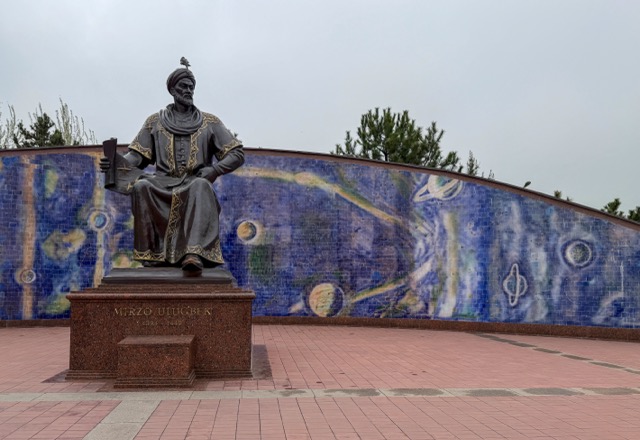
Astronomy reached remarkable heights. Ulugh Beg, grandson of Timur, was not just a ruler of the dynasty his grandfather created, he was one of the most important astronomers and scholars of his time. He founded the Ulugh Beg Madrasa in 1417, the oldest of the three madrasas on the Registan. His observatory, his madrasa, and his scholarly network made Samarkand one of the most sophisticated and intellectual capitals of the 14th and 15th centuries. Europe, by contrast, was experiencing the Late Middle Ages characterized by famine, wars, and the Black Death during this era. With the discovery of the Americas by Europeans, however, the global center of scientific innovation began slowly shifting westward and Central Asia became far less important for trade.
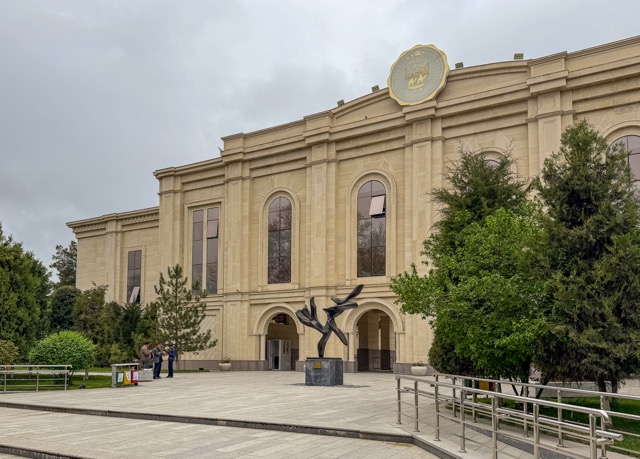
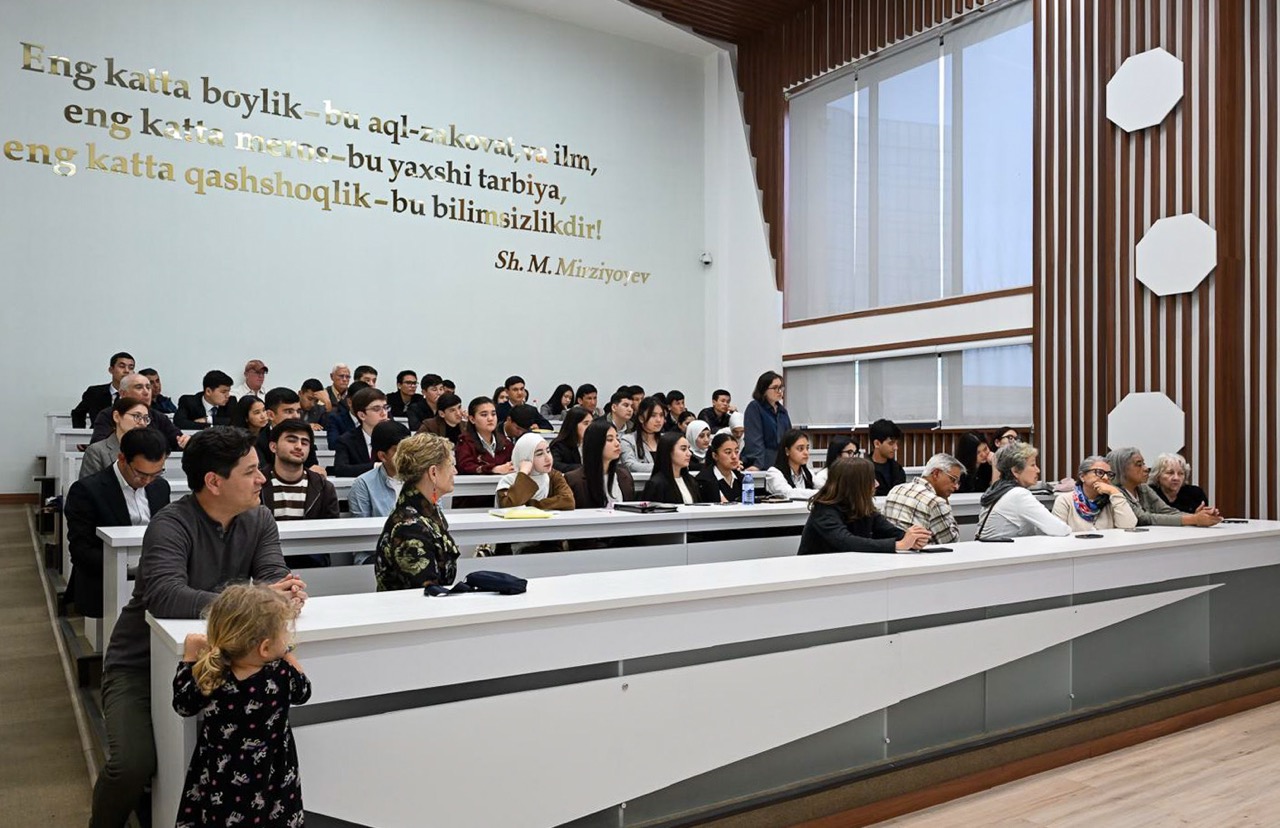
One of the most memorable moments of the trip came during a visit to the Silk Road International University of Tourism and Cultural Heritage with my fellow travelers from the San Diego Diplomacy Council. We spent about an hour with a classroom of students exchanging ideas about tourism, culture, career opportunities, and daily life. Their curiosity and openness made the visit a meaningful cross-cultural exchange. It seems the spirit of the Silk Road isn’t just in the past.
Silk Road International University of Tourism and Cultural Heritage
Surrounded by a sea of blue, confronted by the incredible scale, Samarkand feels otherworldly. It’s not just the beauty that captivates. It’s the expression of a world view in which knowledge was paramount, where learning was public and prestigious. I realized that this city was never just a city to be seen. It was a place designed to shape how people learn and think. It was truly an intellectual capital.
By night, Registran Square transforms into a magical stage, with concerts, light shows and celebrations that echo its past as a gathering place for the city.
Bukhara: A Living Silk Road City
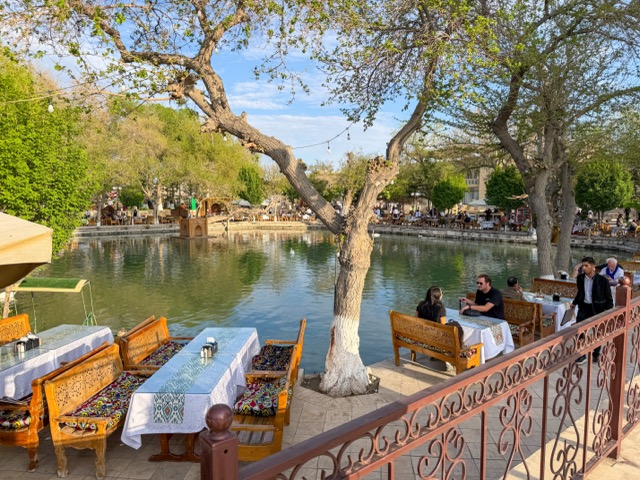
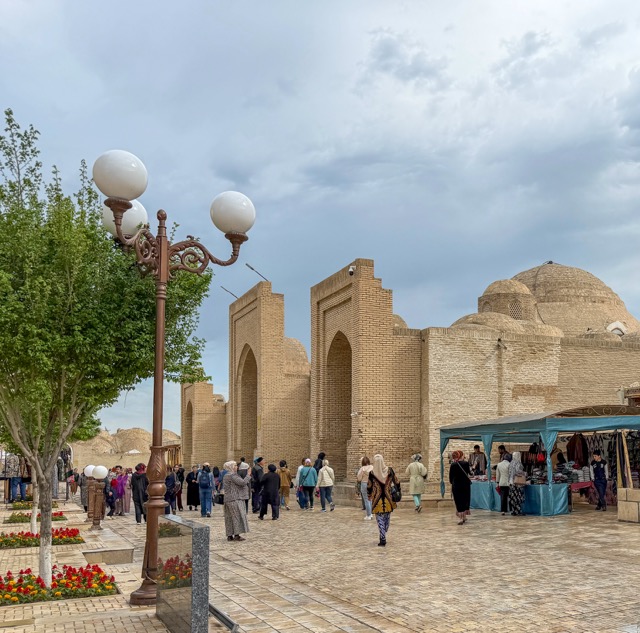
I arrived in Bukhara expecting history. But what I didn’t expect is how alive that history feels. Walking into the old town is less like visiting ancient ruins and more like stepping into a living museum. Lyabi-Houzz, a serene plaza built around a pond and shaded by ancient mulberry trees, is at the heart of the old town. Cafes line the square, and people gather to talk, drink tea, and watch the world go by. Sitting there with my traveling companions, it was easy to imagine merchants and other travelers doing the same centuries ago.
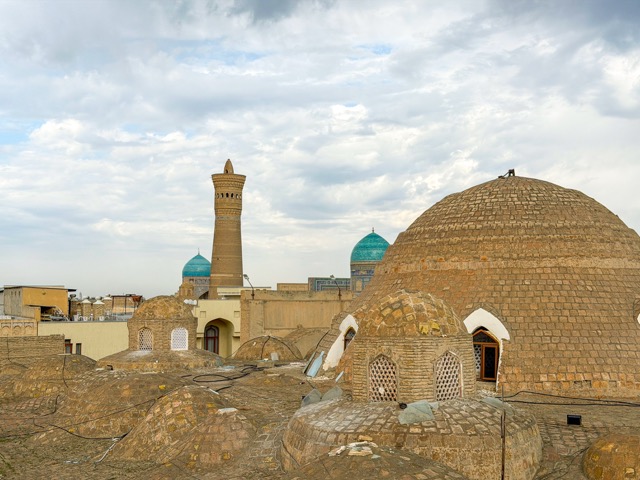
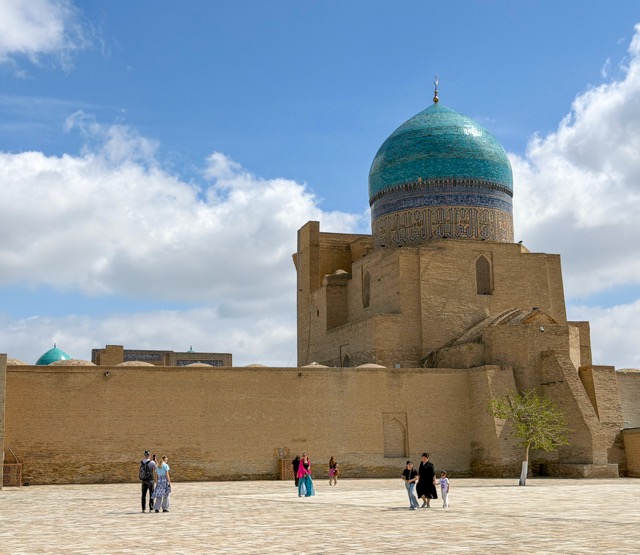
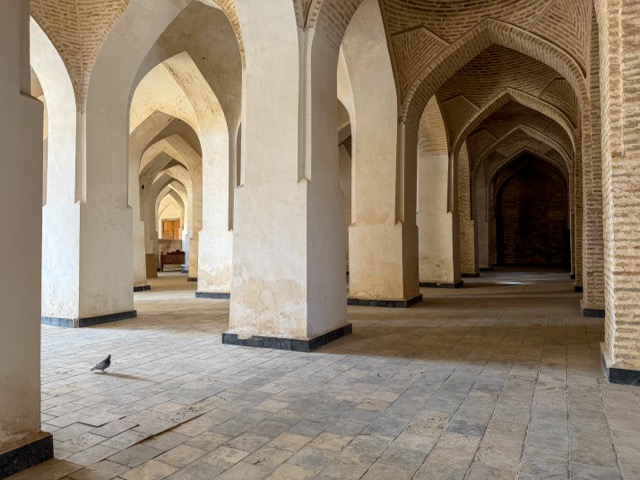
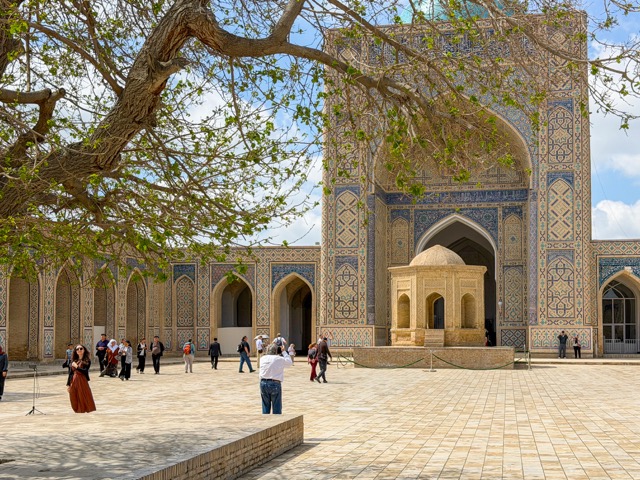
As the city unfolds in warm, sandy hues, narrow alleyways lead to architectural treasures: mosques, madrasas, and hidden courtyards. The Kalyan Minaret, towering above the skyline since the 12th century may have guided caravans approaching the city.
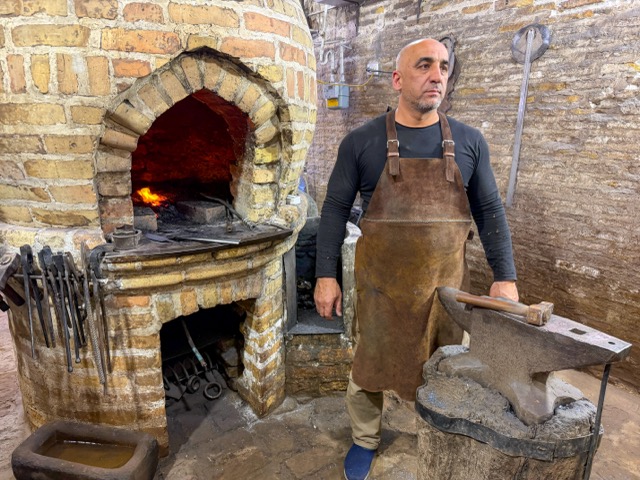
Centuries old workshops house artisans crafting metalwork, textiles, and embroidery and other arts using techniques passed down through generations.
Navrus: A Celebration of Community
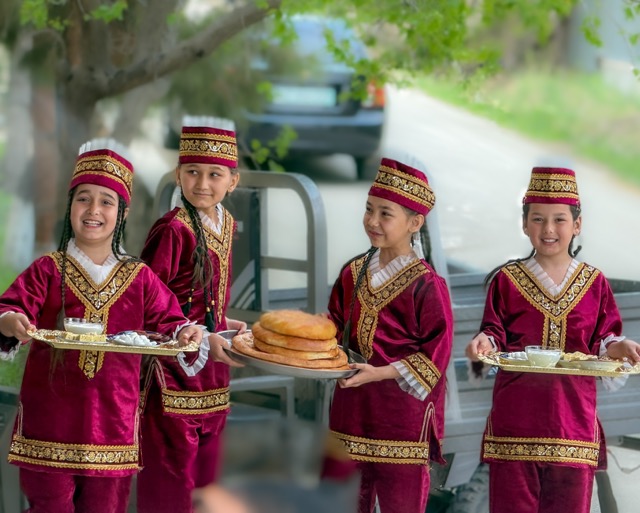
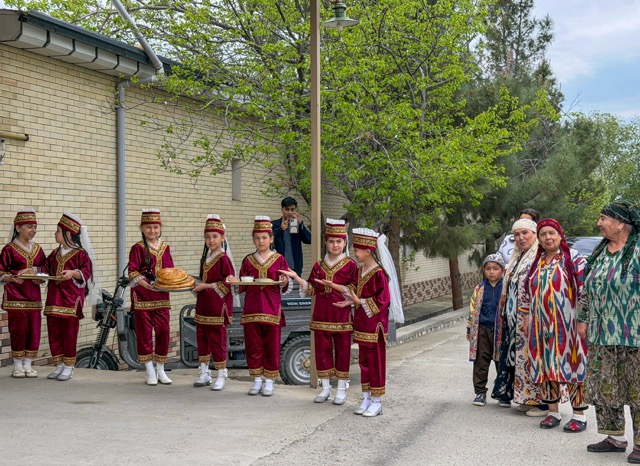
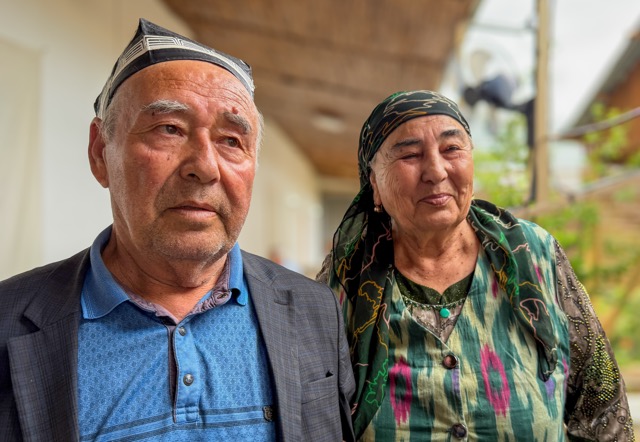
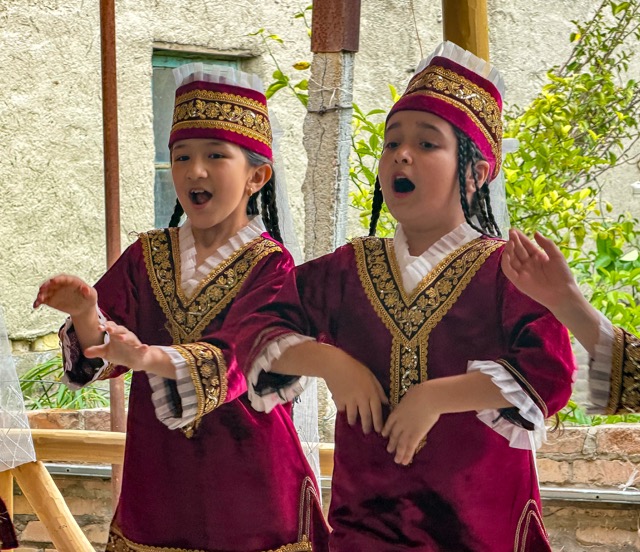
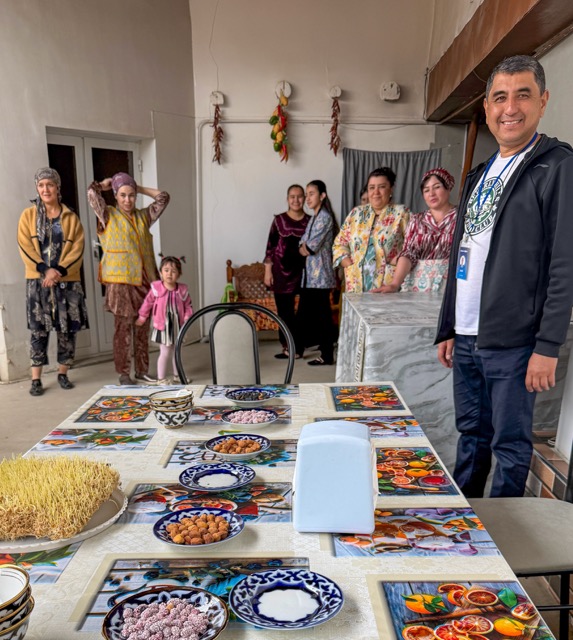
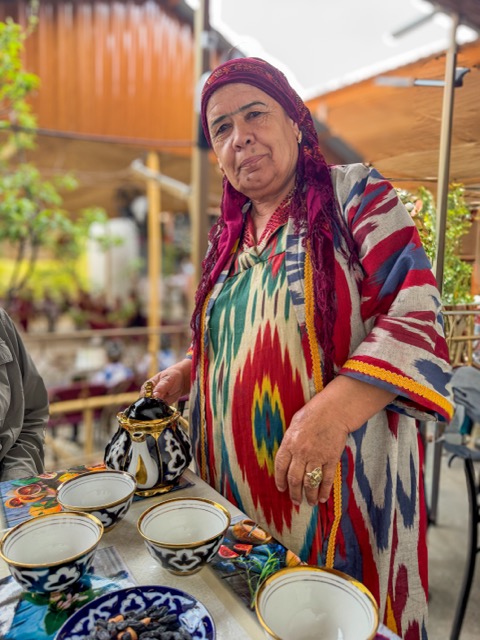
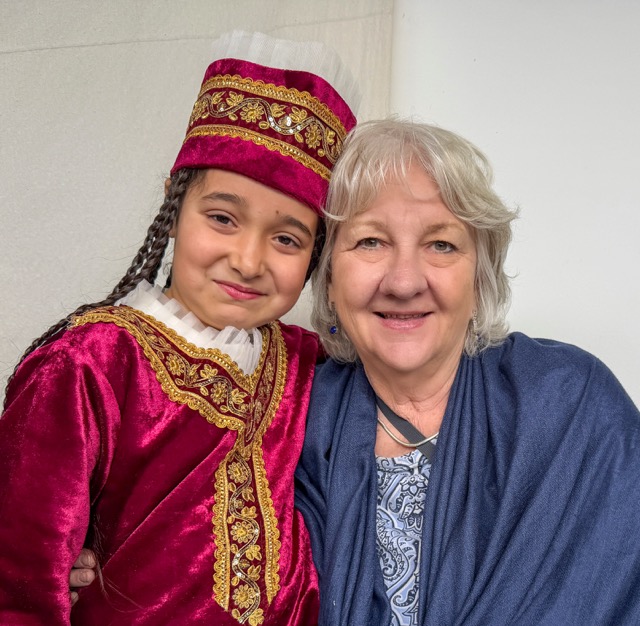
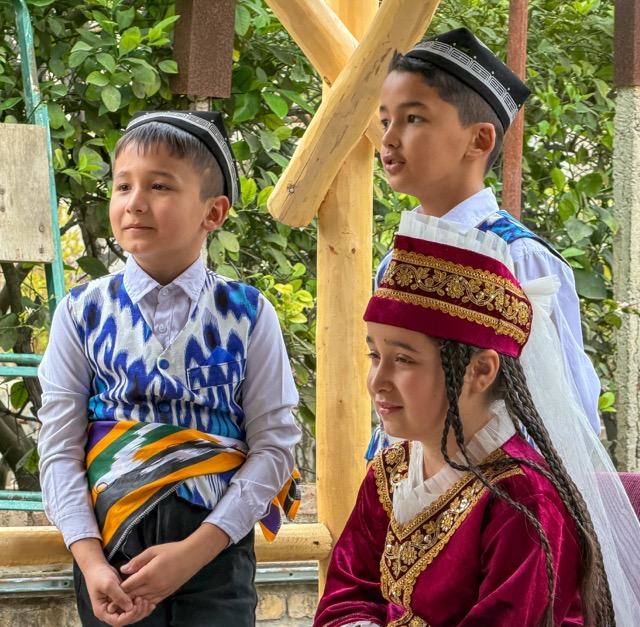
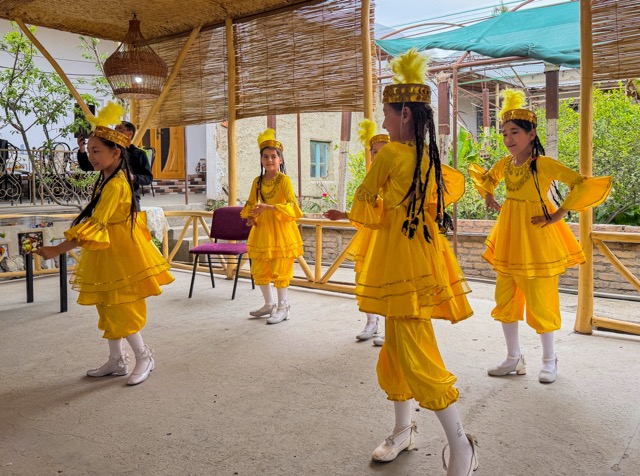
Around the time of the spring equinox, Uzbeks mark the new year with a celebration that predated Islam by thousands of years. Navrus isn’t defined by formal ceremonies. Rather, it’s a time of togetherness. Families and neighbors gather, people dress in colorful clothing, and public squares are full of music and dancing. A highlight of my week in Uzbekistan was joining a Navrus celebration in a small village with a family, their neighbors, and children from the village school. We cooked together, laughed with the children, and shared stories.
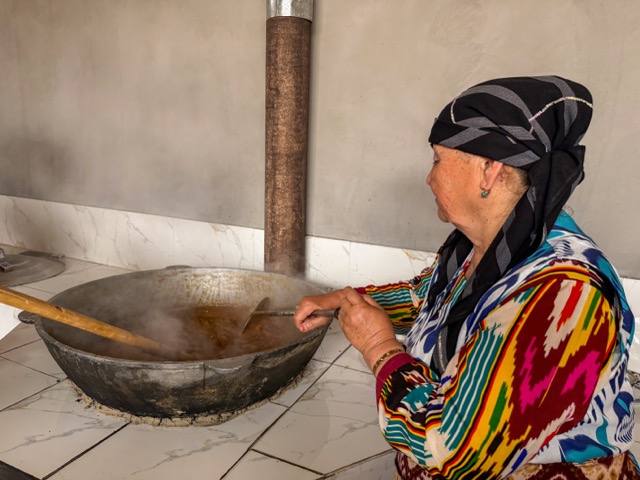
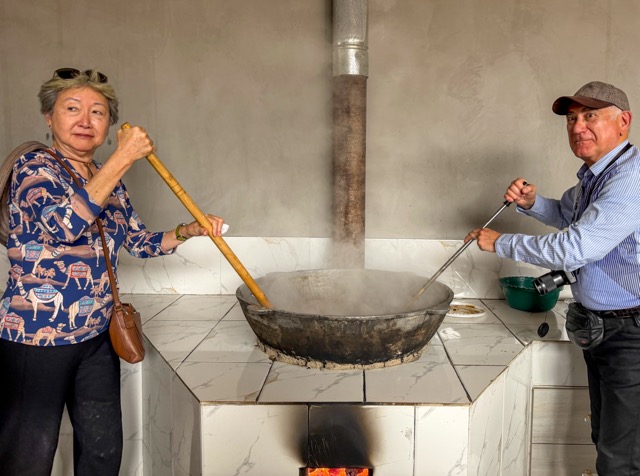
The most iconic Uzbek food prepared for Navrus is sumalak, a dish made from sprouted wheat. Wheat grains are soaked and allowed to sprout symbolizing new life. The sprouts are the crushed to extract a milky juice. This liquid is slowly cooked with flour and oil in a huge cauldron. The mixture is stirred continuously for up to 24 hours. The finished sumulak is thick, smooth, and dark brown with a sweet, malty flavor. The real magic of sumulak is social. Women from the neighborhood gather around the pot and take turns stirring through the night as songs are sung, stories are told, and wishes for the new year are shared.
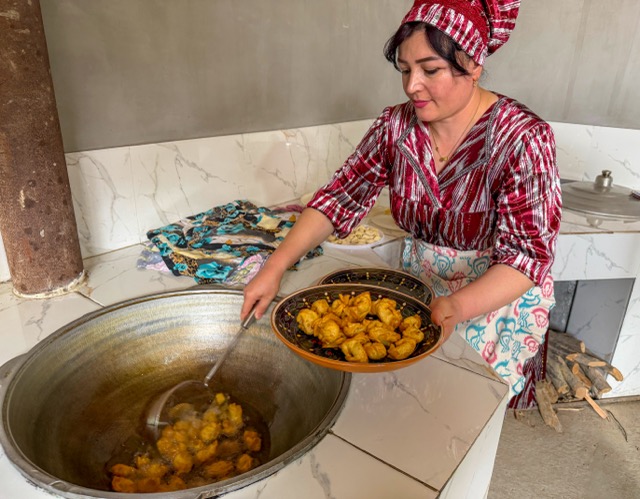
During the celebration we helped prepare other foods as well—dumpling-like pastries filled with meat and freshly baked bread cooked in a clay tandoor oven. The children performed traditional dances, and before long everyone joined in. Eventually we sat down together for a full meal. It was messy, joyful, and unforgettable.
Plov: The Heart of Uzbek Cuisine
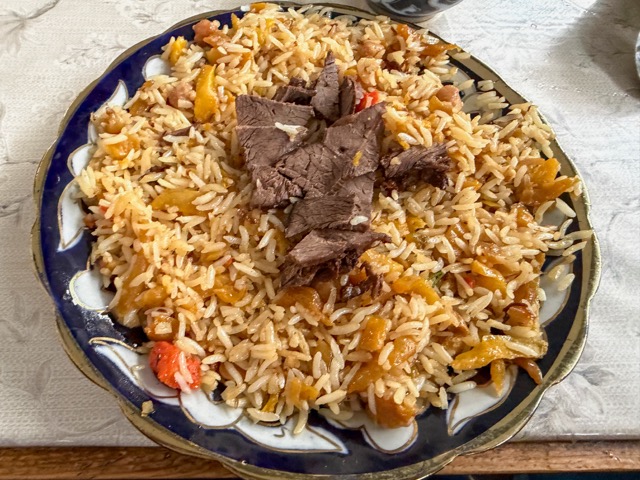
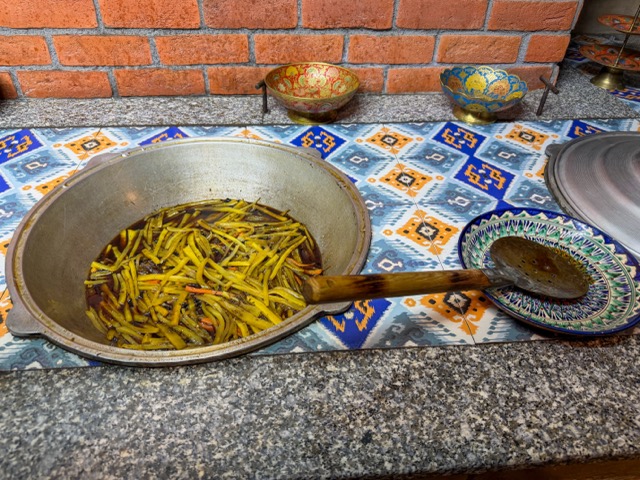
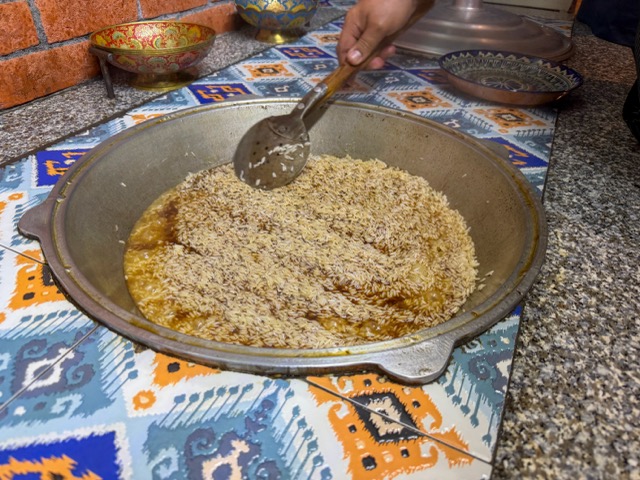
No visit to Uzbekistan is complete without tasting plov, the country’s national dish and culinary heart. Legend traces its origins to the campaigns of Alexander the Great, who supposedly ordered that a nourishing meal of rice, meat, and vegetables be created for his soldiers. Whether or not the story is true, plov today is a symbol of hospitality and community.
In Tashkent, I sampled a few versions at local restaurants. Then, in Samarkand, I joined a cooking class, learning firsthand how to layer the flavors and cook the rice perfectly in a wide pot called a kazan. Plov reminded me of Middle Eastern pilaf, Indian biryani, and even Spanish paella.
At one point, I spotted a t-shirt that said, “All You Need is Plov.” I didn’t buy it, but I secretly wished I had – it perfectly captured the warmth, humor, and pride of Uzbek culture.
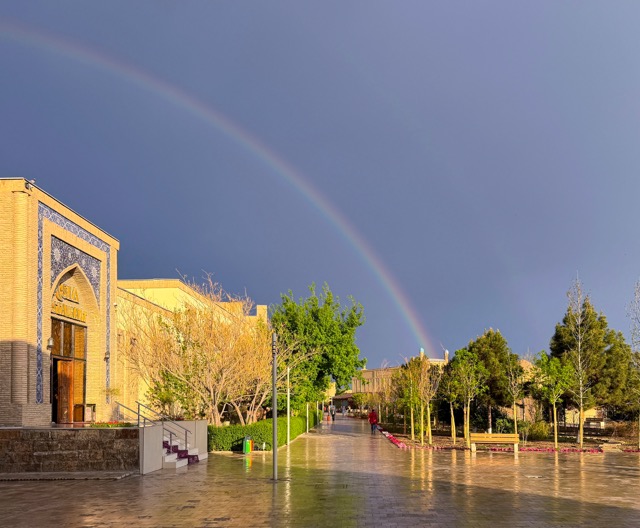
We were treated to a lovely rainbow in Bukhara.
A Different Kind of Muslim Society
Having traveled in other Muslim-majority countries, I arrived with expectations about what I might see and hear. Those expectations were quickly challenged. What I saw instead is a country that is a Muslim-majority society shaped by decades of enforced secularism and a distinct cultural history. For most of the 20th century, Uzbekistan was part of the Soviet Union which officially promoted atheism and tightly controlled religious practice. Even after independence in 1991, that legacy didn’t just disappear. It shaped generations of people who grew up with religion as something private rather than public. Western style clothing is the norm and during my entire visit I never once heard the call to prayer.
Strong pre-Islamic and Silk Road influences are also a factor. Cities like Samarkand and Bukhara were major Silk Road hubs – cosmopolitan and diverse. And Uzbekistan’s modern government actively promotes a secular identity with an emphasis on national culture over religious identity. The result is a society that feels distinct from many other parts of the Muslim world.
What Uzbekistan Left Me With
By the end of my trip, I felt as though I had traveled not just through Uzbekistan, but through time. The mix of history, culture, and food left a mark on me. Like Maria, I came seeking adventure and discovery. I left with something deeper – an appreciation for centuries old stories, warm-hearted hospitality, and the simple joy of sharing a meal – especially if it involves a plate of plov.
Author’s note
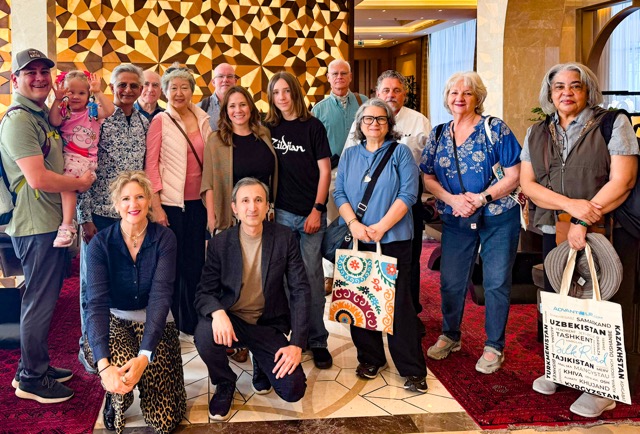
The Silk Road isn’t just ancient history. Connections are still being made today. I want to acknowledge and thank the San Diego Diplomacy Council and my new friends – Lulu and Joel, Tim and Paula, Jeff, Raj, Floyd, Heidi, Ryan, Luca & Pearl, Gloria, and, of course, Maria. And a special thanks to Zahid our amazing guide.
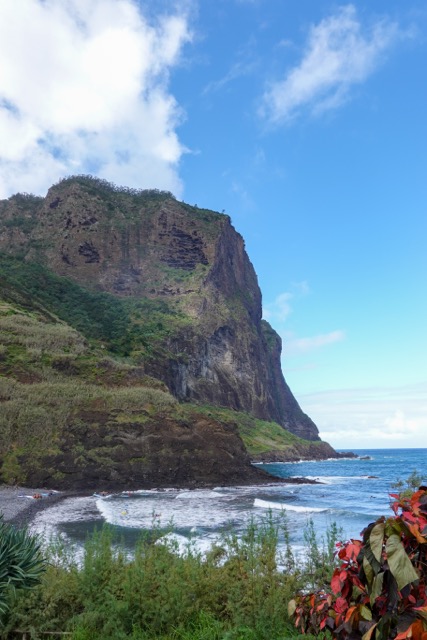
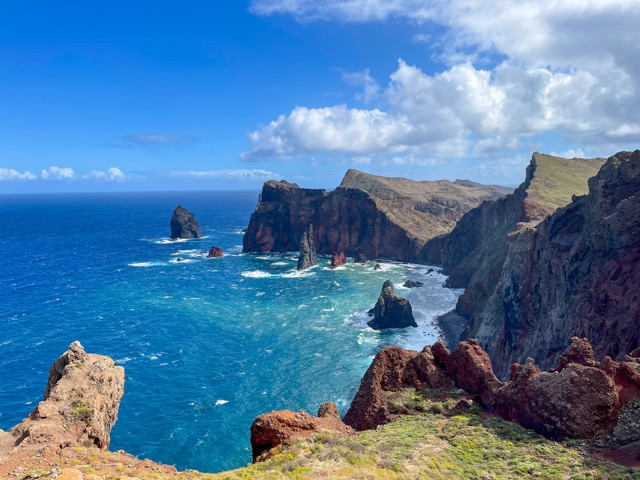
It’s a volcano. A vast undersea mountain with only the top rising from the sea, and like most mountains, it’s a rugged, irregular landscape of peaks and gorges that reach right down to the shoreline. So, our introduction to Madeira began with a minor adrenaline rush. As the plane swooped in low over the Atlantic, it felt like we were landing on a cliff edge – which, it turns out, we were. As the 737 settled into the final approach, we looked out the starboard windows to see a massive cliff streaming by seemingly just a few meters off the wing tip. On the port side, there was nothing to see but the vast blue Atlantic. Later, we learned that the Funchal Airport runway is considered one of the most difficult in the world — pilots need special training to receive certification to land there. Thankfully, that little detail was revealed after landing when it was a bit easier to digest.
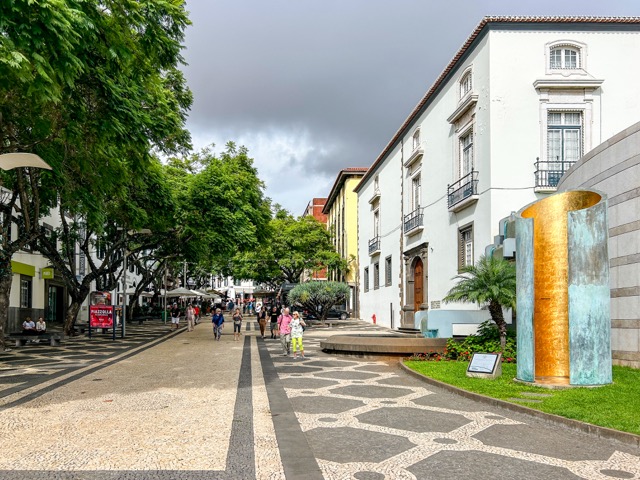
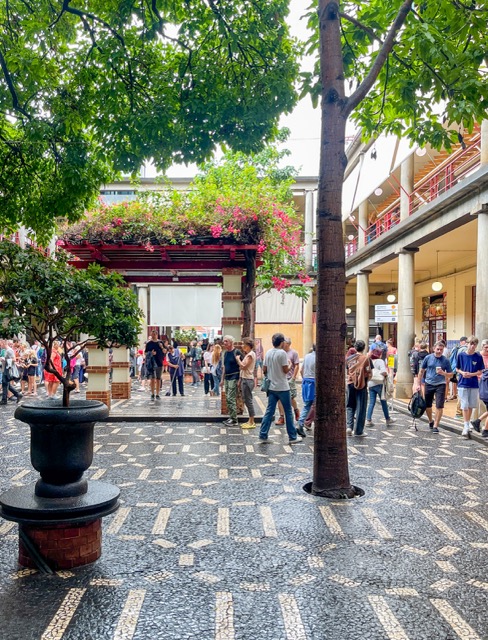
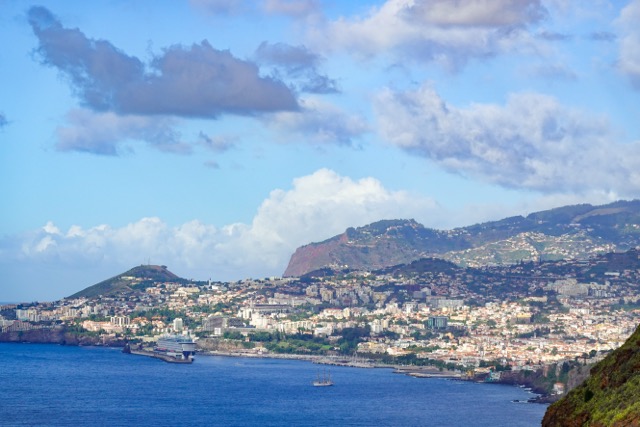
The drama soon gave way to familiarity. Arriving in Funchal (Madeira’s capital city), we stepped out of the taxi into the soft island air and onto that beautiful, patterned black-and-white stone paving we’d loved in Lisbon and Porto. It was a quiet little “welcome back to Portugal” under our feet.
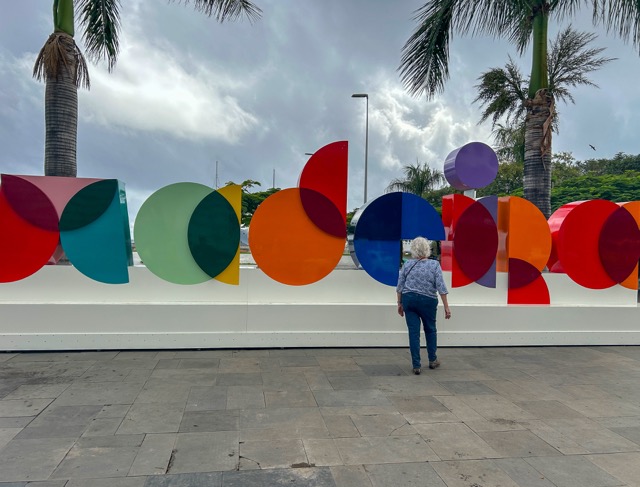
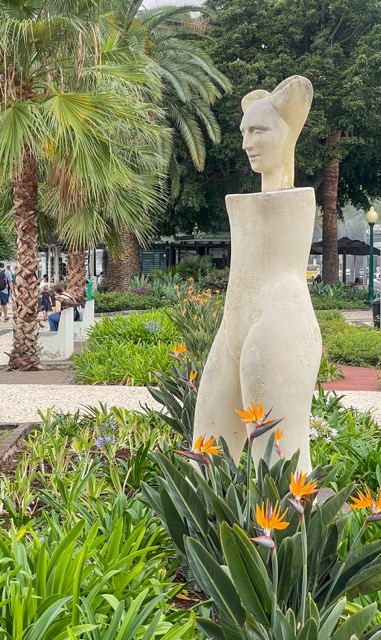
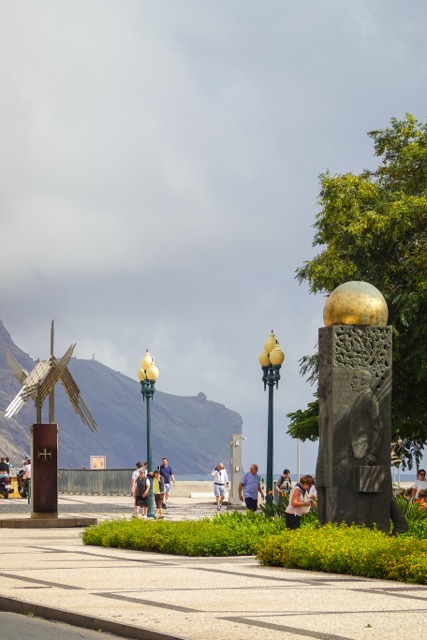
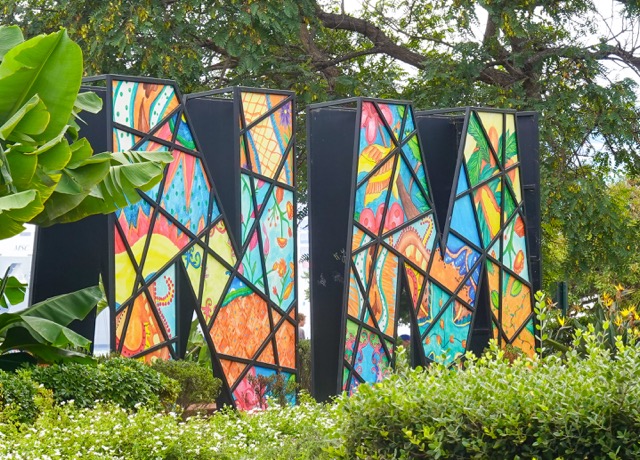
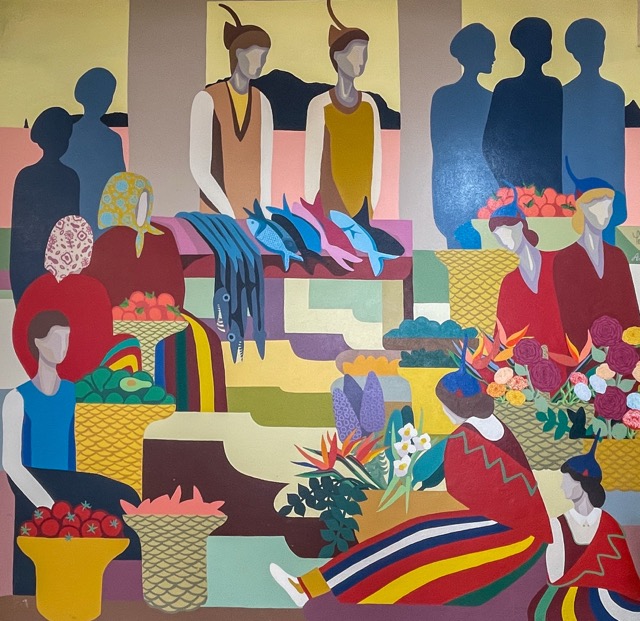
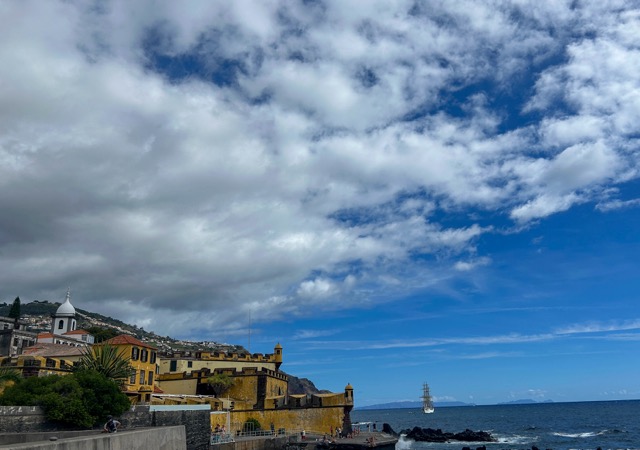
We arrived too early to check in, so we stashed our bags and headed out to explore. Funchal immediately charmed us: cobbled streets, flowering shrubs, the hum of cafés, and a waterfront dotted with public art that felt like an open-air gallery. When we finally checked in later that afternoon, the sea breeze and general vibe of Funchal sealed it: we were going to like it here.
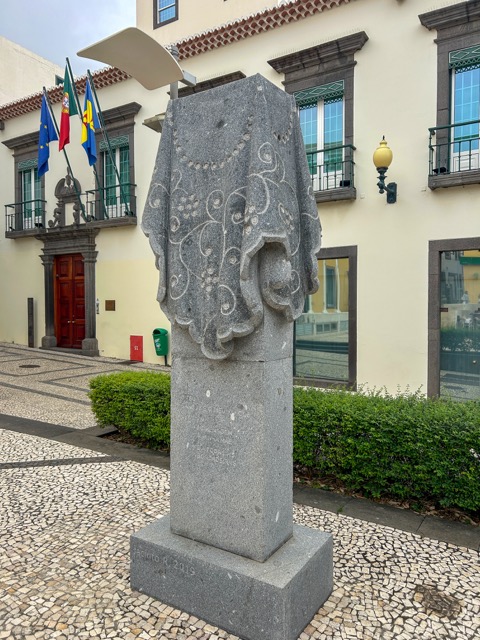
A Tribute to Nelson Mandela
A Market and (of course) a Food Tour
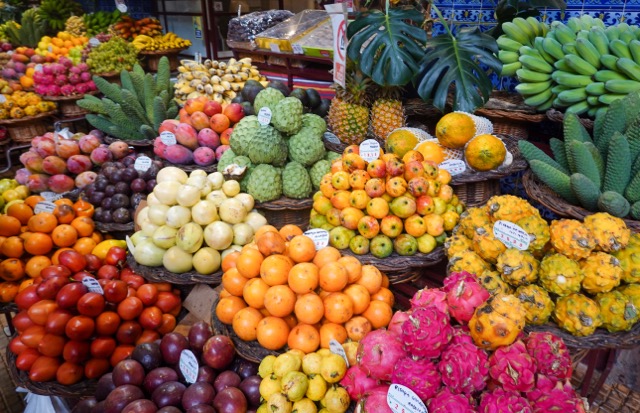
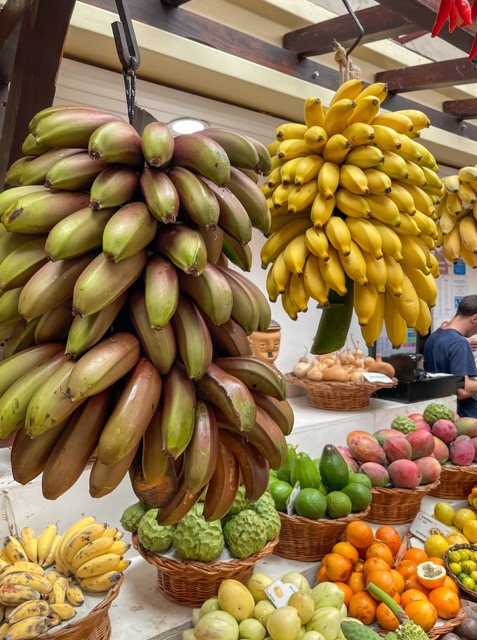
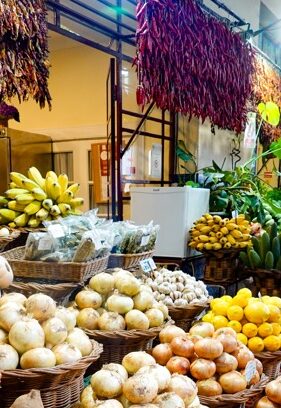
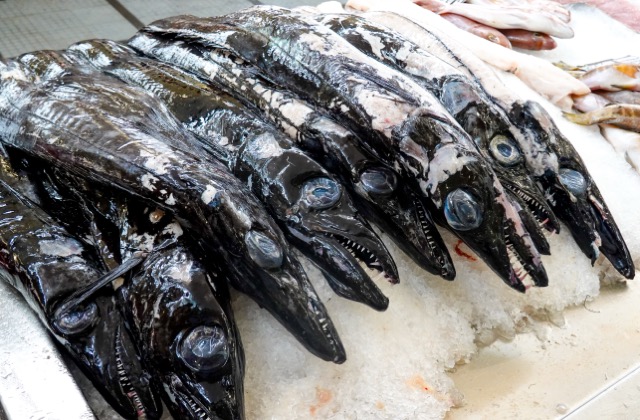
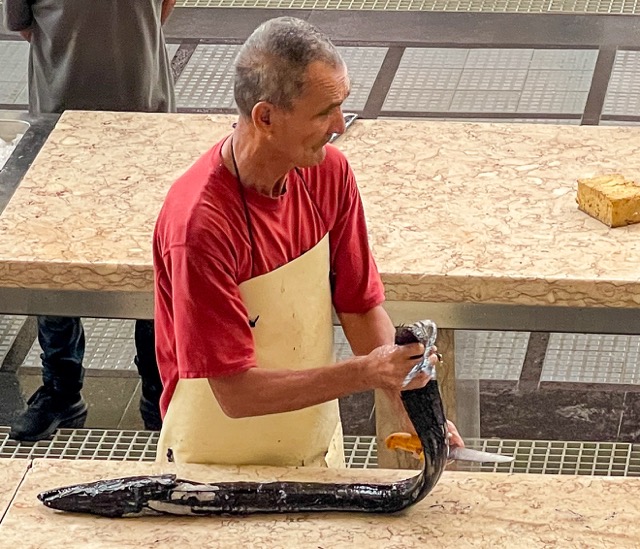
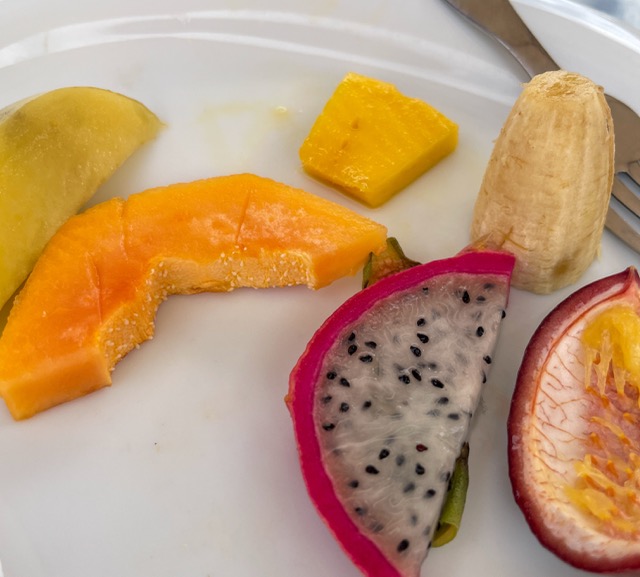
Our first full day in Funchal began at the Mercado dos Lavradores (Farmer’s Market) which turned out to be a feast for the senses in every possible way. Tables overflowing with tropical fruit – bananas, mangoes, dragon fruit, passion fruit, guava, papaya, figs, tangerines, and a few vegetables we couldn’t name. And then, the black scabbard fish (espada) caught us off guard – long, thin, black, and with eyes that looked like a deep-sea monster. The ugliest fish we’ve ever seen. (Also, as we’d soon discover, one of the tastiest.)
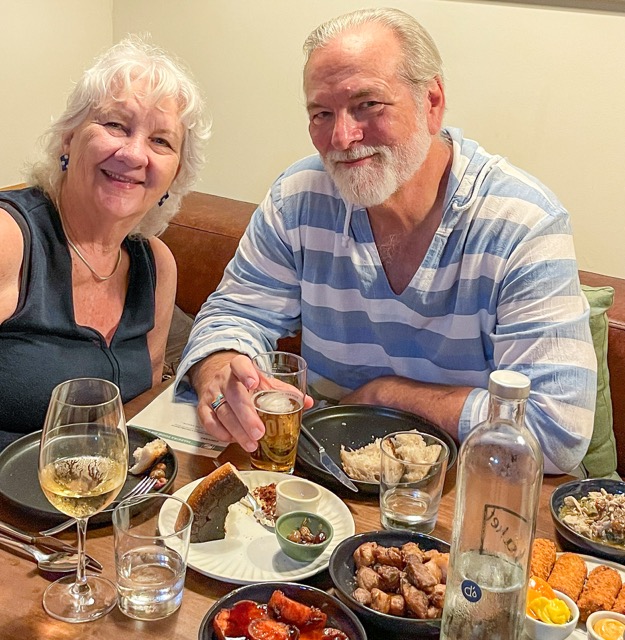
The afternoon was devoted to a food tour that turned into one of the highlights of our trip. It began with a proper lunch:
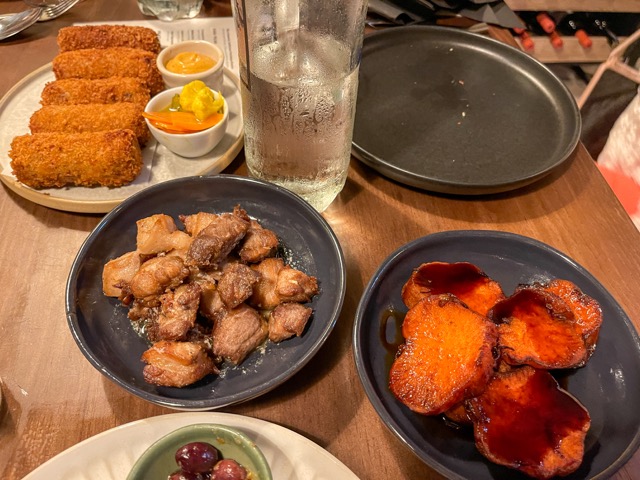
A perfectly crisp croquet stuffed with savory meat.
Carne em Vinha d’Alhos, tender marinated cubes of pork.
Batata-Doce com Mel de Cana, an addictive sweet-potato and molasses combination.
Atum Salpresado, salty cured tuna with all the rich saltiness of the Atlantic.
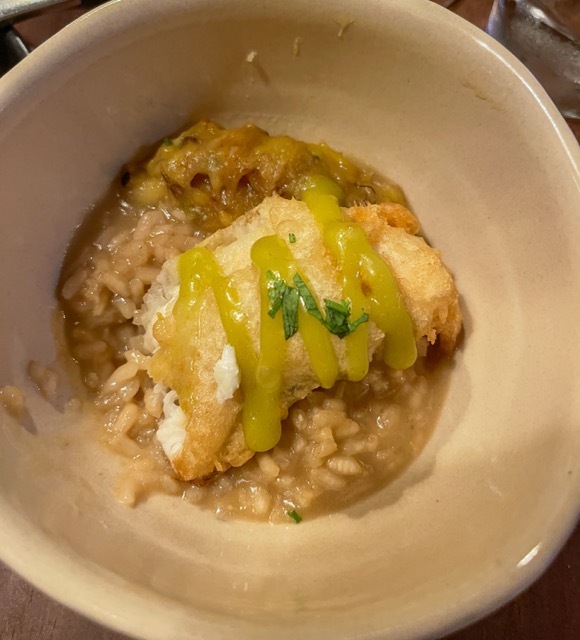
The main course: Arroz de Lima com Espada e Banana — a filet of black scabbard fish over a citrusy rice and topped with a banana concoction. Sounds odd, tastes amazing.
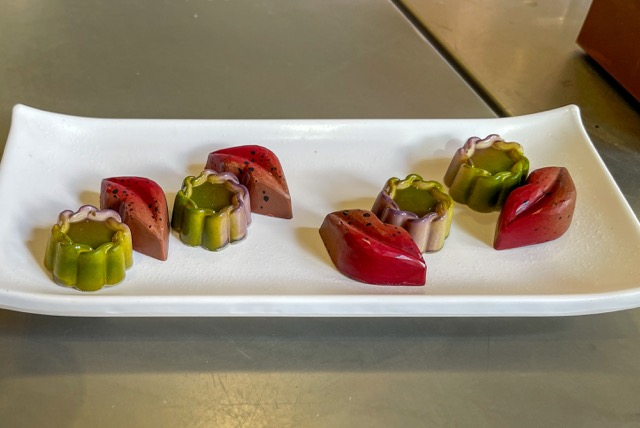
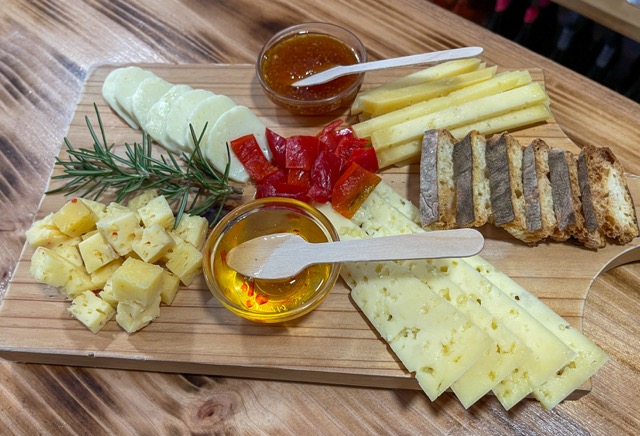
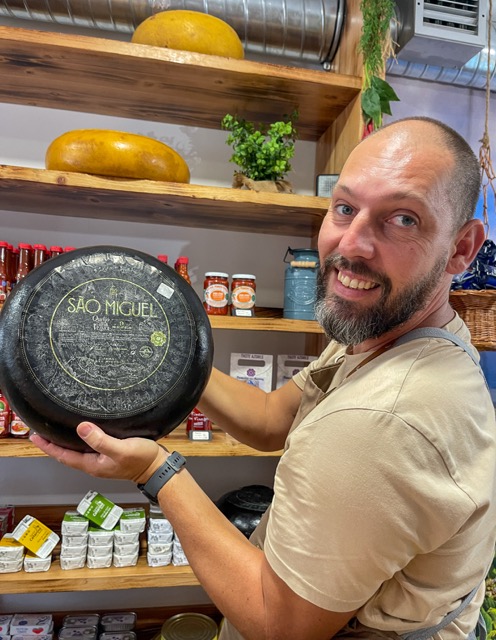
After lunch, we walked (slowly) to our next stop: Uau Cacau, where we sampled artisanal Madeiran chocolates that instantly earned luggage space for the trip home. Then came a tasting of fragrant and colorful tropical fruits and a stop at Fábrica Santo António (a local institution) for traditional Madeiran cookies — crumbly, subtly spiced, old-school good. A cheese and wine tasting at a shop devoted entirely to products from the Azores (note to self: visit the Azores soon!) was our next tasting and that was followed by a final stop for a glass of poncha, the local sugarcane-rum cocktail. By the end of the day, we were equal parts full and blissful — exactly how every food tour should leave you.
The Blandy’s Experience: Stairs and Sips
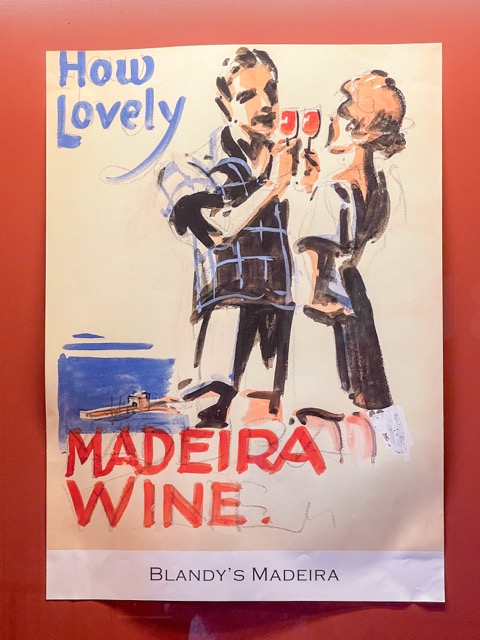
Sticking with the theme of gastronomic self-indulgence, we had booked the Platinum Tour at Blandy’s, the grand dame of Madeira wine for our second day in Funchal. We thought it would be a gentle walk around the winery and a few tastings — you know, the usual. Instead, it was a full-on education (with a cardio bonus).
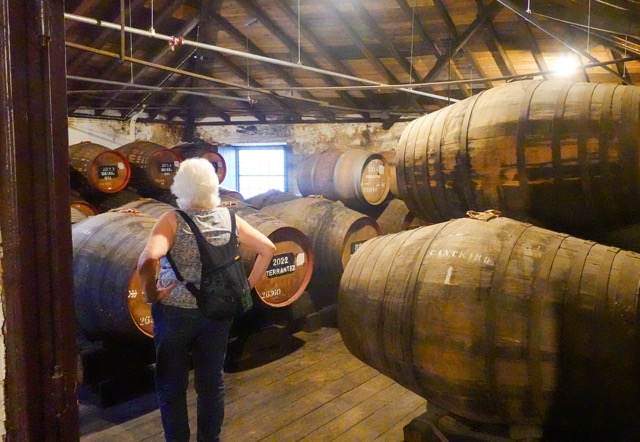
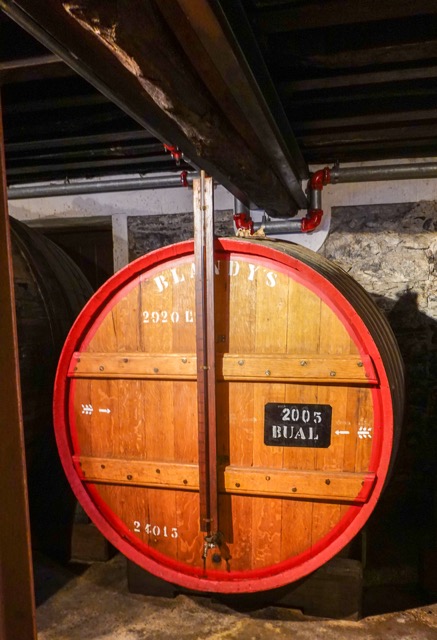
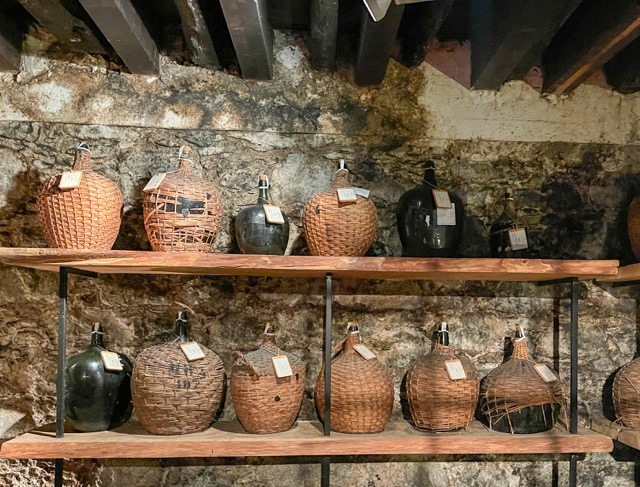
The tour led us up flight after flight of old wooden stairs, each level revealing another layer of Madeira’s winemaking process. Our guide unlocked one after another storage room filled with aging barrels — some decades old, their wood darkened with history and sugar. The air smelled faintly of caramel, oak, and patience.
We quickly realized we’d been underestimating Madeira wine our entire lives. Up to this point, we’d used it for cooking (sorry, Madeira) or occasionally sipped it as a sweet after-dinner treat. But Blandy’s changed that narrative completely.
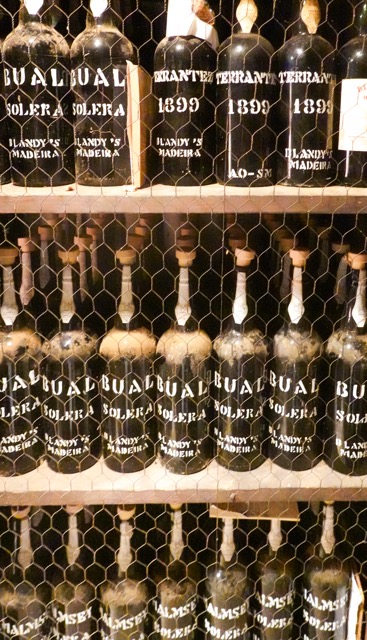
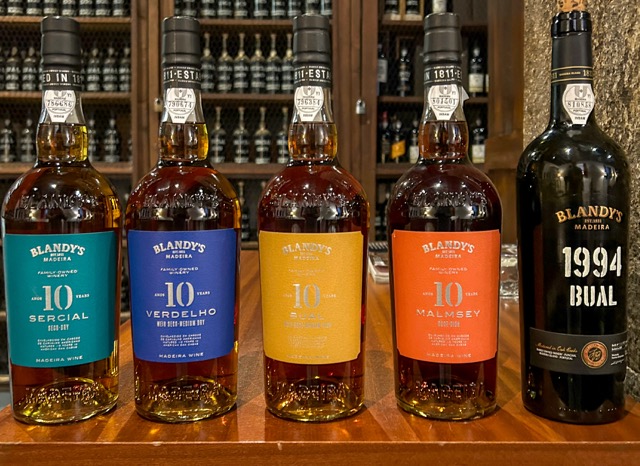
We learned about the different styles of Madeira — from the driest Sercial, served chilled as an aperitif, to the rich Malmsey, that dessert-worthy elixir we already knew. In between are Verdelho and Bual, each with its own unique taste. Who knew there was a whole spectrum of Madeira wines meant to start the evening, not just finish it?
Standing among those timeworn barrels, we could practically taste the island’s story — heat, salt air, and centuries of craftsmanship condensed into amber liquid. By the time we made it back down the stairs (carefully), we had newfound respect for the drink, and a mental note to replace “cooking Madeira” in our pantry with the real thing.
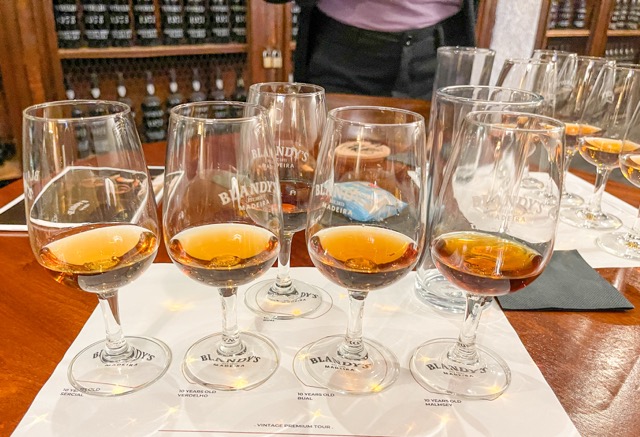
The tasting itself was, naturally, the reward: four glasses lined up from dry to sweet, each one delicious. A fifth glass capped off the experience with one of Blandy’s vintage reserve offerings. We lingered, savoring the shift in flavors — citrus and nut on one end, honey and fig on the other — until we had to leave so the staff could close the place and go home.
The East-Side Trek
One morning, we set off early to explore Madeira’s east side, a day stitched together by villages, forests, and coastal drama. Our full-day trek around Madeira’s east side took us to ridge lines where the cliffs dropped straight in cobalt water, past waterfalls, and through misty laurel forests. It also highlighted for us one of the wonders of Madeira: the road building. Madeira’s volcanic geology means there are almost no flat surfaces anywhere on the island. A mountain ridge runs through the center of the island with peaks above 6,000 feet. In the face of these challenges, Portugal has built a highway and road network that stitches together the whole island. Some roads seem to spend as much time in tunnels as in the open and there does not seem to be a ridge or valley that they have not found a way to bridge one way or another.
We started the day in Machico, the site where the Portuguese first landed in 1419. It’s a mix of beautiful beaches and lush green mountains.
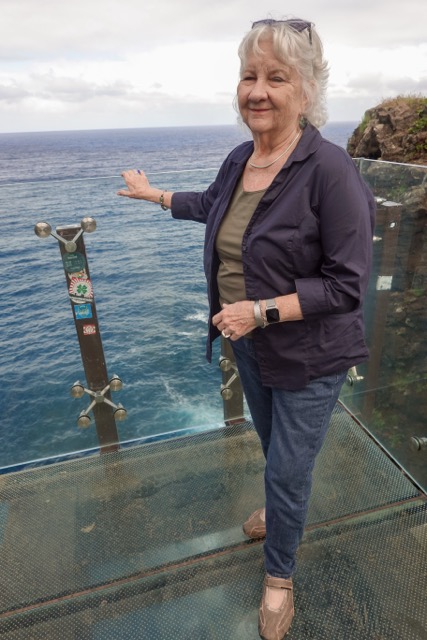
Perched on the island’s north coast, the Faial Glass Walkway offers stunning views of the north coast and the Atlantic Ocean from its two glass walkways that jut dramatically over the ocean.
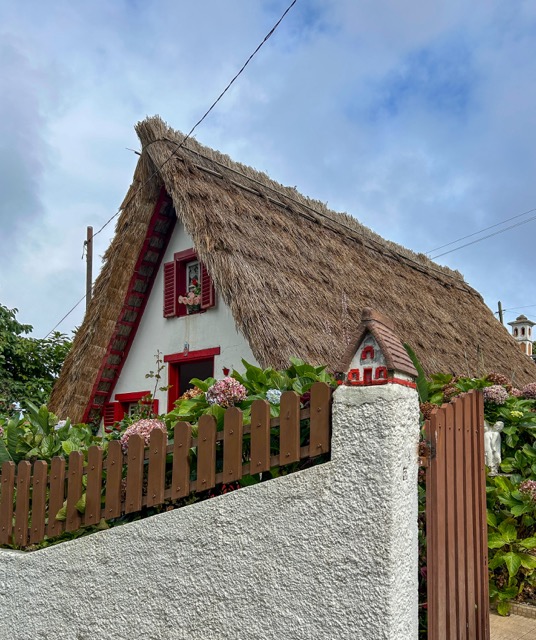
Santana, a postcard village of small, triangular, thatched-roof houses has a quiet and gentle charm with colorful hydrangeas and bougainvillea spilling over stone walls.
In Porta de Cruz we visited a rum distillery where they process the local sugar cane into an award winning Agricole Rum. That designation distinguishes this product as one created directly from the cane syrup unlike more than 90% of the world’s rum which is distilled from molasses. The difference is very distinctive – a smooth, complex, aromatic rum that could become a habit!
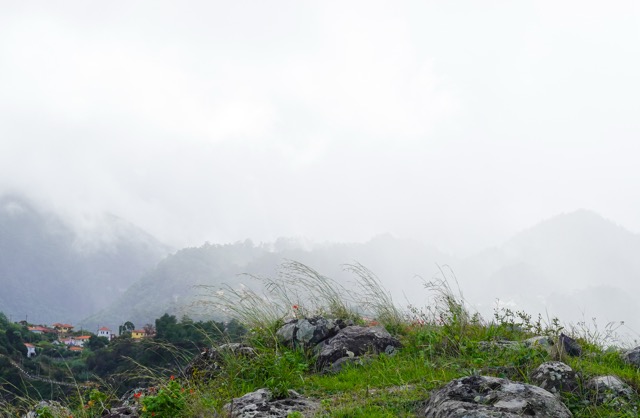
The heart of the Laurissilva forest, a UNESCO World Heritage Site since 1999, has trees that look ancient enough to have seen the first explorers land and the air smells faintly of eucalyptus and rain.
Monte Palace Gardens – Afternoon in the Clouds
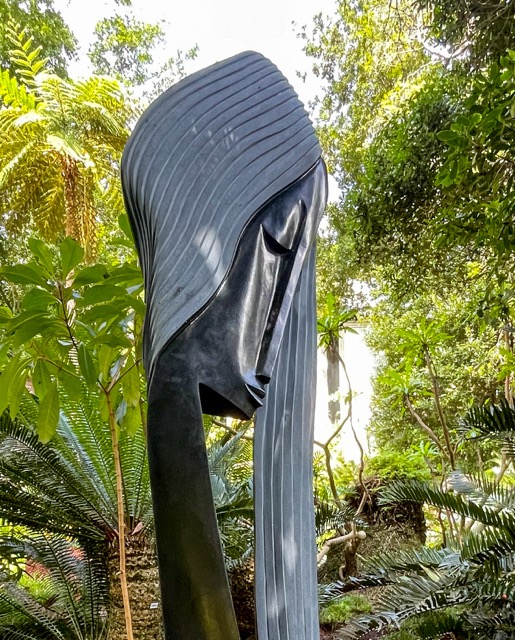
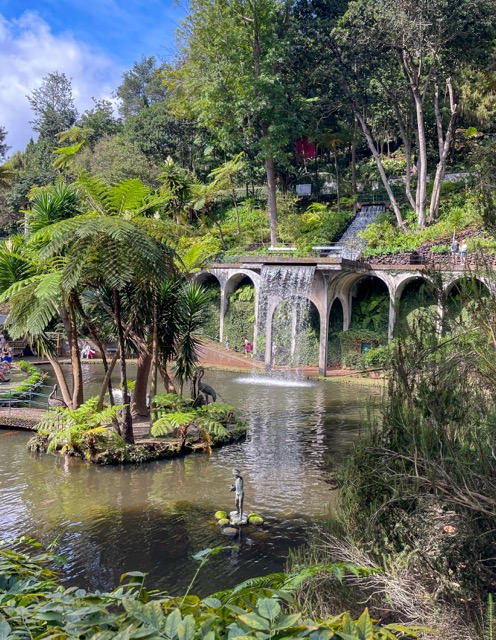
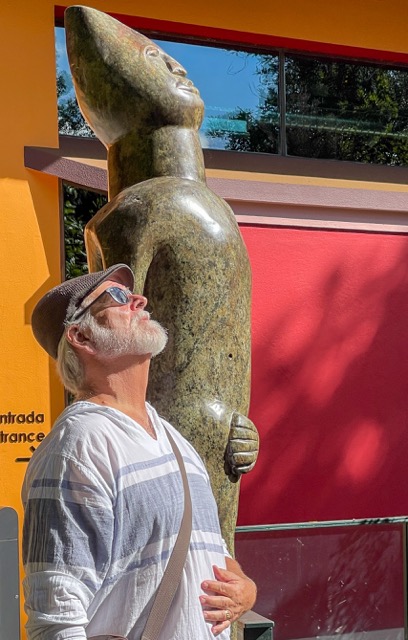
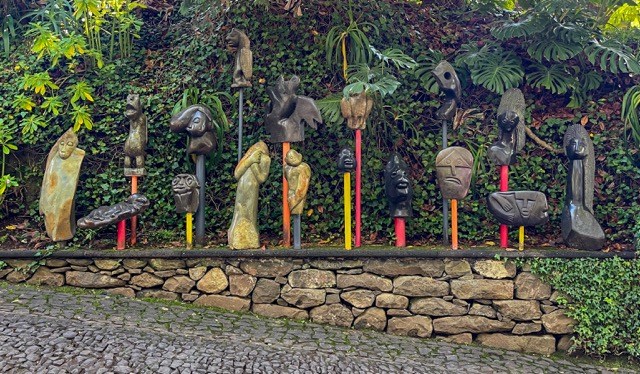
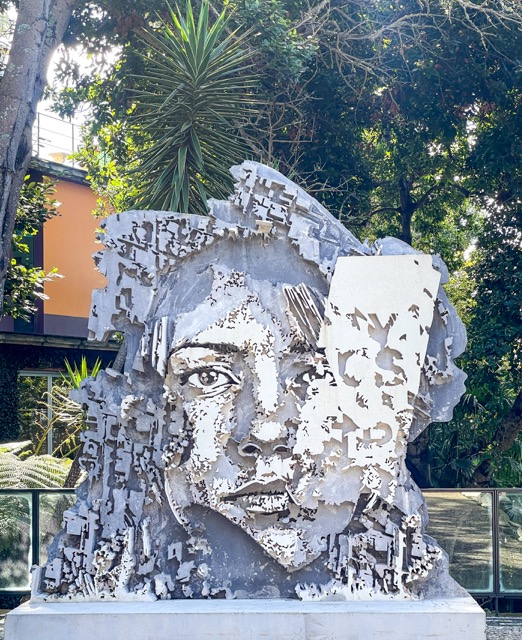
Unfortunately for Ed (but okay by me) the cable gondola was not working for our trip up the hillside the next morning. So, we shared a taxi with a German couple that were heading to the same place. While not high in the air, the on-the-ground approach, turned out to be a windy, twisty, topsy-turvy experience. At the top: the Monte Palace Tropical Garden, a dreamscape of mossy paths, koi ponds, tiled murals, and exotic plants everywhere. The art museum surprised us with contemporary pieces nestled among centuries-old stone. Like all the rest of Funchal, the gardens were created on a hillside with water cascading from all angles and paths that involve steps, switchbacks, bridges and stairways. Everywhere we turned there was art – sculpture, carvings, and ceramic tile panels. The Monte Palace Gardens would be enough to justify a trip to Madeira.
One Last Coffee with the Atlantic
We’d planned to end our trip on the water — a whale-watching excursion to spot the dolphins and pilot and sperm whales that cruise just off Madeira’s coast. But the sea had other ideas: choppy waves, canceled boats, and a brisk Atlantic wind. So, we’ll just have to come back — to finally do that cable-car trek up the mountain, and to set out on calmer seas for a glimpse of those amazing sea creatures. A pretty good excuse, we think, to return to this lovely island that has made our “let’s go back” list. As we looked down from the plane window, the island outlined against the vast blue Atlantic and that infamous runway stretching boldly over the water, we gazed at the green peaks thankful we had been privileged to visit this unique place.
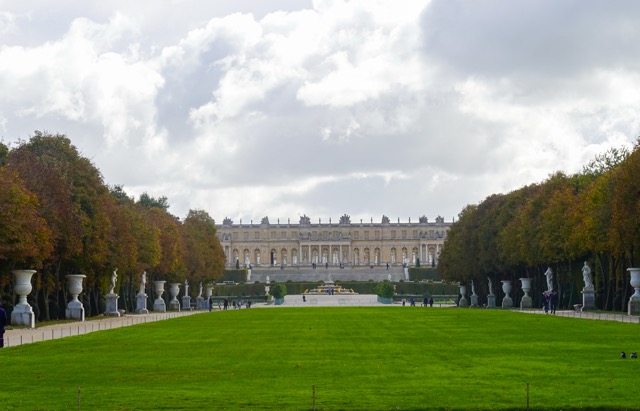
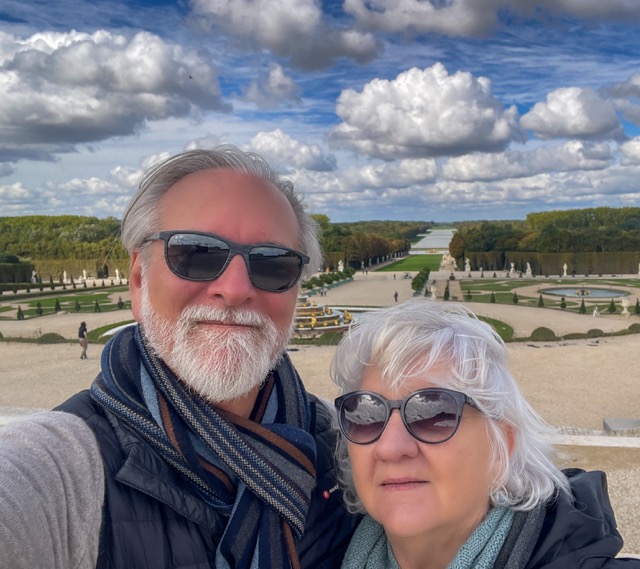
When it comes to conjuring a romantic fantasy, palaces and castles have few peers. And in this category, the Palace at Versailles leads the way in legend, myth, and sheer audacity. It seemed like an ideal destination to celebrate our 52nd anniversary, steeped in history, grandeur and beauty, and a place that we had not yet detoured out of Paris to visit.
Getting There
Paris’s Charles de Gaulle (CDG) airport is always a challenge. Many of our friends claim it is the “worst airport in Europe.” Always busy, it’s huge with a complex and confusing layout. We had our own experience with CDG last year. With an hour-and-a-half to make a connecting flight, we were required to take two bus rides, walk nearly a mile, travel up and down seven escalators, and wade through a huge queue to clear security where every employee seemed to be on their first day working in an airport, finally reaching our gate as they were preparing to close the doors. Whew. That’s CDG.
Knowing what we had to look forward to, we splurged and booked a car and driver to take us to Versailles directly from the airport. You know, it’s our anniversary. Let’s take the stress out of this. But, when we deplaned and made our way to the designated meeting spot, the driver was nowhere to be found. Text messages, phone calls, apologies, he finally showed up nearly an hour late, apologized profusely, and finally, we were off for another anniversary adventure. C’est la vie!
It’s a Town, also
Versailles is the name of a palace, of course, but it is also a lovely city. Out for a walk on our first morning, we discovered an elegant and quietly proud city with tree-lined boulevards, and cafe-lined streets that hum with a slower rhythm than Paris while exhibiting a similar charm. And of course, les pâtisseries!
The most famous name many associate with Versailles may be Marie Antoinette – the queen who lost her head to the guillotine during the French Revolution after famously recommending that the desperate Parisian population eat cake if they could not find bread. But how did we come to that moment? And what role did the palace play?
The Back Story
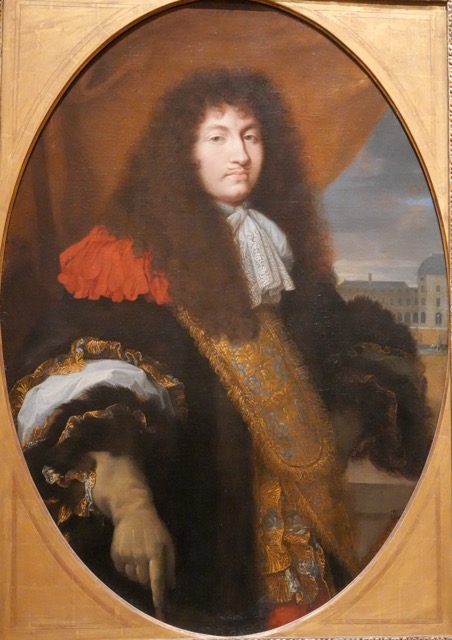
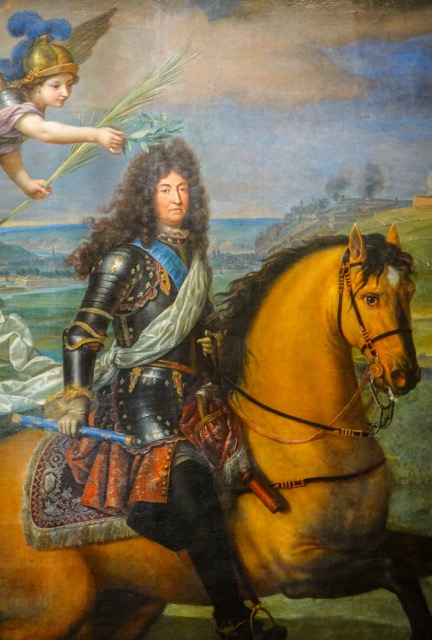
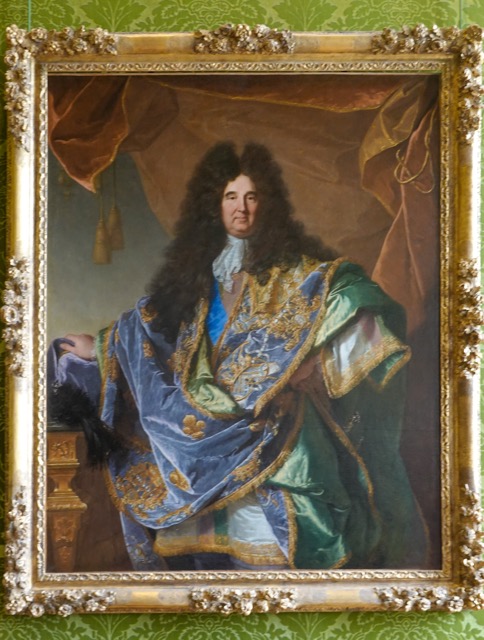
Versailles began as a rich guy’s hunting lodge. The rich guy in question, Louis the XIII, was succeeded by his son, good ol’ number XIV, who imagined an expanded role for Versailles beyond chasing deer through the woods. He thought it would be a great idea to move the seat of his government from Paris – where he was in a continuous power struggle with the nobility and the church – to Versailles where he would hold all the cards. It was a strategic power move that isolated the nobles in an opulent world of ceremony, dependence, and control far from their bases of influence. So, he built a palace. It worked brilliantly (until it didn’t) and XIV declared himself the “Sun King” (this being an age in which most people had figured out that everything did not rotate about the earth). Louis XIV held the throne for 72 years – 1643 to 1715 – as an absolute monarch, building Versailles as a testament to his unparalleled power and glory.
The Sun King – Louis XIV
The dude ruled for so long that he outlived both his sons and grandsons. His great-grandson, Louis XV then ruled for another 59 years, also outliving his offspring, just like his great grandad. So, XV worked out a deal with the Empress of Austria to send her 14-year-old daughter to marry his pubescent grandson hoping to keep the string alive. The child bride was Marie Antoinette. It did not end well. By the time the grandson, Louis XVI took over (1774), the profligacy of XIV and XV had taken a toll and France had become a house of cards. Louis XVI’s decision to go all in on the side of the American colonies in their war of independence was the final straw, financially. With no economic reserves, it only took one bad winter to push the country into famine and light the fire of rebellion against the crown. In the midst of this, his wife, Marie Antoinette, became a lightning rod for public resentment. Rumors of her extravagant lifestyle helped to turn the Palace of Versailles from a symbol of royal power into one of royal decadence. In 1789, as revolution erupted, the royal family was forced to abandon Versailles and return to Paris under armed guard. Of course, the monarchy collapsed, and Louis and Marie were both executed by guillotine in 1793.
Day One: A Walk in the Gardens
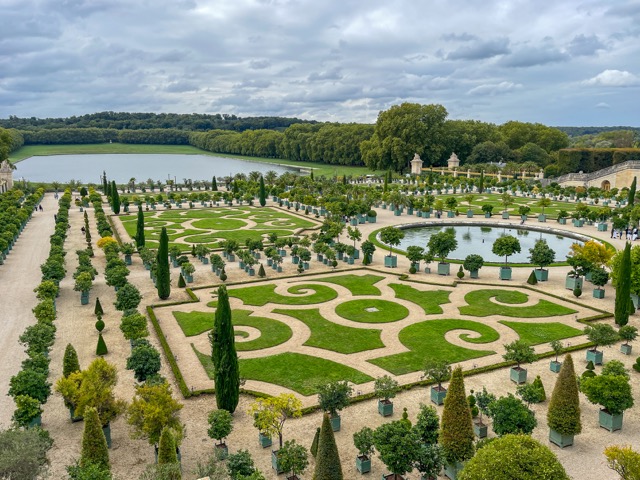
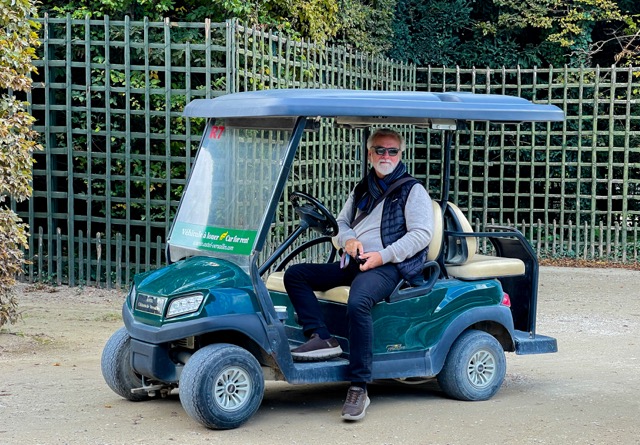
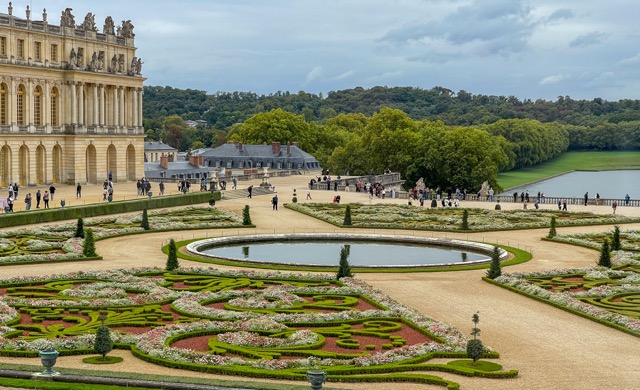
We spent our first day in Versailles wandering through the gardens at our own pace – no plan, no guide, just curiosity and good walking shoes . . . and, well a golf cart. Highly recommend the golf cart. We’re talking about a park that covers 2,000 acres. To give you a comparison, that is 2 ½ times the size of Central Park in New York!
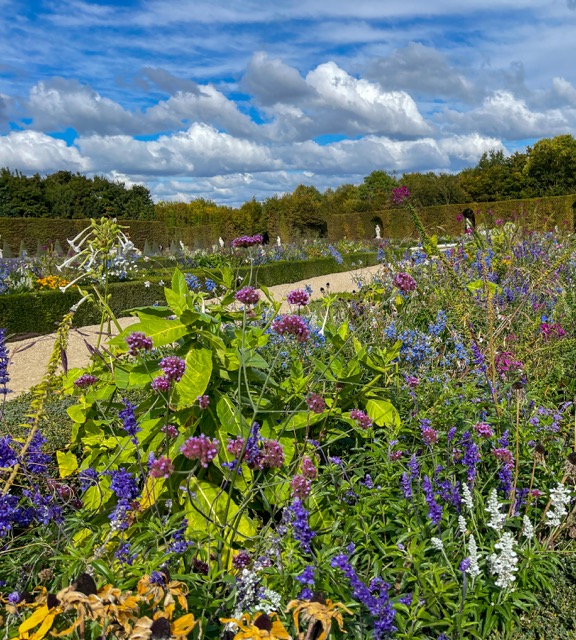
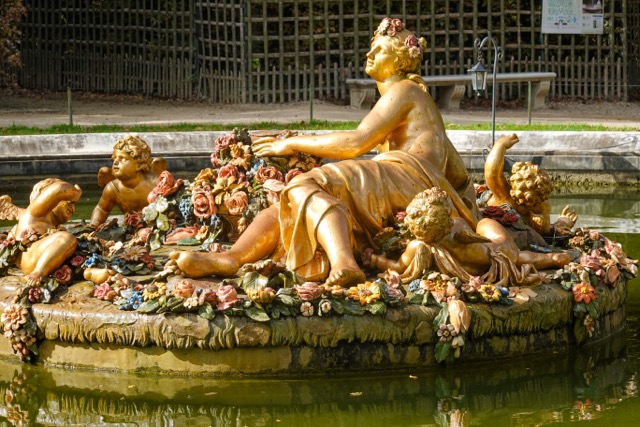
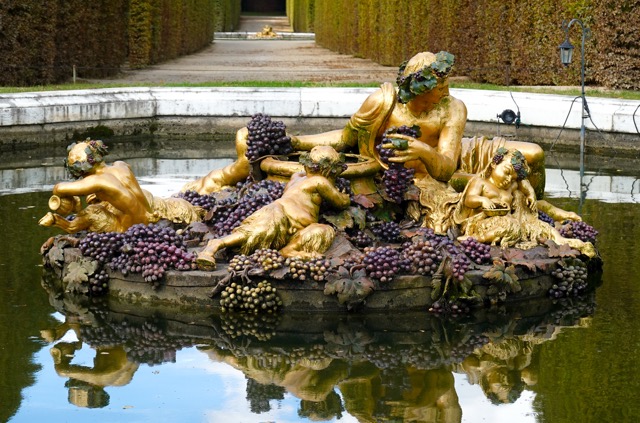
Once you step into the gardens, the scale of it takes your breath away. Gravel paths and sculpted hedges stretch toward the horizon. Wide lawns, precisely manicured shrubs, and fountains appear in perfect symmetry creating a sense of order and calm. We stumbled upon fountains, pools, secret groves, and paused often to just sit and soak in the beauty. Versailles rewards wandering. Every turn offers something new to see – sometimes grand, sometimes intimate. It’s a maze with no wrong turns.
Divine Symbolism
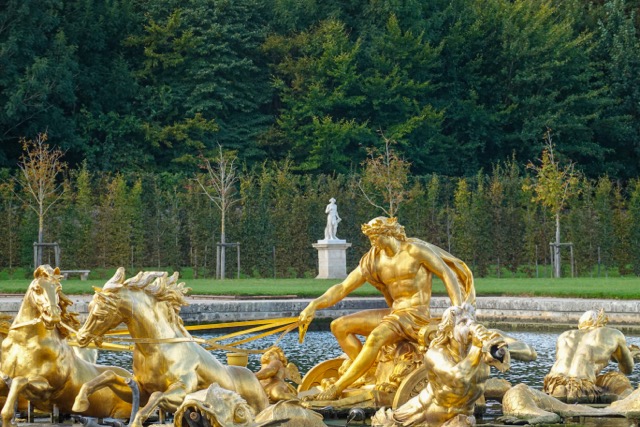
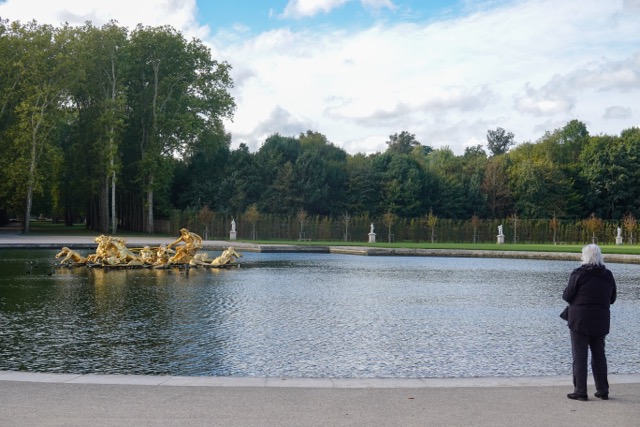
Perhaps the most iconic and central feature in the garden is the Apollo fountain. Located at the very heart of the garden’s layout, it features a dramatic sculpture of the Greek god Apollo rising from the water in a chariot drawn by four horses surrounded by tritons and sea monsters. As it surges from the water, a powerful illusion of movement and energy is created. Here is the sun god – Louis XIV’s avatar – rising from the sea to light up the world for another day. Spectacular!
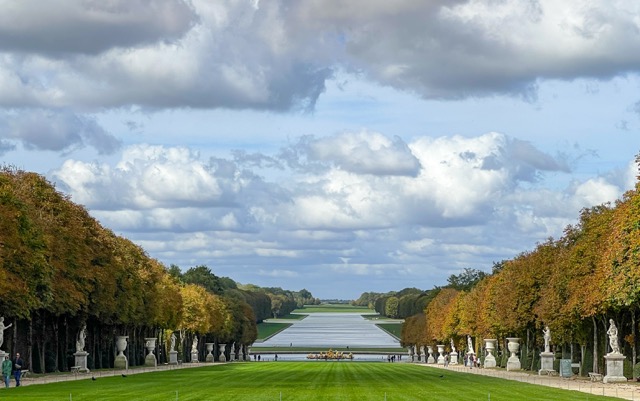
Extending westward from the Apollo fountain, the Grand Canal appears to go on into infinity. With its clean, geometric lines, the canal contrasts with the natural world around it and provides an example of how man – specifically Louis XIV – imposes order on nature. Shimmering in the sun and reflecting the sky above, it reinforces the notion of endless royal power and control.
Day Two: Inside – All is Golden
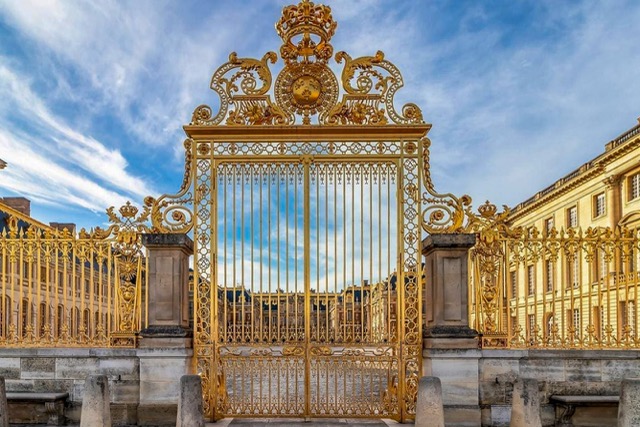
The next morning, we met our guide for the day, Becky, an American from Atlanta, Georgia, who has been living and working in Paris for 34 years. After walking through the majestic and imposing golden gates, our day began at a lovely restaurant located in the forecourt. Over a delicious breakfast, Becky shared her story and set the scene for the day ahead of us.
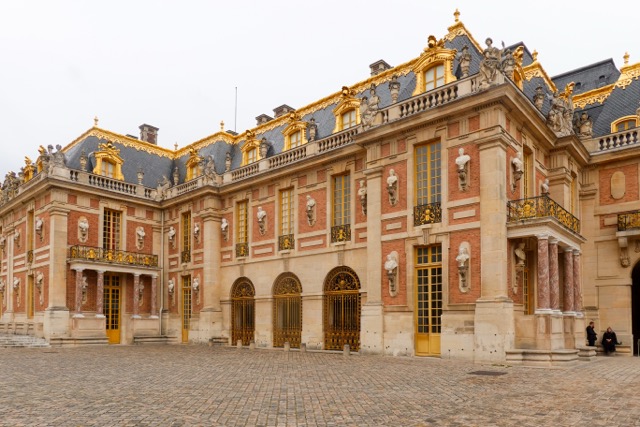
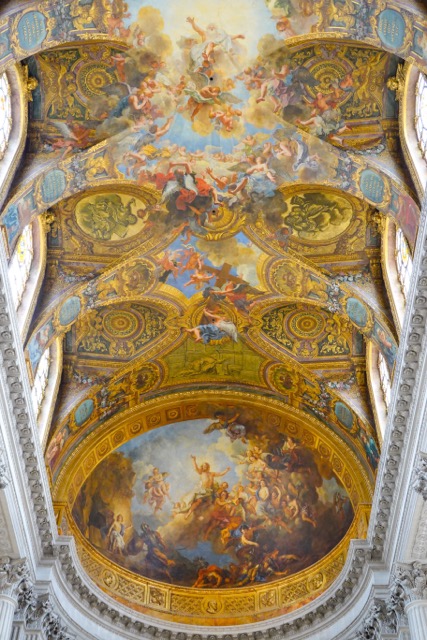
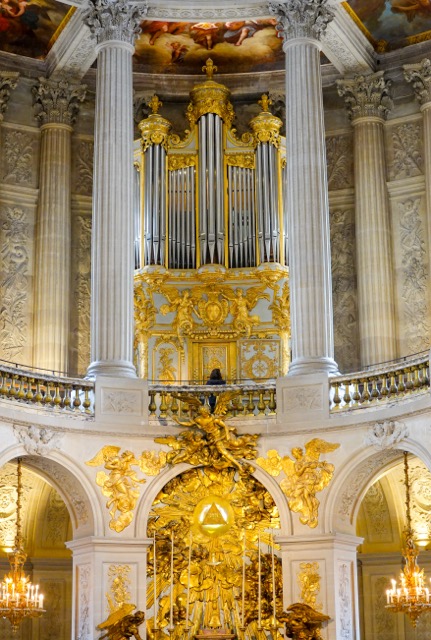
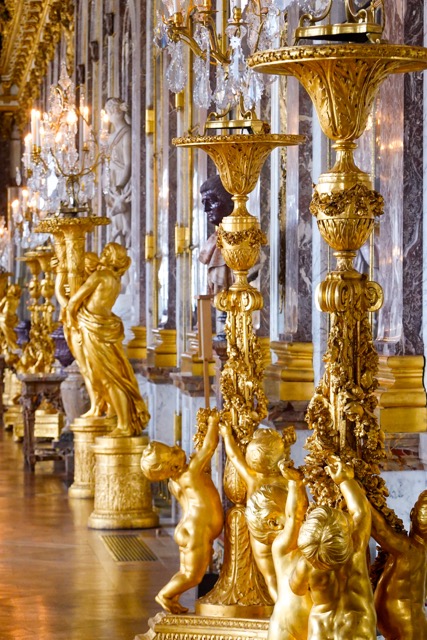
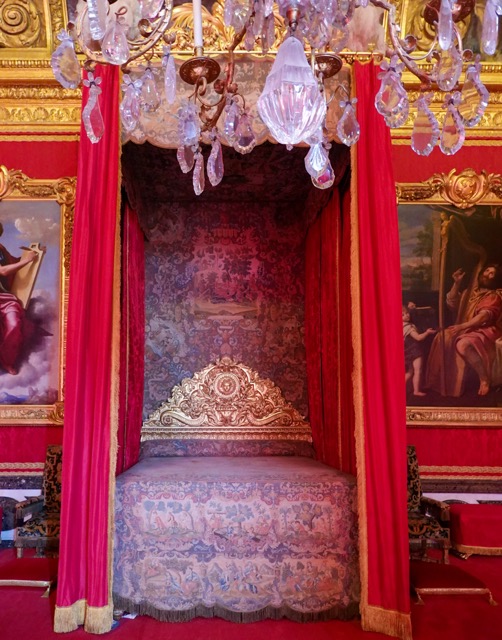
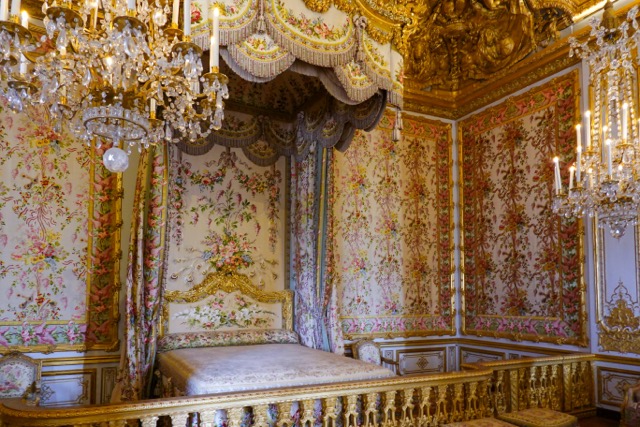
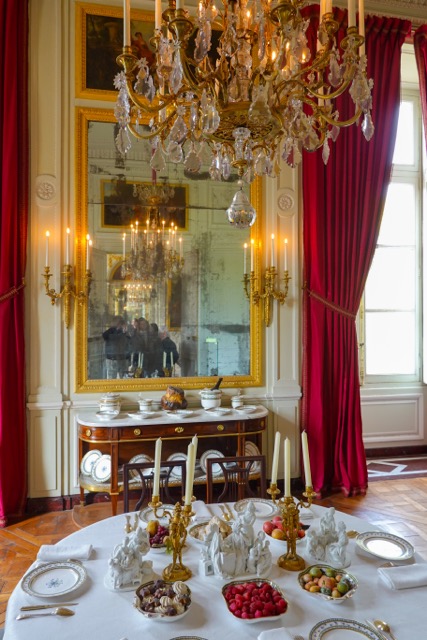
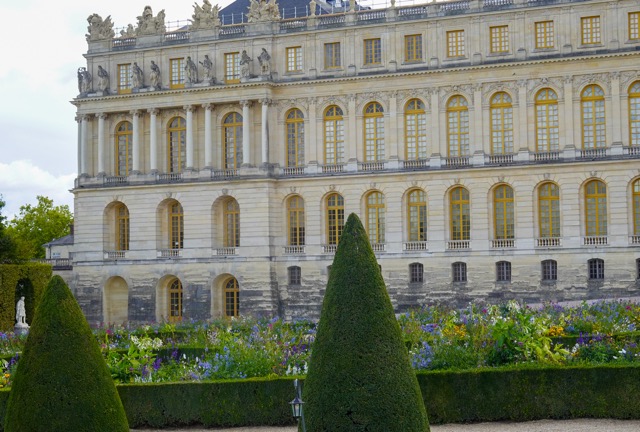
Inside the palace, the grandeur was instantly overwhelming. Gilded ceilings, endless marble, chandeliers – subtlety is not what Versailles is about. The opulence is stunning and tells a story of wealth and power. A masterpiece of Baroque architecture, every room is designed to impress, intimidate, and demonstrate the absolute power of the French monarchy, especially under Lous XIV, the Sun King.
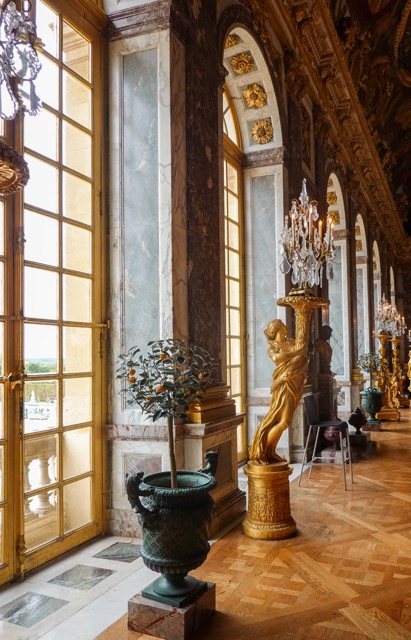
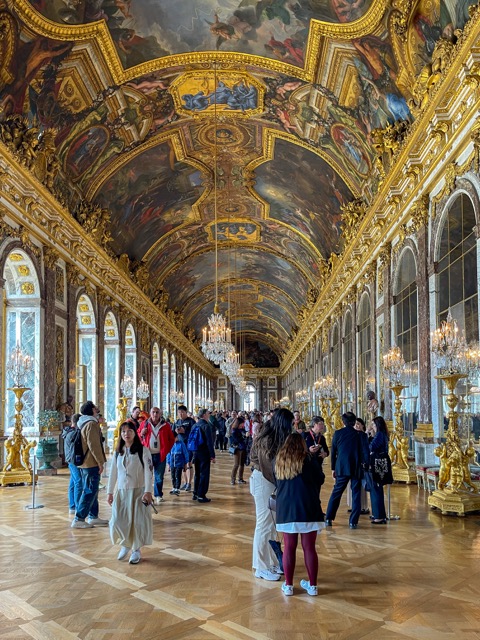
Stepping into the hall of mirrors, 357 mirrors the reflect the light pouring through the grand windows on the opposite side of the hall. Dozens of chandleries add sparkle to the already dazzling space.
Every wall, ceiling, and hallway is filled with huge oil paintings, marble busts, gilded moldings, and fine tapestries. Even the floors are intricately designed inlaid wood or polished marble.
A Close Encounter
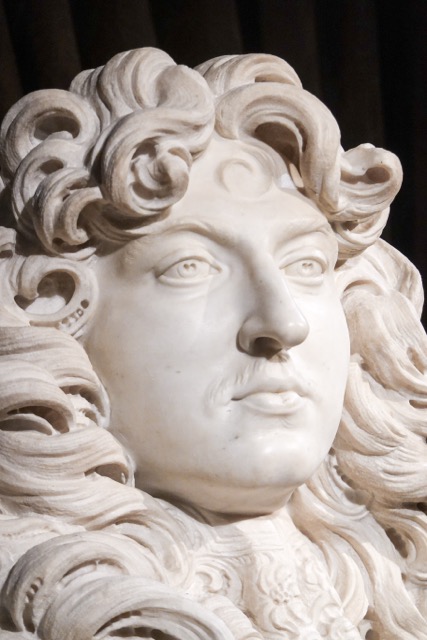
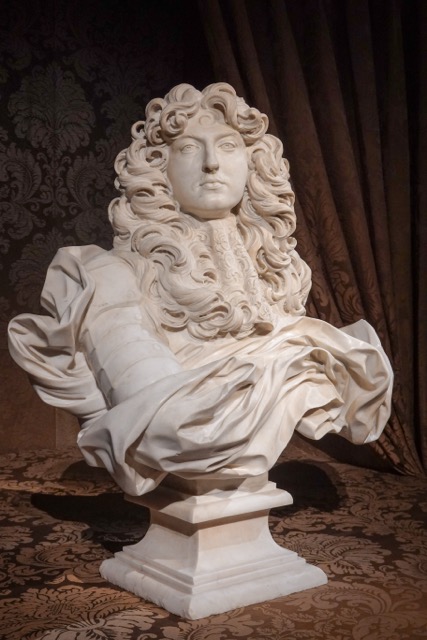
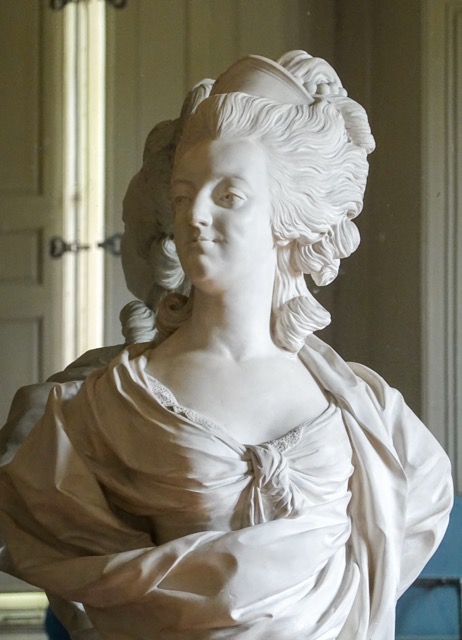
We were fortunate to have timed our visit to coincide with a special exhibit of a famous Louis XIV bust sculpted by Bernini. It is considered one of the great masterpieces of the era and usually displayed on a protected pedestal high above the public’s access. Because of some restoration work, the bust was relocated temporarily to a location allowing full access. Standing before this regal countenance you truly get a sense of the power embodied in this man. Bernini himself believed it was one of his finest works.
The Petite Trianon and the Queen’s Hamlet
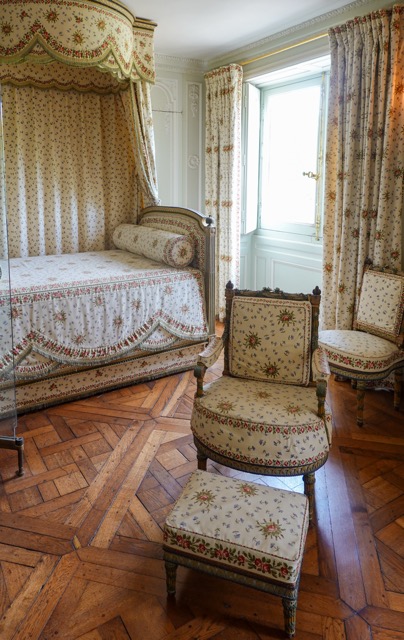
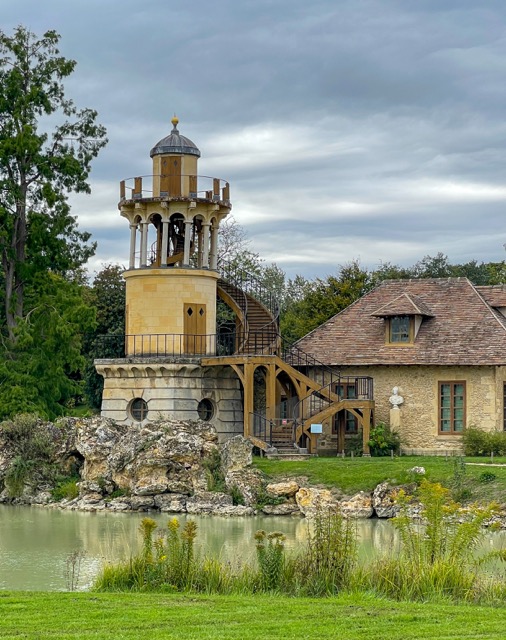
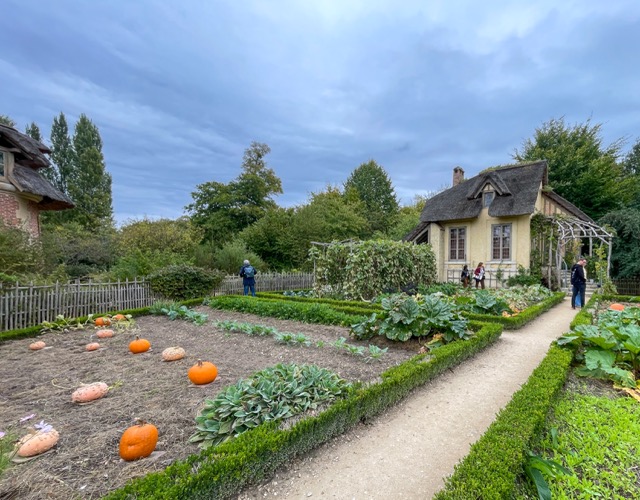
In the afternoon, we made our way deeper into the estate to the Petite Trianon and Marie Antoinette’s hamlet – her private escape from the rituals of palace life. The difference was stark. Where the main palace is all spectacle, this part of Versailles is quiet, romantic, and deeply personal.
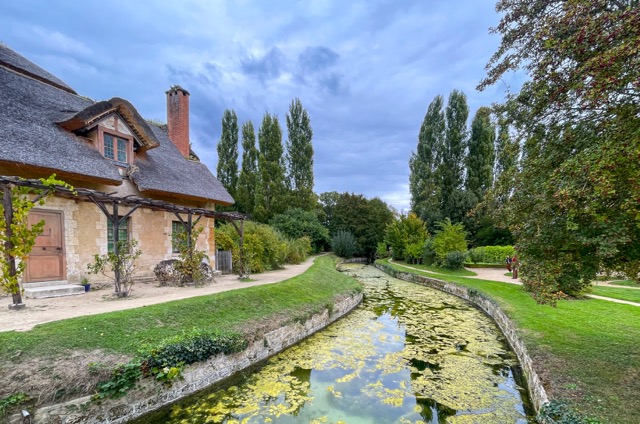
The hamlet is pure storybook – little thatched-roof cottages, vegetables gardens, wooden bridges, lily-covered ponds. It is impossible not to slow down here. We wandered gently, watching and listening to the wind play with the trees. At one point, we sat on a bridge and enjoyed the scent of early autumn in the air.
Madame Deficit
Becky spoke about Marie Antoinette with a kind of quiet reverence – not to excuse, but to understand. Her admiration of this famous queen sparked an interest in us to know more. After our visit, we have been expanding our knowledge of pre-revolutionary France – learning more about the monarchy, the politics, and the real people behind all the gold leaf and powdered wigs.
Inspired and Misguided
While gold leaf covered the palace walls, the countryside struggled with famine and poverty. These are facts. However, as is so often the case when great struggles for power and wealth take place, the facts can be twisted and weaponized. The radical reformists used every rumor and mystery to slander the royals and foment rebellion. For example, historians have now concluded that Marie never said anything like that famous quote about cake. It was made up by a paid witness at her trial. No, fake news was not evented in the 21st century. Nonetheless, the palace became a symbol of everything that was wrong with the monarchy and by the time of Louis XVI and Marie Antoinette, it was a gilded prison. They were surrounded by luxury but detached from the people who would eventually rise up and bring their world to a violent end. Versailles is a place of both beauty and tragedy, and this tension makes it an unforgettable place to visit.
Coda
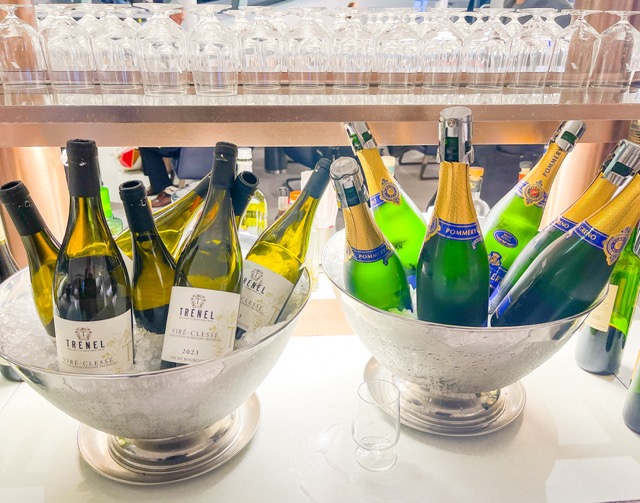
We were not looking forward to another journey through Charles De Gaul including a 5-hour layover to get back to Valencia. We boarded the train to the airport grumbling about what awaited us. We were pleasantly surprised to find ourselves disembarking into a spacious, sparkling new train station in the heart of Terminal 2. A short walk later we had cleared a practically deserted security entrance. Air France is a Delta partner, so we decided to see if access to the Air France lounge might be possible. A wave of our boarding passes seemed to satisfy the lounge gods, and we were in. Wow. What a beautiful way to spend a layover. We suddenly felt a bit like, well, Nobles entering a palace. Great food, champagne on ice, wine and spirits, complimentary spa treatments, showers, private nap rooms. The layover hours flew by. We might need to reassess that “worst airport in Europe” label.
After an idyllic week of sun, sea, and Greek salads on the island of Kefalonia, we exchanged the relaxed warmth of sandy beaches for bustling city streets as we flew north to meet friends in Kraków, Poland. Our good friends from Sacramento, Debby and John, were planning to spend a few days in Kraków after finishing up a Budapest to Prague river cruise. And our Valencia friends, Mary and John, were also going to be in Kraków the same week. Admittedly, Kefalonia to Kraków is an unusual itinerary, but when it comes to spending time with good friends, we’re always ready for an adventure.
A Brief Slovakian Stop
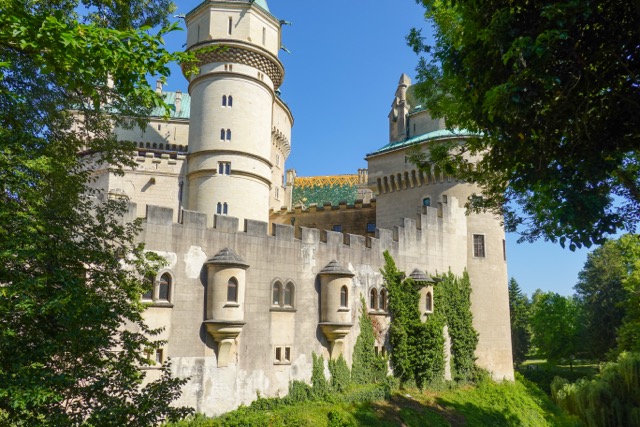
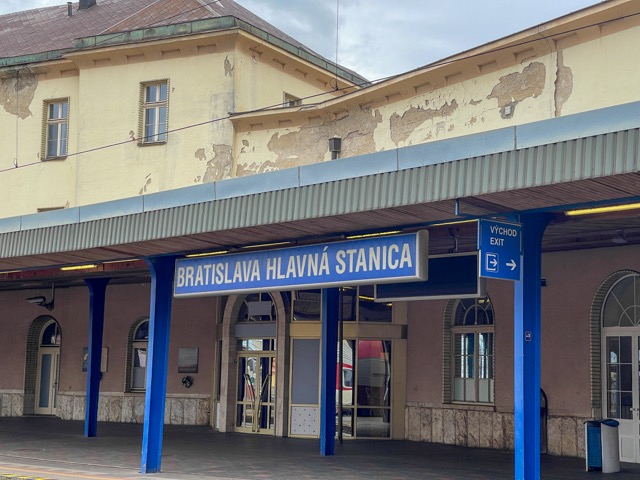
The first leg of our journey began with a two-hour flight from Kefalonia to Vienna. Tempting as it was to stay a few days in the Austrian capital, our curiosity got the better of us and we hopped on a bus to cross the border into Slovakia. We had just one full day to spend in Slovakia and made the mistake of booking a “five castle tour” in the countryside outside of Bratislava, Slovakia’s capital city. While Slovakia boasts more castles per capita than anywhere in the world, we were disappointed with the tour (beginning with the fact that our guide had laryngitis). Nevertheless, Bratislava has captured our interest, and we’ve added it to our “we need to go back there” list. We’re thinking two weeks split between the urban delights of Vienna and Bratislava as well as some down time in the villages and towns of the beautiful Carpathian Mountains, along with a bit of cruising on the Danube. Maybe three weeks!
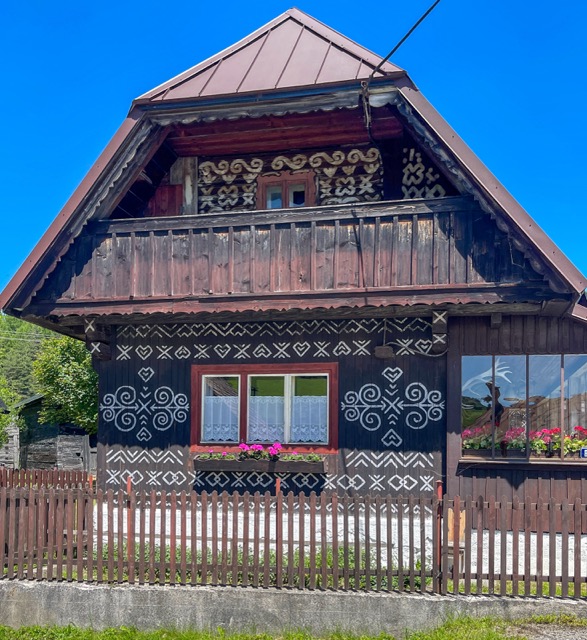
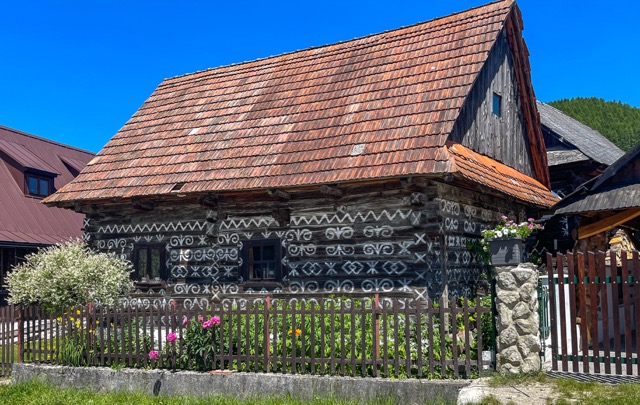
The tiny village of Čičmany (population 204) looks just like it did hundreds of years ago. The village is full of timber houses decorated with intricate patterns in white lime paint.
One of Travel’s Greatest Gifts
After two nights in Bratislava, we boarded a six-hour train bound for Kraków which turned out to be a highlight of the trip. We struck up a conversation with Matthew, an American who has called Poland home for the past three decades. A luthier by trade, Matthew shared stories of his four-year apprenticeship with an Italian master in Rome and his decision to specialize in crafting instruments for Medieval, Renaissance, and Baroque music (https://www.earlymusicinstruments.com/main). The hours flew by as we chatted—a perfect reminder of one of travel’s greatest gifts: the people you meet along the way.
The Square at the Heart of Krakow
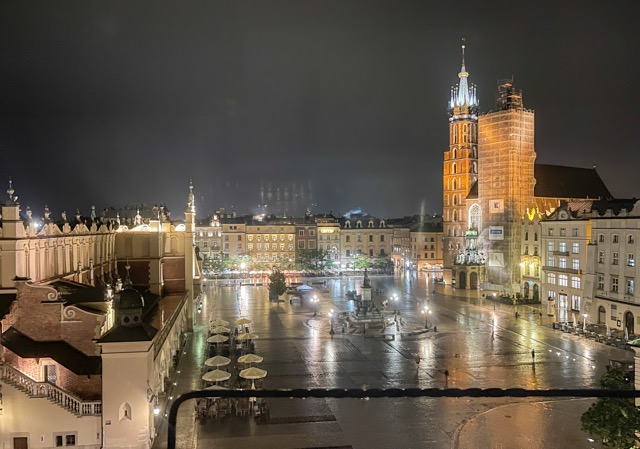
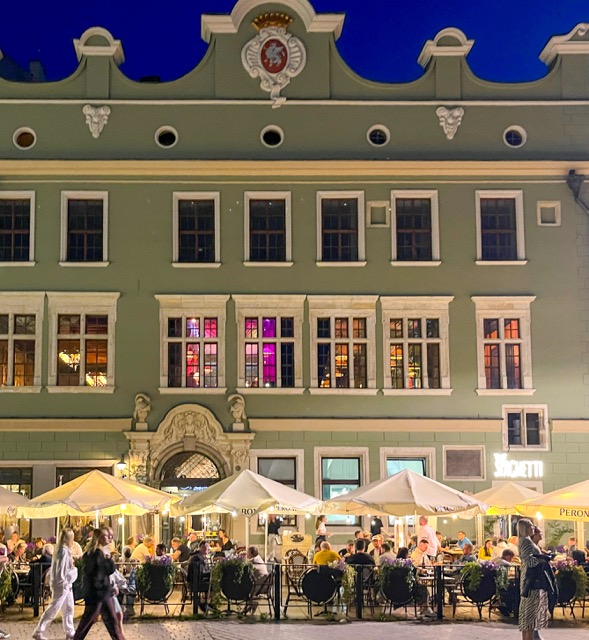
Dating back to the 13th century, Rynek Glówny, the main square at the center of Kraków’s old town, is the largest medieval square in Europe. Laid out in 1257, the square was designed to be the hub of the city, and it serves this same purpose today. Filled with medieval era buildings, horse-drawn carriages, a 14th century brick gothic church, and more sidewalk cafés than one can count, its vibrancy feels timeless.
One half of Kraków’s Main Squareafter after a light evening rain.
A Medieval Masterpiece
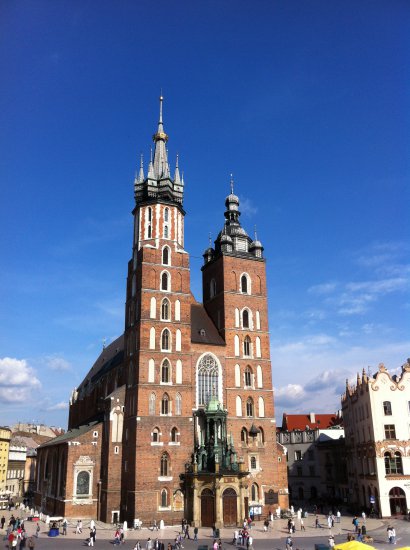
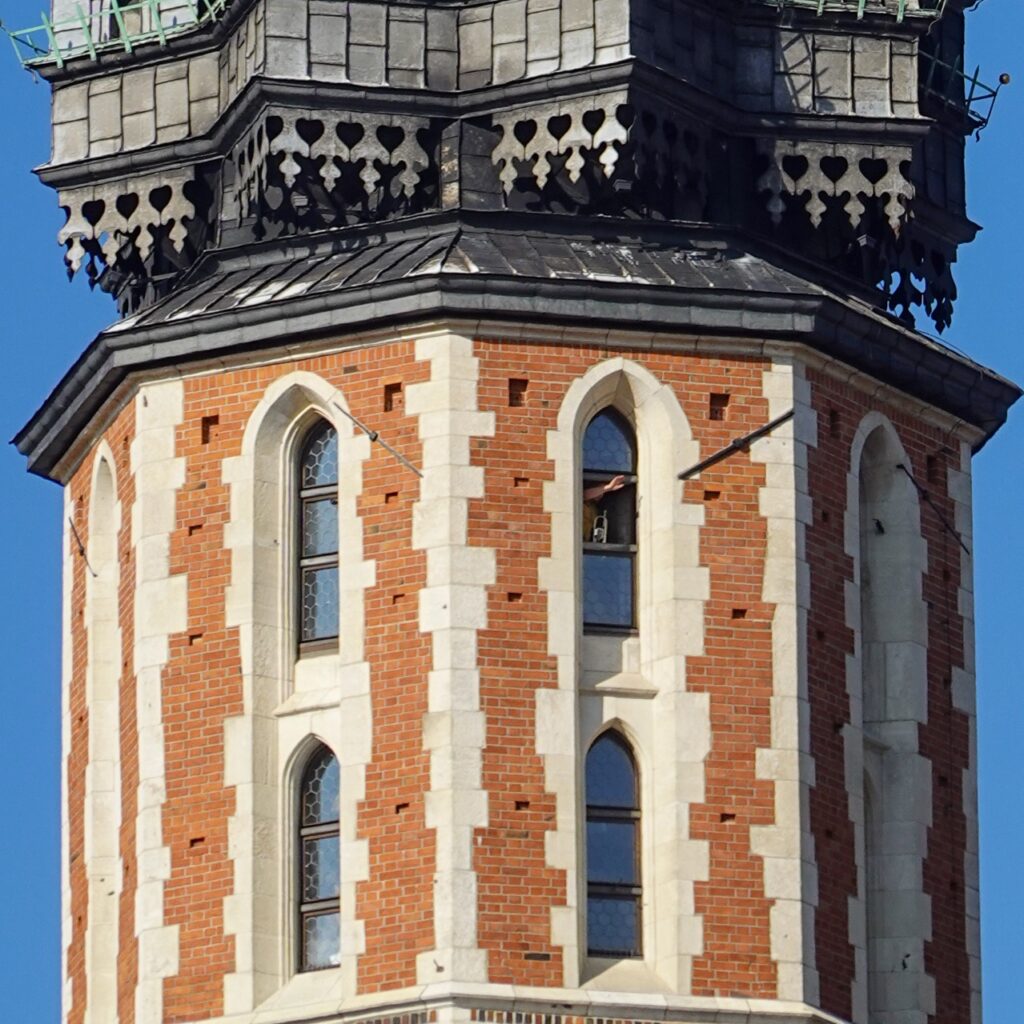
St. Mary’s Basilica, a masterpiece of medieval architecture, dominates the square and the surrounding skyline. The asymmetry of the two towers catches your eye. The taller one, at 80 meters, is almost double the height of the shorter one and the explanation for this goes back to the Middle Ages.
Under the reign of Duke Boleslaus the Modest (Bolesław Wstydliwy, 1243-1279) a decision was made to add two towers to the body of the church standing by the Main Market Square. Soon two brothers embarked on the task. When the younger realised that his tower was much shorter, he murdered his brother out of envy, and the construction stopped. However, the murderer was wracked with remorse: on the day when the church was to be consecrated, he pierced his heart with the same knife he used to kill his brother, and dropped dead from the top of his tower to the ground below.
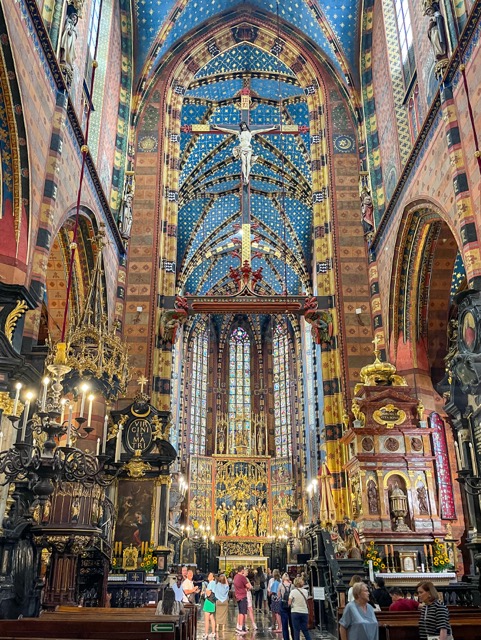
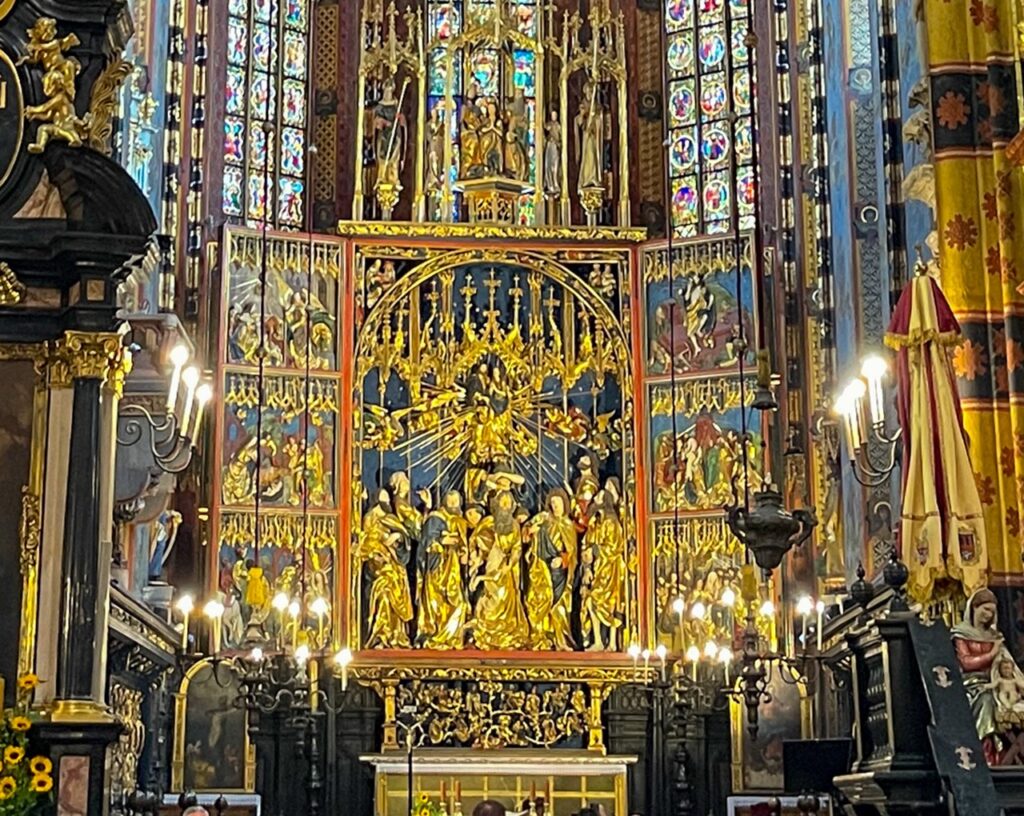
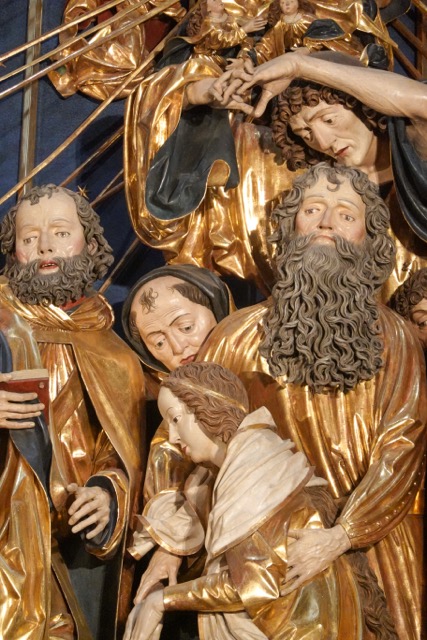
Gory legend aside, the interior of St. Mary’s Basilica, a striking example of Polish-Gothic architecture, is filled with beautiful stained-glass windows and intricate carvings. The altarpiece is one of the great masterpieces of European wood sculpture. It spans the entire length of the church’s altar and took the German artist Veit Stoss 12 years to complete in the late 15th century. The intricately carved panels, gilded in gold leaf, depict scenes from the life of the Virgin Mary. Medieval art typically displays flat, static figures but Stoss’s carvings provide a sense of movement and life that was revolutionary for its time. It is believed that the artist used local Krakow citizens as models for the piece which contributed to the rich, detailed facial expressions that communicate a depth of emotion not generally seen in his era.
Bugle Time
Every hour, on the hour, a bugle player appears at the top of the taller of St. Mary’s Basilica towers and plays the Hejnał – a beautiful, haunting sound that echoes across the square. The tune is played four times, once in each direction, so that every corner of the city can hear it. Of course, there’s a great story behind this unusual tradition.
In the 14th century, during a Mongol invasion of Poland, a trumpeter was stationed in the tower of St. Mary’s Basilica to watch for any approaching enemies. When the Mongols began appearing at the walls of the city, the trumpeter began sounding the alarm to the four corners of Kraków. The attackers, recognizing the bugler was warning the city, began firing arrows at the tower. One found its mark piercing the bugler’s throat and cutting off the tune mid-note. In honor of his bravery and sacrifice, the Hejnał is played every hour, but the music stops mid-note, just as the trumpeter was silenced. This unfinished tune serves as a solemn reminder of that moment in history. It was moving every time we heard it and particularly poignant at the moment it stops. The music, sounding a bit like taps, is simple yet it seems to fill the city with pride.
After playing the Hejnał the bugle player waves from a window in the tower of St. Mary’s Basilica.
A Neighborhood with a Long Memory
Tucked just south of Kraków’s Old Town lies Kazimierz, the historic Jewish Quarter – a neighborhood that echoes with history and hums with creativity. While the Main Square is Kraków’s heartbeat, Kazimierz seems to be its soul. It feels lived-in and deeply human. Founded in the 14th century as a separate town, Kazimierz became home to Kraków’s thriving Jewish community for hundreds of years. By the 16th century, it was one of the most important centers of Jewish life in Europe and it flourished with synagogues, schools, kosher bakeries, and bustling marketplaces.
That vibrant life came to a devastating halt during World War II. Under Nazi occupation, the Jewish population was forcibly relocated to the nearby Podgórze ghetto, and much of Kazimierz was emptied and left to decay. But in recent decades, the neighborhood has undergone a quiet revival that honors its history while breathing new life into its streets.
A neighborhood that’s seen it all and is still standing, there’s both a grittiness and a warmth to be felt here. Crumbling tenement buildings sit next to hipster cafés. Both modern jazz and Klezmer music can be heard in the plazas and outside the sidewalk cafes. Menorahs and Hebrew signs are etched into old walls and street art covers the alleyways. There are seven historic synagogues in Kazimierz, including the Old Synagogue, dating back to the 15th century. Moss-covered gravestones lean gently in every direction in the old Jewish cemeteries.
Across the River – Kraków’s Jewish Ghetto
A thirty minute walk across the river from Kazimierz, is a museum on the site of Oskar Schindler’s Factory. As you likely remember for Steven Spielberg’s movie “Schindler’s List” this is where more than 1200 Jewish workers were employed and protected during the Nazi occupation in WWII. The museum is dimly lit with many immersive exhibits that transport visitors into the daily life of Kraków under the Nazis.
Oskar Schindler’s Desk
In 1941, the Nazis moved Kraków’s Jews from Kazimierzi to an area near Schindler’s factor where they set up a ghetto in the Podgórze District of Kraków. As we walked through this area, we often felt the weight of history along with a reminder of the difference one person’s actions can make in the darkest times.
The ghetto was enclosed by a wall of barbed wire and stone. The stones used were designed to look like tombstones, but also included actual Jewish monuments and tombstones from the cemetery.Ghetto Heroes Square in Kraków’s Podgórze district.
The heart of the Jewish ghetto established by Nazi Germany in March 1941, this square was used for deportations. Victims assembled in its western part, while looted property was stacked in the center. Executions occurred in the square and nearby courtyards. During the ghetto’s liquidation in March 1943, many elderly, sick, and unemployed residents – along with children – were shot on-site.
In 2005, the city commissioned a monument inspired by Tadeusz Pankiewicz’s memoir, The Kraków Ghetto Pharmacy. He wrote: “In Plac Zgody, an incalculable number of wardrobes, tables, sideboards and other furniture was rotting.” These words inspired an installation of oversized metal chairs, symbolizing what was left behind – and the absence of those who once sat there.
For more than 500 years Wawel Castle was the seat of Polish royalty. Perched above the Vistula River, its blend of Gothic, Renaissance, and Baroque styles is a walk through history. The castle has been invaded, plundered, rebuilt and restored over several centuries making it a symbol of Poland’s resilience.
Vistula River in Kraków
A Place Beyond Words
On our last day in Kraków, Debby and I took a day trip from Kraków to visit Auschwitz-Birkenau, the former Nazi concentration and extermination camps. Of course, this was a solemn, heavy, and profoundly moving experience. We walked through rows of brick barracks, stood beside barbed wire fences, and saw rooms filled with the belongings of victims – eyeglasses, shoes, suitcases, photographs.
The scale of the tragedy is overwhelming. I found myself listening, absorbing, and trying to make sense of something that defies understanding. At the end of the tour, as we walked through the vast, open space of Birkenau, I knew there was nothing to say. No right words. Only the promise to remember.
Salt Mine – Ed’s Experience
With the ladies off on their guided tour of Birkenau and Auschwitz for the day, John and I arranged a little excursion of our own to a location not far outside of Kraków – the Wieliczka Salt Mine. Now, I don’t know what you think of when you hear the term “salt mine,” but I am pretty sure whatever you’re imagining will fall short of this place.
First, you must understand that salt is a mineral, meaning it can form rock like any other mineral. The resulting rock is relatively soft, but stable, nonetheless. So, imagine a salt mountain – maybe the size say of Mount Tamalpais – except below the earth. And when I say a salt mountain, I mean solid salt – not veins of salt through granite, not pockets of salt, solid salt. There is apparently nothing like it anywhere else in the world.
Sometime in the 11th century, people began to mine this underground salt mountain. That is, they began chipping away at it, pulling up big, huge chunks of salt rock to process into smaller crystals of salt for all the typical uses – preserving food, seasoning, etc. This was an extremely valuable commodity. By the 14th century, the saltworks at Wieliczka had become such an important part of the Polish economy that King Casimir the Great began to take a very active interest, building a hospital for the miners and generally providing for their care. To be a salt miner became a revered and honored trade. Kraków became a wealthy and prosperous city.
Now imagine the network of tunnels, chambers, and caverns that would result from 900 years of continuous labor, invention, and technological development. Trust me, you can’t. Nine centuries of digging and hauling, non-stop. The mine reaches a depth of almost 1100 feet with 178 miles of tunnels and passages. And everywhere it is solid salt. John and I walked 2 ½ miles of tunnels and descended almost 800 steps to a depth of 450 feet over three hours. We covered less than 2% of the mine. It is an unimaginable labyrinth.
Down in the mine, it’s a fairytale land of exotic caverns, underground lakes, and salt sculptures. It seems that as the mine became more and more celebrated, the miners began to decorate their pride and joy. Eventually, the mine came to include chambers for music, for worship, a tavern, and a theater – all carved from the salt. Crystal chandeliers hang in some caverns; the crystals all made of pure salt. The floors of formal spaces are polished salt, carved to resemble floor tiles.
Crystals in the chandeliers are made of pure salt.
In 1978, when UNESCO began attempting to identify and preserve the world’s great heritage sites, this mine was on the first page. Very appropriately so.
Kielbasa and Much More
Other than kielbasa, I didn’t know what to expect when it came to food in Kraków and I was pleasantly surprised. Every meal felt like a discovery and while Polish cuisine is rooted in tradition, in Kraków it’s served with creativity, care, and more than a few delicious surprises.
Pierogi: Poland’s Most Beloved Dumplings
Let’s start with the star of the show – pierogi. These half-moon dumplings are Poland’s comfort food. The classics are Pierogi Ruskie (filled with potato, twaróg – white cheese, and sautéed onion), Pierogi z Mięsem (filled with minced pork or beef, often with onion and spices), Pierogi z Kapustą i Grzybami (filled with sauerkraut and mushrooms), Pierogi z Szpinakiem i Serem (filled with spinach and cheese pierogi). We ordered pierogi several times and found them all to be delicious. Who doesn’t love dumplings?
A Splurge
Our first night in Kraków, we treated ourselves to dinner at a Michelin starred restaurant – Pod Noseum (https://kanonicza22.com/restauracja/). We splurged on the starter, sharing a tin of Oscietra (also called Ossetra), one of the world’s most prized (and expensive) Russian caviars served with blini, quail egg, and crème fraîche. While champagne or vodka are the traditional pairings for caviar, we enjoyed it with a smokey Islay whiskey. Disclaimer: I did confirm that it is now harvested sustainably from sturgeon who are raised in wild river fields and aquacultures.
Yep….I ate the quail eggs!
Pink Soup – Hot or Cold?
Ed’s first course at Pod Noseum was Chłodnik, Poland’s cold beet soup. It was a vibrant magenta color dotted with herbs and a halved quail egg. The next day, on a walking food tour, we were served Barszcz which is a warm beet soup that’s earthy and slightly sweet. Hot or cold, both were delicious!
Street Food
Sold on Kraków’s main square for well over 600 years, obwarzanek is a sort of bagel meets pretzel. A chewy, braided dough ring sprinkled with salt, poppy or sesame seeds, obwarzanki are sold from blue rolling carts on street corners all over Kraków. Claimed to be the predecessor of the bagel, it was invented by Cracovian Jews. With a sell-by-date of about three hours, the bakers of Kraków are kept busy producing up to 200,000 obwarzanki per day in the summer.
Pączki are plump, pillow soft donuts that are traditionally filled with rose petal jam. Yum! This wonderful Polish pastry is so popular it has its own holiday (Tłusty Czwartek or Paczki Day) which is celebrated before Lent and involves binge-eating paczki in the company of family and friends. Using up all the ingredients that can’t be eaten during Lenten fasting – lard, sugar, eggs – provides a reasonable excuse for this madness.
Papal Cake
The famous Kremówka, also known as Papal Cake, was a favorite of Pope John Paul II who was born and spent his childhood in a small town near Kraków. This “cake” is actually a dense block of vanilla cream custard sandwiched between layers of pastry and sprinkled generously with powdered sugar. Amazing!
Too Many Vodkas, Not Enough Time
Poland takes vodka seriously. There are dozens of different types, each with unique flavors and ingredients. There is traditional plain vodka made from grains (rye or wheat) or potatoes. Flavored vodkas are infused with herbs, fruits or spices with the most famous being Żubrówka or Bison Grass Vodka (our favorite!). You can also find small-batch artisanal vodkas and premium aged vodkas. With so many to try, it looks like we’ll have to return for another round or two.
Na zdrowie!
One of our favorite rituals when we travel is learning how to say “cheers” in the local language. It’s a small gesture, but it always makes a toast feel more meaningful—and more connected to where we are. In Poland, the word is “Na zdrowie!” (pronounced nah ZDROH-vyeh), which literally means “to your health.” In addition to raising your glass, the Polish toasting etiquette includes making eye contact with each person. The clink of glasses, the warmth of the spirit, sharing a table, all bring us closer to one another and remind us to live in the moment. To your health!
Holding on to Hope
Poland in the 20th century is a compelling narrative of resilience. After literally being wiped off the map for 123 years by the Prussians, Hapsburgs, and Russians, Poles regained their independence as a nation in 1918 after WWI. Then, less than 20 years later, Poland was the first country in Europe to experience World War II and suffered the heaviest proportionate human losses – nearly 20% of its population. Of course, Poland’s occupation didn’t end when the war did. Beginning in 1945, the Soviet Union’s Red Army occupied Poland, along with much of Central and Eastern Europe, installing an authoritarian system of government. Like other Eastern Bloc countries, Poland only became a free nation again in 1989, as the fall of the Soviet Union began. The adoption of a fully democratic system, integration with NATO, and the embrace of the European Union have sparked the regeneration of a thriving Polish economy and culture that perhaps hasn’t been seen since its heyday as a salt empire.
Reflecting on all of this has helped me place our despair over the current ascendency of brutal authoritarians into some context. There is hope. Poland’s current renaissance gives testimony. The darkness is not permanent.
There’s something magical about arriving in a new country for the first time. Something unexpected appears around every corner – the sound of a foreign tongue, the smell of unfamiliar food, the gleam of buildings from another era. Belgium had not been particularly on our radar. But our youngest son, Michael, visited last year with his partner, Charlotte, and after hearing their reports, we decided on a meet-up with Mark in Belgium (not far from Mainz, Germany where he is currently residing). Nestled between France and Germany, this small nation makes an impression far beyond its size. We explored Brussels, Gent, Bruges, and Antwerp. It was a bit much to squeeze into just five days, but we were delighted by the combination of old-world charm and modern vibrancy.
Gent’s Saint Michael’s Church dates back to 1105 when a chapel dedicated to Saint Michael was first documented on the site. The current late Gothic church began construction around 1440.
Gent is at the confluence of two rivers – the Scheldt and the Leie and there are some great spots on the river to enjoy a beer.
An Art & Poetry Lesson
We had just one day to spend in Brussels before hopping on a train to meet Mark in Gent for dinner. Our plan had been to join a walking tour of the city followed by lunch at a small estaminet (a small café selling alcoholic drinks) featuring Belgian cuisine. However, the cold rainy day we woke up to was less than ideal for a walking tour of the old city. So, after getting a late start, we wandered over to a small café, enticed by the wafting odors of fresh coffee and pastries.
The late start was due to a bit of insomnia on my part. I woke up about 4AM and couldn’t get back to sleep. That’s when I read a message posted on our blog by our dear cousin Nayan.
“When you are in Brussels, you will most likely remember Auden’s poetic comment on Brueghel’s Musee de Beaux Arts, I believe to be one of the greatest poems in Western literature. (I have committed it to memory.) Nayan xo”
For those of you who don’t know Nayan, she graduated from Cal Berkeley in 1955 with a double master’s degree in English and Rhetoric and then in 1988 with a PhD in Educational Philosophy. She taught college for decades and served as the Dean of the English Department at a Bay Area community college before retiring and becoming ordained as an Episcopal priest in 2002. Nayan turned 94 as I was finishing this blog post, and she continues to amaze and inspire me.
I must admit, I was not aware of either Auden’s poem or Brueghel’s painting. But I am always eager to learn and was inspired by Nayan’s message. So, while Ed slept, I spent a couple early morning hours reading. One internet search led to another, and I learned much about W.H. Auden, Pieter Brueghel the Elder, ekphrastic poetry (when a poem is written in response to another work of art, such as a painting or sculpture), a poem by William Carlos Williams about the same Brueghel painting, a refresher on the Icarus myth, and modernism vs. postmodernism. Whew! It was quite a morning!
Musée des Beaux Arts By W. H. Auden, 1938
About suffering they were never wrong, The Old Masters: how well they understood Its human position; how it takes place While someone else is eating or opening a window or just walking dully along
How, when the aged are reverently, passionately waiting For the miraculous birth, there always must be Children who did not specially want it to happen, skating On a pond at the edge of the wood: They never forgot That even the dreadful martyrdom must run its course Anyhow in a corner, some untidy spot Where the dogs go on with their doggy life and the torturer’s horse Scratches its innocent behind on a tree.
In Brueghel’s Icarus, for instance: how everything turns away Quite leisurely from the disaster; the ploughman may Have heard the splash, the forsaken cry, But for him it was not an important failure; the sun shone As it had to on the white legs disappearing into the green Water; and the expensive delicate ship that must have seen Something amazing, a boy falling out of the sky, Had somewhere to get to and sailed calmly on.
As we sipped our coffee and tea that morning, I shared what I had learned with Ed. I also told him that we were a mere two blocks from the Musées Royaux de Beaux-Arts de Belgique (Royal Museum of Fine Arts of Belgium) where the “Old Masters Museum” proudly displays the Brueghel painting that inspired Auden’s poem. We had a new plan for the day!
We arrived at the museum, stood in line for tickets, and as soon as we were inside, made a beeline for the Brueghel room. There it was!
Landscape with the Fall of Icarus – Pieter Brueghel, c. 1560
Landscape with the Fall of Icarus William Carlos Williams, 1960
According to Brueghel when Icarus fell it was spring
a farmer was ploughing his field the whole pageantry
of the year was awake tingling near
the edge of the sea concerned with itself
sweating in the sun that melted the wings’ wax
unsignificantly off the coast there was
a splash quite unnoticed this was Icarus drowning
The Census at Bethlehem is another Pieter Brueghel the Elder masterpiece. And, his son painted Peasant Wedding Dance.
I Had Some Questions
What the heck does all this mean? Why is the mythological tragedy of Icarus barely noticeable in the corner of the canvas? Why are the shepherd, the farmer, and the fisherman, all absorbed in their work, seemingly unaware of the boy’s demise? Brueghel, Auden, and Williams all seemed to be saying that the fall of Icarus was just another unnoticed event in the rhythm of everyday life. They describe the isolation of individual pain in a world that neither pauses nor offers consolation. Pretty dark, right? Can this be true?
We had a long conversation with Mark over dinner and then I read what a few art and literary critics had to say about all of this.
“The painting is about the invisibility of suffering. It is not seen. It happens while the sun is shining and the ploughman is at his work.” John Berger (art critic), Ways of Seeing, 1972.
“Auden’s insight is that suffering is always private, while indifference is public and communal.” Edward Mendelson (literary critic), Later Auden (an Auden biography), 1999.
“Williams’s sparse diction and flat tone reflect the painting’s quiet irony, refusing to elevate Icarus’s death above the seasonal rhythms of peasant life.” Marjorie Perloff (literary critic), The Dance of the Intellect, 1985.
Is it true? Do we, more often than not, look away? We are, of course, overwhelmed by a 24/7 news cycle describing countless tragedies – wars, humanitarian crises, environmental disasters – many of which barely sink in beyond the fleeting headlines.
Collective Indifference
Perhaps the COVID-19 pandemic is an example of our collective indifference. As we all recall, there was a moment in early 2020, when the streets cleared, cities quieted, and our fear turned to expressions of solidarity. But that didn’t last. Before long, the American creed of individualism and productivity reemerged. Masks became a political statement, reopening was seed as liberation, and the dead began to accumulate quietly, mostly out of view. More than 1.2 million Americans perished from Covid-19, many of them in isolation. Nursing homes turned into morgues and hospital workers buckled under the pressure. Yet, the national mood increasingly mirrored Brueghel’s painting – a slow turning away. The suffering became background noise.
We can see this turning away today in the ongoing global refugee crisis. With millions of people being forcibly displaced, the response is often apathy and political posturing rather than meaningful action. As Auden wrote: “They never forgot…That even the dreadful martyrdom must run its course…Anyhow in a corner, some untidy spot…” Border crossings, overcrowded boats, and refugee camps have become today’s “untidy spot.”
Gent
Climate change is another slow-motion Icarus tragedy. Scientists warn of rising temperatures, ecosystem collapse, and mass displacement, yet our consumer culture, economic systems, and political timelines continue mostly undisturbed – plowing ahead, like Bruegel’s farmer. William Carlos Williams’s line—“a splash quite unnoticed”—feels distressingly prophetic. Catastrophes like wildfires, floods, and droughts strike with increasing regularity, but then fade quickly from media attention.
Today’s tech oligarchy aims to “fly” ever higher through space colonization, artificial intelligence, and biotechnology. Their oversized ambition seeks to outrun any attempts at restraint, embracing economic inequality, digital surveillance, and exploitation of workers. Yet, we avert our gaze from the human suffering their “disruptions” create, blithely accepting the growing crisis our planet is facing. Just as the plowman in Brueghel’s painting keeps working while Icarus drowns, people around the world continue their routines while others suffer. As writer Rebecca Solnit puts it, “The failure to imagine a world in which everyone matters is a kind of moral failing—but also a failure of imagination.” (Hope in the Dark, 2004).
Our first day in Brussels was, for me, an encounter with Brueghel’s message and to understand it as an ethical imperative. Of course, making sense of this is deeply personal. Neither the painter nor the authors offer easy answers. Perhaps all I can do is avoid the temptation of hopelessness and rather than despairing about indifference attempt to break it, in small quiet ways. Brueghel’s painting, and the poems it inspired reveal to us what is, so we can determine what ought to be.
Another Surprise
The Museé Oldmasters Museum was not through surprising us, however. As we strolled through one gallery after another of amazing paintings, Ed stopped with a gasp, staring across the room. “Oh my god, they have David’s masterpiece! ” He took me by the hand, and we slowly approached the piece as he began to explain its significance.
Ed: The Death of Marat is a painting that has long haunted me. Jacques-Louis David created the painting in 1793 basically as a propaganda piece for the radicals of the French Revolution. It depicts the assassination of a leading revolutionary figure, Jean-Paul Marat, who was stabbed to death by a woman from the French nobility while sitting and working in his bath. David was a passionate supporter of the revolution and had become a key voice in rallying the people of France. He created The Death of Marat in just three months following Marat’s murder with the full intention of giving the revolution an image of martyrdom that would incite support. It worked.
For me, it is one of the most challenging paintings ever produced. On the one hand, it could be said to be the first modernist painting ever created. David looks humanity in the eye and renders an unflinching image of contemporary reality, challenging the viewer, forcing you to confront the moment. And yet it is executed with the glowing, flawless beauty of an old master.
And yet, this painting came to represent all the horror and death of the Reign of Terror. The ten years that followed its unveiling saw thousands murdered in the streets of Paris touching off a cataclysm that did not end for decades.
And yet, this is the revolution that truly put the western world on a course for democracies to flourish. It is truly the dawn of modernity.
Unsettling, disturbing, luminous, surreal, it is the kind of profoundly moving work that could only be produced from the confluence of factors it embodies – David’s passion, the urgency of the moment, the pressure to work quickly – all conspiring to extract the artist’s greatest achievement. And yet . . .
Our first day in Brussels had taken us on a wholly unexpected journey and it wasn’t even cocktail hour! Still animatedly discussing all that we’d seen in the museum, (thank you, Nayan) we collected our bags and headed for the train to Gent, anticipating dinner with Mark. We enjoyed a couple of days exploring Gent and Bruges with Mark, checked in on Antwerp, and spent our final day back in Brussels before returning to Valencia.
There was lots of train and tram time during our visit to Belgium. One evening we had dinner al fresco at a table across the street from the restaurant and tram track. A delightful urban experience!
Castle of the Counts, Gent Saint Michael’s, Gent Canals of Brugge (Venice of the North)Brugge Town HallBrugge Market SquareGent Street ArtCathedral of Our Lady, AntwerpAntwerp Train Station – Wow!Guild houses on Brussels’ Grand SquareWalking about BrusselsBrussels City Museum
Belgian Culinary Adventures
Belgium is a small country (about the size of the state of Maryland), but its culinary reputation is anything but modest. In Belgium, food isn’t just about sustenance. It’s about heritage, indulgence, and joy. And, food can be a powerful salve for human suffering offering a tangible form of care, presence, and connection. Bon Appétit! Smakelijk! (Dutch)
Waffles and Chocolates and Beers, Oh My!
Waffles aren’t what you think. In Belgium, they’re an anytime indulgence, not just a breakfast treat. The two types of Belgian waffles, Liège and Brussels are both are delicious. A Liège waffle, dense and chewy, has a sweet, crunchy glaze that is created with caramelized embedded pearl sugar. A Brussels waffle, light, airy, and crisp, is typically dusted with powdered sugar or topped with whipped cream and berries. Whichever you choose, a warm waffle eaten on the go is one of Belgium’s most satisfying pleasures.
2Be Wall of Beer – Brugge
Luxuriously Chocolate
Few things feel more quintessentially Belgian than chocolate. But why is Belgian chocolate so good? It starts with selecting high-quality cocoa beans from specific origins. Three West African countries – Côte d’Ivoire, Ghana, and Nigeria – are the key suppliers of cocoa beans to Belgium. Next, the exceptionally fine grind of the cocoa beans results in a very smooth, melt-in-the-mouth experience. Then, there’s the higher percentage of cocoa compared to other chocolates, contributing to a richer, more intense flavor and the use of pure cocoa butter which enhance the smooth texture. Each bite feels like a little moment of luxury.
A Sacred Craft
The beer culture in Belgium is world-renowned. With over 1,500 varieties and a brewing tradition dating back to the Middle Ages, Belgian beer not just a drink, it’s an art form. Each beer style has its own unique character—and often its own specific glass to enhance the experience. The Trappist beers, brewed by monks within abbey walls, are particularly revered. We did our best to sample as many as possible over our five-day visit and were fortunate to have the guidance of our youngest son, Michael (via text messages) and Mark’s good company, as we tasted our way through Gent, Bruges, and Brussels.
On Michael’s recommendation, we were fortunate to taste what some consider to be the best beer in the world. Westvleteren 12 is a Trappist ale, brewed by monks at the Saint Sixtus Abbey in western Belgium. There are just five monks who oversee the production of this beer which is very low because the monks only brew as much as they need to maintain their quiet lifestyle. After shelling out a mere €17, we split a small bottle with our guide for the day. It was delicious!
Vieux Spijtigen Duivel (the “Vieux Spijt” or “the Spijt” to its regulars) is the oldest surviving estaminet in Brussels – opened , between 1726 and 1741. However, legend has it that the Vieux Spijt has actually existed since 1500. This is where we had the “world’s best beer” (for €17 a bottle). This is where we sampled the World’s Best Beer – Westvletern 12.
Moules-Frites: The National Dish
Few dishes capture the soul of Belgian comfort food like moules-frites—steaming mussels served in a fragrant broth with a side of golden, double-fried Belgian fries. Belgian mussels have a particular taste, reflecting the blend of North Sea nutrients they feast on during their 18-month growing period. Strong currents carrying plentiful nourishment mean Belgian mussels grow more quickly and become plumper than those grown in calmer waters, Cheap and plentiful, they were originally considered food for the poor, and they’ve long been paired with fried potatoes at the country’s famous fry shops, known as friteries in French and freetkoten in Dutch, the language of Flemish Belgium.
Frites are taken seriously by Belgians. They are fried twice for a perfect crispy exterior and fluffy interior and are served with homemade mayonnaise or a variety of gravy-like sauces. Belgians will tell you that Belgium, not France, is the true home of fries. The earliest recorded history of fries is in Belgium, specifically in the region of Wallonia (the southern area bordering France), in the late 17th century. Nearly three centuries later, American soldiers stationed in Belgium during World War I encountered the dish and because French was the dominant language in that area, the soldiers mistakenly believed the dish was French. And so, the name “French fries” stuck.
A Lifestyle to Envy
Belgians seem to enjoy a high standard of living. We noticed well-maintained infrastructure, excellent public transportation, and bicylces everywhere. We sensed a mix of traditional values and progressive ideas as well as multi-cultural diversity (especially in Brussels). The people we interacted with were reserved but always polite, and they switch effortlessly between Dutch, French, and English. When making a dinner reservation by phone on our last evening in Gent, the person answering the phone initially spoke in Dutch. When Ed asked, “Is English possible?” the response was “Of course, we speak English!” We always felt welcomed whether asking for directions, ordering a beer, or talking with a chocolatier. While Belgium may not shout for your attention like other European destinations, that is a part of its charm.
Manneken Pis (Dutch for Little Pissing Man) is a landmark bronze fountain sculpture in central Brussels.
We’d come to Belgium with the expectation of sampling world class beer. We found that, of course, but were also far more deeply affected and accumulated a new trove of experiences to ponder and assimilate into our world view. To this end we travel.
It seemed like an odd start to a gourmet food tour.
We met in front of a Michelin starred restaurant – one of only two in the city of Prague – where our guide for the evening waxed poetic about the marvelous things the young chef of Le Degustation was extracting from traditional Czech cuisine. My mouth was already watering. He then proceeded to direct us across the street to a particularly unpromising looking “pub” with harsh fluorescent lighting, sterile décor, and a mountain of beer mugs covering a stainless worktable.
So much for fine dining.
It turned out that Jan, our Taste of Prague guide, had an agenda beyond merely introducing us to the food and wines of Prague. He was intent on making sure we were left with a taste of the culture, history, and politics of the Czech Republic.
Where Pilsner is King
A Soviet style pub – not cozy, . . . but efficient.Jan, explaining the Czech ballot to us – 23 political parties, thousands of candidates – pretty robust democracy!
And so, there we were, gathered around a simple utilitarian table, in what turned out to be a replica of a Soviet era pub – a place designed to serve the state approved menu alongside the ubiquitous pilsner that pretty much defines Czechs. This particular Lokál is basically a 240’ long hall lined with tables and stainless-steel tanks all containing one thing: Pilsner Urquell. More than 3,000 beers, with an average of nine mugs per person, according to Jan, are consumed here on a typical day of socializing and dining. The story Jan wanted to tell, however, was about much more than just beer. (Although, in Prague it is hard to find a subject more important than pilsner.)
A Short Lesson on Czech History
Czechoslovakia was under Soviet domination from 1948 to 1989 during which all property and all commercial enterprises were taken over by the state. Absurdly, the Soviets went so far as to standardize all restaurant menus throughout the country. An official cookbook was issued annually for what could be prepared and served in the commissary style diners that were the state approved restaurants for the workers. It was not, apparently, Michelin quality.
With the success of the “Velvet Revolution” in 1989, the Czechs were once again free to pursue a democratic society, and free elections were successfully held in November of 1990. In this moment, the Czechs embraced the west in every possible way, moving as far as possible from the hated totalitarian state. In the realm of food and dining, that meant creating a new restaurant scene that was at pains not to look or feel anything like the old Soviet diners. That is, until a young entrepreneur said, “Wait a minute, what if those diners had focused on quality, local ingredients? And, what if we add a little beer to the menu?” Apparently, the passage of one generation into the next is enough to create a bit of nostalgia that allows for a pseudo-Soviet ambiance to succeed if the food is great – and it is – and there is plenty of pilsner. It also provides a fitting backdrop for Jan to share his story of life as a citizen of Jewish heritage in Prague.
Castles in the Sky
Without really planning it, we found ourselves in a second former Soviet state just four weeks after visiting Georgia. The universe seems intent on opening our American eyes to the reality of today’s global politics. In fact, the whole notion of a quick jaunt to Czechia’s capital came up through a chance email we received while in Tbilisi. An organization we have been slightly involved with – Democrats Abroad – was holding a fund-raising gala in a palace at the Prague Castle complex. Attendance was merely conditional on a donation to the cause which we were happy to make. Castles? Palaces? Us? Yes!
The Prague Castle complex – Lobkowicz Palace is on the far right.
The mansion in question is known as the Lobkowicz Palace and sits at the far end of the massive complex of medieval buildings which has been the seat of power in Bohemia for more than a thousand years. The Castle was begun in the 9th century and today, among many other things, is the home of the president of the Czech Republic. Lobkowicz Palace is unique as it is the only privately owned element of the castle complex. The Lobkowicz’s have been a Bohemian noble family since the 14th century and the palace came into their possession through marriage in the 16th century. They have a heritage.
Navigating the titles and connections of European royalty is way beyond my blogger pay grade but suffice it to say that the palace fell to Maximillian Lobkowicz in the early 20th century. He was then forced to watch as the Nazis invaded his homeland in 1939 and confiscated the palace along with the rest of his family’s properties in Bohemia. Maximillian fled to London with his family where he made the gut-wrenching decision to ship his three young sons to America during the German blitz. There, they were adopted and raised by American families in the northeast. In 1945, at the end of the war, Maximillian returned and reclaimed his properties only to have them confiscated once again by Stalin in 1948. Again, the family was exiled, this time escaping to the U.S. with only their basic belongings. When the Velvet Revolution finally took place in 1989, Maximillian’s grandson, William, who was born and raised in Boston, returned to his homeland to claim his heritage. For the next 25 years he worked to put the family legacy back together and opened Lobkowicz Palace to the public as a museum and concert hall in 2007.
Our evening at the gala was an indulgence that allowed us to play act another existence for a few hours, meet new people, enjoy several live musical performances, and soak up the ambiance of an actual palace. The highlight of the evening for me was listening to Maximillian’s granddaughter recount the family’s long odyssey, including a moving tribute to the America that had defended democracy and adopted her grandfather. What an experience!
Seeing the Sights: Eyes Opened
Wandering about Prague, enjoying amazing fall weather, and gawking at the eclectic architecture, we were continuously amazed by the vibrancy of this culture. We were also regularly reminded by landmarks and monuments of the difficult, tortured history these people have endured. The thread that has tied together our experiences in Georgia with our brief time in Prague is the fragility of the democratic dream, not as a theoretical challenge, but in the real world, with real people and experiences. In Georgia, the people want desperately to be free to elect their leaders and live in a pluralistic society. That dream is being slowly crushed by a billionaire autocrat. In Czechia, the people suffered under the totalitarian Soviet system for 40 years before successfully creating a robust, tolerant, democratic society. We were blessed, in both countries, by the friendship of people, who are, or have been, on the front lines of the struggle.
Key site of the Prague Spring protests (1968) – brutally repressed by the Soviet military.The famous medieval astronomical clock – Prague Orloj.Horsepower – Various Forms
This struggle – between those who desire an inclusive, tolerant culture and those who insist on a single dominant system that excludes all “others” – has been ongoing for many hundreds of years. The amount of slaughter that has been perpetrated in the pursuit of one or the other of these ideals throughout western history is incomprehensible. Putin’s attempts to crush Ukraine’s fledgling democracy is the obvious current example. This fight has been expressed in all the wars between Christians and Muslims, the Napoleonic wars, the World Wars, and of course the Cold War. I fear we are destined to continue this legacy of human suffering and cruelty in the U.S. over the same issue.
An Early Memory
I was still a child when I began asking questions about the conflicting lessons I was being taught between Sunday school and grammar school. If Christ the King was the ideal form of government, why did we support American democracy where the people were the rulers? I could not reconcile these obviously opposing ideas and asking the adults had not produced a satisfying answer. Well, it turns out that support for U.S. democracy was conditional, and today, we are living this conflict: those that believe only a single, all-powerful theocracy will provide the orderly society they crave versus the inclusive, messy, tolerant ideals embodied by democracy.
For a pluralistic society to thrive, there must be a consensus around the benefits and value of the “system” supporting that pluralism. In the U.S. that consensus no longer exists. The MAGA project seeks to replace pluralism with an autocratic regime that does not tolerate dissent. It’s not much different from all the authoritarians that have preceded it. Nearly half of Americans support the MAGA project. Clearly, the consensus has been shattered, no matter the outcome of the 2024 election. America has entered a very dangerous period of struggle between these two competing sets of values – a conflict that has defined the bloody, violent history of western society for a thousand years. The outcome for America is far from certain. Our travels this past year have provided a glimpse of what the struggle may look like and a few of the various outcomes that are possible, some bright, some very dark.
Bonnie and I will always stand for pluralism, democracy, and rule by the people.
Our travels have also shown us that people continue to hope and endure, regardless. So shall we.