

“It is the correspondence that is her manner of living.”
“Imagine all that you have said to another, all the commentary you have exchanged with friends over drinks, over the phone with colleagues and distant relatives — really, the sum of this interpersonal communication is the substance of your life. Relationships being, as we know by now in our old ages, the meat of our lives. But all of that is gone. Vanished! And one day, you yourself will be gone.”
Virginia Evans, The Correspondent
When I read that first line, I stopped. It wasn’t describing me exactly — but it was pointing at something I recognize. We live in Valencia, Spain. Our sons, their families, and our grandchildren live in the United States. We are separated by an ocean and, on most days, by several time zones. So, one of the primary ways I experience being their mother and grandmother — the day-to-day texture of those relationships — is through correspondence.
That word, “correspondence,” carries the scent of another era. I think of fountain pens, wax seals, letters crossing the Atlantic by ship. Of course, my correspondence looks nothing like that. It is a text message on a Tuesday morning. A photo sent to a digital frame on the other side of the world. A FaceTime call where a grandchild drifts in and out of the conversation as they play. A blog post. A typed letter for a birthday. A handwritten thank-you note, because some things still deserve the ceremony of pen and paper.
Each form does something different. A text is immediate, it says: “I’m thinking of you. Right now.” The blog is slower, more considered; it’s where I try to articulate what my life in Spain and our travels feel like, what I notice, what surprises me. FaceTime is something else again — not quite a visit, but close enough that I can watch an expression change, catch a mood, be present for a small moment in a way that a message can’t replicate. The digital frame we recently bought for our grandchildren is, I think, another level of intimacy. Ed and I send them videos and photographs of our daily life: a market stall, laundry hanging from balconies, a huge pan of paella in a restaurant window, a street musician in the plaza – and of our travels. It’s a small window through which they see where their grandparents are. Correspondence is not what we do instead of being with them. Ed and I visit the States at least twice a year. We keep a home in the small Pennsylvania town where our grandchildren live, and we spend unhurried weeks there — the kind of time that allows for ordinary life together.
And every January, we manage something I treasure deeply: a family gathering built around a rare alignment of our three sons’ very different schedules. One is a college professor, on semester break. One owns a restaurant, which he closes for a week or so after the holiday rush. The third works in hospitality, where January is reliably slow. For a few days, the calendars open at the same time, and we are all in the same place.
Those weeks and that gathering are my bedrock. But they are not the whole of the relationship — and this is where Evans’s first line rings true for me. What correspondence does is keep the connection warm between those times. It means that when we walk through the door in Pennsylvania, we haven’t drifted. The grandchildren already know what we’ve been up to. They’ve watched our videos and seen the photos on the frame. We don’t have to spend the first days becoming reacquainted. We can simply pick up where we left off, because we never quite put it down. Still, I won’t pretend it’s effortless.
Evans puts it more starkly in that second passage: she asks us to imagine all we have said to another — the conversations over drinks, the phone calls with distant relatives, the messages typed quickly into a phone — and observes that the sum of all that communication is the substance of a life. Relationships are the meat of our lives. And then she delivers the blow: all of it vanishes. And one day, so do we. That’s the stakes, really. Which is why correspondence requires something that doesn’t come automatically: intention. There are weeks when time slips by and I realize I’ve been quiet for too long. There are time zones to navigate, days when everyone is tired, moments when reaching for the phone feels like one thing too many at the end of a full day. But you must decide, again, and again, that the connection matters enough to reach for it. Because the alternative — letting it quietly thin — is its own kind of loss, one that happens so gradually you might not notice until it’s too late.
But when I do reach — when I send the photo, write the letter, make the call — something is returned. Not always immediately, not always in kind. But the relationship stays warm. My grandchildren are growing up with a sense, however partial, of who their grandmother is and how she lives. And I am watching them grow in ways I would otherwise only hear about secondhand.
It is the correspondence that is her manner of living. I understand that now. It isn’t a workaround or a consolation. For those of us who live far from the people we love most, it is one of the primary ways we inhabit those relationships — a daily practice of reaching across distance to say: “I am here. You are not forgotten.” The ocean that separates us does not have to mean silence. It never has.
Author’s Note
This essay grew out of reading Virginia Evans’s debut novel The Correspondent with my book club in Valencia — a wonderful group of women from around the world, all English-speaking, who meet monthly to read and discuss, with tapas and wine always included. The novel sparked thoughts about distance, family, and connection that I couldn’t quite let go of.

About Us
Welcome to our little corner of the world where we invite you to embark on exciting journeys with us!
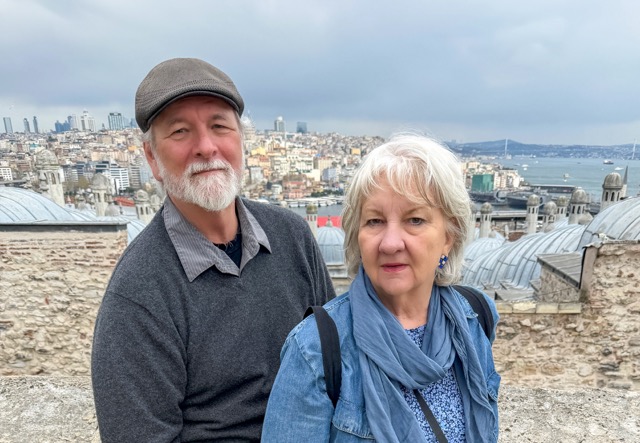
We’re Ed and Bonnie, a duo passionate about exploring the world and experiencing its wonders. Our love for travel isn’t just about discovering new places; it’s about sharing those moments with cherished family and friends like you.
Our hope is that you will feel like you’re right there with us, sharing in the excitement and wonder of each destination. Better yet, let’s plan a rendezvous somewhere wonderful! Learn more


Loved your blog on the correspondent…You have quite the way with words, dearest Bonnie. Thanks for sharing your deep thoughts and quiet reflections. You matter!!! thinking of you and Ed and knowing you are enjoying life abroad.
I, too, was enormously moved by Virginia Evans memorable novel, as was my Book Club In fact, I read aloud the opening quote that you chose here which led to a discussion similar to what you have expressed beautifully, . How lucky your family is to have a matriarch who treasures all of them and finds multiple ways to communicate her devotion . I found your words both potent and moving, Bonnie, and plan to share.
with my Book Worms! Jo xox