
A personal archive of presence and persistence
Since we’ve lived in Valencia and started traveling more consistently, I’ve been collecting something I don’t really have a name for — women I encounter, read about, or remember long after I’ve left a place behind. Over time, I’ve realized I’ve been building a quiet archive of presence and of persistence – women who make an impression and leave a trace. I call it my wall.
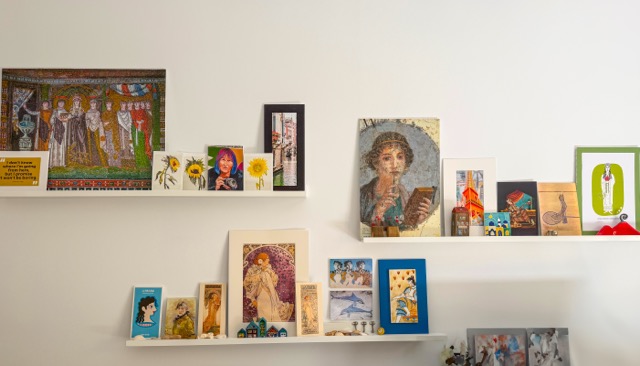
It’s in my room — part studio, part office — and displays posters, postcards, and sometimes printed photographs of women I’ve encountered while traveling. Some are historical figures I’ve learned about in museums. Some are artists, activists, or writers I’ve come across in exhibitions or conversations. And some are unnamed entirely, preserved only in fragments of ancient imagery.
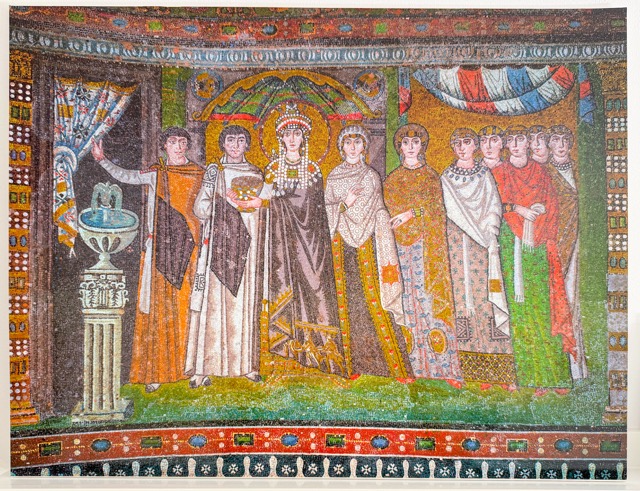
Among them is Theodora, whom I encountered in Ravenna, Italy, standing in front of the extraordinary Byzantine mosaics. In those golden, still figures — imperial, severe, and luminous — she felt less like a distant historical figure and more like someone whose influence had been encoded into the walls themselves. Empress of the Byzantine Empire from 527–548 CE, she is remembered not only for political power but for legal reforms that expanded protections for women, including making rape punishable by death and strengthening women’s rights to own and inherit property.
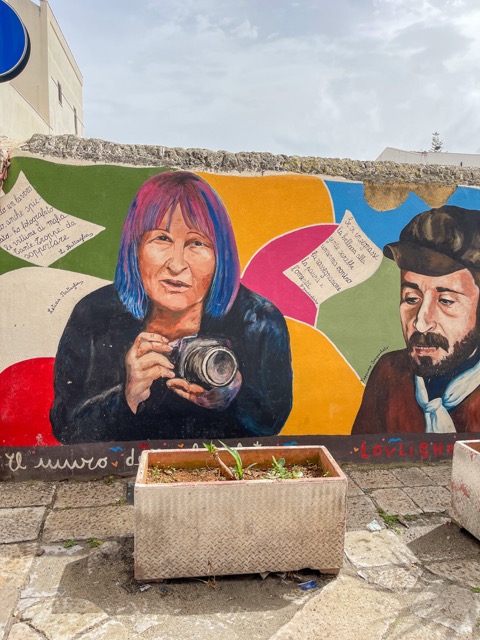
Then there is Letizia Battaglia, whose image I found in Palermo, Sicily, on a wall honoring those who resisted the Mafia. Seeing her honored in a public tribute — among others who had fought for truth and accountability — made an impression instantly. Her life’s work as a photojournalist documented both everyday Sicilian life and the violence of the Mafia with an unflinching clarity that refused to turn away.
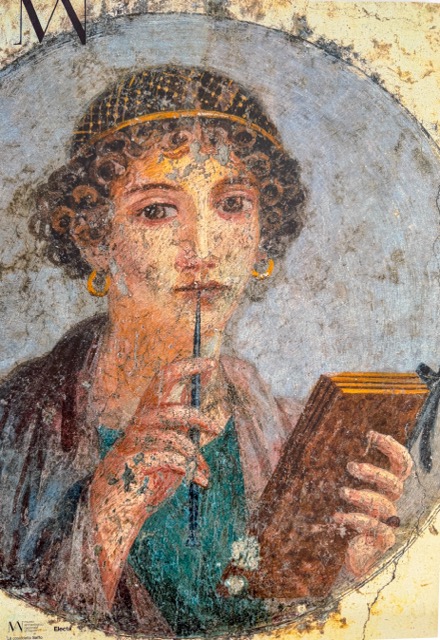
Some figures on the wall are not identifiable at all. There is an image from ancient Athens of a woman holding a book and a stylus, which I discovered at the Acropolis Museum. No name survives, but the symbolism is unmistakable: a woman aligned with writing, thought, and authorship in a world where such roles were rarely preserved in the historical record. She remains on my wall precisely because she is unknowable.
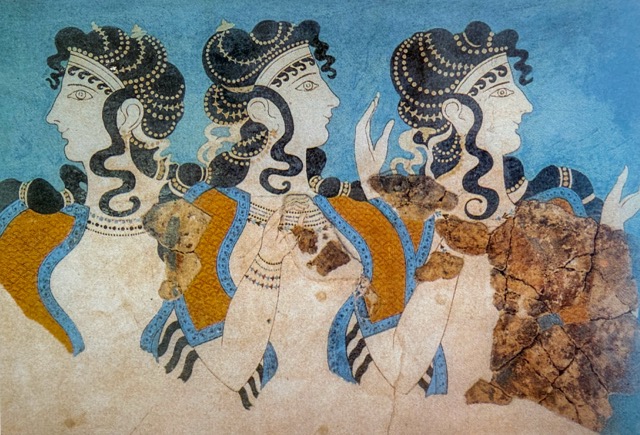
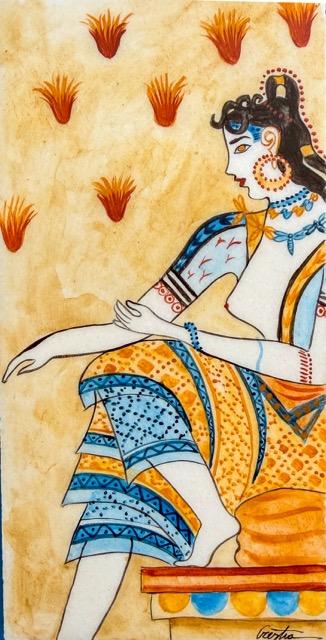
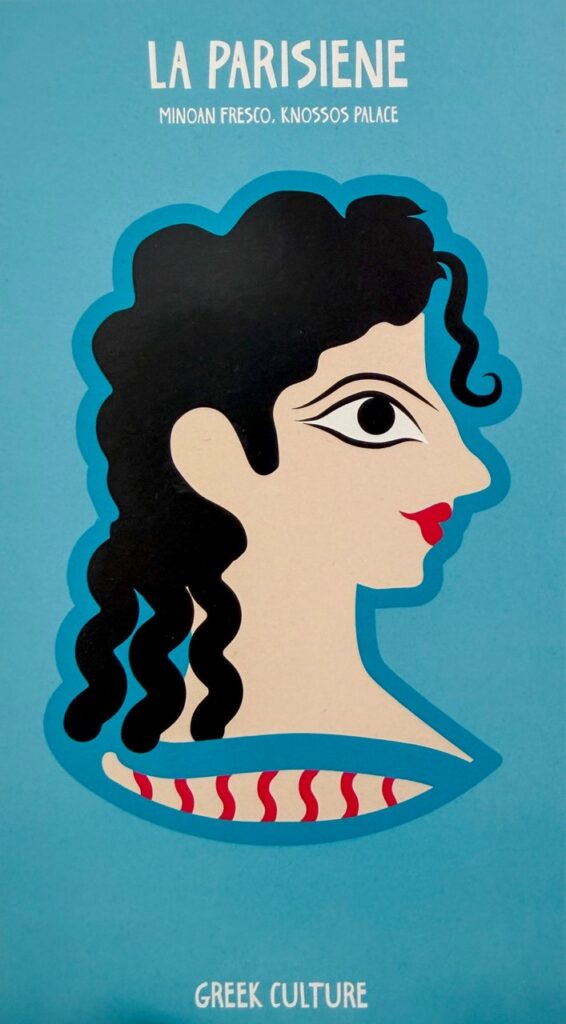
There are also the Minoan women — the figures known as the Ladies in Blue and The Parisienne — whom I first encountered in the frescoes displayed at Knossos on Crete. Dating to around 1600 BCE, they predate everything else in the archive, yet they don’t feel ancient in the way that word usually implies distance. They are animated and richly ornamented — women who appear central to whatever world they inhabited, not peripheral to it. Minoan civilization remains only partially understood; its script has never been fully deciphered, and scholars still debate the social roles these figures represent. But the frescoes themselves are unambiguous in one sense: these women were worth painting large, in color, with attention.
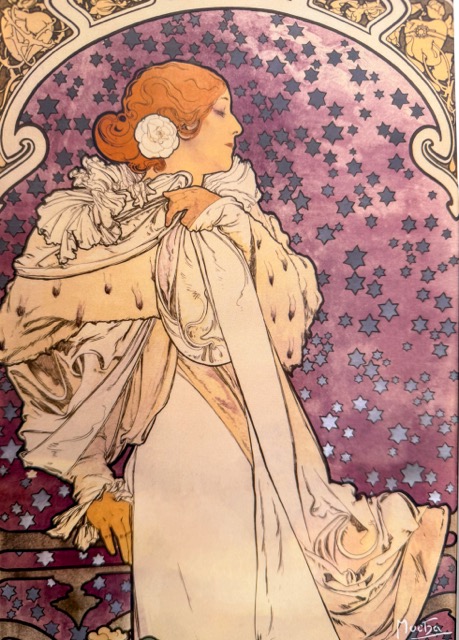
Sarah Bernhardt, whose image I encountered through the Art Nouveau paintings of Alphonse Mucha while visiting his museum in Prague, holds a place on my wall. In Mucha’s work, she appears almost mythic — elevated, stylized, iconic — but her real life was even more compelling. A celebrated French stage actress, she challenged gender norms of her time and used her fame to advocate for women’s rights and support other women artists.
I discovered Berthe Morisot at the Musée Marmottan Monet in Paris when we went to see a special exhibit of Eugene Boudìn’s works. The first woman Impressionist, she worked alongside artists like Monet, Renoir, Degas and Pissaro. Unlike her male peers, Berthe worked within strict social limits placed on women in the 19th century. She couldn’t freely visit cafés, studios, or public nightlife scenes to paint. While she built a professional career in a male-dominated art world, she sold relatively few works in her lifetime, and her art is little represented in museums. For me, she is a model for a quiet but powerful challenge to gender norms.
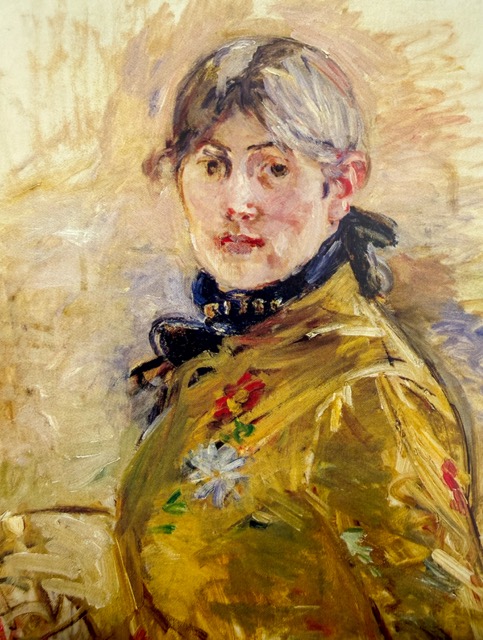
These women, though separated by time and circumstance, are connected by a shared spirit of resistance and imagination.
On my recent trip to Uzbekistan, I added another. I was traveling in Tashkent with the San Diego Diplomacy Council when we met Dinara Dultaeva. She spoke to our group in a way that felt both grounded and expansive — less a speech and more like sharing something she had been building for decades.
Dinara is the founder of her own publishing and media company. Over the years, her work has included more than 50 magazine editions promoting Uzbekistan as a place to live, travel, and understand. She has also published books about the country, including a coffee table volume titled 10 Reasons to Visit Uzbekistan, which I was able to purchase while in Tashkent — filled with photographs of deserts, cities, mountains, and everyday life.
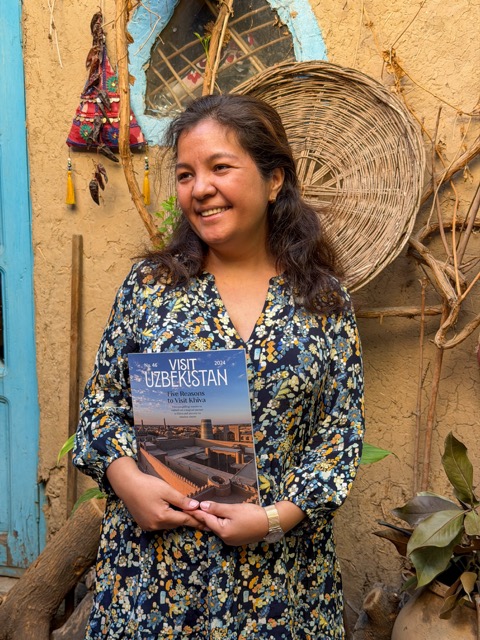
What makes her work particularly striking is not only its content, but its timing. She began building her company roughly 20 years ago — around 2006 — fifteen years after independence, in a country still negotiating its identity, and in a cultural context where professional space for women is just emerging. What stayed with me was not only the scale of what she built, but the clarity of her vision. Her work is not passive documentation — it is active storytelling. It participates in how Uzbekistan is seen, imagined, and remembered by others.
Rome offered a different kind of encounter — one shaped more by what was missing than what remained. On a recent visit, as Ed described in his recent post, we spent hours with an archaeologist walking through ancient Rome. As I listened to his stories I was struck as much by what was missing as by what remained. Women surfaced occasionally in the stories, and more than once our guide reminded us that this was a deeply patriarchal society — one where women’s lives were often recorded through the perspectives of men and shaped by the demands of power and survival.
We visited Livia’s garden room; a space often associated with Livia Drusilla, wife of Augustus, the first emperor of Rome. The interpretation of her influence is still debated — whether she was a political strategist, a stabilizing force, or simply a woman whose proximity to power defined how history remembers her. Livia’s record is filtered through the men around her — and something about that framing kept her off the wall.
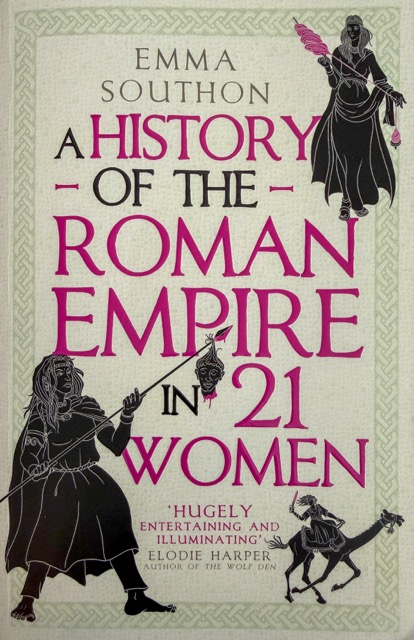
Instead, what I carried forward from Rome was something else. While browsing in a bookstore (a favorite pastime), I found myself drawn to A History of the Roman Empire in 21 Women by Emma Southon — an irreverent, sharp, and intentionally unsanctified retelling of Roman history through the women who are often sidelined or flattened in its telling. It is witty in a way that feels corrective, refusing to treat history as neutral or complete. I’ve only just started it, but I already find myself wondering which women will emerge from its pages and whether some of them will eventually find their way onto my wall.
Maybe that is the next layer of this archive — not only the women I meet in places, but the ones I meet through someone else’s insistence on seeing differently. Because whether it is Theodora in Ravenna’s mosaics, Letizia Battaglia in Palermo’s memorial walls, Sarah Bernhardt in Mucha’s Prague, an unnamed woman in Athens holding a book and pen, the intriguing Minoan women, or the voices reconstructed in Southon’s Rome — the thread is the same. A persistence of presence across time, even when recognition is uneven or incomplete.
What I’ve been practicing, I think, is a kind of attention — noticing who is building, who is preserving, who is resisting invisibility. My wall is not finished. I don’t think it ever will be. But it keeps growing — one encounter, one image, one story at a time.

About Us
Welcome to our little corner of the world where we invite you to embark on exciting journeys with us!
We’re Ed and Bonnie, a duo passionate about exploring the world and experiencing its wonders. Our love for travel isn’t just about discovering new places; it’s about sharing those moments with cherished family and friends like you.
Our hope is that you will feel like you’re right there with us, sharing in the excitement and wonder of each destination. Better yet, let’s plan a rendezvous somewhere wonderful! Learn more
LOVE YOUR CHOICES, BONNIE, MOST ESPECIALLY THE GREEK WOMAN IN BLUE (SAPPHO?) AND BERTHE MORISSOT! THE OTHERS ARE NEW TO ME AND AN INSPIRATION. WHAT A WONDERFUL WALL!!! Jo G